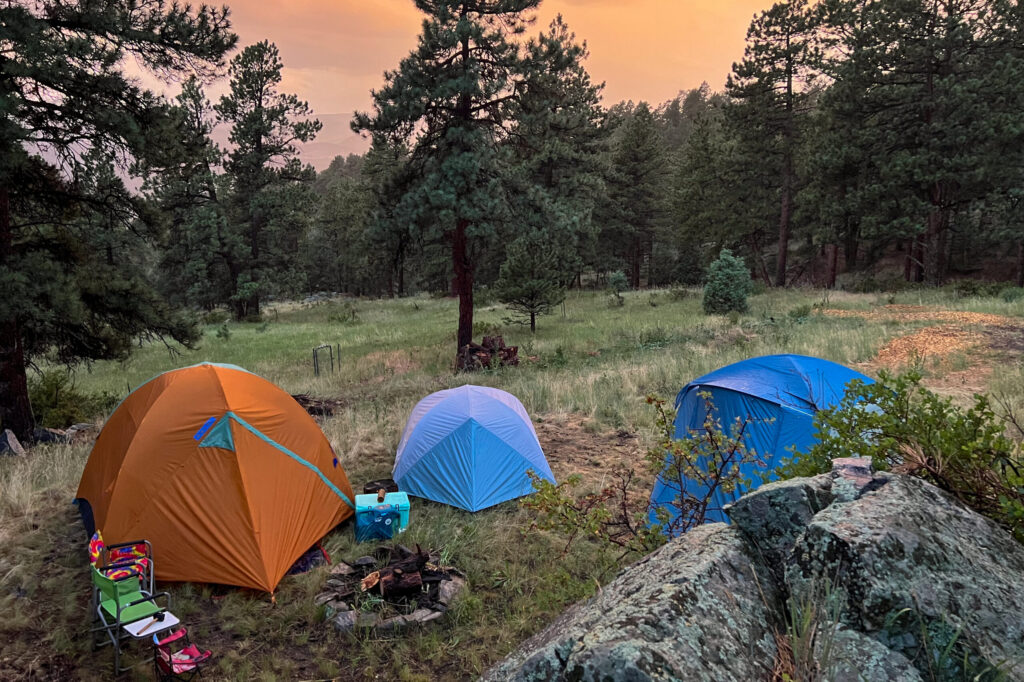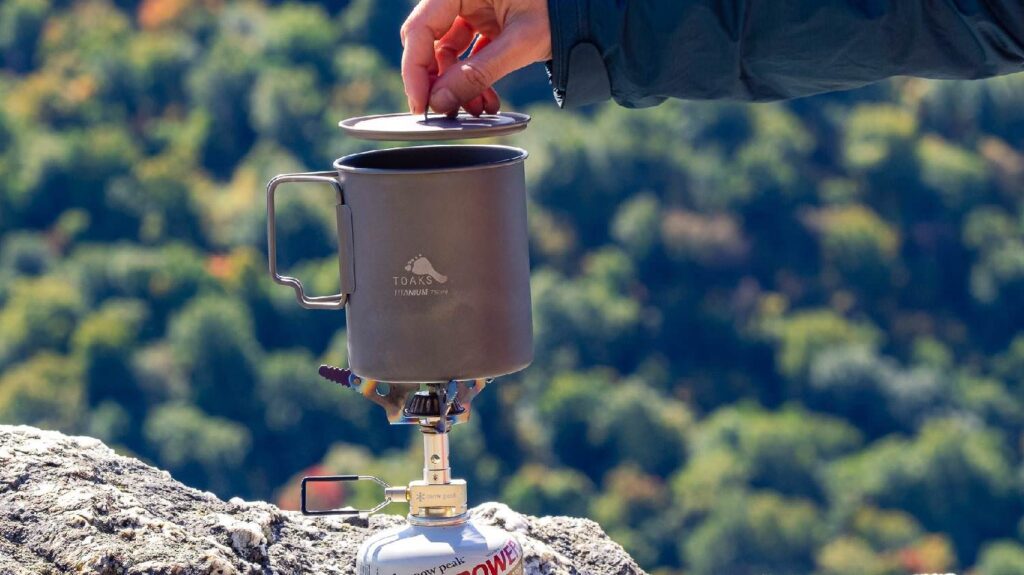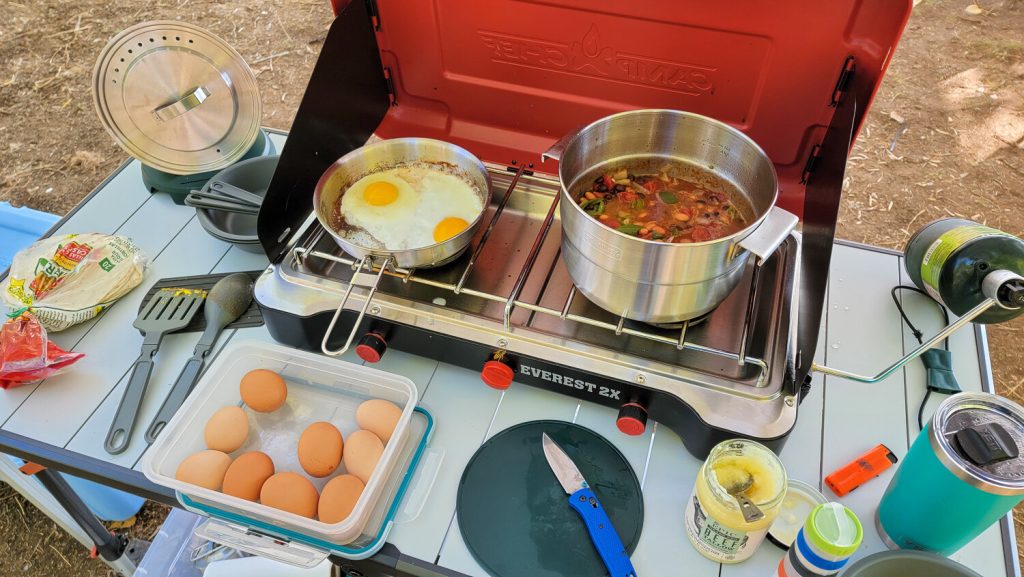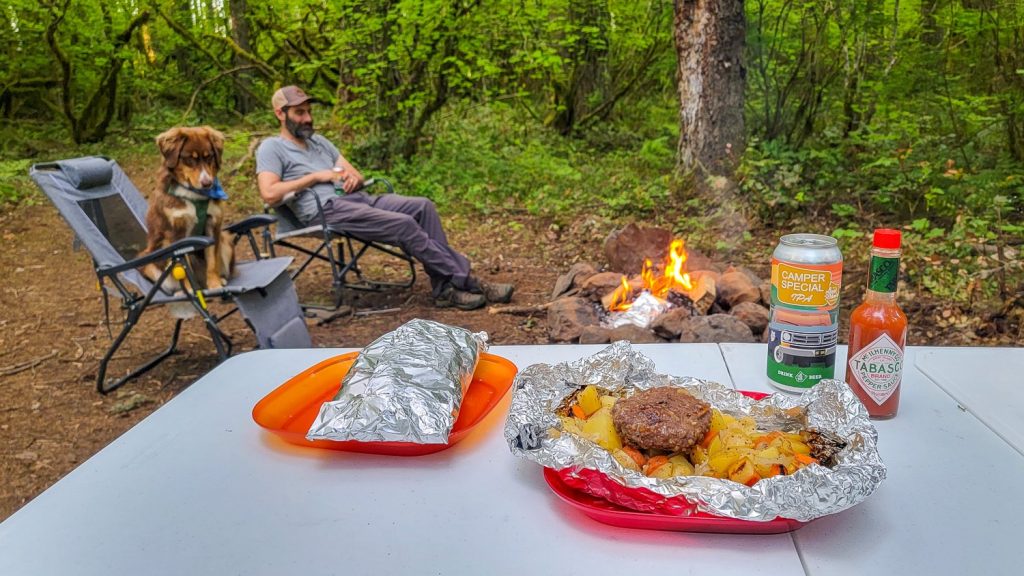



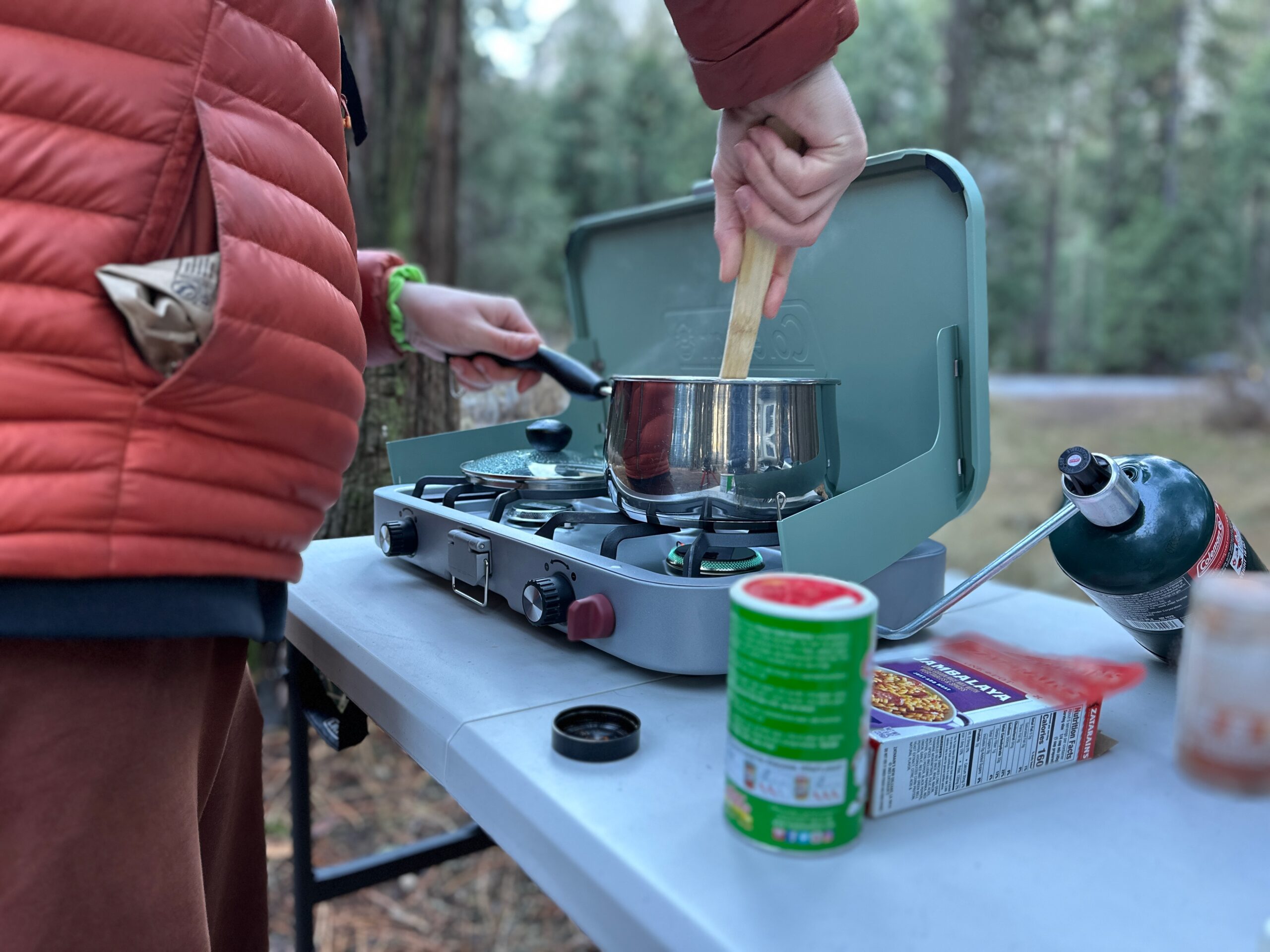
The CleverHiker team has spent over a dozen years testing more than 40 camping stoves all over the country. From high-desert camps to stealth sites hidden at high mountain passes, we’ve put leading designs from Jetboil, Camp Chef, Snow Peak, and more through their paces in all sorts of conditions.
Editor’s Note: We last updated this guide on May 18, 2026, to add a few new stoves to our lineup – the Camp Chef Everest 2X, ONTOMYO BRS-32, and Primus Kinjia – as well as revamp our coverage on some old favorites.
How We Test Camping Stoves
Our gear analysts have spent up to six months at a time living on the road, cooking exclusively on camp stoves. During our most recent round of testing, we whipped up meals in 40-mile-per-hour winds in Joshua Tree National Park and Red Rock Canyon. We’ve also enjoyed gourmet menus while camping at high mountain passes in the Eastern Sierra.
For more info, check out some of our other most popular gear guides:

#1. Best Camping Stove Overall
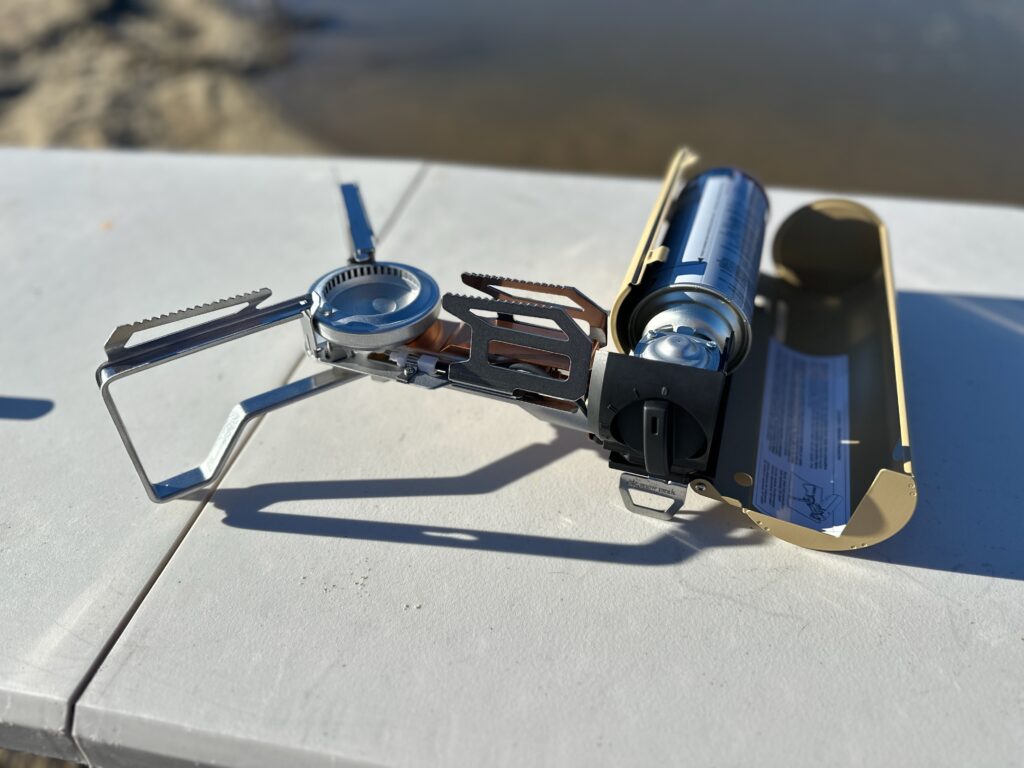
The Snow Peak Home & Camp Burner stove is powerful, compact, and easy to use. It cooks super evenly, disappears in a full car, and has proven to be a great value for us during our hands-on testing in California and Nevada.

Quick Picks for Camping Stoves
Burn through our quick list of camping stoves below, or turn up the heat and keep scrolling for our thoughtful and in-depth reviews.
1. Best Camping Stove Overall: Snow Peak Home & Camp Burner ($100)
2. Best Duel-Fuel (Propane/Butane) Stove: Gas One GS-3400P ($40)
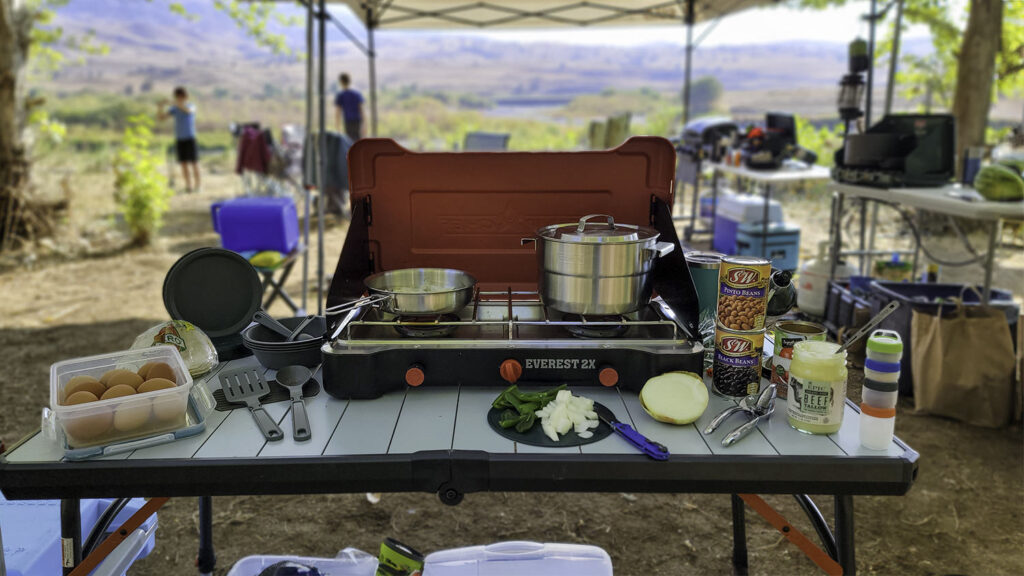
3. Best Cooking Ability: Camp Chef Everest 2X ($230)
4. Most Versatile Camping Stove: Coleman Cascade 3-in-1 ($275)
5. Best Self-Contained System: Jetboil Genesis Basecamp ($450)
6. Most Dependable Camping Stove: Coleman Classic 2-Burner ($98)
7. Best Budget Buy: Coleman Classic 1-Burner Butane ($46)
8. Most Packable Camping Stove: ONTOMYO BRS-32 ($60)
9. Best Stove for Large Groups: Camp Chef Explorer ($160)
10. Most Aesthetic & Functional Camp Stove: Primus Kinjia ($240)
Snow Peak Home & Camp Burner
Best Camping Stove Overall
CleverHiker Rating: 4.8/5.0
Price: $100
Weight: 3 lb.
Boil Time: 5:11
Fuel Efficiency: 0.4 oz.
Number of Burners: 1
BTUs (per burner): 8,333
Fuel Type: Butane
Pros
- Compact and self-contained
- Extremely packable
- Powerful given its small size
- Auto-ignitor
- Easy to use
- Works with pots up to 12 inches
Cons
- Only runs off of butane
- Not great for windy, freezing, or high-altitude camps
- Not intuitive to set up
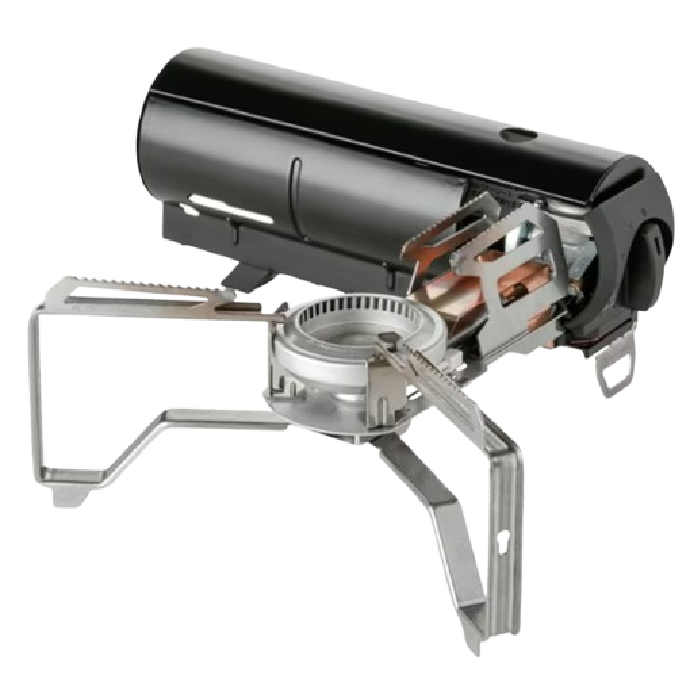
There are several reasons the Snow Peak Home & Camp Burner is our top-rated camp stove for 2026. It cooks quickly and well, has a sleek design, is lightweight, and packs up as small as a reusable water bottle.
It is a snapper of a stove. It has the highest BTU rating of any single-burner stove on our list at 8,333 BTUs. This power shows up when boiling water: It was the second-quickest in our testing, taking just over 5 minutes.
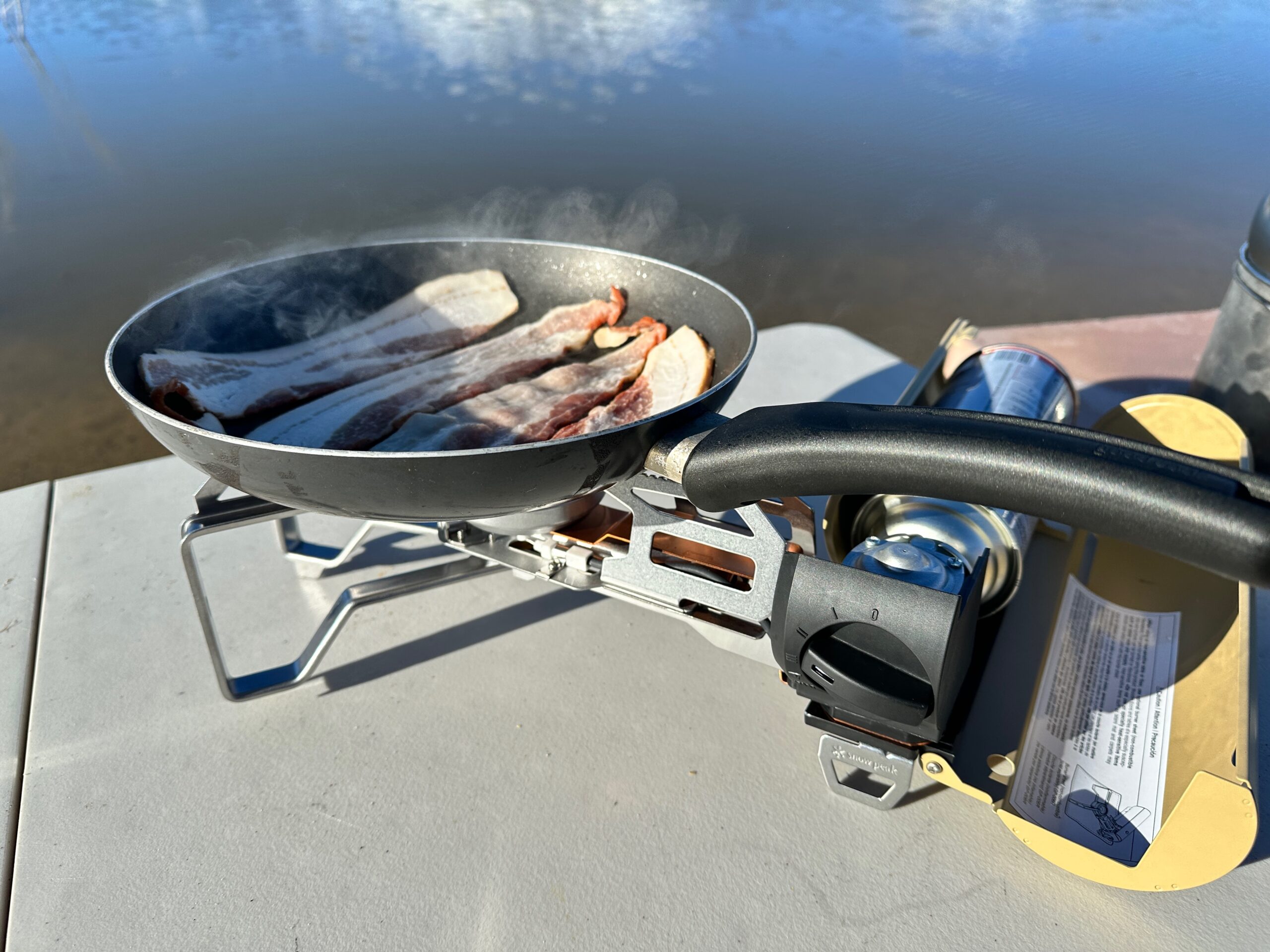
Though it’s fast and powerful, it can simmer a pot of rice like a dream and cook a pan of bacon evenly. Convenient features like an easy-to-read temperature gauge make it easy to control the flame and heat.
It’s a great value because it is packable and can travel anywhere, making it perfect for quick meals on the go and stealth camping setups.
The most notable downside to this stove is that it runs exclusively on butane, which limits when and where it can effectively run. The only other drawback is that the design isn’t as intuitive as other camp stoves out of the box and can take some getting used to.
Gas One GS-3400P
Best Duel-Fuel (Propane/Butane) Stove
CleverHiker Rating: 4.7/5.0
Price: $40
Weight: 3 lb. 4.8 oz.
Boil Time: 8:29
Fuel Efficiency: 0.6 oz.
Number of Burners: 1
BTUs (per burner): 8,000
Fuel Type: Butane and propane
Pros
- Affordable
- Lightweight
- Loaded with safety features
- Auto-ignitor
- Intuitive design
- Can run off of propane or butane
Cons
- No wind guard
- Low-temperature setting is inconsistent
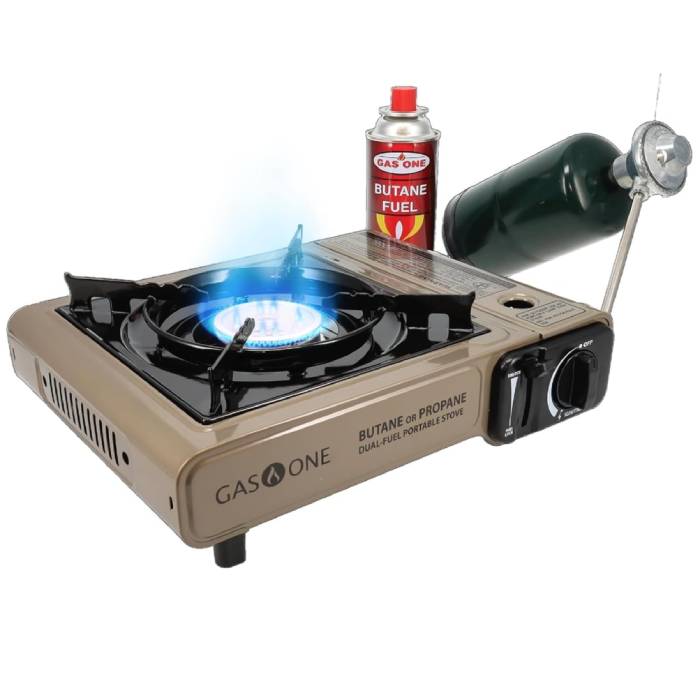
The Gas One GS-3400P is our number-two stove because of its versatility, quick and reliable cooking, intuitive design, and strong value.
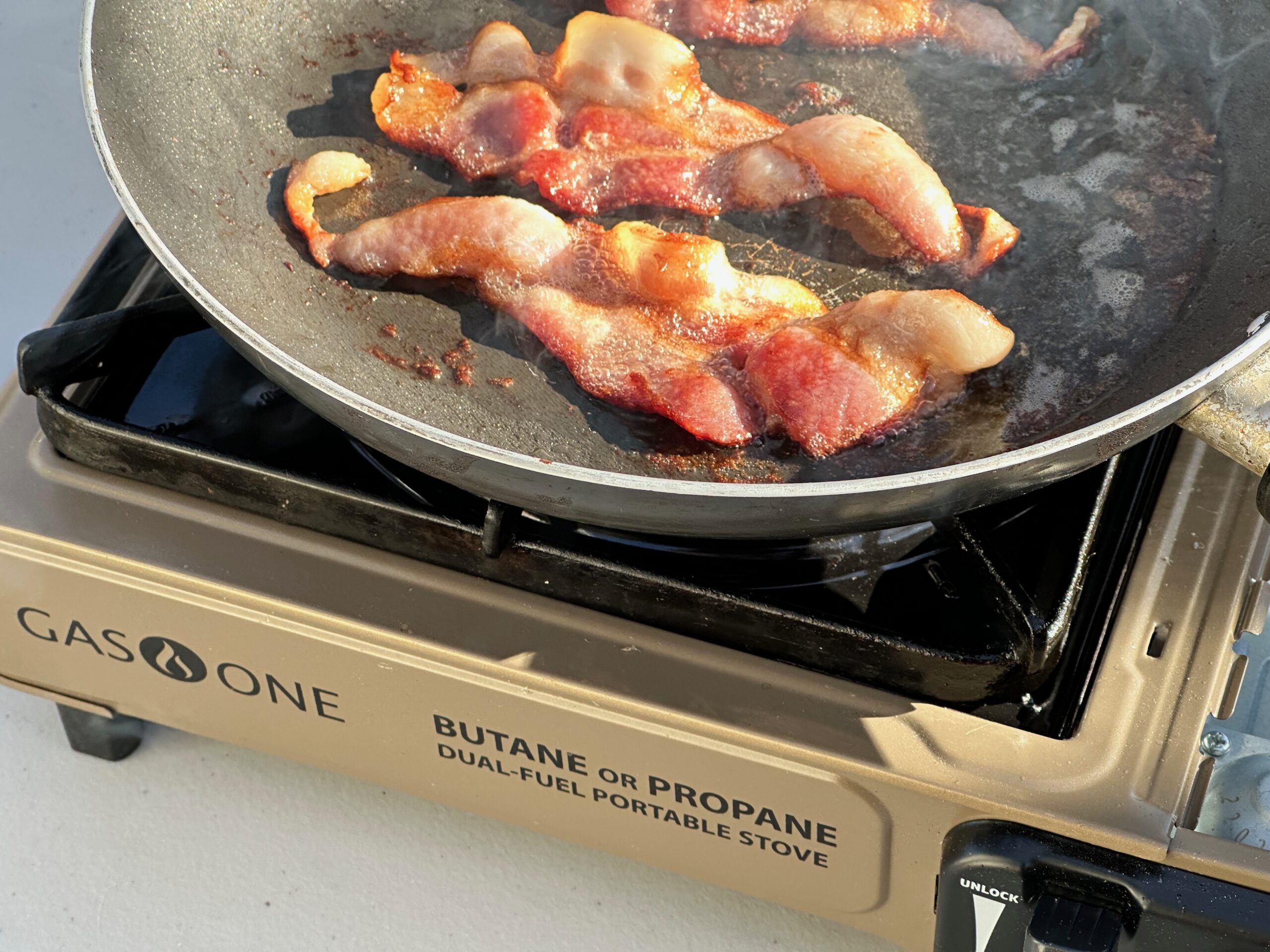
This model is an excellent beginner stove that won’t disappoint more advanced chefs. It has easy-to-use features, travels very well, has amazing power, and can run off of either propane or butane. Our complaints are minimal and mostly relate to weight-saving compromises – like the lack of a wind shield, which is easy to purchase separately or DIY.
As a single-burner design, this stove can be limiting for more complex meals. If you have a cookbook full of one-pot meals, this may not be a drawback for you. However, if you love bacon and pancakes with your eggs (and want them all to be hot at the same time), this stove may not be a great option.
One thing we missed was a wind guard. However, this omission helps keep this stove light and easy to fit into its small case for transport – and boy, is this thing portable.
One of the more versatile options on our list, this stove can run off of either propane or butane, giving first-time users a chance to try out both fuel types. This dual-fuel capability also allows the stove to work well in all temperatures (as butane stops vaporizing below 31 degrees Fahrenheit).
Camp Chef Everest 2X
Best Cooking Ability
CleverHiker Rating: 4.7/5.0
Price: $230
Weight: 12 lb.
Boil Time: 3:49
Fuel Efficiency: 1 oz.
Number of Burners: 2
BTUs (per burner): 20,000
Fuel Type: Propane
Pros
- Powerful burners
- Excellent wind protection
- Self-ignition
- Intuitive design
- Simmers well
Cons
- Heavier and bulkier than some
- High price tag
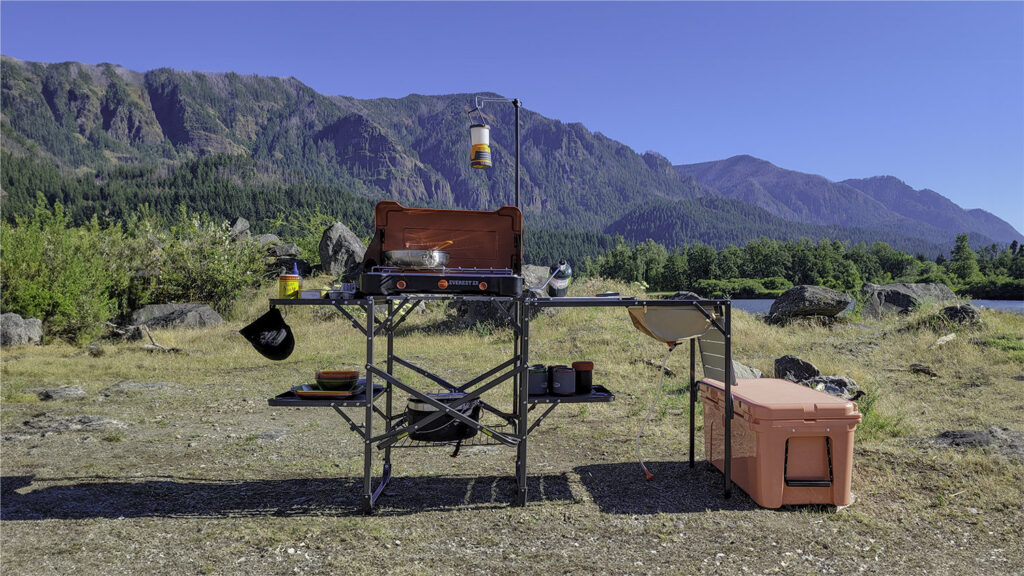
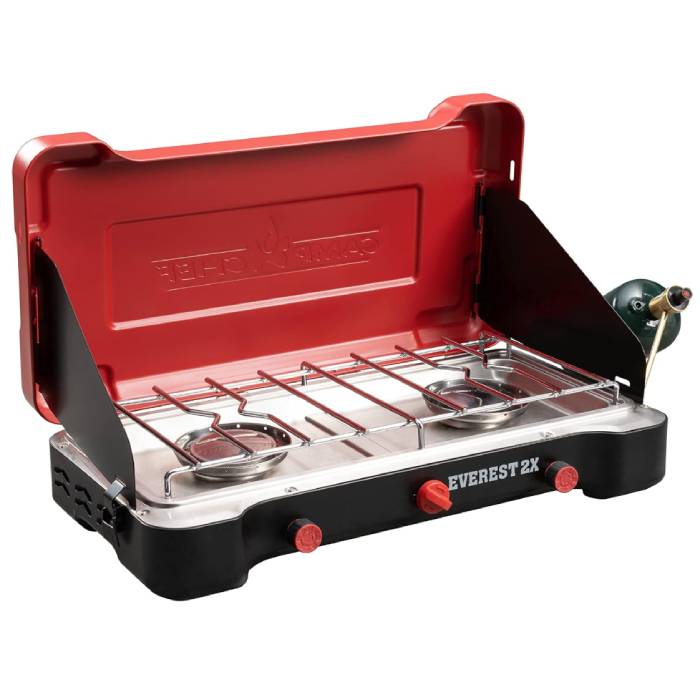
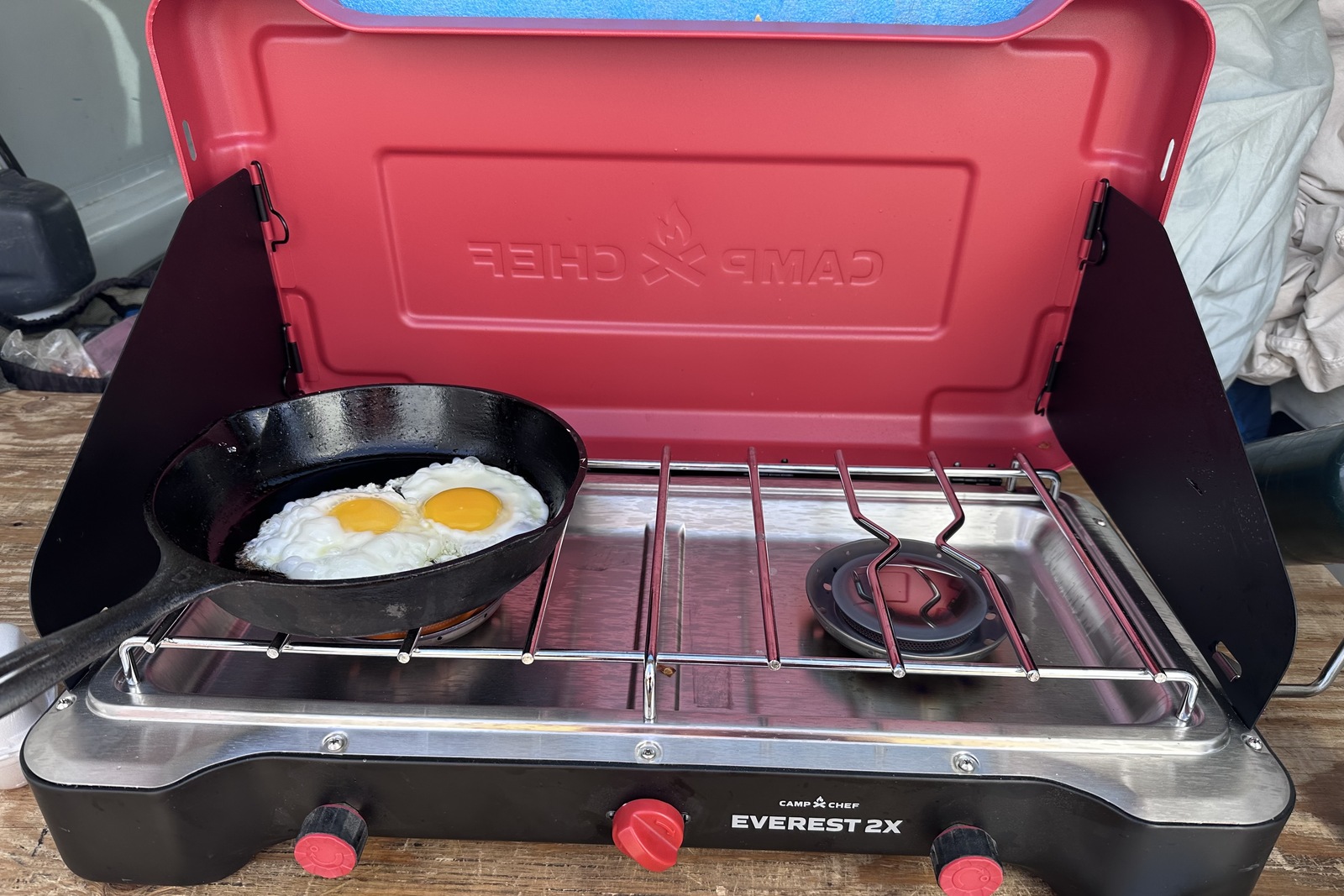
The Everest 2X from Camp Chef is one of the most powerful stoves on our list. With 20,000 BTUs per burner, the Everest easily boiled a liter of water in less than 4 minutes – our fastest time by a wide margin.
Despite all of this power, the Everest 2X doesn’t sacrifice cooking ability. We were impressed with how well it could simmer rice, sauté veggies, and perfectly melt cheese in our quesadillas. The generous burners accommodate larger pots and pans, making this a great choice for families or medium-sized groups.
The Everest 2X maintains its impressive cooking abilities even in harsh conditions. Generous windscreens snap securely into place to protect the burners from gusty weather. The stove is also quite intuitive to set up, and the auto-ignitor replaces the need for a lighter or matches (although it’s always good to have a backup).
The biggest drawback to the Everest 2X is its size. While not excessively heavy, it’s a bit bulkier than the other double burners on our list. For someone with limited vehicle or storage space, this large stove may be a tough sell.
Overall, the Everest 2X is a nice middle ground between the smaller stoves above and Camp Chef’s own Explorer below, which is our top choice for large groups. With plenty of burner space and tons of power, you’ll be able to cook delicious feasts for the whole crew.
Coleman Cascade 3-in-1
Most Versatile Camping Stove
CleverHiker Rating: 4.6/5.0
Price: $275
Weight: 14 lb. 12.8 oz.without attachments
Boil Time: 9:24
Fuel Efficiency: 0.9 oz.
Number of Burners: 2
BTUs (per burner): 12,000
Fuel Type: Propane
Pros
- Powerful
- Versatile
- Protective wind guards
- Easy to pack and travel with
- Intuitive to use and set up
- Auto-ignitor
- Storage for fuel attachment
Cons
- Expensive
- Heavy with both attachments
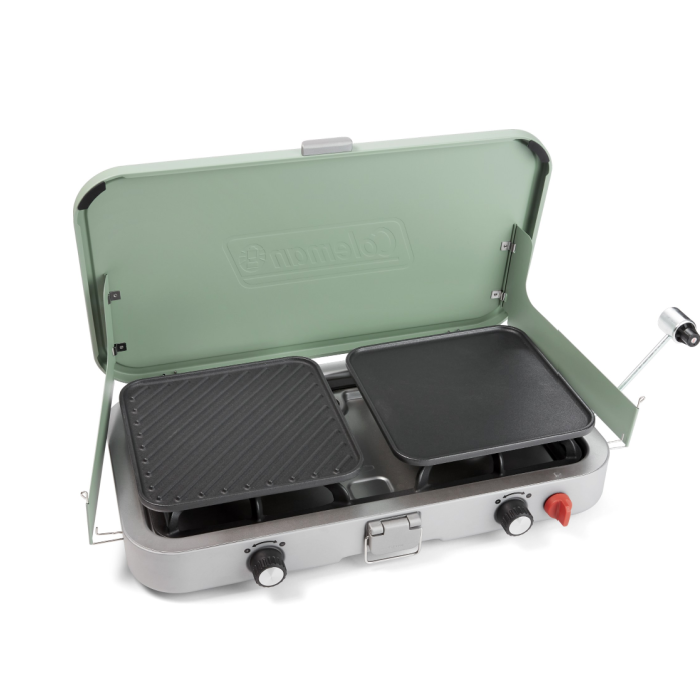
The Coleman Cascade 3-in-1 stove earns a spot high on our list because of its smart features, intuitive design, included accessories, and overall cooking abilities.
Particularly impressive is this stove’s ability to pack down and carry into camp. The hidden handle makes for easy transport, while thin (yet sturdy) windshields fold into the top. It also has storage for the fuel attachment. Folded up, this stove is thin and portable.
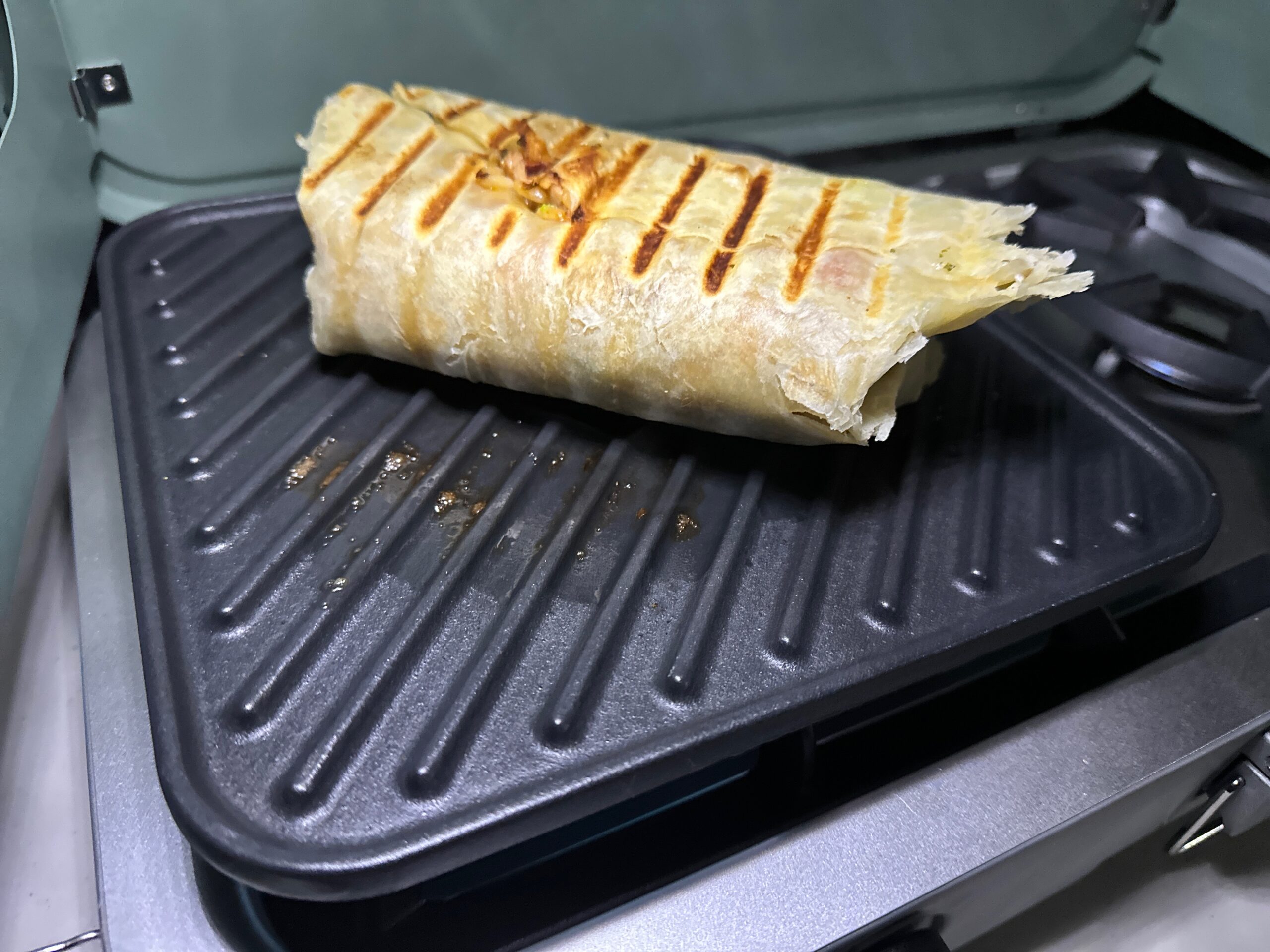
Another thing we love about this stove is its versatility. The two cast iron attachments – a griddle and grill top – allow camp chefs to pull out all the stops. We found the attachments easy to use and appreciated how much more we were able to cook with them.
Like all cast iron cookware, the attachments require some extra care and maintenance. Be sure to wipe them down after cooking and season them between uses. They also add considerable weight (around 10 pounds) to the total setup, although they do come in a convenient carry case.
Finally, the stove has a built-in ignitor and a wide range of flame output. We were able to set it high enough to get a nice char on our burritos but could also whip up a perfect pot of rice on a low, steady setting. Overall, it’s a great option for discerning camp chefs who like to get creative at camp.
Jetboil Genesis Basecamp System
Best Self-Contained System
CleverHiker Rating: 4.6/5.0
Price: $450
Weight: 9 lb. 1.6 oz.
Boil Time: 7:21
Fuel Efficiency: 0.7 oz.
Number of Burners: 2
Fuel Type: Propane
BTUs (per burner): 10,000
Pros
- Packable
- Includes cookware
- Auto-ignitor
- Intuitive design
- Quick boil time
- Excellent accessories
Cons
- Very expensive
- Common complaints of faulty regulators
- No wind guard
- Not the best for simmering
- Can cook unevenly
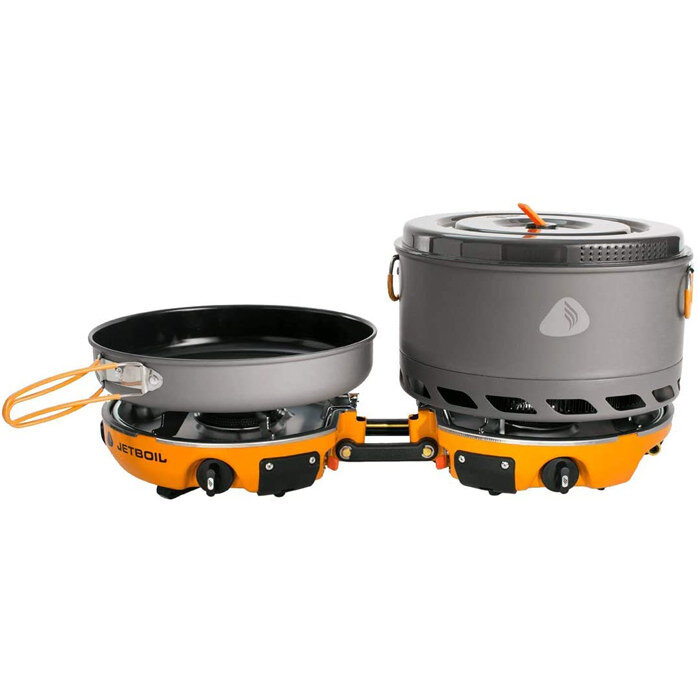
We thought the Jetboil Genesis Basecamp System would rank higher on our list but experienced some issues that pushed it down. On the bright side, it has a smart packing system and is very easy to use. It also boils water quickly and efficiently, requiring little fuel.
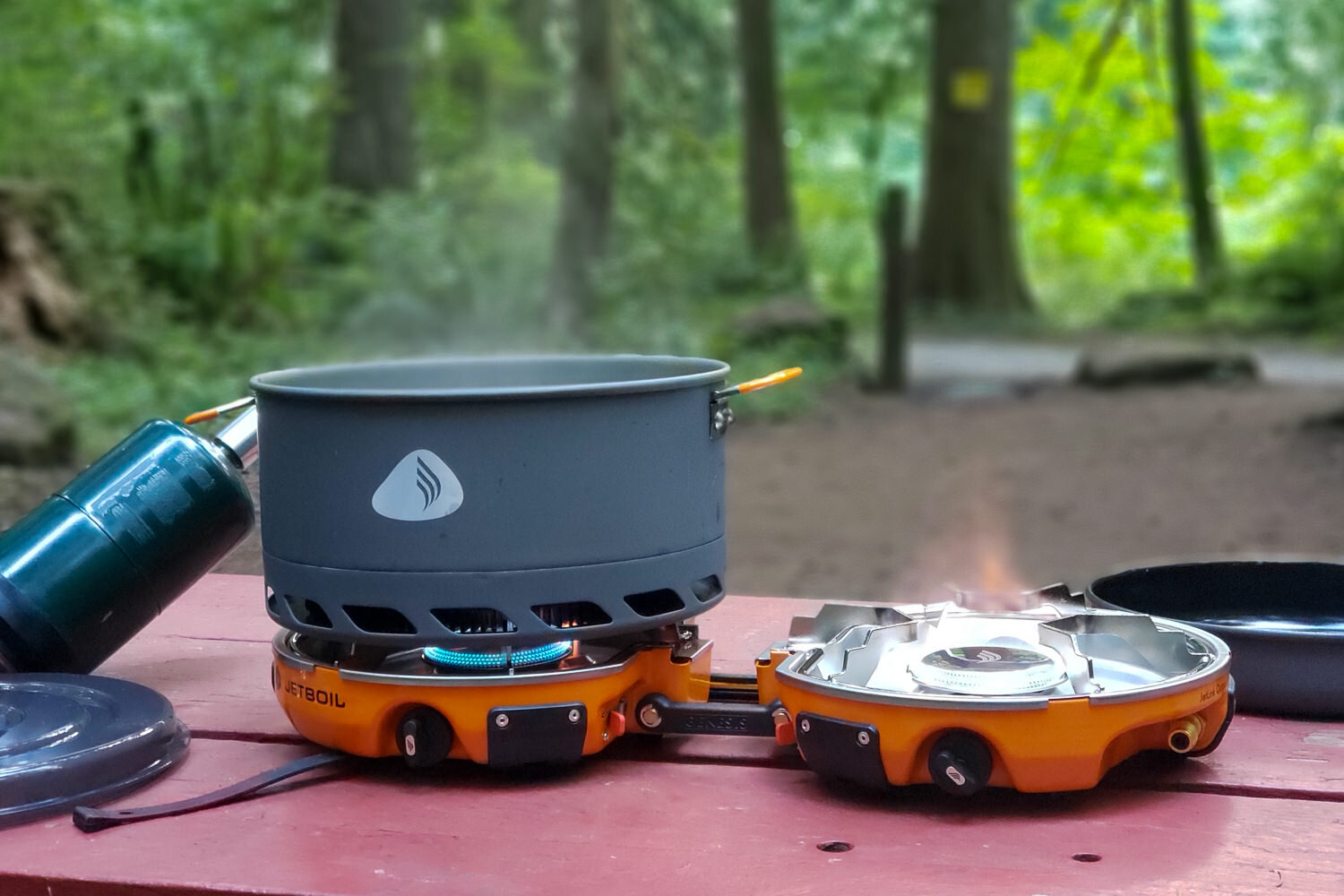
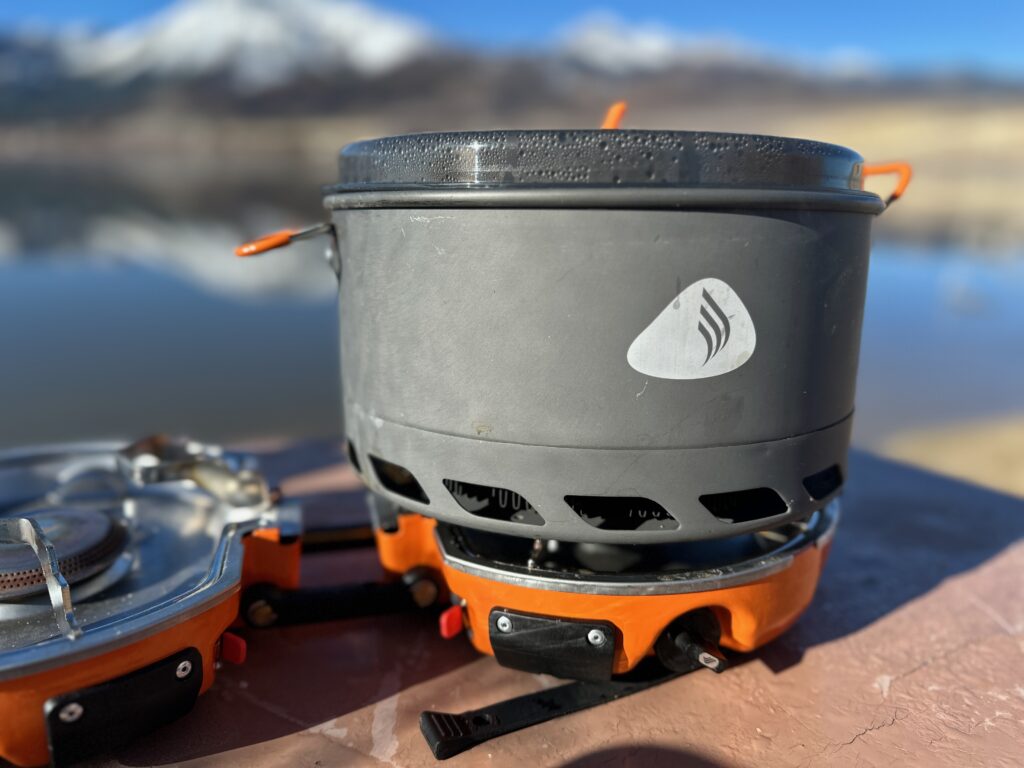
This is more than a stove; it’s a system. It comes with the Genesis Stove, a 10-inch fry pan, a 5-liter pot and lid, and a carrying bag. The stove folds in half (like a waffle maker) and nests inside the pot. The pot’s lid sits on top of the stove, and the pan tops it all. The whole unit nests nicely in the carry case, which features a Velcro pocket to stash the fuel attachment.
Another reason we love this stove is it’s very easy to use. It features built-in ignition and a stable design. It has temperature controls that allow the flame to get really low.
However, when put to the test, we found this stove didn’t simmer as well as others we tested, nor did it produce an even cook. It did, however, cook very quickly and with a lot of power.
With the right monitoring, these issues might not be dealbreakers for you. But for how pricey this stove is, we expected a more refined cooking experience with minimal effort.
Coleman Classic 2-Burner
Most Dependable Camping Stove
CleverHiker Rating: 4.5/5.0
Price: $98
Weight: 11 lb. 10.4 oz.
Number of Burners: 2
Boil Time: 10:26
Fuel Efficiency: 0.8 oz.
BTUs (per burner): 10,000
Fuel Type: Propane
Pros
- Relatively affordable
- Adjustable windshields
- Fuel attachment storage
- Handle makes it easy to carry
- Decently lightweight
- Cooks evenly
- Simmers well
Cons
- No auto-ignition
- Not as powerful as other two-burner stoves
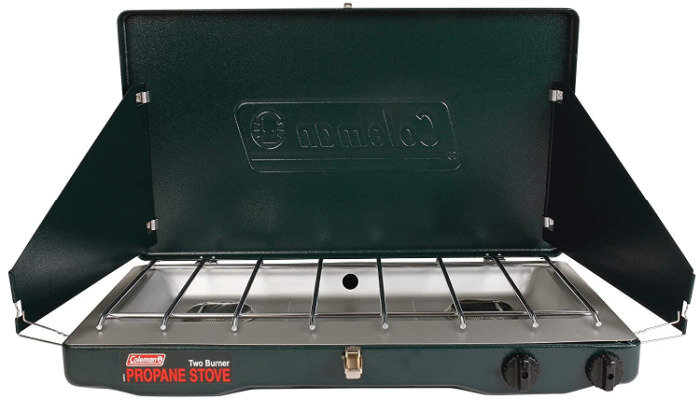
The Coleman Classic 2-Burner has been around forever and remains one of the most dependable options on the market. Though it lacks some power and efficiency compared to the brand’s pricier 3-in-1 above, it’s simple to use and will last many seasons.
One of our favorite parts about this stove is how easy it was to pack and carry into camp. It has a slim profile that fits nicely into a packed car. The simple, no-frills design also makes it easy and dependable to operate.
When testing three stoves side by side, our gear analysts enjoyed cooking on this stove more than the other two because of its ease and consistency. When running around from stove to stove, this one was steady and didn’t need much attention – a characteristic we appreciate at camp when there are typically many distractions.
We wish the stove had a built-in ignitor, but we don’t have major complaints beyond this. Yes, it lacks some power compared to other stoves on our list. But would take a perfectly cooked pot of rice over a burnt pan any day of the week.
Overall, the Classic 2-Burner stove handily outperforms its price tag, making it a solid value for new and seasoned campers alike.

Coleman Classic 1-Burner Butane
Best Budget Buy
CleverHiker Rating: 4.4/5.0
Price: $46
Weight: 5 lb. 2.4 oz.
Boil Time: 16:08
Fuel Efficiency: 0.8 oz.
BTUs (per burner): 7,650
Number of Burners: 1
Fuel Type: Butane
Pros
- Cheap
- Comes with a wind baffle
- Lightweight
- Easy to use
- Auto-ignitor
- Packs and transports easily
Cons
- Not a lot of power
- Only runs off of butane
- Not great in harsh weather
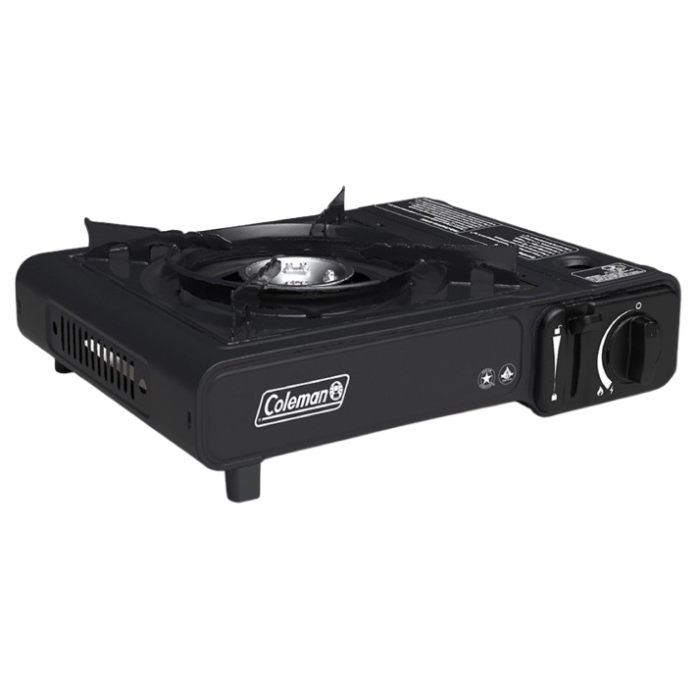
This Coleman Classic 1-Burner Butane stove showcases why Coleman is one of the top camp stove brands. The design is easy enough for beginners to navigate. It packs into a convenient carrying case, is one of the lightest options on our list, and even comes with an auto-igniter.
This stove runs exclusively on butane gas, which is limiting for cold-weather and high-altitude use. When we tried to simmer a pot of rice, the low setting extinguished the flame. It also doesn’t have the power to boil water quickly. It took us over 16 minutes to boil one liter, which was the slowest time in our testing.
Overall, though, we found the stove reliable, easy to set up, and perfect for whipping up quick and simple meals. We appreciated the wind baffle that provided a low-profile barrier around the burner. It didn’t offer as much protection as a true windscreen, but it helped on breezy evenings.
Packing it up was probably the best part. Its carrying case allowed it to stash easily in our fully loaded cars.
We wish the low setting were more reliable and that the stove could run off of propane. But overall, the Classic 1-Burner is a solid budget option that takes minimal thought and effort.
ONTOMYO BRS-32
Most Packable Camping Stove
CleverHiker Rating: 4.4/5.0
Price: $60
Weight: 2 lb. 9.6 oz.
Boil Time: 5:53
Fuel Efficiency: 0.6 oz.
Number of Burners: 2
BTUs (per burner): 6,000
Fuel Type: Butane
Pros
- Extremely packable
- Affordable
- Convenient carrying case
Cons
- Uneven cooking due to small burners
- No wind guards
- No auto-ignitor
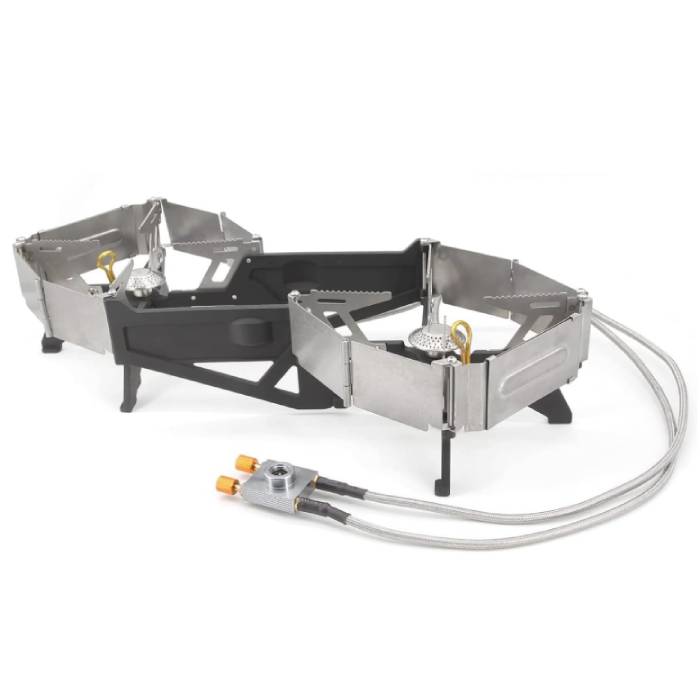
The ONTOMYO BRS-32 is hands-down the smallest, most packable double burner on our list. Smartly designed with foldable burners, it stows in a convenient zippered case that’s small enough for air travel. It could be a good option for basecamping during an international expedition, especially if you’ve got a wind-protected site.
The small burners put out a decent amount of power, boiling a liter of water in just under 6 minutes. With no windscreens, however, this time would likely increase significantly in blustery, cold weather. In fact, we attempted to cook dinner on this stove in 40-mile-per-hour winds, but the flame went out within 30 seconds.
The BRS-32’s cooking ability is adequate, but it doesn’t stand up to more powerful double burners like the Camp Chef Everest 2X. The small burners make it difficult to cook evenly, and it’s hard to maintain heat with the lack of windscreens. When it comes to cooking simple meals like pasta and red sauce, this stove does the trick.
Those who like to make complex camp meals may be disappointed by the simmer control and power of the BRS-32. But if you’re looking for a double burner to take on an airplane or a road trip, this impressively packable stove will fit almost anywhere.
Camp Chef Explorer
Best Stove for Large Groups
CleverHiker Rating: 4.3/5.0
Price: $160
Weight: 30 lb. 8 oz.
Boil Time: 6:59
Fuel Efficiency: 3.2 oz.
BTUs (per burner): 30,000
Fuel Type: Propane
Number of Burners: 2
Pros
- Removable windshield
- Standalone stove
- Removable legs
- Powerful flame
- Wide cooking surface area for large pots and pans
Cons
- Bulky and awkward to move
- Heavy
- Not the easiest to pack
- Requires a propane tank
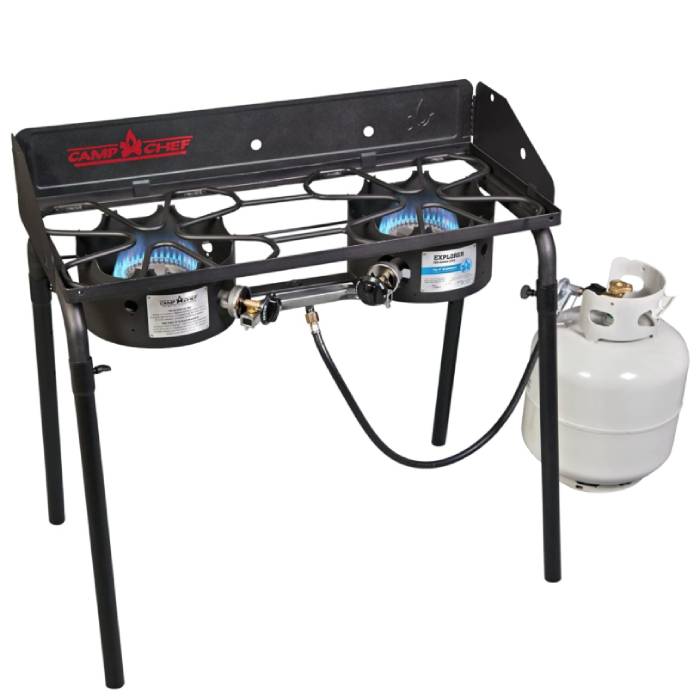
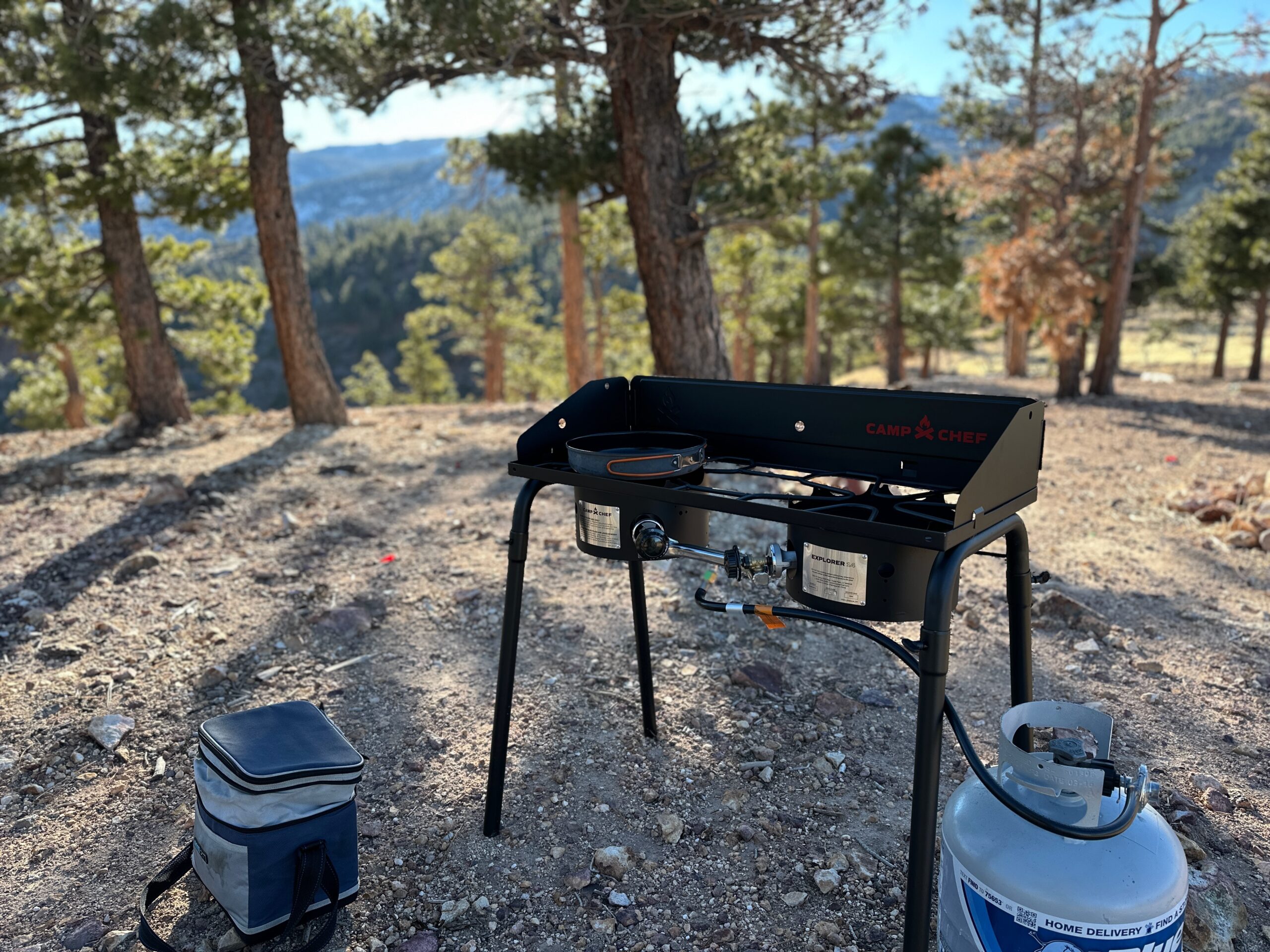
The Camp Chef Explorer is a beast of a stove. This large, freestanding design is perfect for multi-day raft trips, family campouts, and any outdoor scenario where you’ll be feeding a lot of people.
This stove has the power and capacity to cook massive amounts of food – it’s the stove you want when you have a big crowd. The wicked flame can make a heck of a burger just as well as it can cook a pot of rice.
The stove’s large frame is easy to clean, but it doesn’t fold down for storage. The legs are removable (and adjustable), and the windscreen detaches, but the stove still takes up a lot of space in a car.
On top of that, you’ll have to make room for a propane tank. This may or may not be a problem depending on the size of your vehicle and the rest of your camping kit. The stove does come with a three-foot hose and regulator.
In the end, we consider this stove a great value because it can double as a grill at home (Camp Chef has lots of fun attachments). Whether you’re camping, tailgating, or hosting a gathering, the Explorer is up to the task.
Primus Kinjia
Most Aesthetic & Functional Camp Stove
CleverHiker Rating: 4.2/5.0
Price: $240
Weight: 8 lb. 2.5 oz.
Boil Time: 5:56
Fuel Efficiency: 1.2 oz.
Number of Burners: 2
BTUs (per burner): 10,200
Fuel Type: Propane and butane
Pros
- Sleek and packable
- Intuitive design
- Wooden handle makes it easy to carry
Cons
- High price tag
- No windscreens
- No auto-ignition
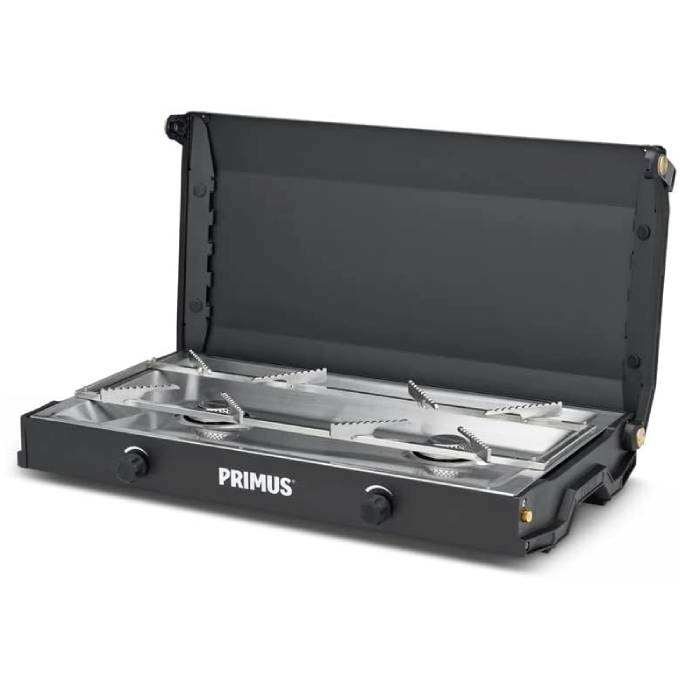
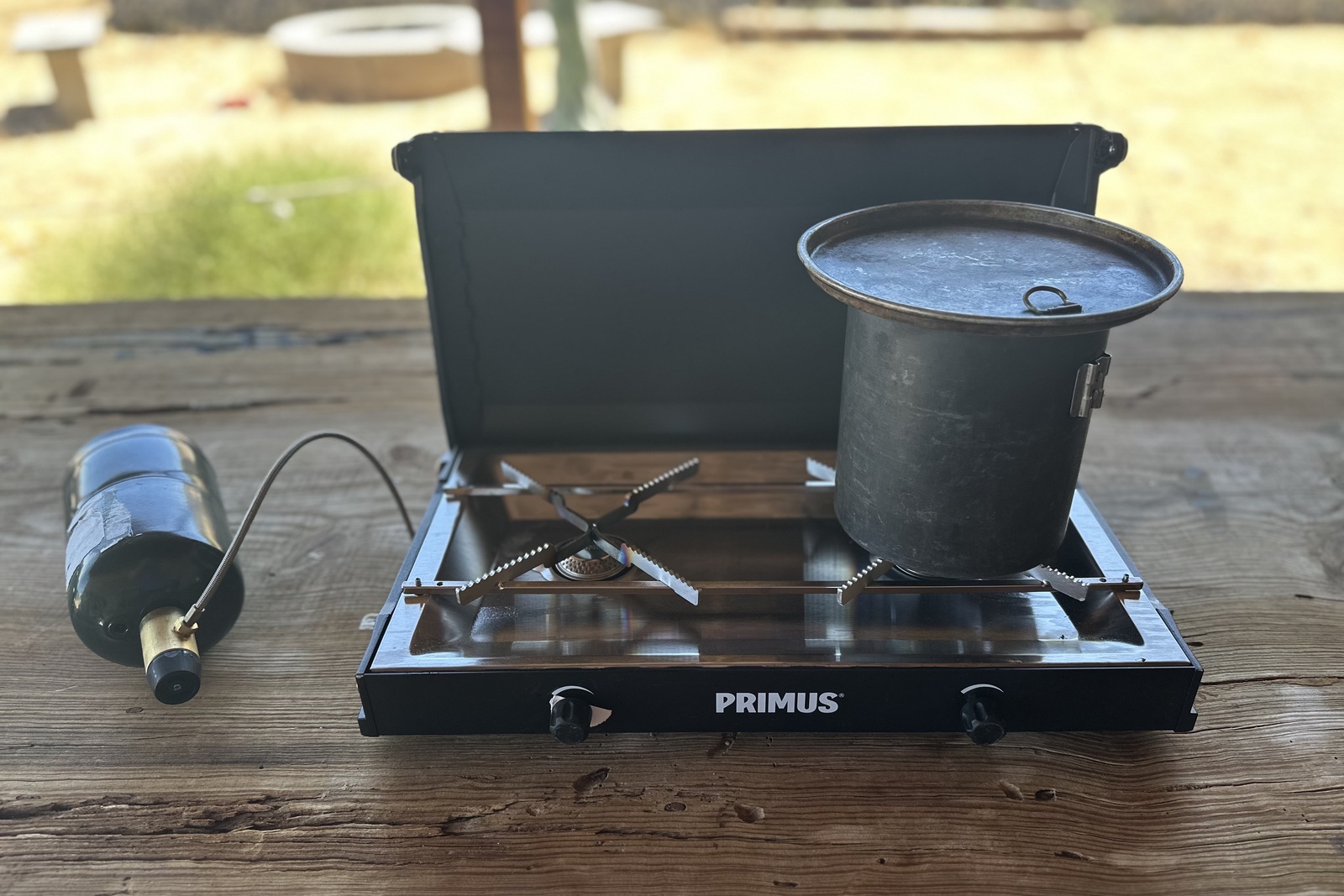
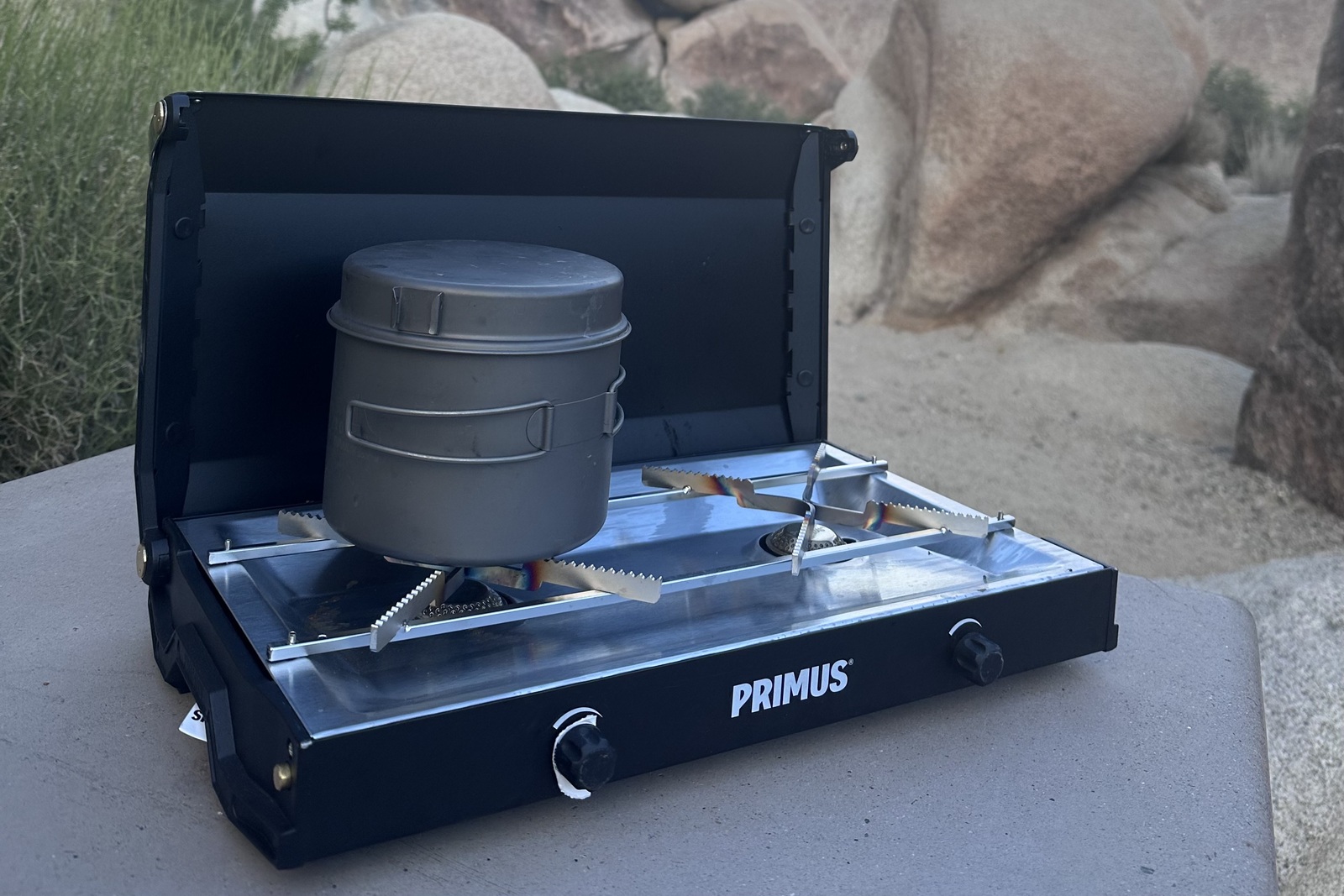
Space can be limited when you’re camping out of a vehicle, but the low-profile Primus Kinjia slides easily underneath a carseat. This is one of the most compact two-burner stoves we tested, making it a great option for those with smaller cars or less storage space. The Kinjia has an attractive, sleek design, and we like that the fuel line tucks neatly into the storage compartment on the back.
When it comes to cooking, the Kinjia is totally acceptable, although it lacks the raw output and finesse of the Camp Chef models above. Still, we easily boiled water, sautéed veggies, and cooked pasta on this intuitive double burner.
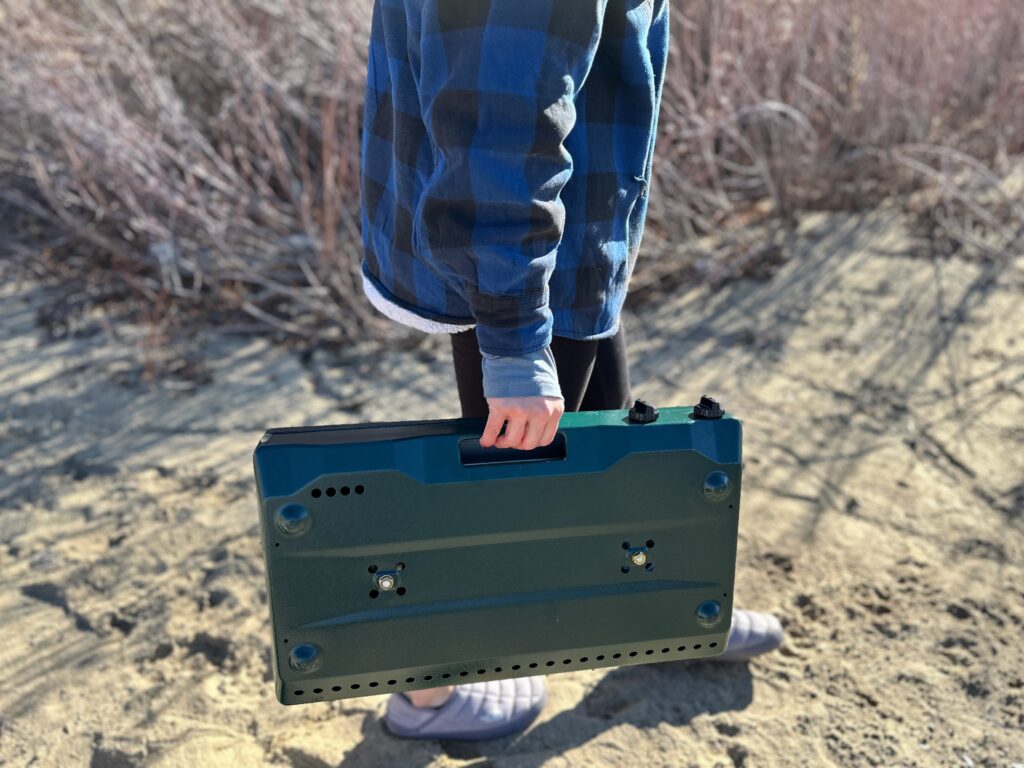
The wooden carry handle is a nice touch and makes the stove easy to transport from car to campsite. It’s also intuitive to set up and turn on. There’s no auto-ignition, though, so don’t forget a lighter.
The Kinjia’s exceptional packability means that its burners are fairly small, so a larger pan doesn’t heat as evenly as on the Everest 2X. The pan also sits closer to the flame. Our pancakes burned quickly on one side but didn’t cook all the way through. That said, if you’re limited on space and not preparing a gourmet meal, the Kinjia is an excellent option.
Product Comparison Table
| oSort | Product | Price | Weight | Boil Time | Fuel Efficiency | Number of Burners | BTUs (per burner) | Fuel Type | Power | Efficiency | Cooking Ability | Portability | Ease of Use | 0 |
Snow Peak Home & Camp Burner View at Amazon View at Backcountry 
|
$100 | 3 lb. | 5:11 | 0.4 oz. | 1 | 8,333 | Butane | 5.0 | 5.0 | 4.6 | 5.0 | 4.2 | 1 |
Gas One GS-3400P View at Amazon View at Gas One
|
$40 | 3 lb. 4.8 oz. | 8:29 | 0.6 oz. | 1 | 8,000 | Butane and propane | 4.4 | 4.8 | 4.6 | 5.0 | 4.6 | 2 |
Camp Chef Everest 2X View at Amazon View at Cabela's
|
$230 | 12 lb. | 3:49 | 1 oz. | 2 | 20,000 | Propane | 5.0 | 4.2 | 5.0 | 4.5 | 5.0 | 3 |
Coleman Cascade 3-in-1 View at REI View at Amazon |
$275 | 14 lb. 12.8 oz. without attachments | 9:24 | 0.9 oz. | 2 | 12,000 | Propane | 4.2 | 4.2 | 4.8 | 5.0 | 4.8 | 4 |
Jetboil Genesis Basecamp System View at REI View at Amazon |
$450 | 9 lb. 1.6 oz. | 7:21 | 0.7 oz. | 2 | 10,000 | Propane | 4.6 | 4.6 | 3.8 | 5.0 | 5.0 | 5 |
Coleman Classic 2-Burner View at Amazon View at Coleman 
|
$98 | 11 lb. 10.4 oz. | 10:26 | 0.8 oz. | 2 | 10,000 | Propane | 4.2 | 4.2 | 4.6 | 5.0 | 4.6 | 6 |
Coleman Classic 1-Burner Butane View at Amazon View at Coleman
|
$46 | 5 lb. 2.4 oz. | 16:08 | 0.8 oz. | 1 | 7,650 | Butane | 3.6 | 4.2 | 4.0 | 5.0 | 5.0 | 7 |
ONTOMYO BRS-32 View at Amazon View at Walmart |
$60 | 2 lb. 9.6 oz. | 5:53 | 0.6 oz. | 2 | 6,000 | Butane | 4.6 | 4.7 | 4.4 | 5.0 | 4.4 | 8 |
Camp Chef Explorer View at Amazon View at Backcountry |
$160 | 30 lb. 8 oz. | 6:59 | 3.2 oz. | 2 | 30,000 | Propane | 4.8 | 3.6 | 4.6 | 3.6 | 4.8 | 9 |
Primus Kinjia View at Amazon View at Backcountry |
$240 | 8 lb. 2.5 oz. | 5:56 | 1.2 oz. | 2 | 10,200 | Propane and butane | 4.6 | 4.1 | 4.4 | 4.8 | 4.5 |
|---|
Analysis & Results
In this section, we turn up the heat and see which camping stoves burn brightest when it comes to boil time, fuel efficiency, simmer control, ease of use, and portability.
Which Camping Stove is the Best Value?
For how well it performs, the Snow Peak Home & Camp Burner is fairly inexpensive, making it a very strong value. This compact stove is powerful, cooks evenly, and packs down to the size of a water bottle. With a price tag of just around $100, it’s a no-brainer for us.
The Coleman Classic 2-Burner also offers good bang for your buck. It’s a dependable, easy-to-use double burner that won’t give you sticker shock. This understandably popular stove includes windscreens, cooks evenly, and simmers well – all at a very palatable price.
Our budget pick for this category is the Coleman Classic 1-Burner. It’s one of the least expensive models on our list but still cooks reasonably well. For those who are getting into camping, it’s a very accessible option that won’t disappoint.
Which camping stove is the most powerful?
Boil time gives us a direct comparison of power stove to stove. Though we can look at BTUs (British Thermal Units) as a power measurement, they are only one piece of the output puzzle. We tested each stove side by side to see which one brought a liter of water to boil the fastest.
The Camp Chef Explorer has 60,000 BTUs split between two burners (30,000 each), which is the highest rating in our lineup. However, it took almost 2 minutes longer to boil a liter of water than the Snow Peak Home & Camp Burner, whose burner is only rated to 8,333 BTUs. Similarly, the Coleman Classic 1-Burner Butane stove matches the Gas One GS-3400P in its BTU rating but took twice as long to boil a pot of water in our test.
The Camp Chef Everest 2X had the fastest boiling time (3 minutes and 49 seconds). Its powerful and wide burners kick out a lot of heat, and its windscreens do a good job trapping it. By contrast, the Coleman Classic 1-Burner Butane stove had the slowest boiling time at just over 16 minutes.
The second-fastest boil came from the small but mighty Snow Peak Home & Camp Burner (5 minutes and 11 seconds). Surprisingly, the ONTOMYO BRS-32 came in third at just under 6 minutes – impressive considering its relatively low BTU rating.
Which Camping Stove is the Most Efficient?
On paper, the Snow Peak Home & Camp Burner wins for efficiency, using only 0.4 ounces of fuel to boil a liter of water. The Gas One GS-3400P and ONTOMYO BRS-32 are close runners-up, using only 0.6 ounces each.
We should note, however, that our tests were performed in climate-controlled conditions. In below-freezing temperatures, butane is much less effective than propane, which would change the results.
Stoves that run exclusively on butane aren’t as fuel-efficient – or simply won’t admit any gas to the stove – in low temperatures. We encountered this with the Snow Peak stove when we tried to cook bacon on a 24-degree morning. The bacon sizzled at first but then went eerily quiet. We could hear the stove still running and see heat waves, but there was little power behind it. It took over 30 minutes for our bacon to crisp up.
Which camping stove has the best cooking ability?
Our gear analyst awarded stoves points for simmering ability, evenness of cooking, windshields or other protective measures, temperature range, and easy adjustments.
We were consistently impressed with the performance of the Camp Chef Everest 2X. Not only is it powerful, but it also produces fluffy rice and perfectly golden-brown pancakes. Some of this is due to the fact that the burners are wider, and pans sit farther away on higher metal grates. This design allows for better simmer control and heat management.
The Snow Peak Home & Camp Burner would have had a perfect score if it included some sort of wind guard. Again, this is a trade-off to the light and portable design. However, the stove was powerful enough and cooked quickly enough that we didn’t find ourselves missing a windscreen too much.
Of the stoves we tested, here are the ones that simmered the best and cooked a perfect pot of rice (in no particular order):
- Camp Chef Everest 2X
- Snow Peak Home & Camp Burner
- Coleman Classic 2-Burner
- Coleman Cascade 3-in-1
- Camp Chef Explorer
Here are the ones that cooked evenly:
- Snow Peak Home & Camp Burner
- Camp Chef Everest 2X
- Camp Chef Explorer
These camping stoves had windshields/flame protections:
- Camp Chef Everest 2X
- Coleman Classic 2-Burner
- Coleman Cascade 3-in-1
- Coleman Classic 1-Burner (kind of)
- Camp Chef Explorer
Based on our tests, these camping stoves demonstrated the best temperature range/adjustments:
- Snow Peak Home & Camp Burner
- Camp Chef Everest 2X
- Coleman Classic 2-Burner
- Coleman Cascade 3-in-1
- Jetboil Genesis Basecamp System
- Camp Chef Explorer
The outliers in this final category are the Coleman Classic 1-Burner and Gas ONE GS-3400P, which do have temperature controls, but they didn’t feel accurate or helpful. Also, the Camp Chef Explorer offers a nice temperature range, but the flame is extremely high – even on low.
Which camping stove is the most portable?
The Snow Peak Home & Camp Burner could practically fit in a cupholder, making it a delightfully easy partner for simple, hot food. Its single burner is relatively limiting, however, making it best suited for solo adventures and one-pot meals.
The average camper who cooks meals for three to five people would be more interested in the Jetboil Genesis Basecamp System, ONTOMYO BRS-32, or Primus Kinjia. These options pack well but also have the space to cook more food.
At the bulky end of the spectrum is the freestanding Camp Chef Explorer, which is incredibly difficult to pack. It doesn’t fold down, requires a large propane tank, and didn’t fit in our gear analyst’s packed car.
Which camping stove is the easiest to use?
The stoves that rated the highest were the Coleman Classic 1-Burner Butane, Camp Chef Everest 2X, and Jetboil Genesis Basecamp System. These were awarded five out of five in this category because they embody all the qualities of ease: they are quick to assemble (including hooking up fuel), offer auto-ignition, have a stable base for cooking, and are simple to clean up.
All other stoves rate fairly high in terms of ease of use, except the Snow Peak Home & Camp Burner. We had to knock this stove down a bit because it’s not intuitive to set up. The instruction manual helps streamline the process, but if you happen to leave the instructions behind on your first outing with the stove, it’s easy to get the steps wrong.
How to Choose a Camping Stove
What’s the best size for a camping stove?
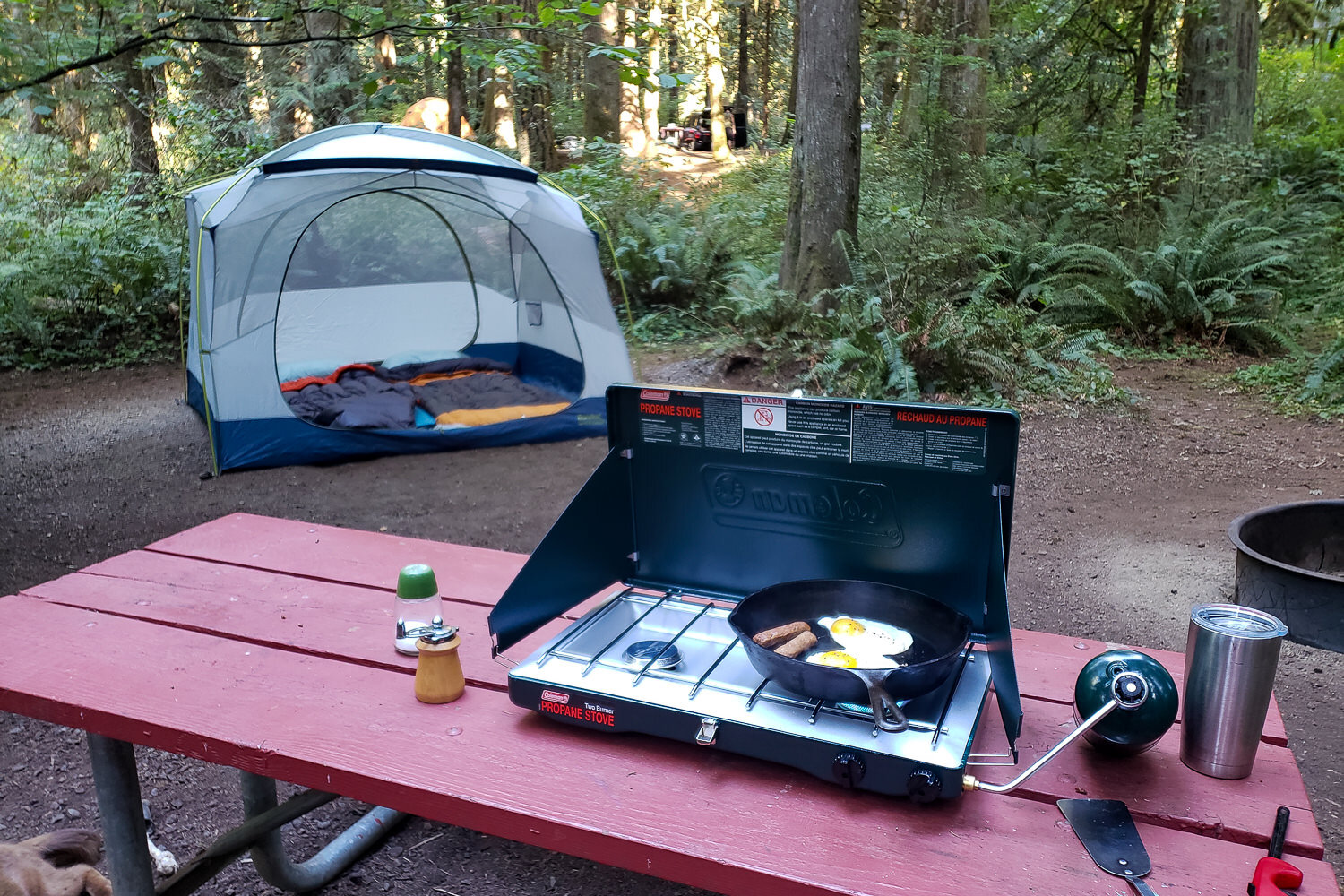
One of the biggest considerations is the capacity you need out of a stove. Single-burner stoves are lighter, pack easier, and are great for solo or small camp groups who prioritize simple meals, like one-pot chili.
Double-burner stoves are better for groups of three or more. They also make more sense for those who like to whip up complex meals – like a full breakfast spread with pancakes, eggs, bacon, and coffee. There are some three-burner options on the market, but they’re few and far between.
Is propane better than butane?
Another important consideration is the fuel type that best suits your camping habits. Generally, we recommend propane stoves for the best performance in a variety of temperatures and environments. However, if you plan on only camping during the summer, a butane stove might be a good option.
Butane becomes a gas at 32 degrees and effectively stops working at cold temperatures (see our review of the Snow Peak Home & Camp Burner for more information on this). Butane also loses performance above 6,000 feet, whereas propane still works well at high altitudes. However, butane outperforms propane in weight and efficiency, so it lasts longer than propane ounce for ounce.
What are the best camping stove accessories?
The last major consideration when looking at buying a stove is versatility. Some stoves provide options for grills, flattop griddles, and traditional burners that are interchangeable.
These accessories make these stoves attractive for situations outside of strictly camping. If you see yourself using a camp stove for tailgating or at home, a more robust stove with versatility like this might be a better choice for you.
How many BTUs should my camping stove Have?
The more BTUs a stove has, the hotter it burns. The average tabletop camping stove has around 10,000 BTUs per burner.
For up to three or four people, 10,000 BTUs per burner is sufficient for most campers, providing a good balance between power and fuel efficiency. However, you may want to bump up the BTUs if you’re cooking for a large group or will be camping in cold, windy conditions.
What is a good price for a camping stove?
Quality camping stoves are expensive, but if you spend a lot of time cooking outside, it’s worth investing in a stove you enjoy using and will last for years – if not decades. As a general rule, the higher the price tag, the more heat a stove puts out. Plus, more expensive stoves usually provide more control over your flame and a bigger cooking surface. That said, you’ll find outstanding stoves at every price point, which is reflected in the wide spread of options above.
Why Trust CleverHiker
We take camp meals seriously. With over 50 nights of camping, gear analyst Helena Guglielmino has tried countless meals on countless camp stoves. She once spent six months living out of her Subaru, cooking the majority of her meals on a single-burner camp stove. Now she spends the majority of her time camping in the Sierra Nevada, pulling up to stealth spots by her favorite lakes, rivers, and passes.
Gear analyst Katie Griffith has been an outdoor educator and guide for 15 years. She has cooked hundreds of meals for groups of up to 50 while camping, from hot dogs and chili to tacos and even hot pot. Like Helena, Katie has spent months at a time living out of her van, and eating well on the road is a priority for her.
Testing Methodology
Here, we break down the key ingredients we look for in top camping stoves, including boil time, fuel efficiency, simmer control, ease of use, and portability. Our team has cooked on every stove year-round and in harsh conditions, from freezing and snowy to wet and windy.
How do we measure boil time?
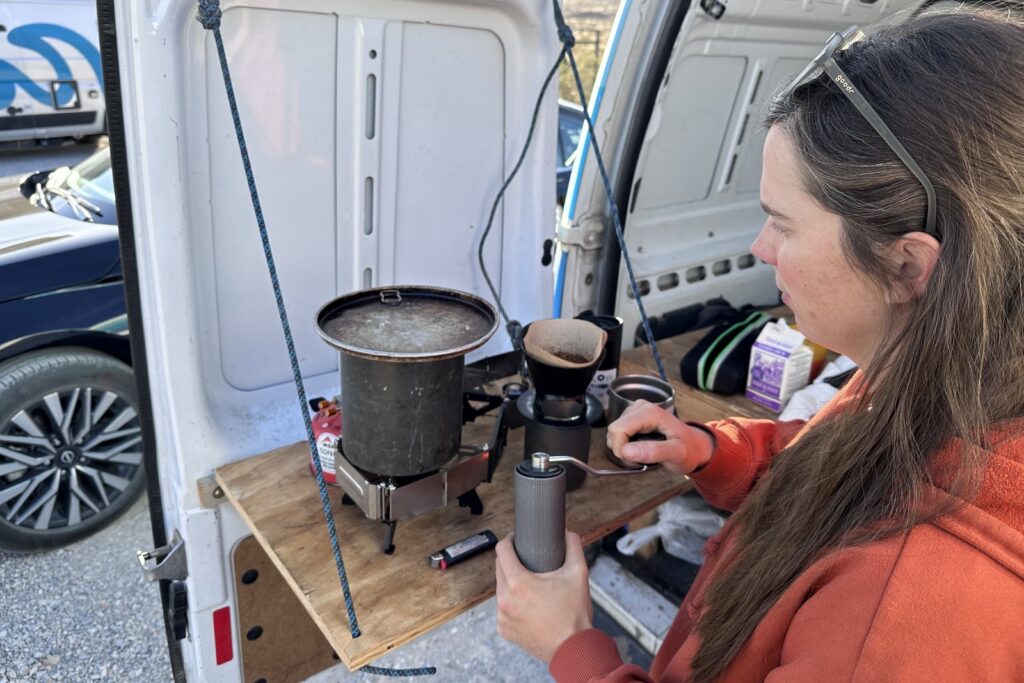
We conducted boiling tests for each of our stoves to test their power. To do so, we used each stove in the same controlled environment. We made sure the temperature was consistent and there was no wind or other elements that could interfere.
We used the same pot for each test and filled it with exactly one liter of room-temperature water. We set each stove to medium heat. As soon as we placed the pot of water on the burner, we began a timer. After testing all the stoves, we were able to compare their boiling times to gauge output.
The boiling test was performed at around 4,500 feet above sea level. Boil times change as you gain or lose elevation. You should expect stoves at sea level to take more time to boil than what our tests show. Likewise, boiling water on these stoves above 5,000 feet will take less time.
Generally, with each 500-foot gain in elevation, water decreases its boiling point by 1 degree Fahrenheit. However, cook times increase at higher elevations because of the lower boiling temperatures.
How do we Evaluate fuel efficiency?
We noted both boiling times and the amount of fuel it took to bring a liter of water to a boil. By measuring the fuel level, we gauged which stoves were more efficient to help you save money on propane or butane.
To test this, we weighed the bottle of propane or butane before we started our boil test and immediately after. We noted the difference between the weights. We also researched each stove to see what sort of technologies they may utilize to maximize their heat output – like integrated heat exchangers or radiant burner designs.
How do we assess cooking ability?
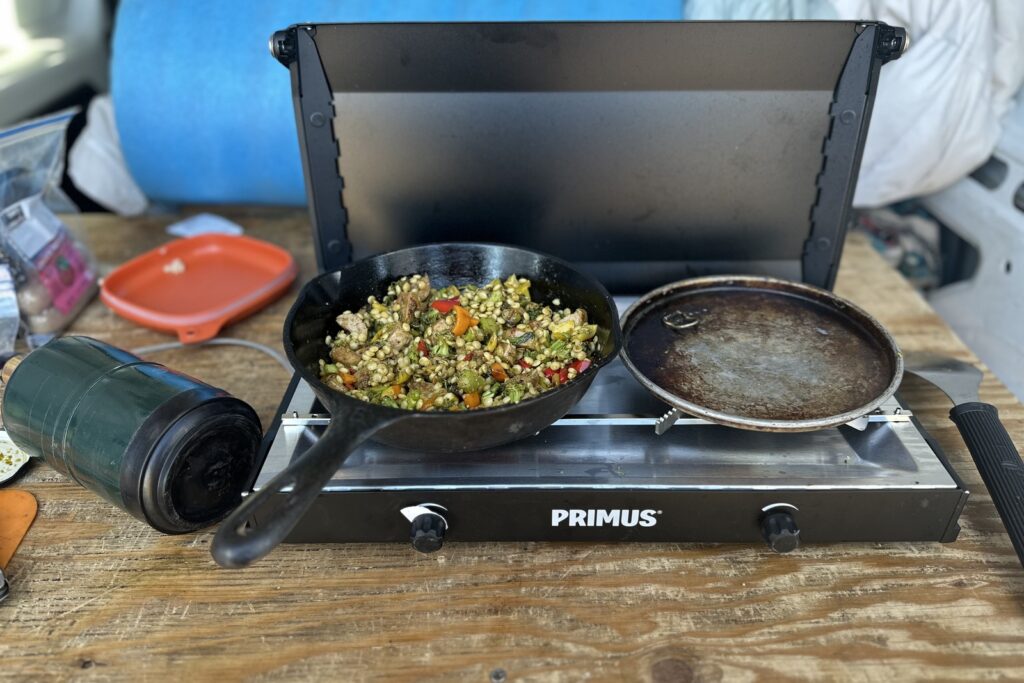
A stove’s cooking ability depends on a few factors. These include the ability to keep a consistent flame at different settings, the evenness of cooking, and the overall versatility of the stove.We tested these aspects in two ways and considered features of the stove to round out our evaluation of cooking ability.
First, we tested the simmering ability by cooking rice on each stove. A pot of rice requires low heat for 20 to 30 minutes. We made sure to note which stoves could not maintain a slow boil (some were extinguished when set to low after a few minutes), how well the water was absorbed, and how fluffy and thoroughly cooked the rice was by the end.
Second, we wanted to see if each stove could cook evenly throughout a pan or its griddle/grill top. To test this, we chose food options like bacon, pancakes, hamburgers, and buns. Each stove was tested with at least one of these options. We ensured each pan or flattop had food evenly distributed throughout.
Finally, we considered features like wind guards and temperature controls that may enhance a stove’s ability to cook well.
What do we look at for portability?
If a stove doesn’t pack well or is too awkward, it’s probably not something you want to take to camp. To assess this metric, we evaluated each stove’s weight, packed dimensions, and features like handles for carrying. We also made note of how each stove packed into our car and if we could easily unload it with our hands full.
How do we assess ease of use?
We measured ease of use with the mindset of what would feel intuitive for a beginner camp stove user. We considered simplicity of assembly, fuel source connections, ignition method, stability features, and ease of cleaning.
When we took each stove out to cook at camp, we wanted to be able to use it for the first time while frantic with hunger. These conditions mirror a common experience: coming back to camp after a long day of adventure, hungry for a hot meal. We took into account the features of each stove but placed a lot of emphasis on actual performance under pressure.
Fuel type is a major consideration. We tested butane, propane, and wood-burning stoves – each of which has unique benefits and drawbacks. Generally, we found propane stoves to be the most reliable, though butane stoves are more powerful in temperatures above 40 degrees. Wood-burning stoves run on renewable resources (like sticks around camp) but can be tedious to monitor. They are also subject to fire restrictions in many areas, so be sure to do your research ahead of time.
Conclusion
Every camper is different, which is why we aimed to provide a wide range of options, from single-burner units for solo adventures to freestanding designs for family cookouts. The best stoves balance characteristics like power, ease of use, and portability. We looked at each stove through the lens of a beginner user to provide recommendations that work for new campers and seasoned camp chefs alike.