


Bottom Line
The Trailmade (men’s / women’s) is the least expensive shell in the current ranking, best suited to short outings, errands, and occasional light rain. Its mixed mesh-and-taffeta lining feels less plasticky against skin than many entry-level shells, but it also traps heat.
During testing in Alaska, a five-mile cold-weather run left the lining sweaty within roughly twenty minutes. Water resistance was another weakness: the jacket struggled during longer downpours, and its hood and storm flap did not seal as confidently as sturdier models. The shell itself resisted abrasion better than expected, although the DWR finish lost effectiveness much sooner.
For more options, see our Best Rain Jackets guide.
How We Tested
Miles Knotek tested the Trailmade in coastal Alaska through wet autumn hikes, sleet, and a five-mile run in cold rain. That run showed how quickly moisture collected inside the jacket. Repeated outings also revealed shortcomings in the hood and storm-flap closures and how quickly its water-repellent finish lost effectiveness.
Quick Specs
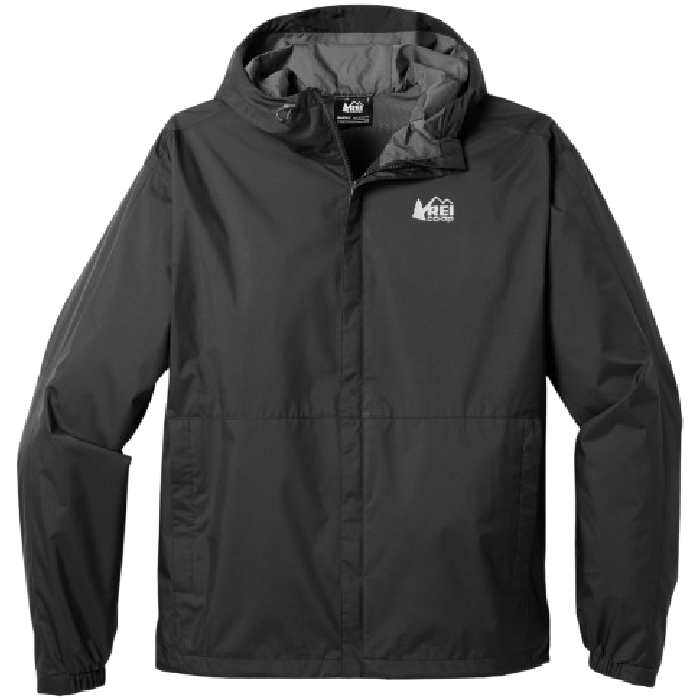
REI Trailmade Rain Jacket
Least Expensive Rain Jacket
CleverHiker Rating: 4.0/5.0
Price: $70
Listed Weight: 15.5 oz. / 13.1 oz.(men’s / women’s)
# of Vents: 0
Pros
- Comfortable split-fabric lining
- Tough outer polyester fabric
Cons
- No pit zips and poor breathability
- DWR wears off quickly
- Heavy and bulky in a pack

Comfort & Mobility
The mesh upper lining and taffeta lower section feel less clammy against bare skin than many inexpensive jackets. The cut is boxy and generous, so slimmer hikers may prefer sizing down. The partially elastic cuffs and limited hem drawcord reduce fit precision.
The split lining was pleasant during gentle walking but did not compensate for the jacket’s boxy overall shape. Limited cuff and hem adjustments made it difficult to seal out gusts or tailor the fit. A casual walker may appreciate the softer feel, while a hiker carrying a pack in unstable weather is better served by more precise closures.
Comfort & Mobility Score: 4.3/5.0

Weather Resistance
Coastal Alaska testing showed that the Trailmade’s weather protection fails to match its appealing price. Its DWR wore off quickly, and the hood toggles and unsecured storm flap allowed wind-driven rain through. It is better for brief, light showers than prolonged rain.
Miles’ coastal Alaska testing revealed that wind could force water past the hood and front closure when storms intensified. Quick deterioration of the DWR compounded the problem, allowing the outer fabric to soak sooner than expected. We would limit this jacket to modest showers instead of relying on it for extended wet backpacking trips.
Weather Resistance Score: 4.1/5.0

Ventilation
With no pit zips, the lined two-layer shell retains a lot of perspiration. During a five-mile run in cold Alaska rain, the inside became wet with sweat within twenty minutes. We do not recommend it for high-output activities.
Sweat accumulated despite cold temperatures, demonstrating that a lined shell with no pit zips is a poor choice for running. The main zipper is the primary way to release heat but exposes the front to rain. Low-exertion errands are a much more defensible use than strenuous hikes.
Ventilation Score: 4.0/5.0

Durability
The thick polyester outer fabric resisted scrapes and abrasions, and the central zipper felt sturdy. Unfortunately, its water-repellent treatment deteriorated far more quickly. Fabric toughness and sustained weather protection are different kinds of durability.
The outer fabric did resist scrapes and small abrasions during testing, and the central zipper seemed sturdy. Nevertheless, the water-shedding finish declined before the face fabric wore out. That difference matters to a shopper because a tough-looking jacket is not necessarily a long-lasting rain barrier.
Durability Score: 4.3/5.0

Weight
The men’s Trailmade weighs 15.9 ounces, while the women’s version weighs 13.1 ounces. The Trailmade does not zip into its own pocket, taking considerable pack space. Its $80 price is appealing, but this is not a weight-conscious backcountry choice.
The weight advantage goes to much lighter models, and this jacket also takes considerable space because it cannot stuff into its own pocket. An occasional user may accept the bulk to save money, but a frequent backpacker should think carefully about both carrying weight and storm reliability. The higher-quality Rainier is only modestly more expensive.
Weight Score: 3.8/5.0

Should You Buy the REI Trailmade Rain Jacket?
The Trailmade is an inexpensive, comfortable option for short neighborhood walks and low-intensity hikes when rain is unlikely to last. It is available in current men’s and women’s versions, and the men’s weight is 15.9 ounces.
Do not buy it expecting all-day protection on remote hikes. The rapid sweat accumulation and weak performance in prolonged Alaska rain are significant limitations. Spending a little more for the Rainier provides more ventilation and a better all-around balance.

What Other Rain Jackets Should You Consider?
Check out our full gear guide for more of our other favorites for rainy weather.
REI Rainier Review: The Rainier costs $100 and adds pit zips, an adjustable hood, and a more dependable balance of features for regular day hikes. It still has limits in long heavy rain, but it is an upgrade in weather protection.
REI XeroCloud 3L Review: The $189 XeroCloud provides three-layer construction and a stretchier, more layer-friendly fit. It makes more sense for hikers who can spend more to move beyond the Trailmade’s entry-level limitations.
Black Diamond Fineline Stretch Review: The Fineline is a lightweight, mobile step up for hikers expecting regular rain. It offers better technical features than the budget-focused Trailmade while staying below premium-shell prices.