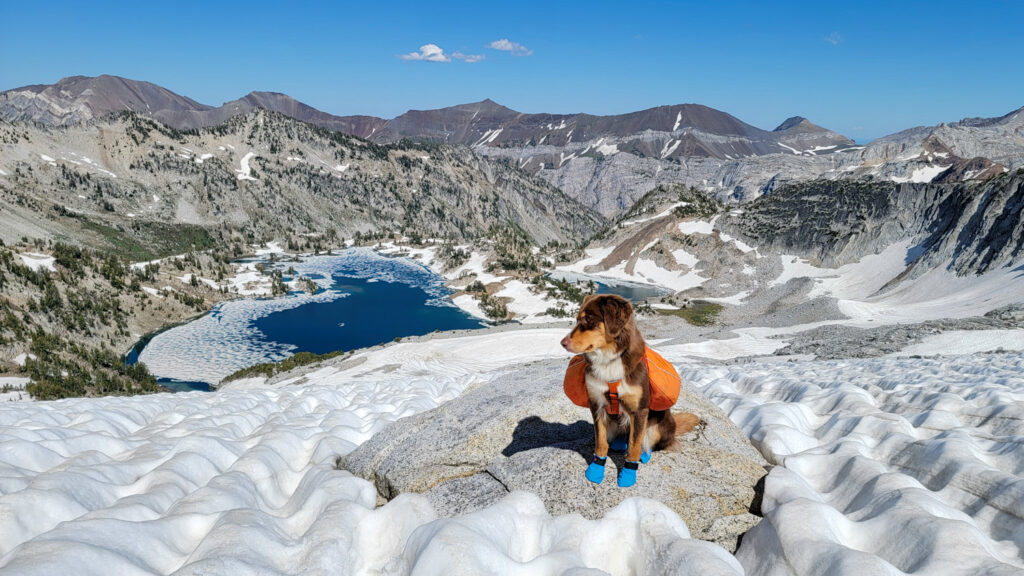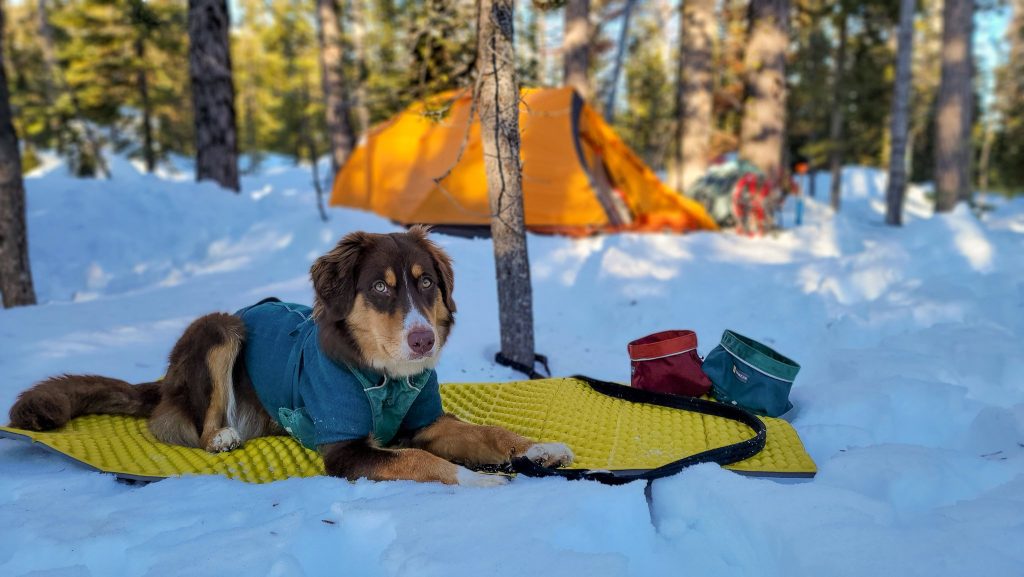


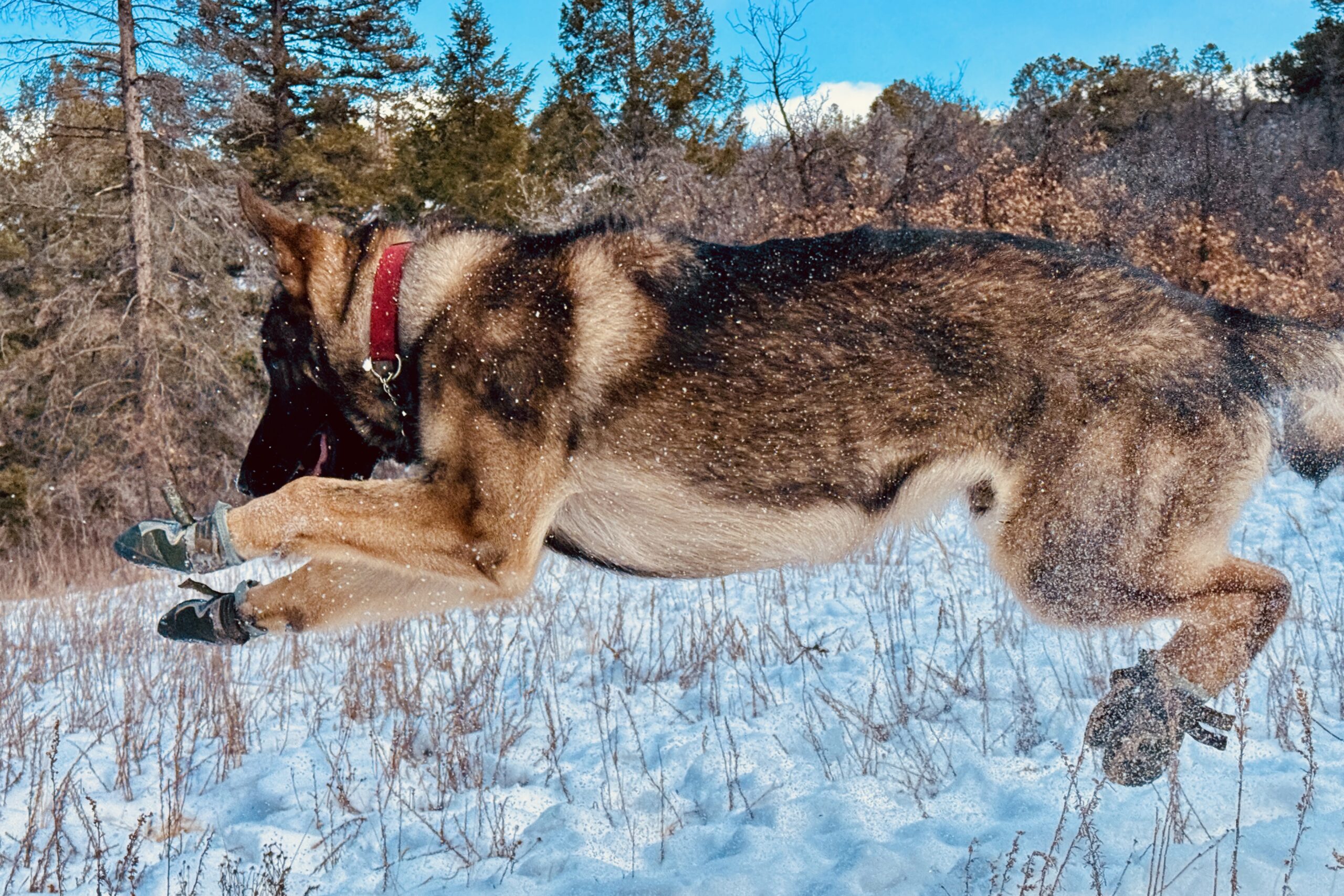
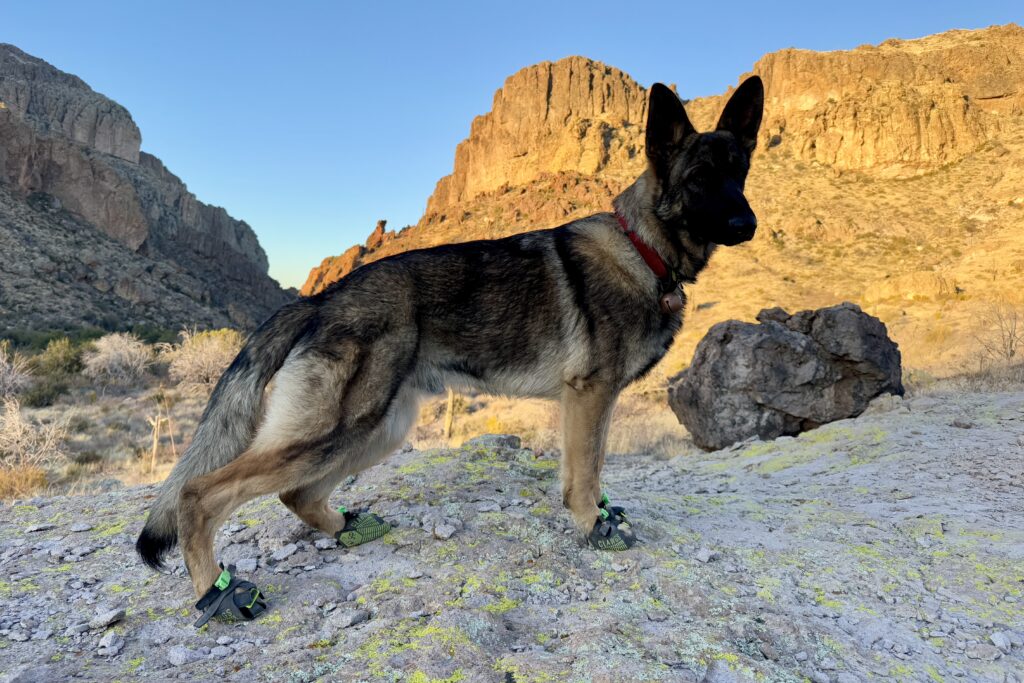
There are many reasons why dogs may need to wear boots, such as protecting their feet from sharp objects, hot pavement, rough terrain, or snow. Over the course of thru-hiking 7,500 miles with our dogs on trails like the Continental Divide Trail, Pinhoti Trail, and Idaho Centennial Trail, we have experienced firsthand how even the toughest of dogs may require boots in certain situations. This has led to a passion for finding the best dog boots.
Editor’s Note: We updated this guide on August TK, 2026, to ensure prices and product specs are accurate and to confirm we still stand behind the picks on our list.
How We Test Dog Boots
Over the years, we have tested 20 different foot care solutions for fit, durability, traction, breathability, protection, and ease of use. As mentioned above, the testing has included hiking thousands of miles on some of the country’s most popular and tough trails.
We evaluated dog boots from popular brands like Wagwear, Ruffwear, Kurgo, and Non-Stop Dogwear. And since our pups mean so much to us, we were extra thorough throughout this testing.
When heading out into the backcountry on a longer trip, a dog backpack may also come in handy for helping transport your pup’s gear. For those who are just getting started in the backcountry with your dog, check out our tips for hiking and backpacking with dogs and our guide to hiking with dogs in winter.

#1. Best Dog Boots Overall
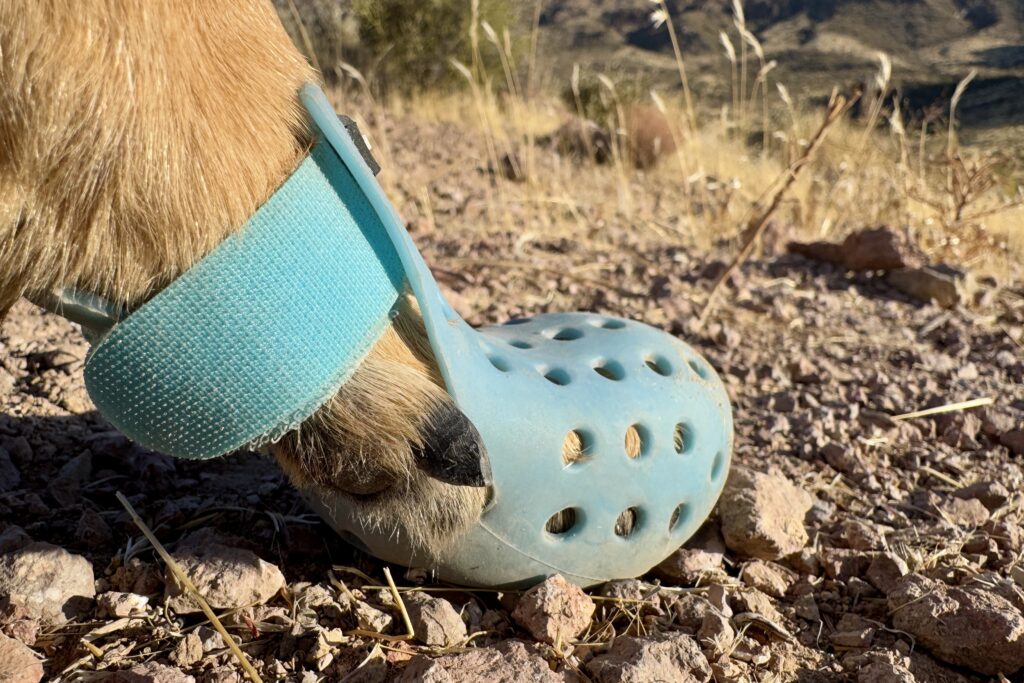
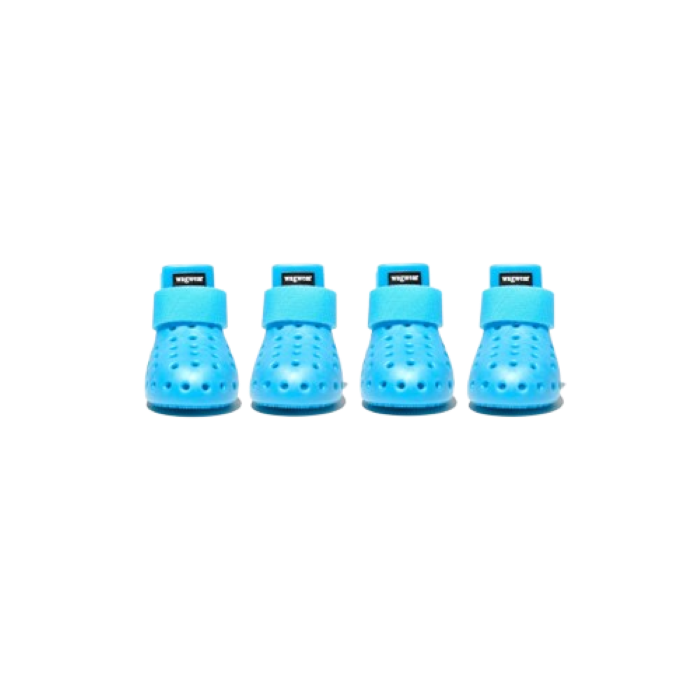
The Wagwear Wagwellies Mojave boots are our favorite dog boots thanks to their breathability, traction, simple design, and durability. Our pups hiked hundreds of miles in them with no sores or issues.

Quick Picks for Dog Boots
Check out this quick list of our favorites if you’re in a hurry, or continue scrolling to see our full list with in-depth reviews.
1. Best Dog Boots Overall: Wagwear Wagwellies Mojave (4 for $55)
2. Best Dog Boots for Foot Protection: Muttluks All Weather (4 for $76)
3. Best Hiking-Specific Dog Boot: Ruffwear Grip Trex (2 for $50)
4. Best Mushing-Style Dog Boot: Non-Stop Dogwear Protector Bootie (4 for $37)
5. Best Dog Boot for Traction: Kurgo Blaze (2 for $35)
6. Most Dew Claw-Friendly Boot: Clawgs V3 (2 for $55)
7. Best Budget Buy: Dog Booties 1000 Denier Cordura ($3.70 per bootie)
8. Best Boot for Ease of Use: Non-Stop Dogwear Long Distance Bootie (4 for $15)
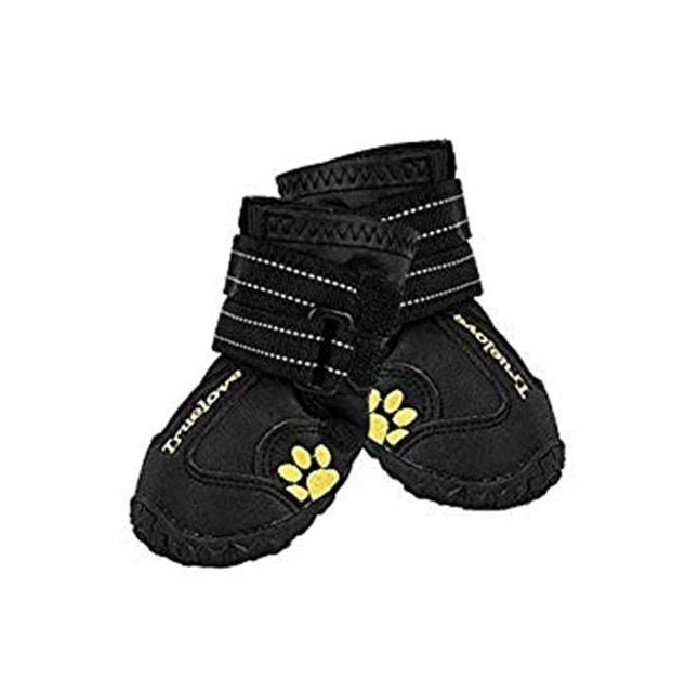
9. Most Affordable Rubber Boot: Expawlorer Anti-Slip Dog Shoes (4 for $25)
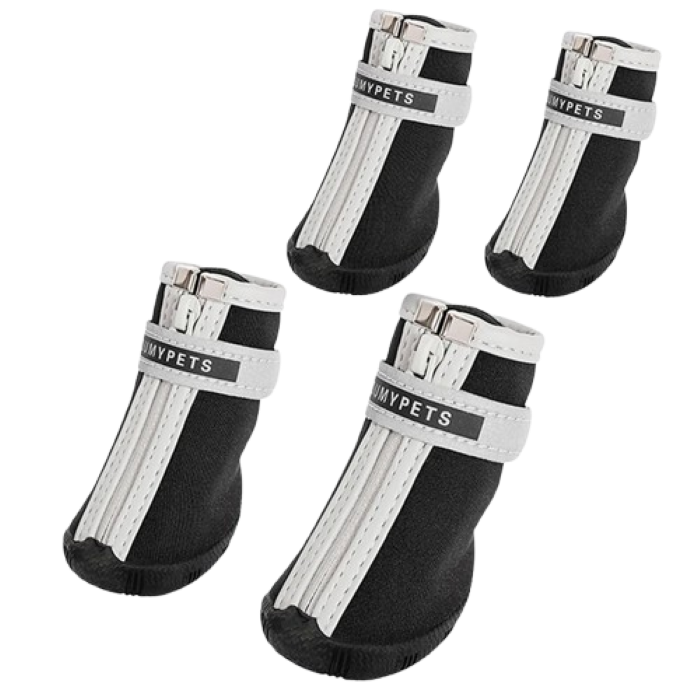
10. Best Small Dog-Specific Shoes: Qumy Dog Shoes for Small Dogs (4 for $23)
11. Best Alternative to Boots: Musher’s Secret ($16)
Wagwear Wagwellies Mojave
Best Dog Boots Overall
CleverHiker Rating: 4.5/5.0
Price: $55 for 4
Weight: 1.4 oz
Pros
- Durable materials
- Breathable design
- Dew claw friendly
- Leg liners available
- Thick sole protects feet
Cons
- Holes can get caught on sticks
- Rocks can get in boot easily
- Strap does not attach to front of boot
Great breathability, good traction, a simple design, and materials that will last miles on the trail are just a few of the reasons we love the Wagwear Wagwellies Mojave dog boots. The Croc-like appearance of these boots is deceiving at first, particularly for serious hikers. However, our testers have spent years searching far and wide for a boot that protects feet for miles on the trail without causing sores. The WagWellies tick all the boxes.
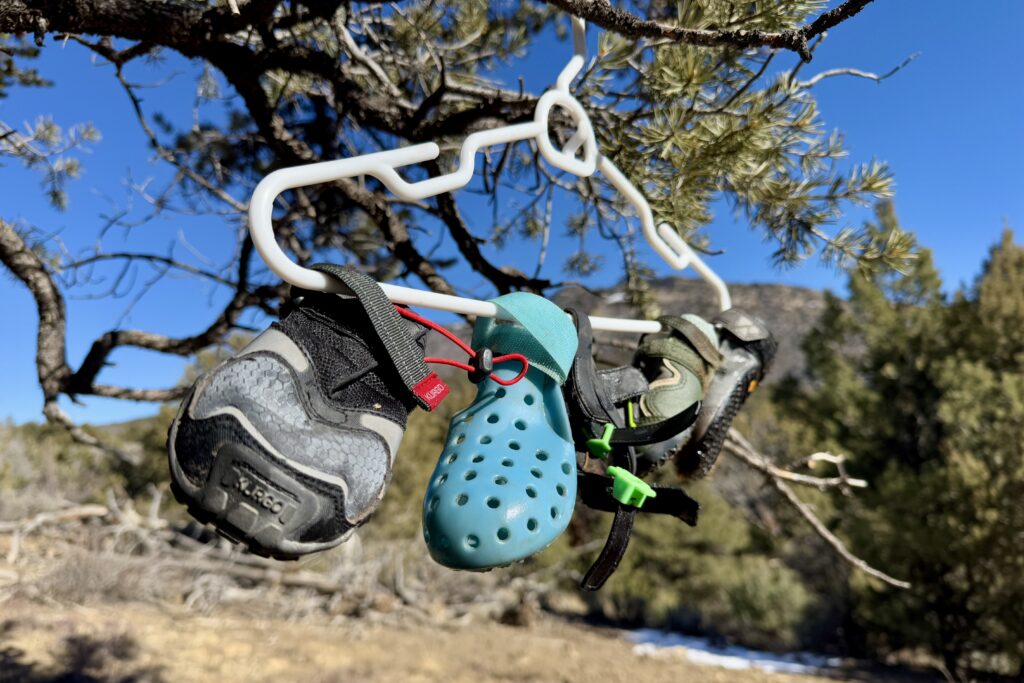
During comparison testing, we found that these dry faster than any of the other boots we tested. Because they consist entirely of rubber, there isn’t any fabric to retain moisture. The holes in the Mojave model also allow water to drain easily from the boot. That design also helps make these boots incredibly durable. Because our testers thru-hike with dogs, we are all too aware how quickly some boots wear out. We love that there isn’t any mesh or fabric that will rip or develop holes.
The rubber sole design also lends better to traction on slick surfaces. There is a wavy tread design on the bottom of the boot to help with grip. The sole is also thick enough to protect the feet from sharp objects. We were unable to puncture these boots with a knife or sewing needle during our side-by-side comparison test. While hiking in Arizona, we never had any problems with our tester dog’s feet being poked by cactus spines, either.
One thing that we really appreciate about the Wagwellies’ design is the open slots around the dew claws. Our testers have logged thousands of miles managing dew claw rubbing due to the way most other boots are designed. The open design allows the dew claw to breathe, which helps prevent sores. For the same reason, these boots can take a few more seconds to put on than other models we tried — but not unreasonably so. There is so much more that we have to say about these awesome boots, but we will leave that for the full review of the Wagwear Wagwellies Mojave boots.

Muttluks All Weather
Best Boot for Foot Protection
CleverHiker Rating: 4.4/5.0
Price: $76 for 4
Weight: 0.6 oz.
Pros
- Good protection from sharp objects
- Great traction
- Small dog sizing
- Free single boot replacement program
- Can be paired with Muttluks socks
Cons
- Expensive
- Some wear after a short amount of use
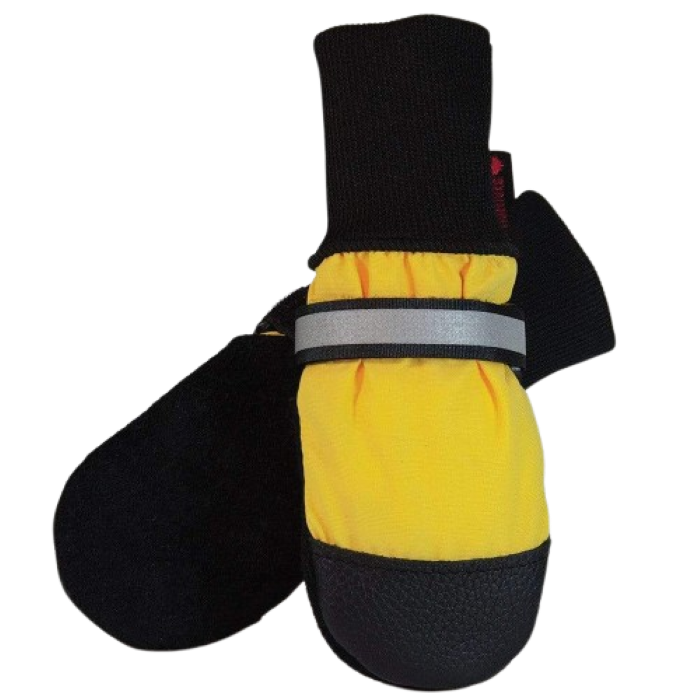
The Muttluks All Weather dog boots strike an incredible balance between the durability, traction, and protection of rubber-soled boots and the fit and comfort of mushing boots. During our side-by-side comparison tests, these boots performed incredibly well in our protection test. We scraped them and poked them with various objects, such as razors, knives, and sewing needles, and the Muttluks did not allow any punctures or show any visible damage.
Another great benefit of these boots is their good traction. When placed on our traction-measuring device, they maintained contact with the rock despite steep angles. The sock-like design also makes them easier to get on and off, depending on the size.
Keep in mind that these boots have only one adjustment point, so taking measurements before ordering is important for a good fit. We also found that they are not quite as durable as some of the rubber-soled boots in our lineup. But they’re a huge improvement over the mushing-style boots we have used. After about five to 10 miles of use, some scuffing became visible on the toe. We suspect that this might not be as big of a problem on the larger sizes, which feature leather. The boots we tested were the Itty Bitty size, which has nylon fabric instead.
This was a bit frustrating given the high price tag for these boots. That said, we were incredibly impressed with how well they fit our small tester dog. These are one of the few that fit small feet without leaving a lot of extra room, being an odd shape, or falling off. With that in mind — plus many of the other benefits — we would happily make the investment and add these boots to our gear closet.
Ruffwear Grip Trex
Best Dog Boots for Hiking
CleverHiker Rating: 4.4/5.0
Price: $45
Weight: 1.6 oz.
Pros
- Available in sets of two for dogs with different size front and back paws
- Excellent traction
- Durable
- Can be paired with Ruffwear socks
- Easier to put on than rubber boots
Cons
- Expensive
- Dew claw chafing is common
- Lacks adjustment for a better fit
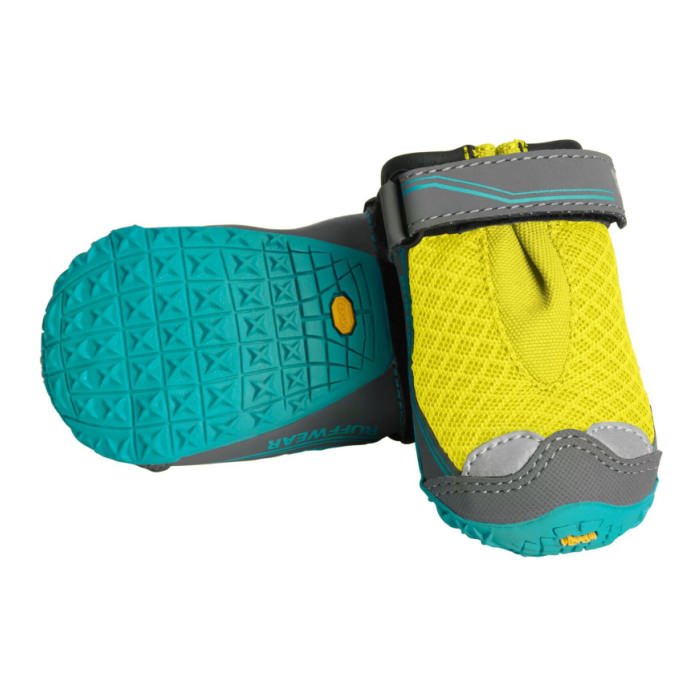
The quintessential dog hiking boot, the Ruffwear Grip Trex provides excellent durability and traction paired with an easy-to-use design. Our primary gear tester used the Grip Trex dog boots on multiple thru-hikes with her German Shepherd, including the Pinhoti and Idaho Centennial Trails. Over the course of those miles, we found that these boots hold up well to use and abuse.
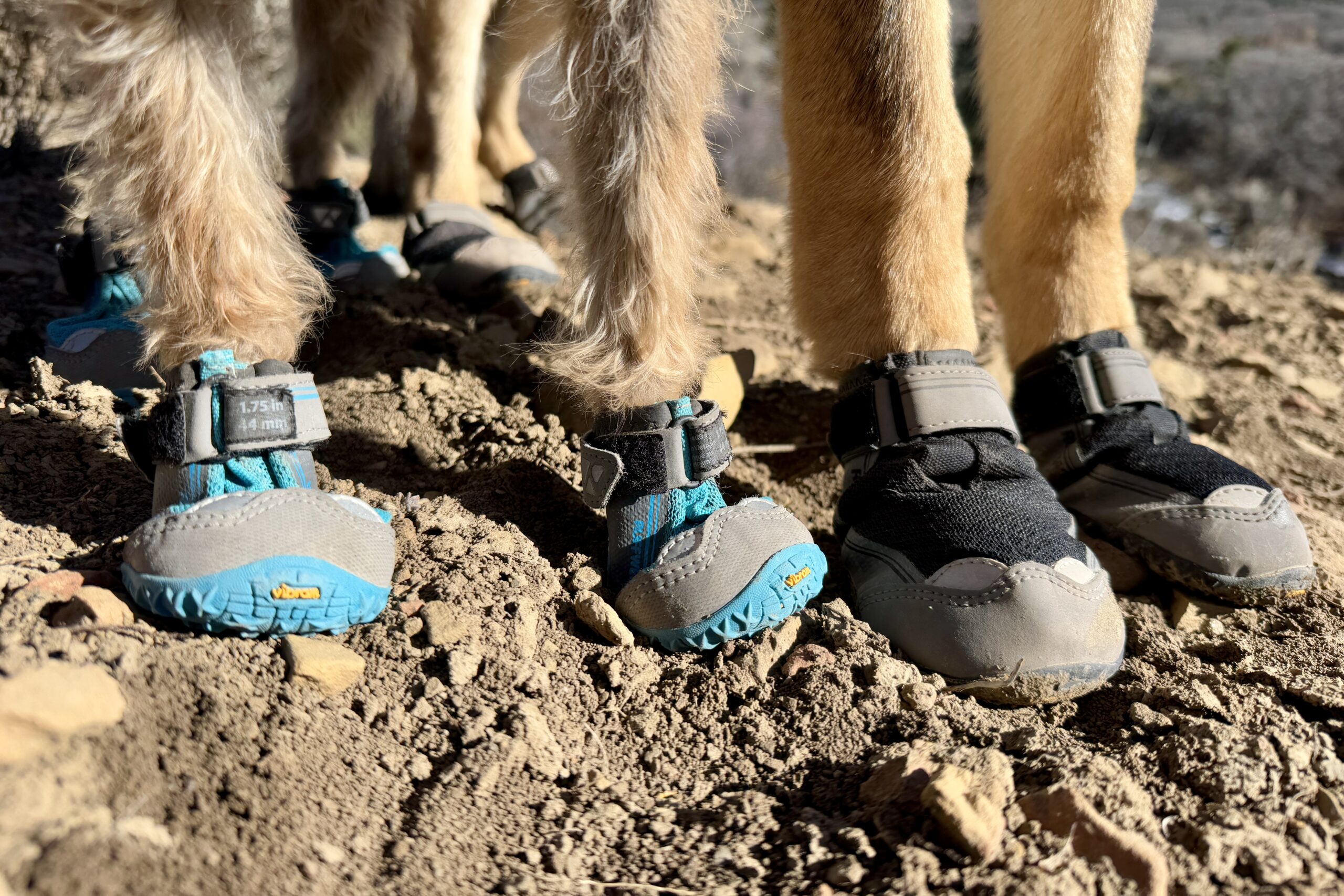
The soles are wear-resistant, and the mesh is durable for daily use. It takes several hundred miles to wear them out, which is a huge improvement over many other boots we tested. The Vibram soles also provide some of the best traction of any boots we have used. They performed well on our traction-measuring device, and our tester dogs have kept their footing while wearing these boots on slick rocks.
There are a few things to keep in mind if you’re considering the Grip Trex boots for your dogs. The simple, one-strap design makes them easier to put on the dog than some of the other rubber-soled, hiking-specific designs we have tested. However, that also means there is less room to adjust the fit. Making sure to take accurate measurements is really important with these boots.
Our experience is that they also tend to cause rubbing around the dew claws. Ruffwear offers many resources to help with this, including tips on its website and sock liners designed specifically for its boots. We also feel like these boots are a bit on the heavy side for smaller dog feet. Plus, they’re pricey. Buyers should be aware that they are sold as pairs to better accommodate sizing differences between the back feet and front feet that are often found in dogs.
Non-Stop Dogwear Protector Bootie
Best Mushing Style Boot
CleverHiker Rating: 4.4/5.0
Price: $37 for 4
Weight: 0.9 oz.
Pros
- Good balance between weight and durability
- Snug closure
- Easy to put on
Cons
- Holds moisture when wet
- Traction could be better
- Black color heats up in the sun
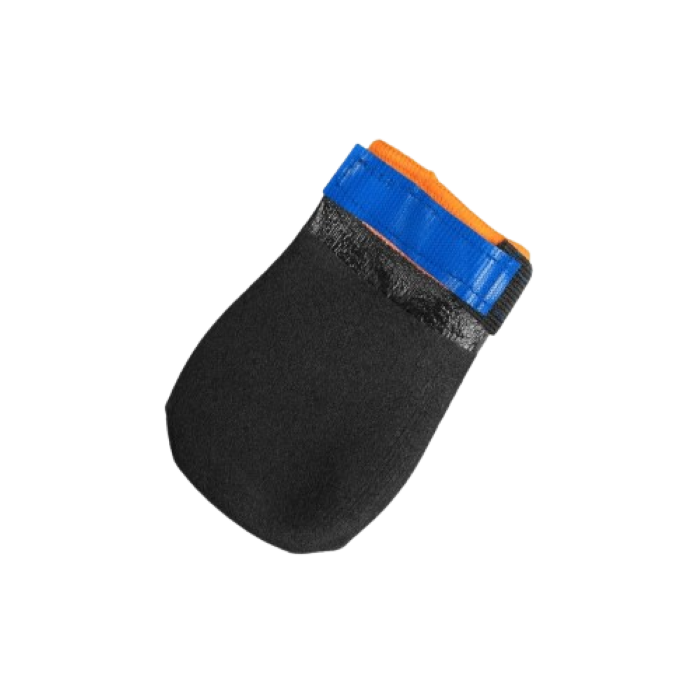
The Non-Stop Dogwear Protector Booties address the biggest issue with lightweight, minimalist mushing boots: durability. Most develop holes within five to 20 miles of use on hard surfaces. Not the Protector boots. The nitrile rubber coating around the outside of the boot makes them very durable without adding much weight. When we tested these boots on the trail, they showed no signs of wear after a day of backpacking in Arizona. This is in stark contrast to the other mushing boots in our lineup, which developed holes after five miles.
A second benefit of the nitrile rubber coating is that it provides additional protection against dangerous objects. During comparison testing, they resisted both sharp punctures and tears. It is possible to poke through with a cactus spine, but we did not have any problems out on the trail.
We also love that these boots are much easier to slip on than the typical rubber-soled boot. The minimalist design, well-sized opening, and stretchy fabric result in less resistance when getting the foot into the boot. The traction on these boots is so-so since there isn’t any dedicated tread. Another issue is the incredibly long drying time. We generally recommend avoiding wet boots anyway, and this model is geared towards trail use rather than snow. With careful management, this should be less of an issue.
Kurgo Blaze
Best Boot For Traction
CleverHiker Rating: 4.3/5.0
Price: $70 for 4
Weight: 2.2 oz.
Pros
- Rubber soles are durable
- Reflective uppers
- Excellent traction
- Two adjustment points
- Pair with Kurgo boot liners for better fit
Cons
- Hold moisture
- Take time to put on
- Expensive
- Elastic adjustment point can get caught on branches
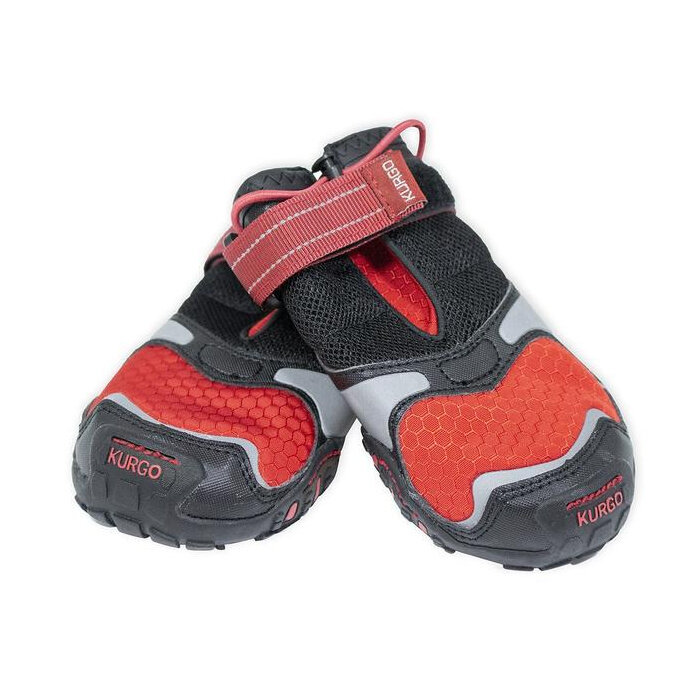
The Kurgo Blaze Dog Boots sport a hiking-focused design with beefy tread, two adjustment straps, and reflective strips for visibility. The two areas where this boot really shines are durability and traction. We have tested many dog boots over the years, and the reality is that boots with thick rubber soles last longer. The Kurgo boots have a sole somewhat similar to that of a human hiking boot. It even has extra rubber coverage on the toes. This part of the boot will last for many miles.
Along these lines, the bottom of the boot has an intricate tread design that helps increase contact with the ground. This provides better traction for use on slick surfaces, such as wet rocks or packed snow. While using these boots with our tester dog in southern Arizona, we found that they were effective at keeping out cactus spines. The dog using them also had no trouble hiking down and up several very steep four-wheel drive roads. In comparison, both humans in the group fell down at least once.
We are less enthusiastic about how long these boots take to dry. They have a woven nylon fabric, which took longer to dry during the comparison test. When dunked in water, they took well over 12 hours to dry in a moderate-humidity, room-temperature environment without sunlight. They also stayed soaking wet for much of the time.
A tighter fit is ideal for rubber-soled boots, as it reduces the risk of rubbing. Paired with the double adjustment straps, these boots are a bit more challenging to put on than some of the other models we tested. Though these boots are a bit expensive, they will last a long time, making the purchase worth it for those who prioritize durability and traction on the trail.
Clawgs V3
Best Dew Claw Friendly Boot
CleverHiker Rating: 4.3/5.0
Price: $55 for 2
Weight: 0.7 oz.
Pros
- Do not rub the dew claws
- Highly adjustable fit
- Open design is breathable
- Smaller company has good customer service
Cons
- Takes practice to use
- Rubber doesn't stop sharp objects
- Expensive
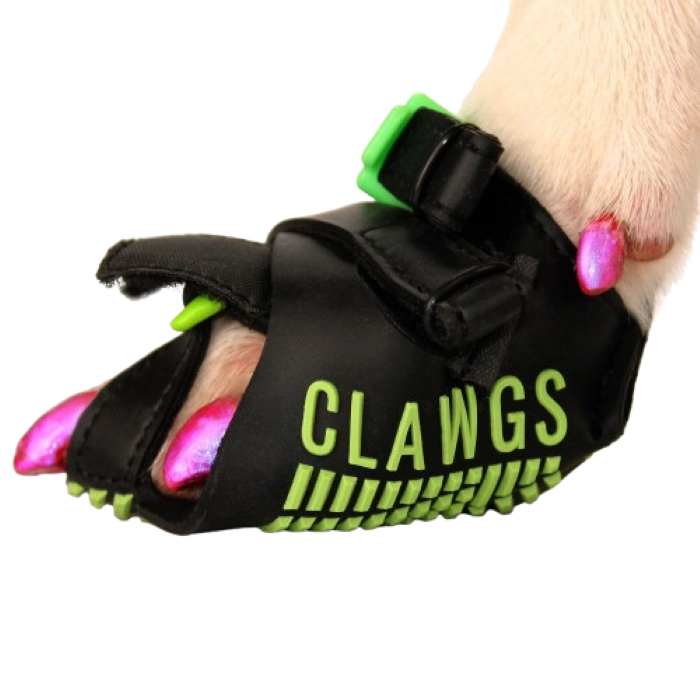
The biggest selling point of the Clawgs V3 boots is that they attach to the leg below the dew claw. When worn long enough, most other boots tend to put pressure on the dew claw, causing sores over time. Though this is dog-dependent, serious hikers covering long distances on backpacking trips and service dog handlers who are out with their dogs every day may find this problem particularly frustrating. The owner of Clawgs created the company after hiking the Pacific Crest Trail with a dog to help other dogs avoid developing sores around their dew claws.
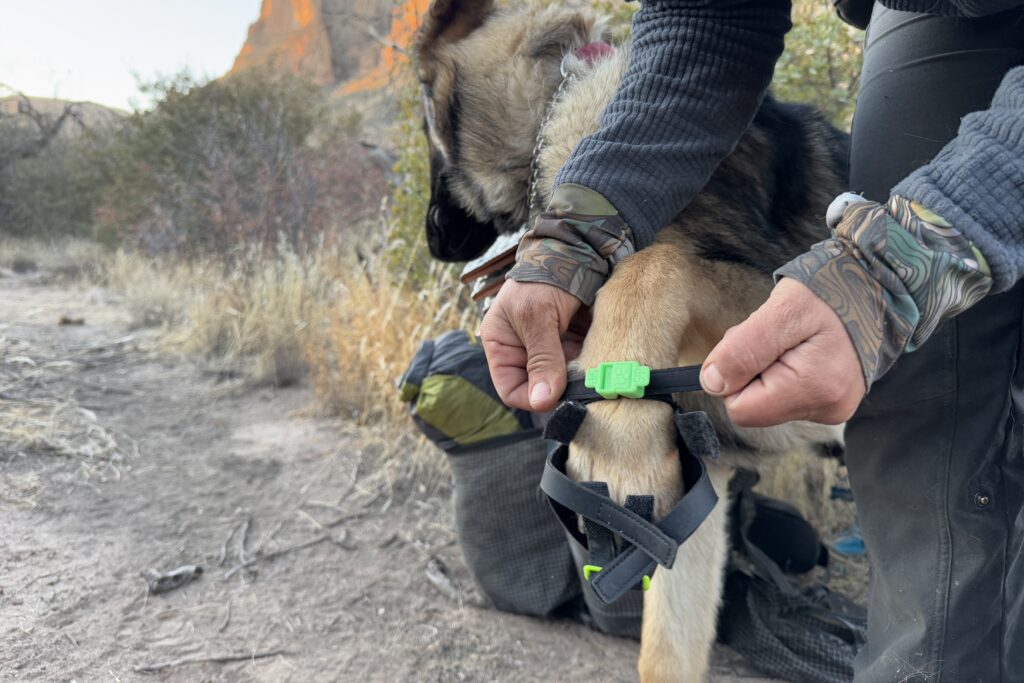
These boots have a very different design from traditional hard-soled and mushing-style boots. Notably, there is a rubber sole to protect the feet from the ground, with six straps to attach it to the foot. The main strap attaches to the back of the metacarpal pad, or “heel,” with a clip. An update from the V2 to the V3 model replaced the other clip with some Velcro straps. We have used both and appreciate that the updated design is easier to put on and take off the dog.
From a performance standpoint, these boots are well ventilated as the toes are open to the air. Because there are so many adjustment points, they also performed well in our fit tests.
We were disappointed to notice that the rubber tread was showing a few signs of wear after about five miles of hiking. While we were backpacking in the Superstition Mountains, our tester dog got some cactus spines stuck in the boot. The spines easily poked all the way through the rubber. These were the only boots our tester dog seemed to notice on his feet. He would stop occasionally to bite at the straps on the tops of his feet. These boots also take a fair bit of practice and tinkering to get fully adjusted to the dog. But once they are, they are not too bad to put on and take off.
Overall, these boots are a specialty piece of gear. They are a bit expensive, and we would primarily recommend them for dogs who are getting rubbed at the dew claws or who may have an odd foot shape that leads to fit problems. Because they are sold in a two-pack, we often only use them on the front feet, where our dog has dew claws. We use a different boot on the back.
Dog Booties 1000 Denier Cordura
Best Budget Buy
CleverHiker Rating: 4.2/5.0
Price: $3.70 per bootie
Weight: 0.5 oz.
Pros
- Affordable and lightweight
- Easy to put on
- Great for use in snow
- Dry fast
- Many color options
- Can be purchased in any quantity
Cons
- Develop holes quickly
- Do not protect feet from sharp objects
- Poor traction
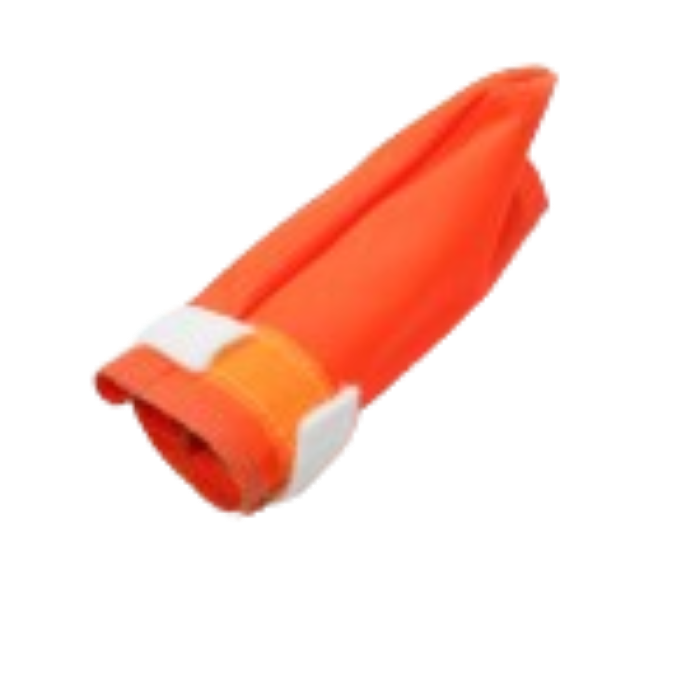
Made by a small company in Anchorage, Alaska, specifically for dog sled racing, the Dog Booties 1000 Denier Cordura boots are perfect for snow or as a backup boot for emergencies. These boots are lightweight, and their design does not restrict feet during use. They are also among the few boots that fit small dogs’ feet well. While the 1000-denier model is only available in size small, smaller options are available in the 500-denier model. We love how affordable these boots are, and you can purchase them in any quantity you like.
Our experience with these boots goes back several years and many miles. Our gear tester used these boots with her dogs on several thru-hikes, such as the San Luis Loop and the Continental Divide Trail. Several things become quickly apparent when using these boots: they are easy to put on, fit is not a big issue, and they get holes very easily.
The sock-like design is simple, and the opening of the boot is large enough that they slip right on. There is a Velcro strap that is easy to tighten and does a good job of keeping the boot on. Because the entire boot features nylon, the design is not as restrictive as many hard-soled boots. This reduces the risk of chafing or rubbing. Though we have still had problems with sores at the dew claws, it is less common due to the lighter weight.
For long-term use on the trail, these boots really are not ideal. They are not durable and quickly develop significant holes. We stretched them out over 40 to 50 miles of use, but they are generally trashed by that time. Likewise, the nylon fabric does not provide as much traction as a boot with actual tread. This should be taken into account when doing activities such as scrambling or hiking on slick surfaces.
With those factors in mind, we mostly recommend these boots for snow. The elastic does a great job keeping powder out, and durability is less of an issue in these conditions. They also dry quickly, which is ideal if the snow gets slushy or melts. Because of their light weight, we also recommend them for backpacking with dogs who do not usually need boots. They make great backups in case of injury, and the weight penalty is minimal.

Non-Stop Dogwear Long Distance Bootie
Best Boot for Ease of Use
CleverHiker Rating: 4.2/5.0
Price: $15
Weight: 0.5 oz.
Pros
- Lightweight
- Affordable
- Dry quickly
- Elastic and velcro closures ideal for snow
Cons
- Durability
- Traction
- Company sizing may not be accurate
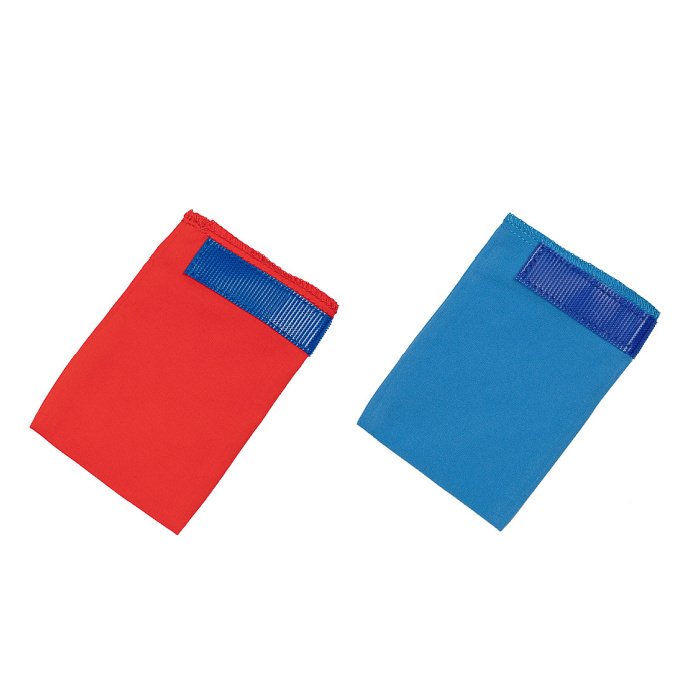
The Non-Stop Dogwear Long Distance Bootie is a mushing-style boot that’s perfect as a snow boot or as a backup on backpacking trips. Like most mushing boots, they feature nylon fabric, are tube-shaped, and have a Velcro closure at the top. This results in a lightweight boot that wears out quickly.
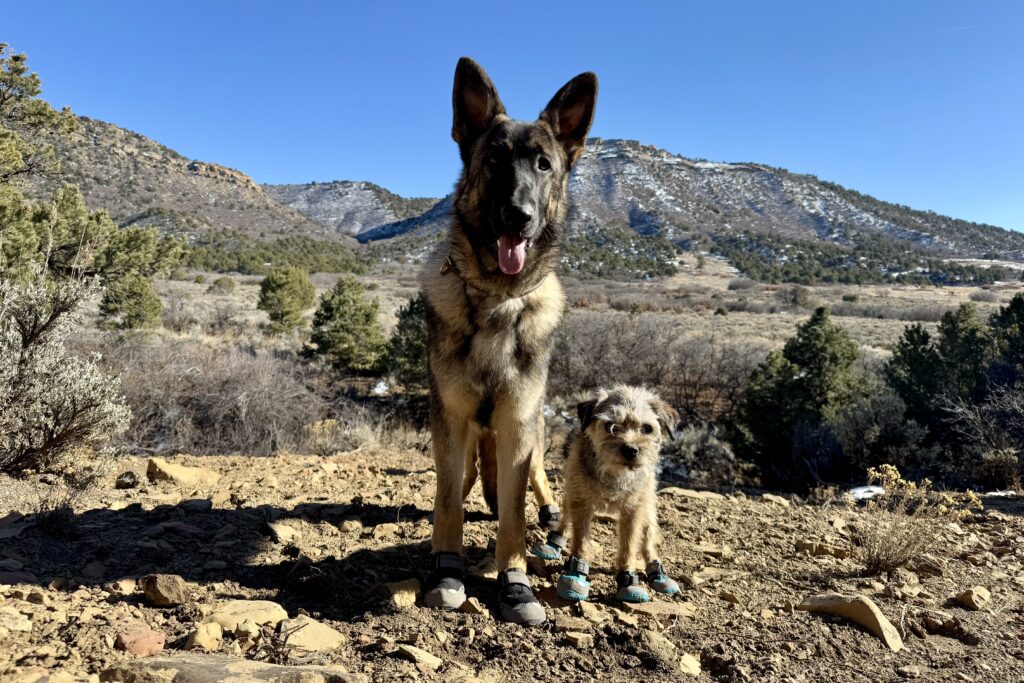
We tested these boots side by side and on a backpacking trip in Arizona’s Superstition Mountains. Our dog tester was a small, 10-pound Border Terrier. During the comparison tests, we found that these boots are easy to put on and take off. When we measured how long it took to put each boot on, these had the fastest time. The nylon fabric also dries relatively quickly, providing good breathability and suitability for use in snow. Not surprisingly, these boots did not have great traction due to the materials and lack of tread.
On the trail, we had a few issues with these boots. The first concerned fit. Mushing boots tend to be ideal for fit because the lightweight, minimal design does not need to fit as closely since the chances of rubbing are much lower. However, we are not impressed with the boot’s sizing. We used Non-Stop Dogwear’s sizing guide, and the boots were too big for our dog. The other issue we had was with durability, which is a common problem with mushing boots. The Long Distance booties developed a hole after about five miles of use.
We recommend these boots for use in snow — they have an elastic, Velcro closure that is great for keeping snow out of the boot. Their weight and price also make them a good choice to carry as emergency backups on hikes.
Expawlorer Anti-Slip Dog Shoes
Most Affordable Rubber Boot
CleverHiker Rating: 4.1/5.0
Price: $25 for 4
Weight: 1.5 oz.
Pros
- Affordable
- Durable
Cons
- Less traction than other rubber boots
- Takes a long time to dry
The affordable Expawlorer Anti-Slip Dog Shoes provide similar durability and protection to the other hard-soled boots in our lineup, but at a more affordable price. The rubber on the bottom helps prevent holes, wear, and tear when used on rough surfaces. It also helps protect the dog’s feet from sharp objects, such as cactus spines or glass. We noticed that the boots resisted sharp objects during our side-by-side tests, but the rubber is softer than some of the other boots we tested. As a result, the traction is not as good as most of the others in our lineup.
While using these boots on day hikes in Durango, Colorado, we found that the sizing runs a bit small. Regardless of the tighter fit, they were about average to put on and take off. There are two straps for fit adjustments, though this was the only boot we tested that fell off when fitted properly. During testing, we found that these boots take a long time to dry. They also collected a large amount of snow around the top of the boot. For that reason, we recommend using these boots only in dry conditions.
Overall, these boots make a good budget buy for anyone wanting a rubber-soled dog boot where performance is not as big of an issue.
Qumy Dog Shoes for Small Dogs
Best Small Dog Specific Shoes
CleverHiker Rating: 3.9/5.0
Price: $23 for 4
Weight: 0.8 oz.
Pros
- Made to fit smaller paws
- Traction
- Rubber soles
Cons
- Less adjustable fits
- Durability
- Slower drying time
The Qumy Dog Shoes for Small Dogs offer sizing specifically for dogs under 30 pounds. Since it’s often difficult to find boots that fit small feet well, we appreciate that these boots address that problem. However, because these boots are not necessarily made for hiking, there are both pros and cons to consider.
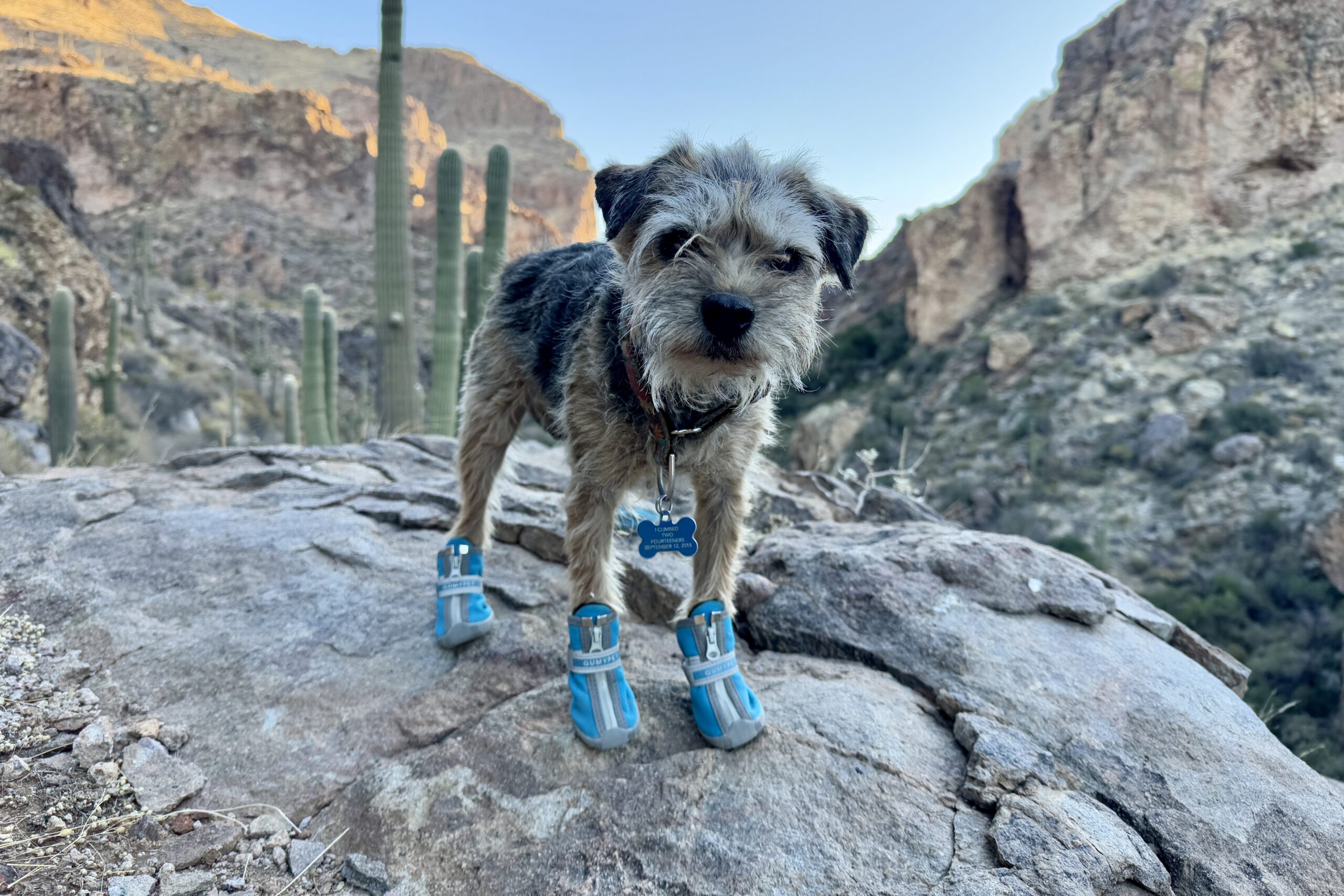
Some things we like include the amount of traction and protection they offer compared with other small dog boots we have tried. During our traction test, these boots had better traction than the mushing boots we tested. They also did a great job resisting sharp objects during our protection test. In the field, we didn’t have any problems with these boots protecting our tester dog’s feet from cactus spines. She was also able to climb up and down rocks while hiking in Arizona’s Upper La Barge Box Canyon without any slipping. Although they didn’t receive the highest fit rating due to less adjustability, these are the best-fitting rubber-soled boots we have tried on a small dog. Generally, rubber-soled boots tend to be too large for the foot, too tall, or both. That was not the case with the Qumy.
There are some downsides to keep in mind with these boots. First, the zipper’s durability leaves a lot to be desired. After about five miles of use, one of the zippers no longer closed the teeth. We can still use the boot, but there is a greater chance of debris getting inside. We also found that even with the zipper, it is challenging to make sure the foot is fully inside the boot. As a result, it takes some finagling to get the boot on all the way. Finally, we found that these boots take longer to dry than some of the other small dog boots we tested.
We like that these boots have rubber soles, fit small dog feet, and have a modest price tag. Though there are some durability concerns, they are a good option for smaller dog adventurers who need some extra protection.
Musher’s Secret
Best Alternative to Boots
CleverHiker Rating: 3.1/5.0
Price: $16
Weight: 2.1 oz.
Pros
- Will not cause rubbing
- Allow foot full range of motion
- Easy to use
Cons
- Not as protective as boots
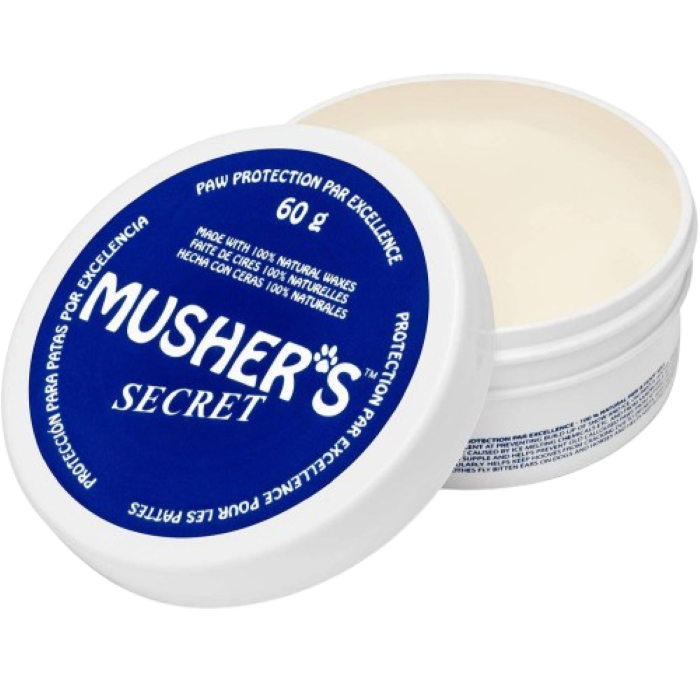
Though it is not a boot, Musher’s Secret Dog Paw Wax deserves a mention for its ability to mitigate the need for boots in many situations. There are some situations where dog boots are necessary, such as on backpacking trips in the desert, long walks on granite, or service dog work on hot pavement. However, sore feet can often be prevented by keeping them moisturized.
Musher’s Secret is a lanolin-based wax that comes in a twist-top container and is rubbed into the feet. The wax helps to moisturize the pads, which helps prevent cracking. This is especially important in arid environments, where dog feet easily dry out. Unlike other balms, Musher’s Secret does not overly soften the feet when used properly, as that can also lead to pad injuries. We generally apply it at night before bed so the feet can absorb the wax.
Using a wax mitigates all of the downsides of a boot. For example, the foot can move freely and breathe better when not in a boot. There is also no need to worry about sores or rubbing when using a wax. Plus, a wax won’t fall off and get lost. Although Musher’s Secret also helps protect the feet from road salt in the winter, it does not protect them from sharp objects, such as glass or cactus spines.
Product Comparison Table
| oSort | Product | CleverHiker Rating | Price | Weight | Fit | Durability | Traction | Breathability | Protection | Ease of Use | 0 |
Wagwear Wagwellies Mojave View at Scheel's View at Wagwear |
4.5/5.0 | $55 for 4 | 1.4 oz | 4.3 | 4.8 | 4.4 | 4.9 | 4.6 | 4.0 | 1 |
Muttluks All Weather View at Amazon |
4.4/5.0 | $76 for 4 | 0.6 oz. | 4.3 | 4.1 | 4.5 | 4.3 | 4.8 | 4.5 | 2 |
Ruffwear Grip Trex View at REI View at Amazon |
4.4/5.0 | $45 | 1.6 oz. | 4.1 | 4.8 | 4.8 | 4.1 | 4.4 | 4.1 | 3 |
Non-Stop Dogwear Protector Bootie View at Amazon View at Backcountry |
4.4/5.0 | $37 for 4 | 0.9 oz. | 4.7 | 4.5 | 4.0 | 3.7 | 4.4 | 4.8 | 4 |
Kurgo Blaze View at Amazon View at Kurgo |
4.3/5.0 | $70 for 4 | 2.2 oz. | 4.1 | 4.7 | 4.8 | 4.0 | 4.0 | 3.8 | 5 |
Clawgs V3 View at Clawgs |
4.3/5.0 | $55 for 2 | 0.7 oz. | 4.4 | 4.3 | 4.1 | 4.7 | 3.8 | 4.3 | 6 |
Dog Booties 1000 Denier Cordura View at Dog Booties |
4.2/5.0 | $3.70 per bootie | 0.5 oz. | 4.7 | 3.5 | 3.7 | 4.6 | 3.9 | 4.8 | 7 |
Expawlorer Anti-Slip Dog Shoes View at Amazon View at Expawlorer |
4.1/5.0 | $25 for 4 | 1.5 oz. | 4.0 | 4.6 | 3.9 | 3.9 | 4.2 | 4.2 | 8 |
Qumy Dog Shoes for Small Dogs View at Amazon |
3.9/5.0 | $23 for 4 | 0.8 oz. | 3.8 | 3.8 | 4.3 | 3.3 | 4.4 | 3.9 | 9 |
Musher’s Secret View at Amazon |
3.1/5.0 | $16 | 2.1 oz. | 5.0 | 1 | 5.0 | 5.0 | 1 | 3.9 |
|---|
Analysis & Results
We rank dog boots on six metrics: fit, durability, traction, breathability, protection, and ease of use. Our comparative results below outline the top performers.
Which dog boots provide the most value?
With a wide range of prices, it can be challenging to determine which pair of boots offers the best bang for the buck. However, when performance is directly compared with cost, we can evaluate which boot offers the most value.
Some standouts from our tests include the Wagwear Wagwellie Mojave and Non-Stop Dogwear Protector boots. As one of our top-performing dog boots with an average price tag, the Wagwellies bring a lot to the table. They are incredibly durable, which also means that they will last a long time before being replaced. Likewise, the Protector boots have a below-average price tag and combine many of the good qualities of rubber-soled and mushing-style boots.
Which dog boots have the best fit?
After testing for fit, we found that the three mushing boots in our lineup provided the best fit for the most dogs. The lightweight fabric and loose fit rarely interfere with the foot or cause rubbing, which is how sled dogs can run in them for miles at a time. The exception is the dew claw, which may still experience rubbing depending on the dog. We ranked the Dog Booties 1000 Denier Cordura and Non-Stop DogWear Protector boots in first place. The Non-Stop Dogwear Long Distance boots came in second due to sizing issues.
Other factors we strongly considered were the number of straps. For this reason, and for the better fit for dogs with dew claws, the Clawgs V3 are another top contender. There are six adjustment points to help achieve the best fit, and they are among the only boots we have never had a problem with rubbing near the dew claws. That said, it is important to buy the proper size and follow the instructions closely when putting them on to avoid sores elsewhere.
Which dog boots are the most durable?
Rubber is much more durable than fabric, so the most durable boots tend to be made of more rubber. With that in mind, the Wagwear Wagwellies Mojave and the Ruffwear Grip Trex are our top picks for durability. Because the Wagwellies are made entirely of rubber, except for the attachment strap, they have incredible durability and will last for many miles on the trail. After using these boots in Arizona, we couldn’t find any signs of wear. We have used the Grip Trex boots on several thru-hikes and have found they last around 200 to 300 miles before wearing out. The front toe, just above the rubber, is where they wear out first.
Which dog boots have the most traction?
Traction is also well correlated with the materials and style of the boot. When we placed each boot on our traction device, we found that the Ruffwear Grip Trex and Kurgo Blaze boots both had very good traction. They were able to remain still on a rock while being slowly raised to a steep angle. On the trail, our tester dogs did not have any issues slipping even on packed snow.
Which dog boots have the best breathability?
Reducing moisture is important for lowering the chances of rubbing caused by sores. With that in mind, the Wagwear Wagwellies Mojave and Clawgs V3 dry very fast due to their all-rubber designs. They both also have open designs to allow for airflow, which helps to prevent sweat from the feet from just sitting on the rubber. The Dog Booties 1000 Denier Cordura boots also dried incredibly fast, with the uppers completely dry in 10 to 20 minutes.
Which dog boots offer the best protection?
One huge benefit of using dog boots is that they can protect the dog’s feet from sharp or harmful objects. For this reason, we compared how well each boot protects the feet from several different objects. The Muttluks All Weather boots came in at the top of our list, with the Wagwear Wagwellies Mojave not too far behind.
The Muttlucks showed no signs of damage from the key or razor and resisted all the puncture holes we tried to make. The Wagwellies had a similar performance in comparison testing. However, we knocked a few points off due to the open design. The holes on the outside mean that a dog could potentially poke their feet on a stick through one of those holes. This happened once during testing.
Which dog boots are the easiest to use?
Boots with a simpler, more minimalistic design tend to be easier to put on and take off. Mushing boots, with their tube-like shape and Velcro closure, are often the easiest to deal with. During our comparison test, the Non-Stop Dogwear Long Distance boots were the fastest to put on our tester boot, coming in at 11.44 seconds. The Dog Booties 1000 Denier Cordura boots took 12.49 seconds per boot, and the Non-Stop Dogwear Protector boots took 12.96 seconds per boot. In the field, we noticed this time difference, particularly with a wiggly puppy who is not used to wearing boots and who did not like having them put on at first.
One big surprise for this category was the Clawgs V3. With all of the straps and adjustment points, they can be quite difficult to use at first. We expected them to rank at the bottom of the list. However, once you adjust the straps to the desired length and spend some time practicing putting them on and taking them off, they are not too difficult to use. They ended up ranking in the middle of the models we tested.
How to Choose a Dog Boot
What is a good price to spend on dog boots?
When looking at boots, it’s important to check whether the price is for one, two, four, or more boots. Some boots — usually simple designs — are sold individually. Others are sold in pairs, allowing different sizes to be purchased for the front and back feet. Many boots are sold in four-packs with one boot per foot. There are a few different models that come with extra boots. This can make it harder to compare pricing, so dividing the price by the number of boots is helpful.
Generally, more durable or innovative boots cost more, but that is not always the case.
How do I find the right fit for dog boots?
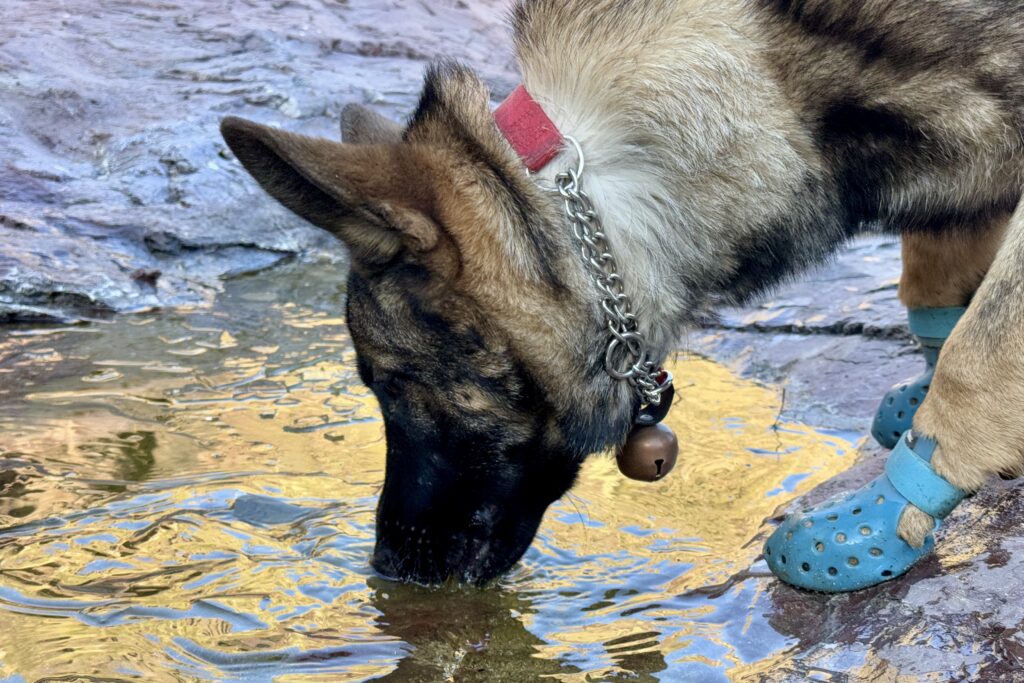
Getting the correct fit can be one of the most challenging and important parts of using a dog boot. Our dogs can’t tell us when something is rubbing or when they don’t feel comfortable, which makes this infinitely more difficult. Some factors that affect fit include the type of foot a dog has, the size of the foot, and whether the dog has dew claws.
Greyhounds, Borzois, and Samoyeds are examples of dogs with hare feet, or a long, narrow foot shape. Cat feet are very compact and rounded. Dobermans, Akitas, and Newfoundlands are examples of dogs that have cat feet. Other dogs fall somewhere in between. How long or compact the foot is can change the fit of a boot. Dew claws also tend to get in the way of boot closures, causing rubbing.
Being aware of these features can help with finding the best fit, but sometimes it just comes down to trial and error.
What is a good weight for dog boots?
Heavier boots may be less comfortable for the dog to wear and may increase the likelihood of rubbing. The extra weight can increase resistance between the boot and places like the dew claw. This increases the risk of sores forming.
How do I find dog boots that are easy to use?
Some boots have features that make them easier to put on or take off. The size of the foot opening, the number of straps to deal with, and the tightness of the fit all impact how easy it is to put on the boot. Simple designs with larger foot openings that are tightened with a strap tend to be quicker and easier to use. Mushing boots are usually in this style, but there are others as well. Boots with zipper openings are also easier to put on because they enlarge the opening. Boots with a narrow opening and multiple adjustment points, where a tight fit is needed, typically take the longest.
What type of dog boot style is best?
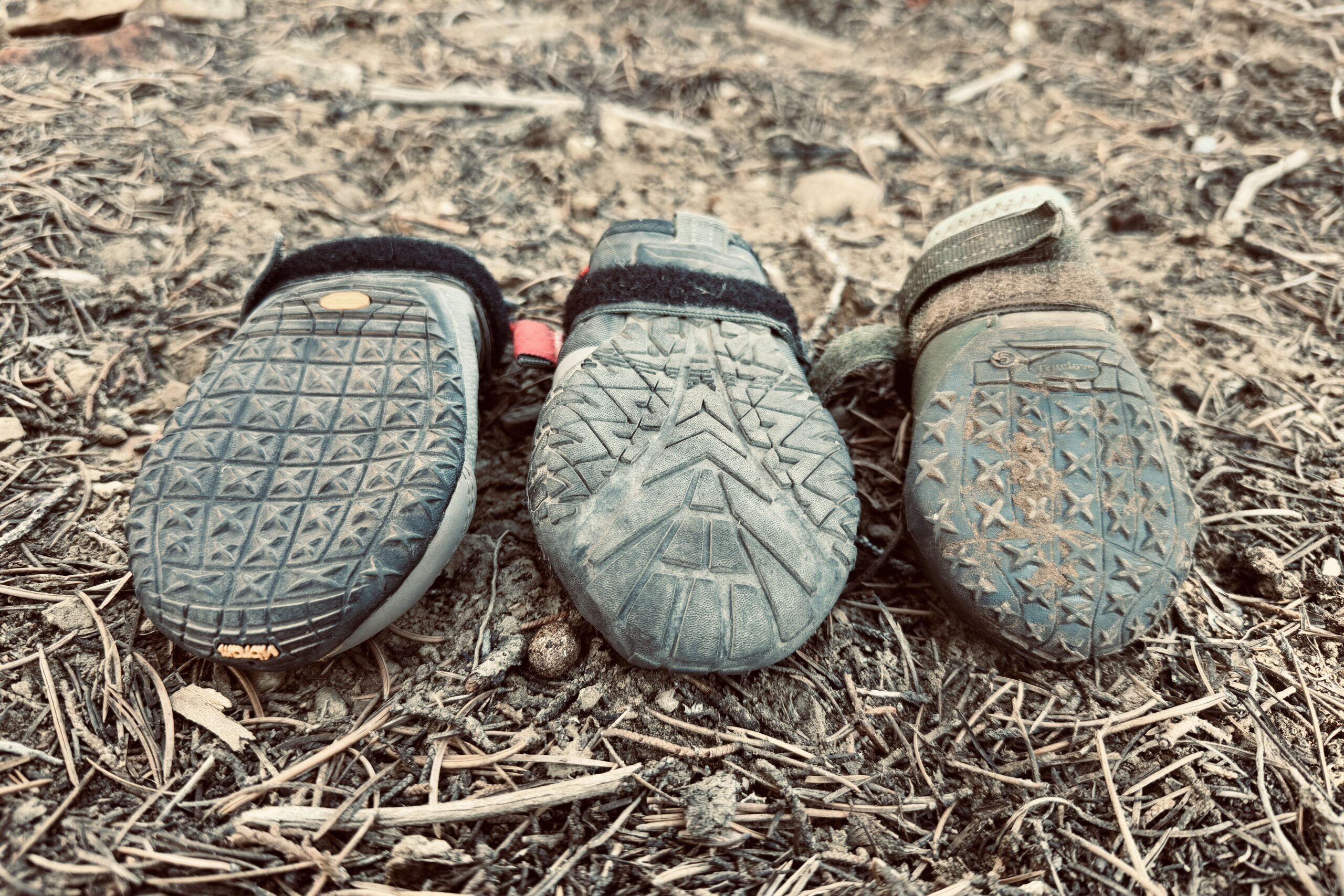
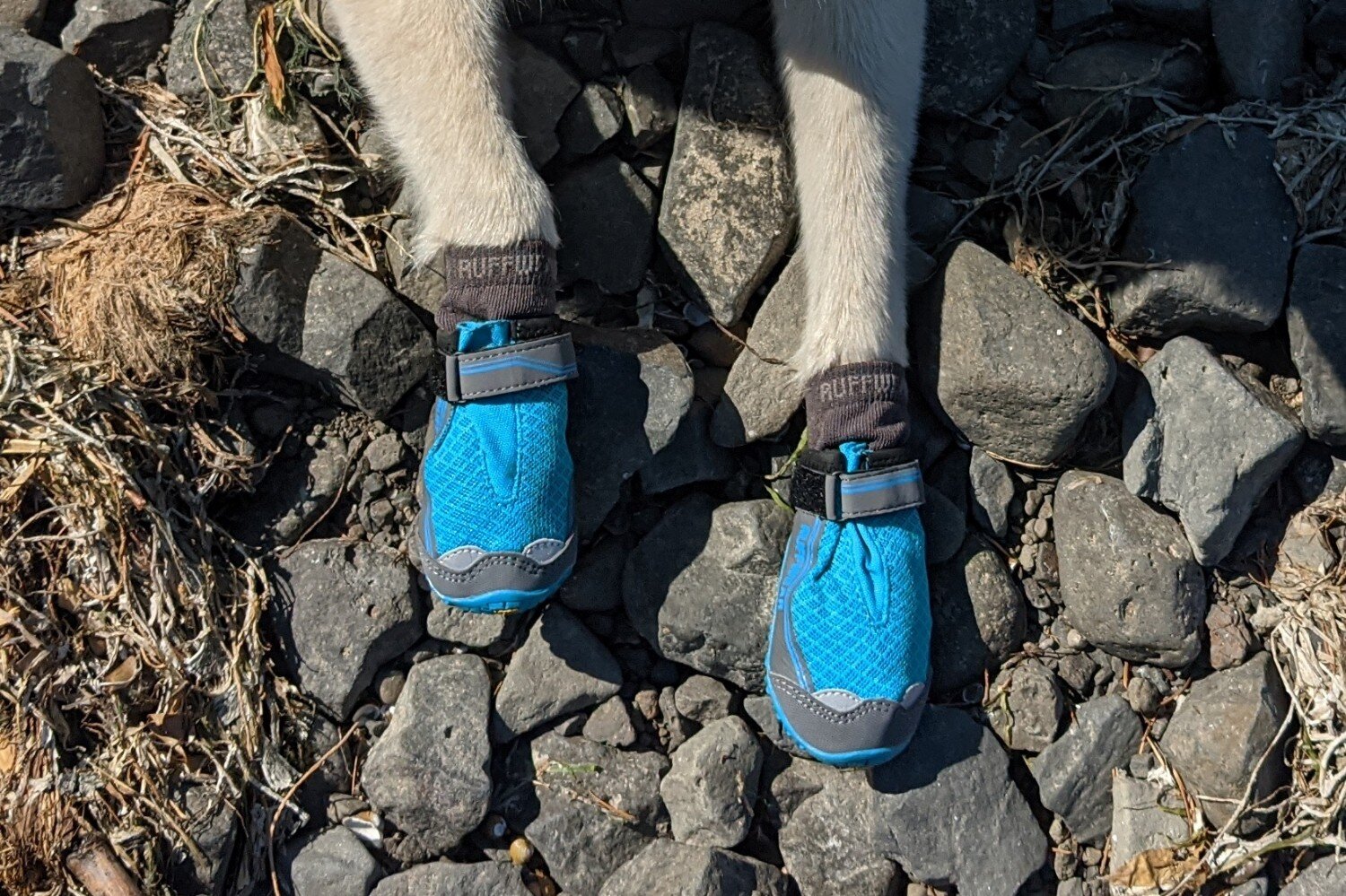
Rubber-soled boots have a rubber sole that is shaped to cover the bottom of the dog’s foot, with a fabric or mesh upper. These types of boots are typically more expensive and harder to fit properly, but they offer greater durability and better protection from the ground.
Mushing-style dog boots have a simple design and typically feature two pieces of fabric sewn together like a dog sock, with a basic Velcro closure at the top. There are other sock-style dog boots that might be a bit more complex, with different fabrics for better durability or warmth. Most mushing-style boots are inexpensive and lightweight but wear out quickly.
The majority of dog boots fall into rubber-soled or sock-style categories. But there are a handful of hybrids and other innovative designs. Some boots mesh the two other styles, with a thicker sole paired with a slip-on design. There are a handful of other boots that take a completely different design approach to address a perceived problem with more traditional dog boots.
Do I need socks and liners?
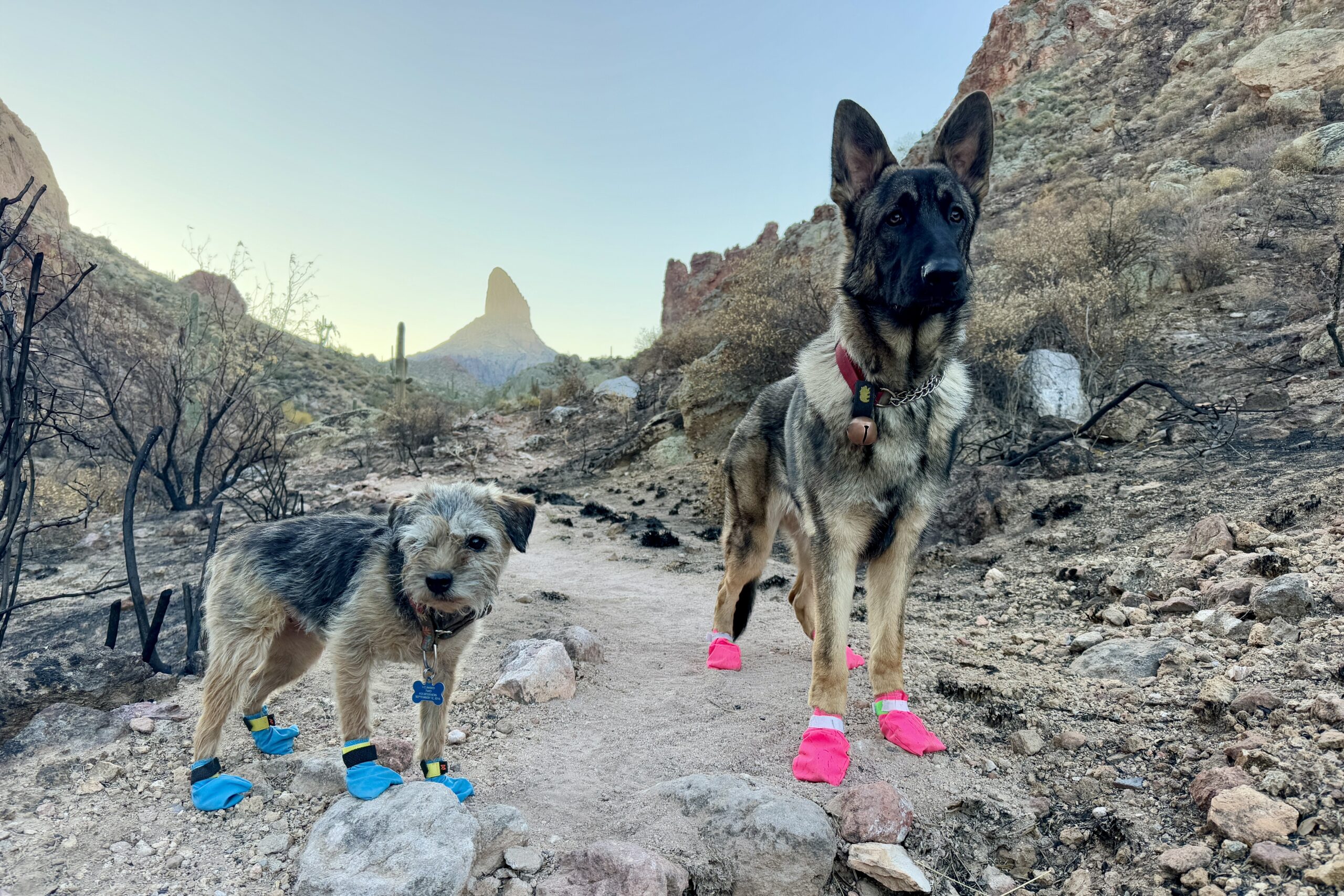
Some rubber-soled boots may be paired with dog socks or boot liners. These liners help with fit by making the boots snugger, providing a barrier between the boot fabric and the dog’s foot, and absorbing sweat. This reduces the chances of chafing or sores forming.
Do dog boots have water resistance?
There are some dog boot models that are water-resistant. Usually, these are rubber-soled boots with water-resistant fabric. These may be more helpful in winter, but we generally don’t recommend searching for them. When crossing streams or hiking in wet conditions, the boots will still get wet quickly. These conditions can lead to rubbing. We generally avoid having a dog wear boots after they become wet.
Critical Dog Boot Considerations
Does your dog need boots?
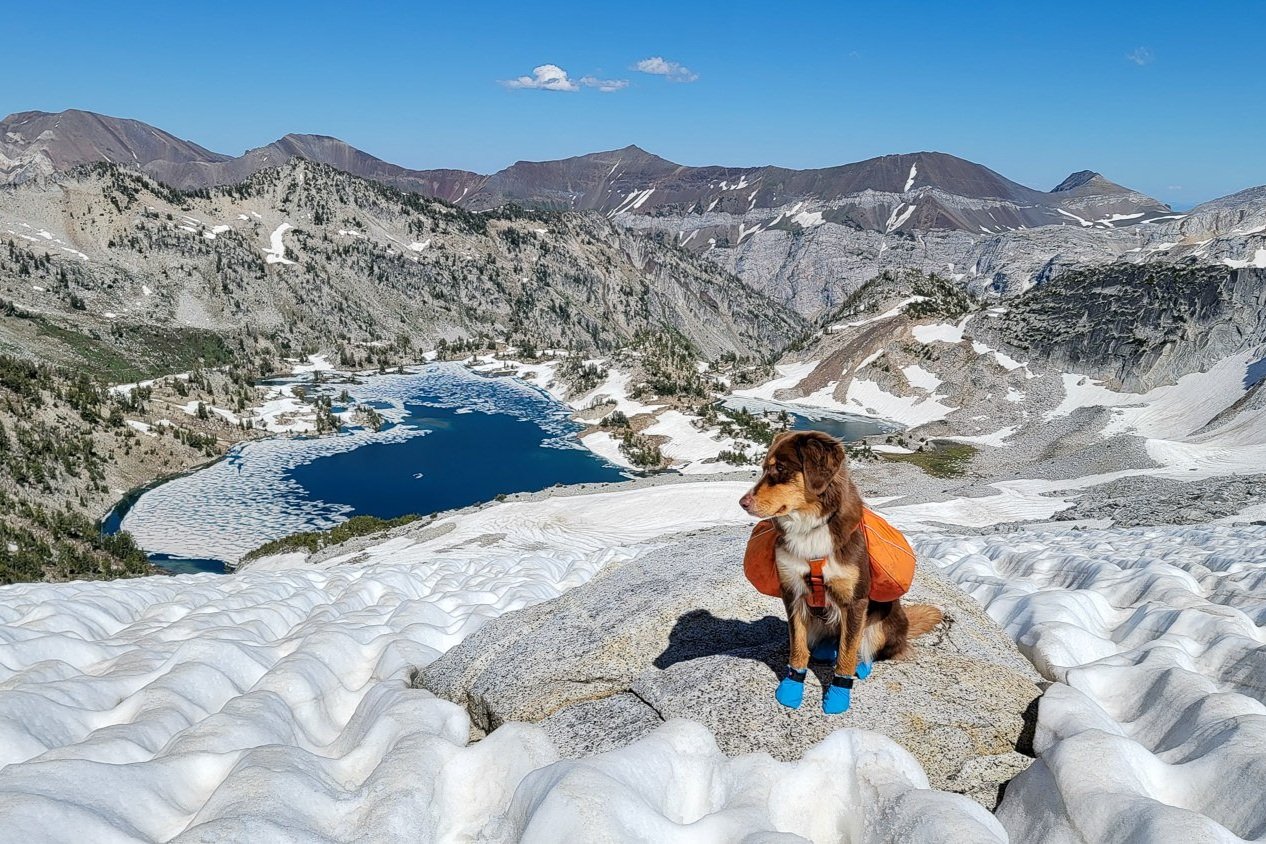
Because of the difficulty in finding the best fit, hiking barefoot is ideal in the right conditions. However, sometimes boots are necessary even for dogs with the toughest feet. Dogs that live in climates with extreme heat, especially service dogs, may need to wear boots when going outside, even for short potty breaks. Likewise, boots might be necessary in extreme cold. Small dogs especially have a hard time keeping their feet warm even when moving.
In our experience, granite, sandstone, lava rocks, and extended road walks are all extremely tough on dog feet when backpacking. This is especially true in arid environments such as those in the Intermountain West of the United States, where feet dry out. Using a paw wax can help, but some dogs will need boots if the conditions are rugged enough. We recommend carrying boots on every backpacking trip, just in case, as they can protect a wound in an emergency.
What should I know about heat safety?
The only part of the body where dogs sweat is through their feet. On hot days, wearing boots can potentially limit a dog’s ability to stay cool. It is possible to safely wear boots for extended periods in warm weather, but it requires that the dog in question has built up their tolerance to exercising in the heat and to wearing boots beforehand.
Should dogs always wear boots in the snow?
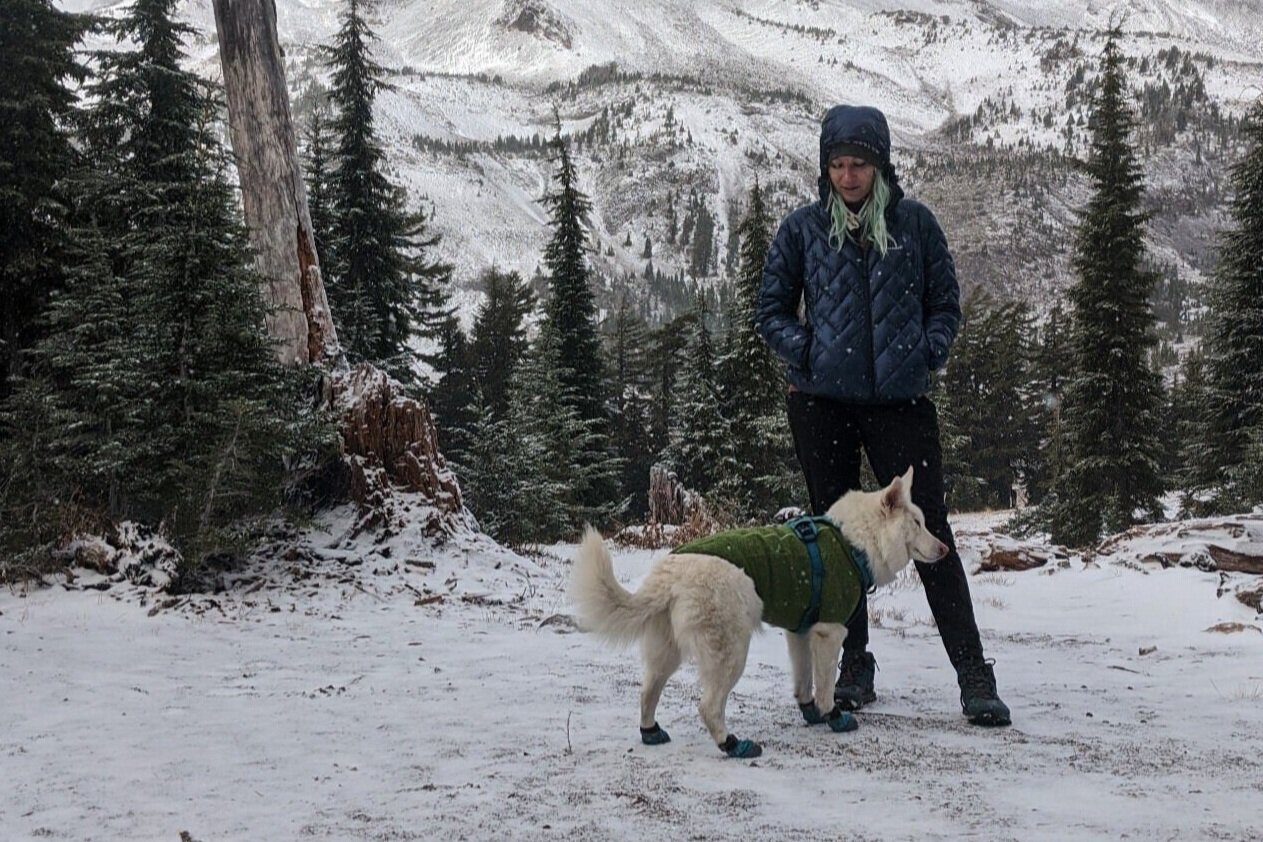
Certain boots are better suited for snow than others because snow can often get into the boot and cause foot problems. Mushing boots are recommended for use in powder because they typically have Velcro closures that tighten much more than the straps on rubber-soled boots. This better prevents snow from sliding into the boot and forming snowballs. Some owners also use vet wrap around the top of the boot opening to prevent snow from building up there.
How can I condition my dog to wear boots?
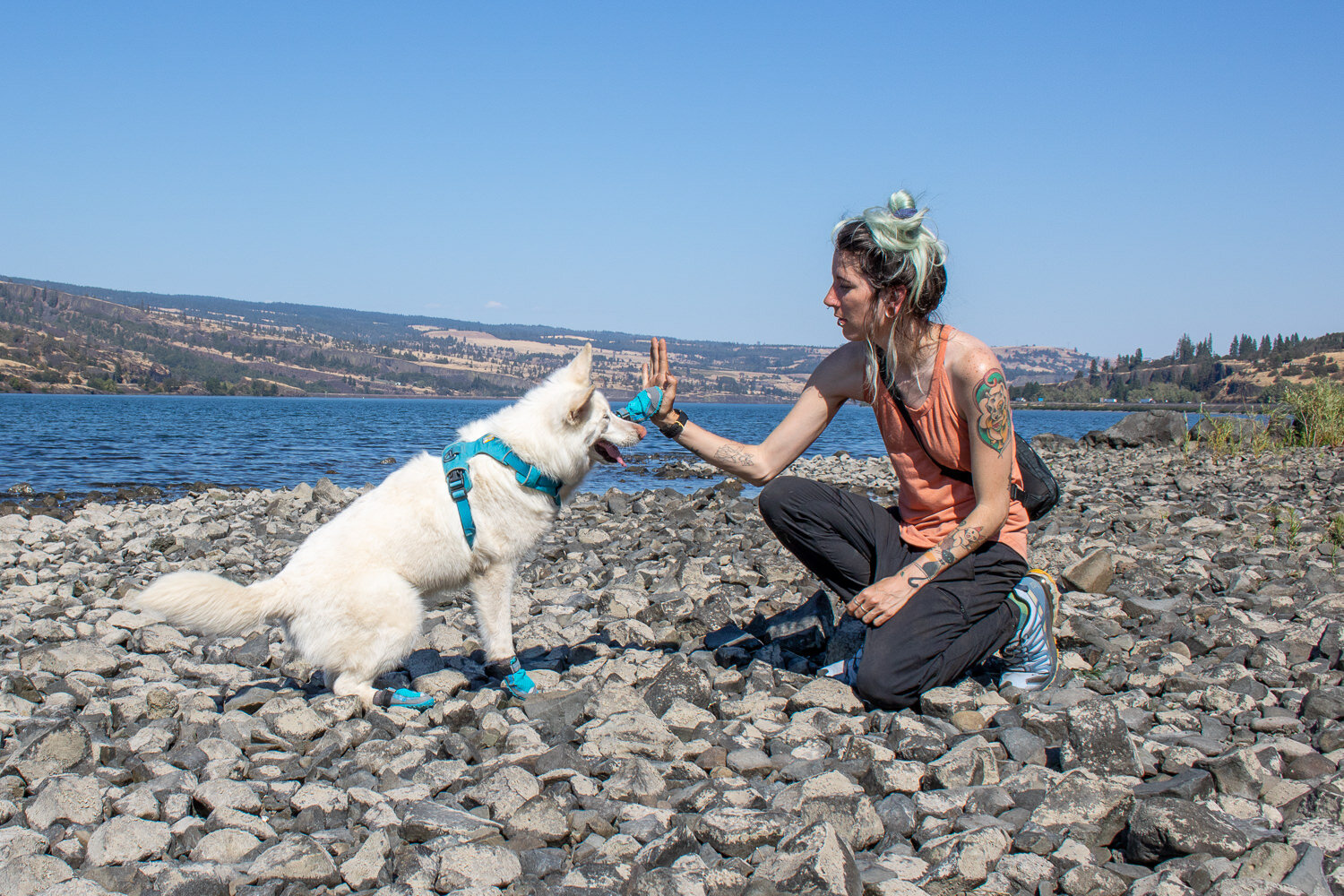
There are several different methods that you can use to condition a dog to wear boots. Making sure they are comfortable with their feet being touched, or at least tolerate it, helps immensely. For dogs not accustomed to having their feet handled, teaching them to “shake” or using treats makes it a positive experience. You can also introduce the boots by using treats so that the dog has a positive association with them.
We generally put the boots on for the first time right before hiking with the dog. Once the boots are on, we start walking immediately. Some dogs may react to the odd feel of the boots. But in general, the dog will be more interested in hiking and less focused on them. This also helps build a positive association with the boots, so the dog connects them with hiking. It is best to start by using them for short periods to reduce the risk of chafing. The duration the dog wears them can be gradually increased to the desired time.
What if my dog has dew claws?
Many dogs with dew claws develop sores caused by rubbing. There are strategies that can reduce this occurrence, but their effectiveness will depend on the individual dog and the amount of time the boots are used. Slowly increasing the amount of time a dog wears the boots is one effective method. Likewise, pairing rubber-soled boots with a boot liner may also help.
Some owners wrap the lower leg with vet wrap to keep the dew claw from moving. Other owners opt for lighter boots, such as dog mushing boots, because they put less pressure on the dew claw. There are even some boots made specifically for dogs with dew claws. Unfortunately, for some dogs, there is no solution to this problem, and careful management is the best course of action.
What is the best way to take care of my dog’s nails?
When using dog boots, it is extremely important to keep the nails as short as possible. Long nails can affect the fit of the boot, causing rubbing or other problems in both the short and long term.
What are some tips for hiking with a dog?
Taking your dog on a hike is a great way to get them some exercise and bonding time. Make sure the experience is safe and fun for both of you by reviewing our Tips for Hiking with a Dog post.
Why Trust CleverHiker
Gear analyst Bailey Bremner has thru-hiked over 7,500 miles with her two dogs on some of the most rugged trails in the U.S. Together, they have successfully completed the Continental Divide Trail, Colorado Trail, Pinhoti Trail, and multiple original routes such as the San Luis Loop, Columbine Route, and a Canada-to-Mexico route through Idaho, Nevada, and Arizona. Now passed away, her dog Prima used boots extensively on all these trips, prompting extensive research and testing. Bailey backpacks monthly with her two current dogs and has been featured in several magazines and on podcasts about backpacking with dogs.
Testing Methodology
We rigorously tested each set of boots using a variety of metrics to determine which was the best. Our process looked at fit, durability, traction, breathability, protection, and ease of use. In addition to years of experience with some of these models, we spent several weeks using these boots in harsh conditions and evaluating how the tester dogs responded to them.
How do we assess fit?
There are multiple different shapes and sizes of dog feet, which make it difficult to measure the best fit. However, it is also an incredibly important metric to evaluate since a poor fit can result in sores, discomfort, or boots that will not stay on. As such, we compared fit by examining the boots’ style and the number of adjustment points. The looser, lighter style of mushing boots means that they inherently fit more foot types and generally cause less rubbing. Mushing boots automatically earned five points each.
Boots could also earn points for the number of adjustment straps, the range of sizes they accommodate (small, medium, large, extra-large), whether socks are made specifically for them, and whether they accommodate dew claws. The boots with the most points were ranked the best.
What do we look at for durability?
We measured durability by tracking the number of miles logged on each pair of boots over the course of testing and comparing it with visual signs of wear and tear. The boots were ranked by how many miles they lasted before wearing out.
How do we assess traction?
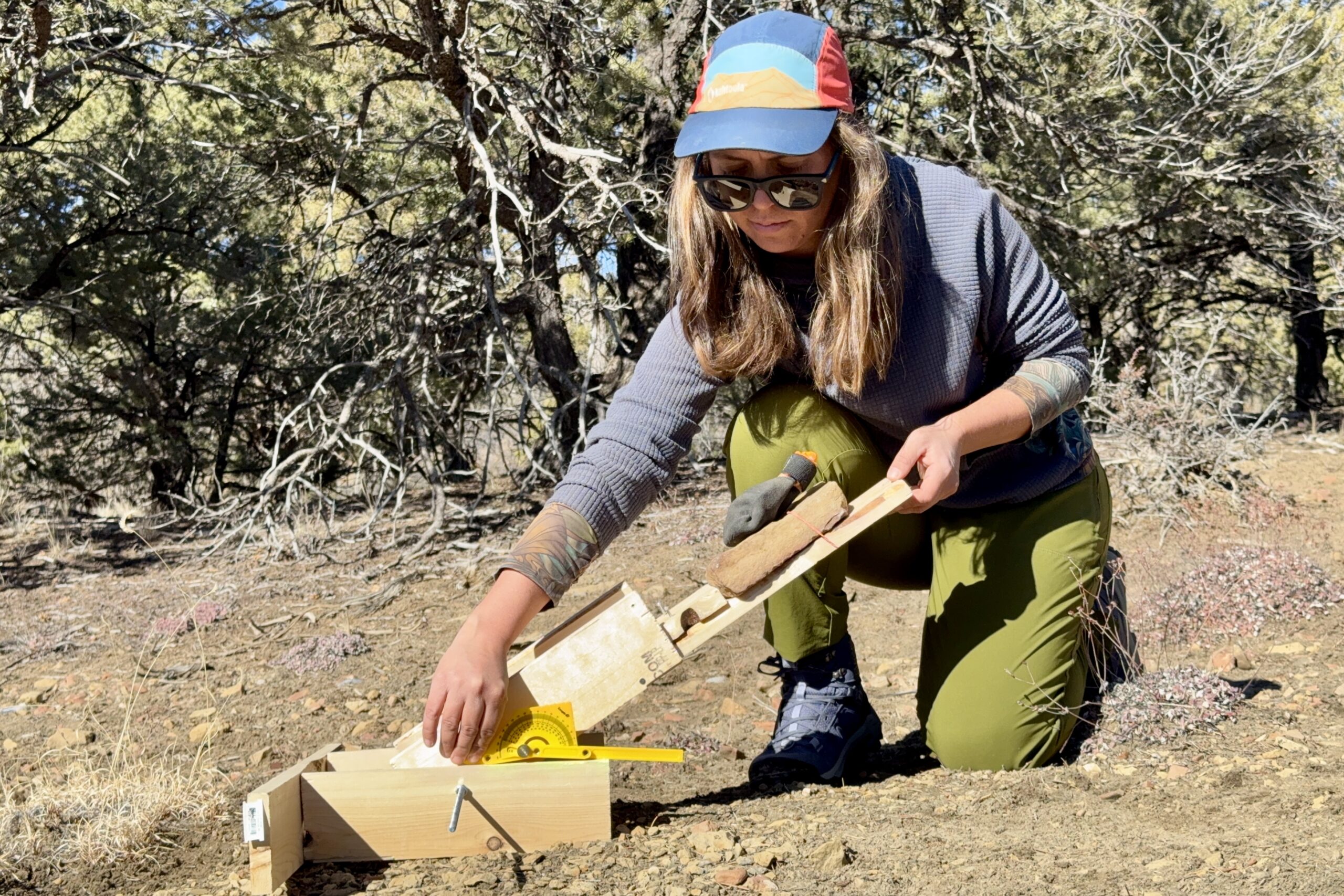
To test traction, we used a specialized traction device to measure the angle at which each boot loses contact with a rock. The device has a lever arm that attaches to the end of a rock. We filled the boots with the same number of coins to weigh them down, then placed them on the rock. We raised the lever arm until each boot slipped, then recorded the angle. The highest angle measure indicates the best traction in this test.
How to we test breathability?
To test breathability, we dunked each boot in water, then hung them to dry. We checked the boots periodically to see how long it would take them to dry. The times were recorded, and the boots with the fastest times were ranked highest.
How do we assess protection?
In this test, we scraped and poked the bottom of each boot with a set of keys, a razor, a knife, and a sewing needle. The boots received a point for each object that they successfully deflected. If the boot showed wear but not immediate signs of compromise, then we deducted half a point. The boots with the most points scored the highest.

How do we test ease of use?
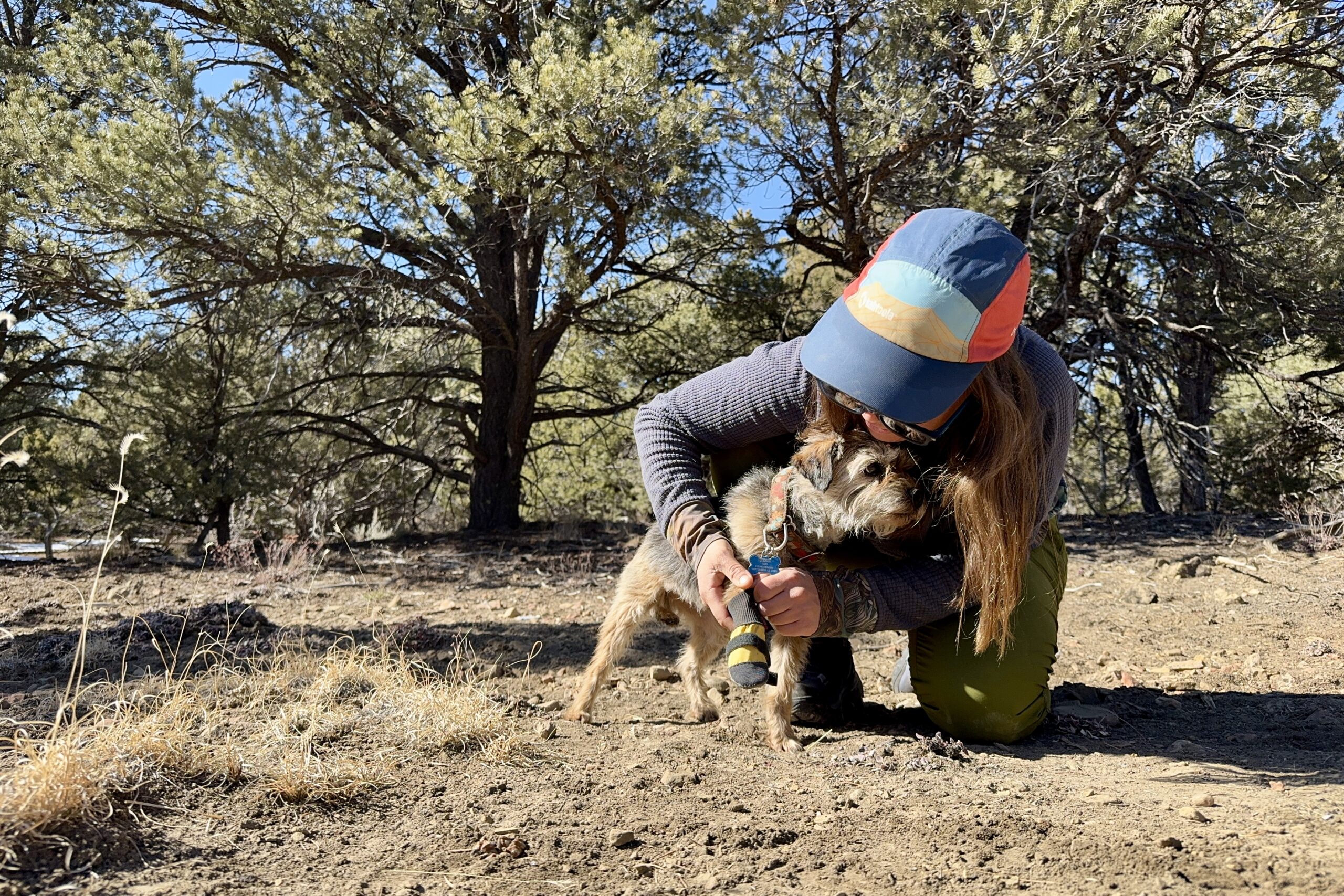
To measure how difficult it is for each dog to put on a boot, we used time trials. One person placed a boot on the tester dog’s front left paw while a second person started and stopped the timer. The shorter the time, the higher the score in this test.
Conclusion
There are few things as special as spending time with your pup, especially outdoors. We have tried our hardest to create the resource that we wish had been available to us when we first started backpacking with dogs. Hopefully, this guide will help cut out all the trial and error so that you can get after it with your dog.