
Bottom Line
The Osprey Aether 65 / women’s Ariel 65 is built for backpackers who genuinely need heavy-load support and durability. We loaded it to 60 pounds and the frame remained controlled, while burly 210D and 420D nylon and limited exposed mesh give it the strongest durability profile in our lineup of backpacking backpacks. Its vertical bottle openings and on-body torso adjustment also work well for such a substantial pack.
The tradeoff is that all of that structure weighs more than five pounds, and our heavy-load testing found the Gregory Baltoro more comfortable at similar weights. The Aether is a specialist for guides, gear-intensive trips, and abrasive use where toughness matters more than minimizing the pack’s own weight.
How We Tested
Rather than judging the Aether at an easy weekend load, Taylor Passofaro took it to roughly 60 pounds on Minnesota winter trails. That demanding setup let us evaluate frame control and pressure alongside the on-body torso adjustment, bottle access, attachment systems, and the core question behind this five-pound pack: whether its burly fabrics and structure earn their weight.
Quick Specs
- Best for: backpackers who need a very durable pack for heavy, gear-intensive loads
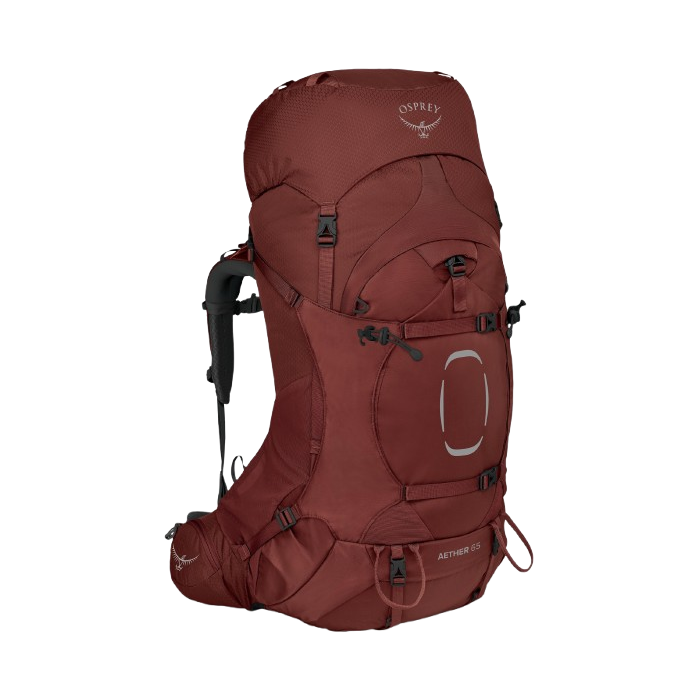
Osprey Aether 65 / Ariel 65
Most Durable Backpacking Pack
CleverHiker Rating: 4.3/5.0
Price: $370
Measured Weight: 5 lb. 1.5 oz.
Volume: 65 L
Max Weight Rec.: 60 lb.
Pros
- Extremely durable
- Great feature set
- Good load-hauling capability
- Good water bottle access
Cons
- Comfort isn't as good as the competition
- Heavy
- Overkill for most backpackers

Comfort
Sixty pounds tells the Aether’s comfort story better than a soft showroom fitting. At that load the suspension stayed controlled without major pressure failures, but it felt less forgiving than the Gregory Baltoro and becomes excessive when loads are modest. We score it 4.2 because its comfort comes from heavy-load control, not plushness. That distinction matters on long carries.
We deliberately tested the Aether at its 60-pound ceiling rather than judging it only with a typical 30-pound weekend load. That test reinforced the pack’s purpose: the frame and suspension remain controlled when most backpacking packs would already be out of their comfort zone. We did not encounter obvious hot spots, and the shoulder straps and back panel handled the load without a structural failure in comfort. What kept the score from rising is comparison with the Gregory Baltoro, which felt more forgiving under similarly heavy weights.
The Aether also feels overbuilt when the load drops. Its foam-and-nylon suspension does not have the same contouring or airy feel as Osprey’s Atmos line, so the pack’s weight and stiffness are always noticeable. The adjustable torso helps dial fit, but this remains a heavy-hauling comfort system first and a general-purpose suspension second.
Comfort Score: 4.2 / 5.0

Features
Gear-heavy trips are exactly what the Aether’s feature set is designed around. On-body torso adjustment, extensive rear webbing, compression, attachment points, practical hipbelt storage, and vertical bottle openings help control bulky loads and support its 4.8 score. None of that feels ornamental, but much of it is unnecessary for compact three-season kits. The systems earn their keep only with demanding loads.
The rear webbing system is much more substantial than the accessory lashing found on ordinary backpacking packs and is clearly intended for large or heavy external items. Osprey also includes dual ice-axe loops with robust retainers, useful hipbelt pockets that can be operated one-handed, and attachment points that can accept a small companion daypack for summit or town use. The front pocket uses solid face fabric with mesh only where it is protected, which is another example of the pack favoring durability over minimum weight.
Vertical bottle openings are practical while walking and help offset the pack’s bulk. These systems make sense for long carries, guides, or technical trips where exterior load control matters. They make much less sense for a compact three-season kit, where the same webbing, hardware, and attachment architecture becomes extra weight without a corresponding benefit.
Features Score: 4.8 / 5.0

Durability
The Aether is the pack we trust most when abrasion and hard use matter more than empty weight. Burly 210D and 420D nylon, reinforced attachment points, a substantial frame, and limited exposed mesh give it a 4.9 for durability. This construction is intentionally heavy, so buyers are trading pounds on the scale for a chassis designed for rougher service.
The Aether is the most durable pack in this field because Osprey uses 210D nylon even in the lighter areas and 420D fabric through the more heavily stressed sections. The frame, webbing anchors, stitching, and attachment hardware all feel designed around repeated heavy loads rather than occasional weekend use. During our testing, nothing about the pack suggested that we were close to its structural limits, even though we deliberately pushed the load to 60 pounds. We also like that Osprey keeps the exposed stretch mesh relatively limited and protects it behind more substantial fabric where possible.
That matters because mesh is usually the first place we worry about abrasion or snagging on a traditional pack. The durability tradeoff is simple: the Aether carries all of that material with it on every trip. Hikers are buying a large safety margin against wear, not a particularly efficient weight-to-capacity ratio.
Durability Score: 4.9 / 5.0

Ease of Use
Despite its size, several Aether details make day-to-day use better than expected. Vertical bottle openings work while walking, hipbelt pockets operate one-handed, and torso length can be adjusted without fully removing the pack, supporting a 4.4 ease-of-use score. The unavoidable drawback is bulk: every lift, shuttle, and on-off transition involves much more frame and fabric than most backpackers need.
The Aether’s adjustment range is broad, and the ability to change torso length while the pack is on makes it easier to fine-tune a heavy load without completely starting over. Hipbelt pockets operate smoothly with one hand, and the vertical bottle openings work with both narrow bottles and larger Nalgenes. The clips, compression systems, and lashing points also feel substantial and deliberate rather than fragile. Where usability suffers is scale.
A five-pound-plus frame with a 65-liter body takes more effort to lift, shoulder, maneuver, and store, and the number of straps and attachment options can feel excessive on a simple overnight. The pack is therefore easy to use relative to other expedition-style backpacking packs, not relative to a lightweight weekend model. For the right trip, its controls are predictable and effective; for an ordinary 25-pound load, the entire system is more hardware than most hikers need.
Ease of Use Score: 4.4 / 5.0

Should You Buy the Osprey Aether / Ariel 65?
Choose the Aether when heavy, bulky, or abrasive loads are a normal part of your trips and you would rather carry a heavier pack than compromise frame support or fabric toughness. Its 60-pound-class suspension, robust materials, and extensive attachment options are meaningful advantages in that use case. Most backpackers do not need that much structure, and our testing favored the Gregory Baltoro for comfort at extreme loads. If your normal load is closer to 30 pounds, the Gregory Paragon is lighter and more comfortable for the job.

What Other Backpacking Backpacks Should You Consider?
Gregory Baltoro 75 Review: The Baltoro is our preferred heavy-load option when comfort at extreme weights matters more than maximum fabric durability. In our heavy-load testing it felt more forgiving than the Aether, while still providing the capacity and access needed for expedition-style carries.
Osprey Atmos AG 65 Review: The Atmos is a better fit if ventilation and organization matter more than a 60-pound-class load rating. It keeps Osprey’s highly adjustable feel but trades some of the Aether’s burly heavy-hauling emphasis for a more breathable suspended-mesh carry.
Gregory Paragon 60 Review: For normal multi-day loads, the Paragon is lighter, more comfortable, and much easier to justify than the Aether’s expedition-scale structure. It gives up the Aether’s extreme durability and carrying ceiling, but most backpackers will find its weight and suspension easier to live with.