
Bottom Line
The Osprey Atmos AG 65 / women’s Aura AG 65 remains one of the most feature-rich and ventilated traditional backpacks we have tested. Its suspended mesh back panel and hipbelt create exceptional airflow, the harness offers broad fit adjustment, and the pack provides abundant storage and access. That package works especially well for hikers who run hot and genuinely use dedicated organization.
The downside is that the same suspension, pockets, zippers, and hardware make the Atmos heavy and more complicated to put on, take off, and manage than simpler packs. Feature-focused traditional backpackers are the Atmos’s clearest audience. Anyone who will not use that much organization can shed substantial weight with the Exos or get a simpler comfort-first carry from the Paragon.
How We Tested
Local Minnesota trail testing gave Taylor Passofaro repeated chances to adjust, load, remove, and repack the Atmos AG 65 rather than judging its huge feature list on paper. We concentrated on the suspended-mesh suspension, torso fit, bottle and pocket access, ventilation, organization, and whether all of that hardware actually improves trail use or simply adds complexity.
Quick Specs
- Best for: traditional backpackers who want maximum ventilation and extensive organization
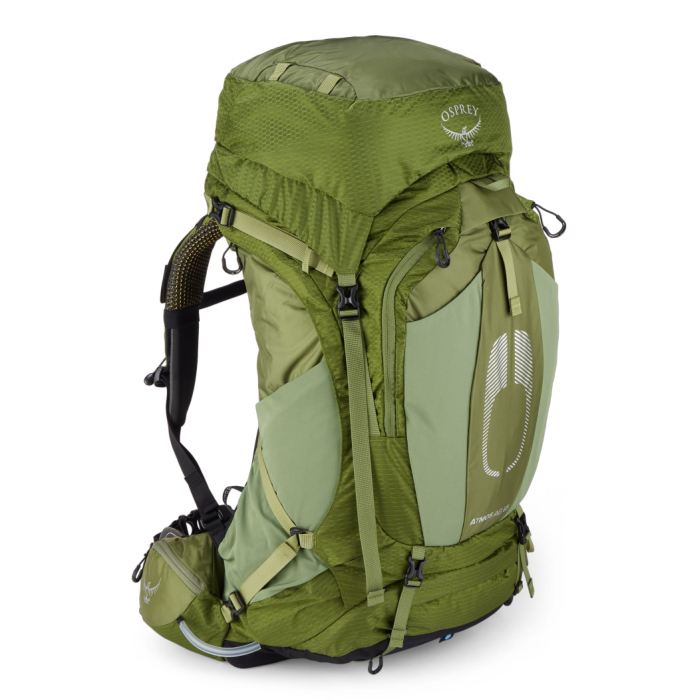
Osprey Atmos 65 / Aura AG 65
Backpacking Pack with the Best Features
CleverHiker Rating: 4.4/5.0
Price: $370
Measured Weight: 4 lb. 9.5 oz.
Volume: 65 L
Max Weight Rec.: 40 lb.
Pros
- Can comfortably hold heavier loads
- Breathable and well-padded frame
- Above-average durability
- Sturdy frame transfers weight to hips well
- Very comfortable suspension
- Plenty of room for extra/bulky gear
- Lots of organization
- Very easy to access water bottles
Cons
- Pricey for backpackers who do not need the full feature set
- Heavy

Comfort
The Atmos prioritizes a cool, highly adjustable carry rather than a close-to-body feel. Its suspended mesh and wraparound hipbelt create excellent airflow and support, which is why comfort lands at 4.6, but the rigid structure also keeps cargo farther from the body and can feel cumbersome. Hikers who run hot are the ones most likely to appreciate that trade.
We tested the Atmos with about 30 pounds, which is a useful point for comparing it with the lighter packs in this field. The suspension transferred that weight very effectively to the hips, and the continuous mesh panel kept the back from sitting directly against the pack body. The same suspended structure extends into the hipbelt, so airflow is one of the strongest arguments for the design. The compromise is stiffness.
The hipbelt and frame hold their shape so aggressively that the pack can feel like a harness system rather than a soft bag, and getting in or out requires lining the hips up with the belt before tightening. Some hikers will interpret that as secure support; others will find it cumbersome. We also note that the 40-pound recommended ceiling is not dramatically higher than much lighter packs, so the Atmos is best understood as a comfort-and-ventilation specialist rather than a true heavy-load hauler.
Comfort Score: 4.6 / 5.0

Features
No pack in this field leans harder into organization than the Atmos. Multiple access points, excellent bottle access, generous exterior storage, deep pockets, and broad fit adjustment give traditional backpackers a huge amount of control, earning a 4.9 feature score. The downside is inseparable from the strength: every added zipper, strap, and compartment brings weight and complexity.
Fit adjustment is unusually deep. The torso can be changed while the pack is being worn, and both the hipbelt and shoulder straps include extension pieces that allow a wide range of body shapes to be accommodated. Those adjustments are especially useful over a long trip if a hiker’s body composition changes. Osprey’s bottle pockets are another highlight: the vertical opening and pull loop make both narrow bottles and one-liter Nalgenes easy to access without removing the pack.
The shoulder-strap trekking-pole system also lets hikers stash poles quickly while keeping both hands free. Side access zippers, internal access, dual ice-axe carry, and extensive pockets round out the system. The limitation is not poor execution but excess. Many hikers will set the fit once and rarely touch several of these systems again, so the Atmos only earns its extra weight when the owner actually values this level of organization and adjustability.
Features Score: 4.9 / 5.0

Durability
The Atmos mixes robust body fabrics and a substantial frame with a suspension built heavily around mesh. Because that mesh is engineered into the load-bearing system rather than used as a flimsy accessory pocket, we have more confidence in it, supporting a 4.7 durability score. We would still keep sharp branches and abrasive rock away from the exposed suspension whenever possible.
The Atmos uses a robust frame and substantial body fabrics, and the pack feels engineered for years of traditional backpacking use rather than for chasing a low empty weight. The major question is the amount of mesh in the suspension and storage system. In this case, we separate load-bearing suspension mesh from thin accessory mesh because the former is integrated into a reinforced frame and is not simply a delicate pocket hanging off the pack. Osprey also moved some areas that were previously full mesh to partial solid fabric, which improves abrasion resistance.
We would still avoid dragging the pack against sharp rock or branches because any exposed mesh can be damaged. Overall, the construction feels more confidence-inspiring than the lightweight framed packs in the category, while falling short of the intentionally overbuilt Aether. The durability score reflects a strong traditional chassis whose ventilation system requires a little more care than solid woven fabric.
Durability Score: 4.7 / 5.0

Ease of Use
Each Atmos feature works well on its own; the challenge is that there are so many of them. Excellent bottle access, precise fit tuning, and abundant organization keep small gear under control, but the suspended frame and extensive hardware make handling less effortless than on simpler packs. That push-pull explains the 4.4 ease-of-use score. Minimalist hikers will notice that complexity most.
The Atmos is not difficult because any single control works badly; it is difficult because there are so many controls. Once we understood the adjustment systems, the buckles, zippers, bottle pockets, and access points all worked smoothly. Bottle access is particularly strong, and the quick trekking-pole attachment is useful enough that we mimic the idea on other packs. Side access also reduces the need to unpack the top of a fully loaded 65-liter bag.
The burden comes from managing the full system: adjustable torso, hipbelt extensions, shoulder-strap extensions, multiple access zippers, compression straps, attachment points, and a rigid suspension that is less effortless to put on and remove. For a hiker who enjoys organization, that complexity becomes useful control. For a minimalist, it becomes repeated interaction with systems that are not solving a real problem.
Ease of Use Score: 4.4 / 5.0

Should You Buy the Osprey Atmos AG 65 / Aura AG 65?
Buy the Atmos if ventilation and organization are among your highest priorities and you are willing to carry extra pack weight to get them. Its suspended mesh has no close equivalent among the traditional packs in this field, and the adjustment range helps dial fit across a wide variety of bodies. Skip it if you prefer a minimalist packing routine or resent carrying hardware you rarely use. The Exos keeps much of Osprey’s ventilated feel at a lower weight, while the Paragon offers a simpler traditional carry.

What Other Backpacking Backpacks Should You Consider?
Gregory Paragon 60 Review: Less weight and less hardware make the Paragon the cleaner all-around choice for hikers who still want excellent traditional comfort. It gives up some of the Atmos’s suspended-mesh ventilation and organization, but its simpler layout and closer carry work better for backpackers who do not need every feature.
Osprey Exos 58 Review: The Exos preserves Osprey’s airy suspended-mesh feel while removing a substantial amount of pack weight. It is less feature-rich than the Atmos, but that simpler design is a better match for lighter kits and backpackers who prioritize efficiency.
Osprey Aether 65 Review: The Aether makes more sense when heavy-load support and maximum durability matter more than ventilation. Both are feature-rich traditional packs, but the Aether’s burlier materials and 60-pound carrying ceiling suit gear-intensive trips better than the Atmos.