
Bottom Line
The Katadyn Hiker Pro is a strong traditional pump option when you need to draw water from places too shallow to fill a bottle. Its replaceable filter and activated-carbon core add useful versatility. We could collect from water only about one-eighth of an inch deep, but the heavier assembly and repeated pumping are less appealing than the convenience of squeeze filters at ordinary streams.
We have used this pump family for thousands of miles, and its ability to draw from pools scarcely deep enough to submerge the inlet remains its strongest advantage. The carbon core also improves water taste, while a replaceable cartridge keeps the housing useful. However, a 12.8-ounce system and repeated pumping are substantial concessions for a solo hiker with easy-to-fill water sources.
For alternative pumps and lighter backpacking setups, read the best backpacking water filters guide.
How We Tested
We have relied on this pump family for thousands of miles, including an Appalachian Trail thru-hike. We also used silty sources and a deliberately muddy mixture to assess cleaning and flow recovery.
Quick Specs
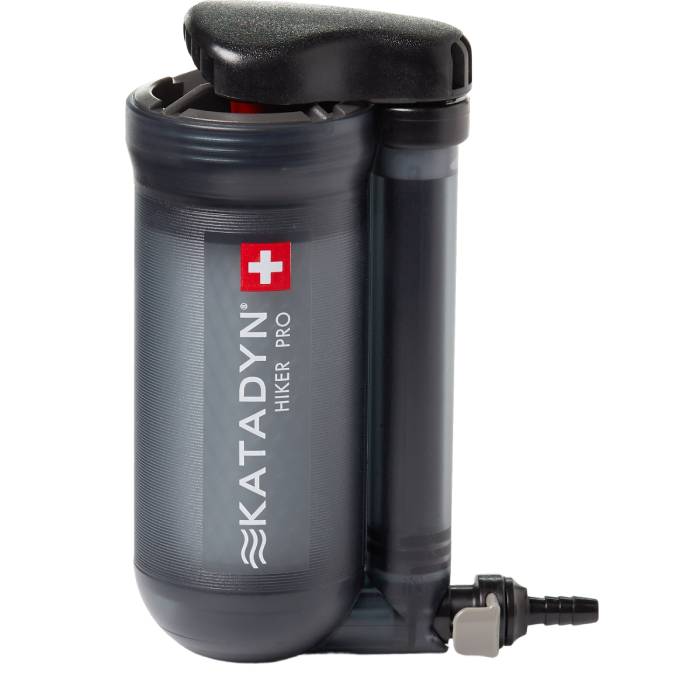
Katadyn Hiker Pro
Best Pump Water Filter
CleverHiker Rating: 4.4/5.0
Price: $100
Weight: 12.8 oz.
Flow Rate: 1.3 L/min
Filter Pore Size: 0.2 microns
Lifetime Volume: 1,150 L
Pros
- Reaches shallow pools
- Replaceable cartridge
- Carbon element
- Good for groups
Cons
- Heavy and bulky
- More setup
- Pumping effort
- Doesn't remove viruses

Water Quality
A prefilter removes coarse material, the 0.2-micron filter addresses bacteria and protozoa, and a carbon stage improves taste and reduces certain chemicals. The cartridge is not rated for viruses. We found the finished water especially pleasant tasting compared with basic microfilters.
We appreciate the combination of a coarse intake prefilter, a microfilter, and an activated-carbon core. It makes water less cloudy and can improve objectionable tastes that ordinary hollow-fiber membranes don’t address. The carbon stage is not a guarantee against every chemical pollutant, and the system does not remove viruses.
Water Quality Score: 4.6/5.0

Ease of Use
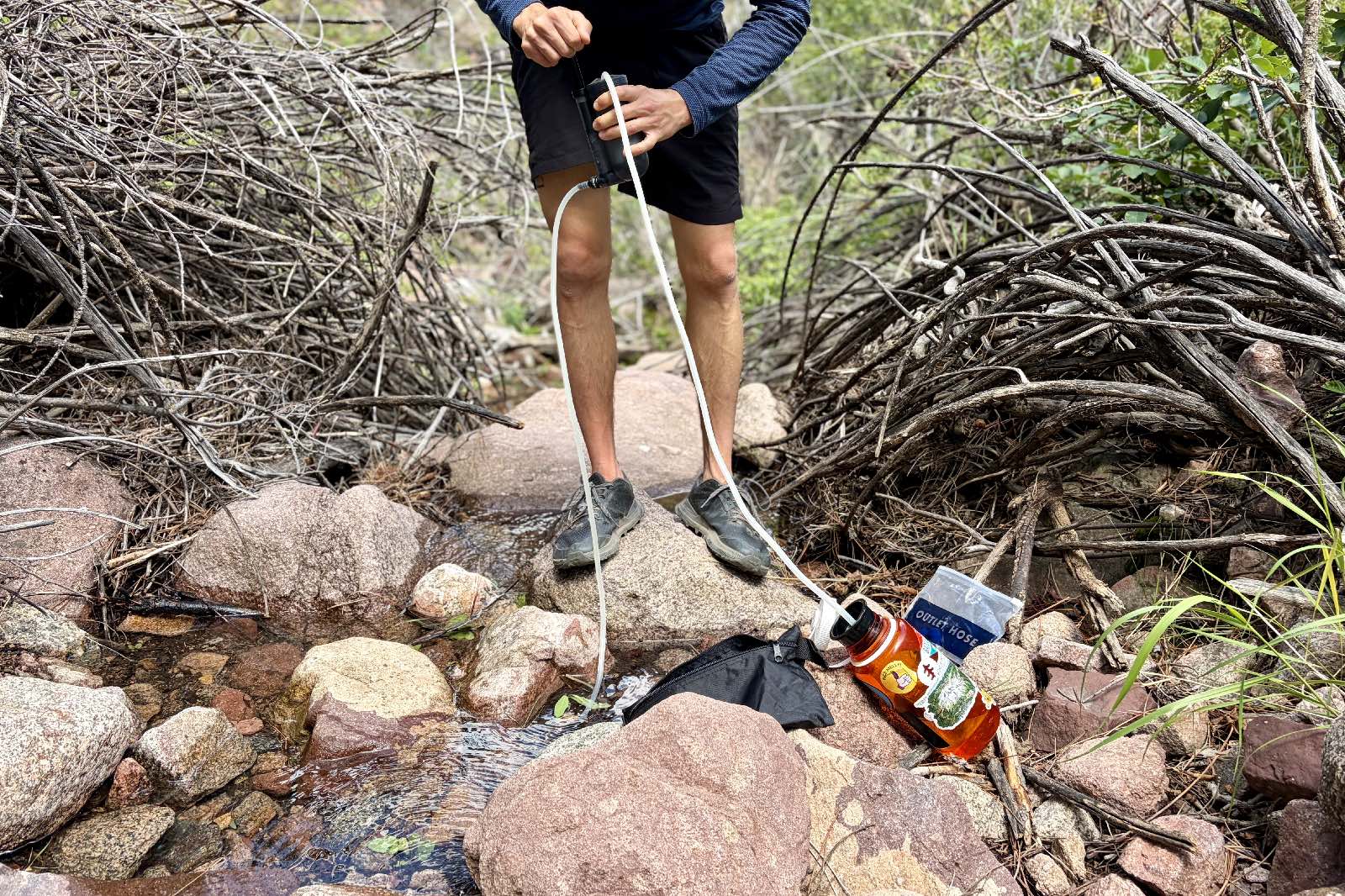
The Hiker Pro’s greatest usability advantage is drawing water without first getting it into a bottle or squeeze bag. We tested its intake in pools as shallow as roughly one-eighth of an inch. That can make a real difference on dry routes where water collects in narrow pockets between rocks.
Setup takes about a minute: connect the tubing, place the prefilter in the source, and direct the outlet to a clean container. A wide-mouth Nalgene makes a stable pairing. We have occasionally had the inlet hose detach while pumping, and repeated strokes are tiring when filling several bottles. Squeeze systems are simpler at flowing streams, but their reservoirs are much harder to fill from a thin puddle.
Ease of Use Score: 4.4/5.0

Treatment Time
We typically produced around a liter in about a minute or less when the cartridge was clean. The prefilter catches large debris, but fine silt eventually increases resistance. Unlike a pouch system, you can keep pumping into successive bottles without refilling a dirty-water bladder.
Once primed, our filtering pace was close to a liter per minute, depending on cartridge condition. A prefilter helps keep large debris out, but fine silt increases resistance over time. We can continuously fill bottles, making the pump more practical for repeated group refills than a tiny straw filter.
Treatment Time Score: 4.5/5.0
Weight
At 12.8 ounces before considering the carrying case and accessories, this is much heavier than a compact filter. It is still lighter than the MSR Guardian and can serve several hikers. Sharing the pump among a group helps justify the burden.
The 12.8-ounce filter assembly is a clear compromise for ultralight backpackers. Tubes and casing make it bulkier than a squeeze cartridge even when well packed. If a single pump serves two or three hikers, that shared load is more reasonable than it first appears.
Weight Score: 3.9/5.0

Maintenance & Longevity
The clear cartridge housing opens for access, and the filter insert can be replaced when worn. We restored roughly 90 percent of original flow after deliberately clogging and rinsing a cartridge. Its stated 1,150-liter capacity requires eventual replacement, unlike a permanently reusable pump housing.
The main body opens for thorough cleaning, and its clear housing makes buildup easy to see. After intentionally clogging the element, we rinsed it and recovered about 90 percent of the earlier flow. Once the rated 1,150 liters are reached or filtration declines beyond recovery, the cartridge can be changed without replacing the whole pump.
Maintenance & Longevity Score: 4.3/5.0

Should You Buy the Katadyn Hiker Pro?
Buy the Hiker Pro if collecting from shallow or scattered water is a regular challenge and you prefer a durable pump. Ultralight solo hikers are better served by the Sawyer Squeeze. For the added protection of virus removal, the larger Guardian is the more appropriate system.

What Other Water Filters Should You Consider?
If the Katadyn Hiker Pro isn’t quite what you’re looking for, check out the three options below, or head to our water filters gear guide for more alternatives.
MSR Guardian Review: The Guardian is the pump we’d consider where virus protection and heavily contaminated water are important. Its self-cleaning membrane handles difficult sources well, but it’s costlier and heavier than the Hiker Pro.
MSR TrailShot Review: For solo hikers drawn to the Hiker Pro mainly because of its intake hose, the smaller TrailShot may provide enough shallow-pool access with less carried weight. Filling multiple bottles by hand is still tiring with either pump.
Platypus GravityWorks Review: GravityWorks takes pumping out of the process and lets several hikers filter water while setting up camp. It needs a source deep enough to fill a reservoir and space to hang the bag, unlike the Hiker Pro’s narrow intake hose.