Bottom Line
For trips where viruses and extremely poor water sources are real concerns, the MSR Guardian offers protection that ordinary hollow-fiber backpacking filters cannot match. Its 0.02-micron system removes viruses as well as bacteria and protozoa, while each pump stroke helps flush away trapped dirt. It is far too heavy and expensive for most uncomplicated backpacking trips, but the performance is compelling in its intended setting.
For its intended use, that extra weight buys unusual reliability. We pumped through mud, sand, and silt and found that the self-cleaning mechanism preserved flow where conventional membranes slowed. It can withstand hard handling and has a field integrity check, but its lack of a carbon stage means it does not address every dissolved chemical. Most hikers who collect from clear streams don’t need this degree of protection.
See when a heavy-duty purifier makes sense alongside lightweight filters in our best backpacking water filters guide.
How We Tested
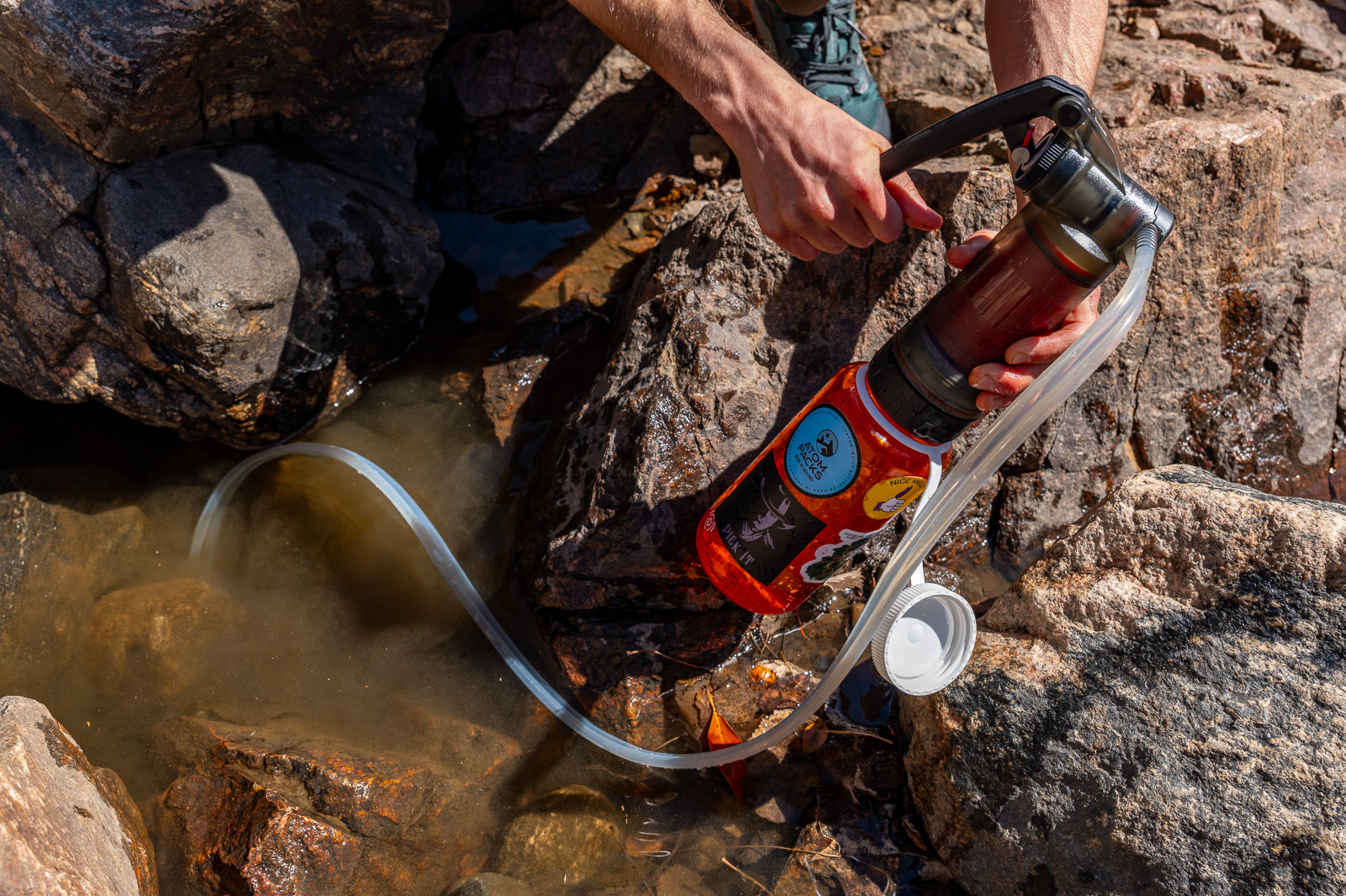
We subjected the Guardian to extremely muddy, sandy, and silty water in deliberate stress tests. We compared pump resistance, treated-water clarity, and flow retention with other systems.
Quick Specs
MSR Guardian
Best Filter for Purifying the Worst of the Worst Water
CleverHiker Rating: 4.6/5.0
Price: $400
Weight: 1 lb. 1.3 oz.
Flow Rate: 2.5 L/min
Filter Pore Size: 0.02 microns
Lifetime Volume: 10,000 L
Pros
- Removes viruses
- Self-cleans while pumping
- Excellent flow retention
- Very durable
Cons
- Heavy and bulky
- Very high price
Water Quality
The Guardian’s purifier-grade membrane meets the military’s NSF P248 protocol for difficult microbiological conditions. In our mud-and-silt testing, it delivered unusually clear water with little offensive taste. It is not a carbon filter, however, and should not be presented as a reliable solution to dissolved chemicals or heavy metals.
The fine 0.02-micron fibers also physically clarify water, unlike chemical tablets and UV pens that leave sediment in the bottle. In our deliberately muddy tests, the result looked and tasted notably clean. There is no activated-carbon stage, though, so dissolved industrial pollutants remain a separate concern.
Water Quality Score: 4.9/5.0
Ease of Use
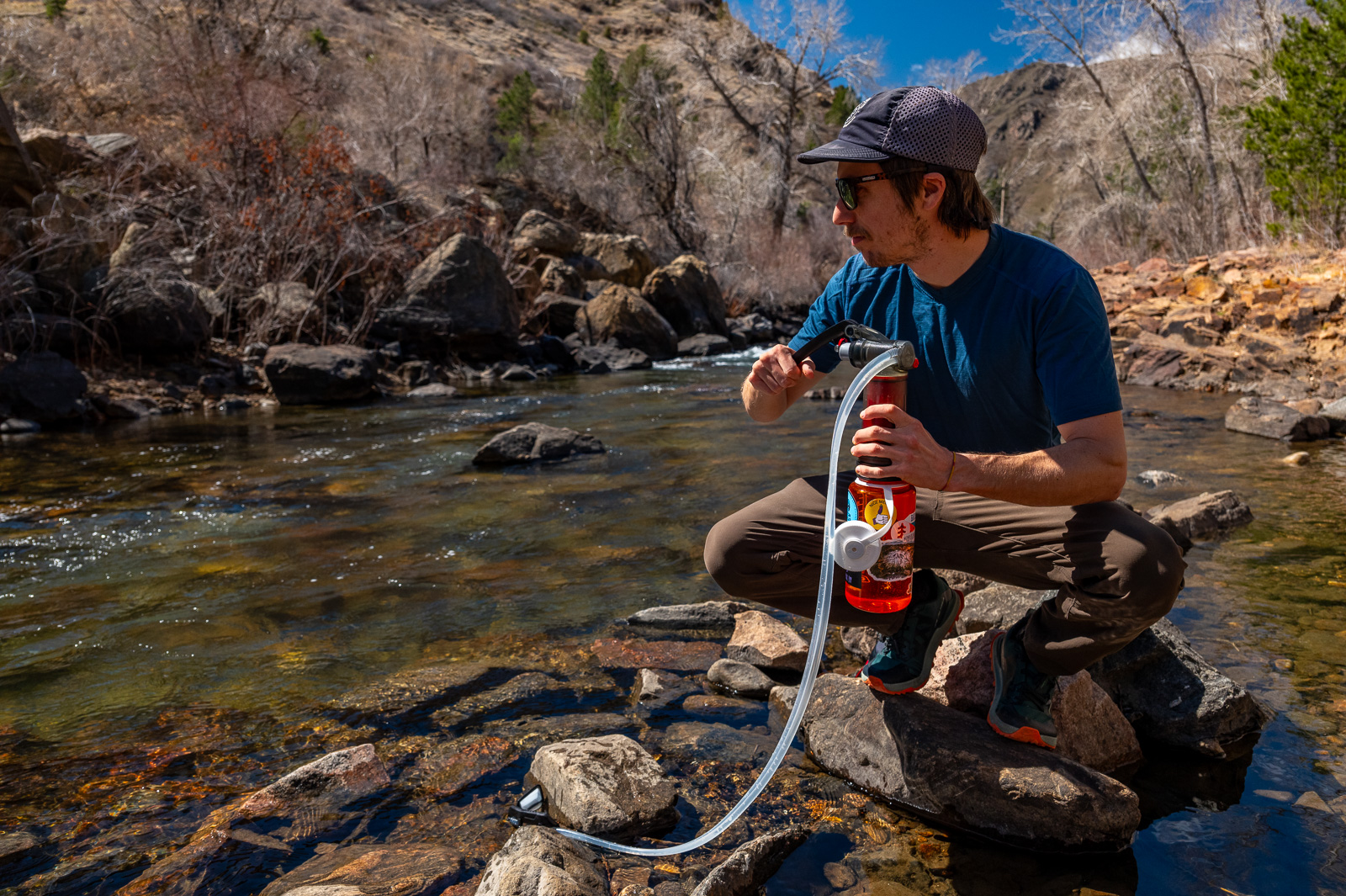
Pumping takes physical work and more setup than filling a squeeze flask. The payoff is direct collection from dirty or shallow sources without relying on a collapsible bladder. We find it especially convenient paired with a wide-mouth Nalgene, although the whole assembly occupies more room than lightweight competitors.
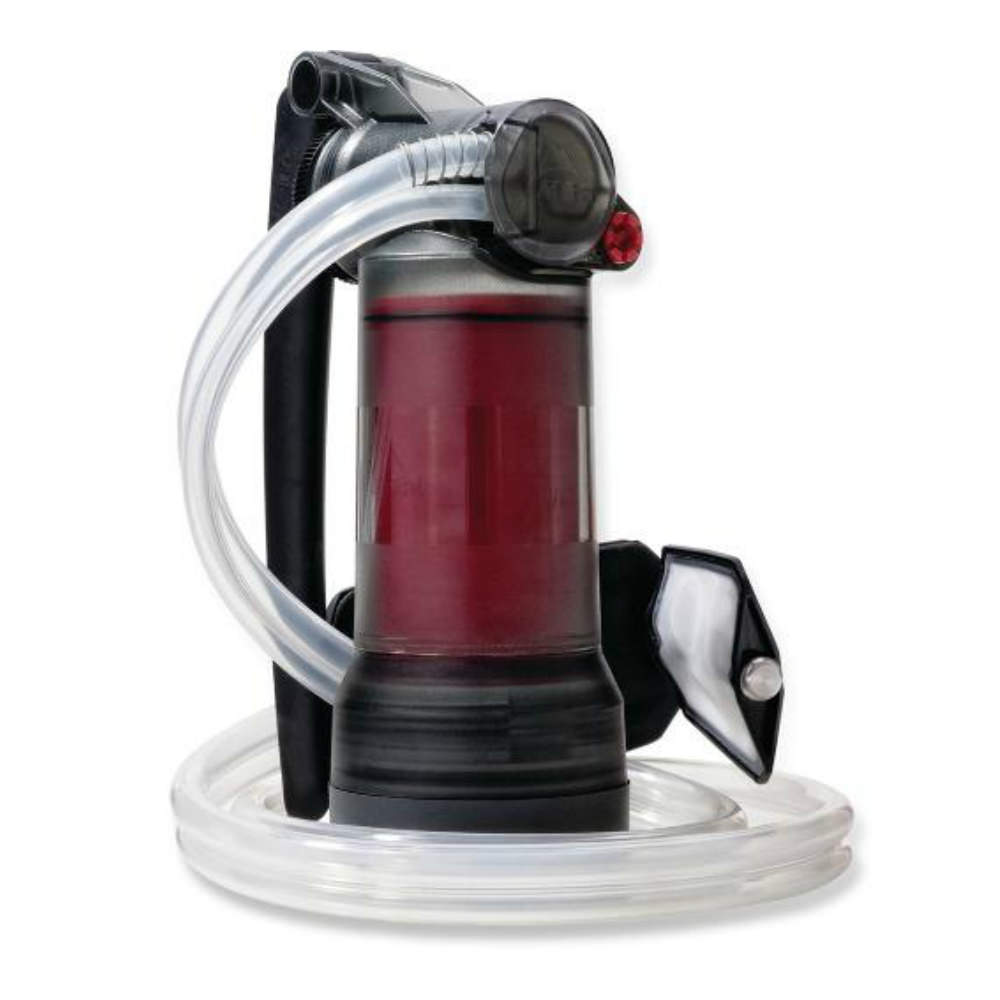
The inlet tube lets us reach awkward sources, and the pump seats conveniently against a wide-mouth Nalgene. The handle gives leverage for sustained pumping, although a squeeze bottle is simpler at clear streams. Its hose winds around the body when packed, keeping the bulky parts together.
Ease of Use Score: 4.7/5.0

Treatment Time
A listed 2.5 liters per minute puts this among the quickest treatments when the pump is operated briskly. More importantly, its self-cleaning action maintained flow during our deliberately dirty-water trials. Many lightweight filters start fast but slow severely after the same kind of challenge.
In testing, we treated a liter in about 30 seconds, or approximately 40 strokes. After two and a half gallons of muddy water, the next clean liter took closer to 50 seconds. Its ongoing self-cleaning action then brought the speed back toward normal, an unusual advantage when poor source water is unavoidable.
Treatment Time Score: 5.0/5.0

Weight
At 17.3 ounces, the Guardian weighs several times as much as our favorite squeeze filters. That’s a decisive drawback for conventional solo backpacking, and the rigid body does not pack as compactly. The additional weight is more defensible for remote international itineraries or expeditions where viral protection matters.
The manufacturer-listed 1 lb. 1.3 oz. is already substantial, and the packed unit occupies space roughly comparable to a wide-mouth one-liter bottle. The intake hose wraps around the pump body, so the shape is organized even if it cannot be compressed. For a casual solo backpacker, a squeeze filter saves a dramatic amount of weight and bulk.
Weight Score: 3.5/5.0

Maintenance & Longevity
The Guardian automatically diverts part of each pump stroke to flush accumulated dirt from the membrane. In our intentionally muddy testing, it retained flow better than any other filter in the comparison. That is more consequential than a high advertised rate when water is consistently silty.
Its rugged housing survived our six-foot drop test onto concrete, and MSR designed it to withstand freezing. A frozen purifier must thaw completely before being pumped. The cartridge is replaceable after its rated 10,000 liters, and the system offers a field integrity test using water and a compatible bottle. Those features help justify its high upfront cost for remote travel.
Maintenance & Longevity Score: 4.8/5.0

Should You Buy the MSR Guardian?
Choose the Guardian for difficult sources and when you genuinely need virus protection. Don’t pay its price or shoulder its weight just to filter clear alpine streams. Chemical purification can offer virus protection with dramatically less bulk if you can tolerate waiting and sediment remaining in the water.

What Other Water Filters Should You Consider?
For some more affordable and lightweight water filters, check out our complete guide to backpacking water filters.
Katadyn Hiker Pro Review: On trips where viruses are not a major concern, the Hiker Pro can draw from shallow water and improve taste with its carbon component. It is less expensive and lighter than the Guardian, but it cannot match the Guardian’s viral protection or dirty-water flow retention.
Katadyn Micropur Review: Micropur tablets protect against viruses with almost no gear to carry, an attractive backup to a large purifier. They require a waiting period and leave grit untouched, so they are a poor substitute for the Guardian when the source is truly muddy.
Katadyn Steripen Ultra Review: If the water is clear, Steripen’s UV method provides viral protection without pumping or a chemical aftertaste. We wouldn’t rely on it alone for turbid sources, and its charging and glass-bulb demands add their own vulnerabilities.