

Bottom Line
For an excellent long-distance shelter for thru-hiking, the Zpacks Pivot Duo impressed us at every turn and became one of our favorite ultralight tents. It’s difficult to evaluate this tent without comparing it to the legendary Zpacks Duplex, which has been a staple on thru-hikes for years. In our opinion, the Pivot Duo makes a strong case that it’s a better shelter for more people than the old classic.
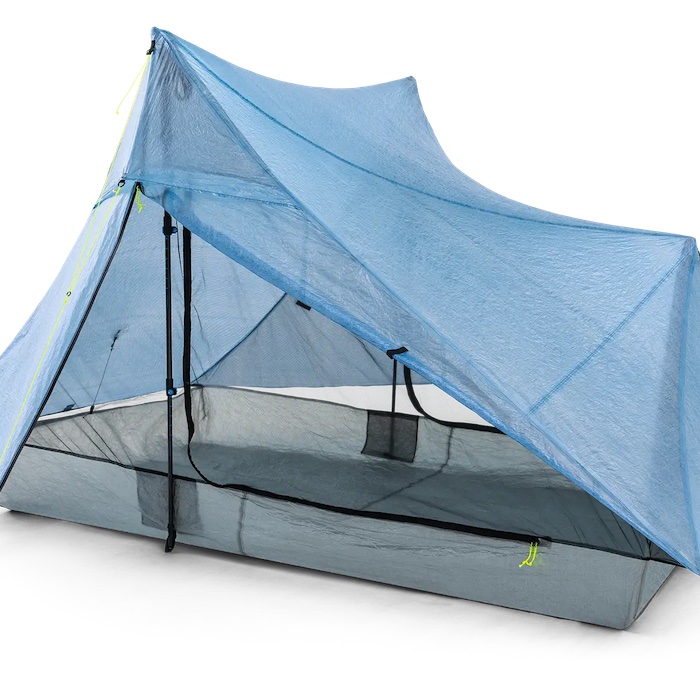
Starting with interior livability, the 32.6 square feet of floor space is more usable than in other A-frame-style shelters because the exterior pole lifts the large front panel away from the foot area. The switch to L-shaped doors is a welcome change from the rainbow doors Zpacks used for years. And the addition of peak vents greatly improves breathability now that the rainfly extends closer to the ground.
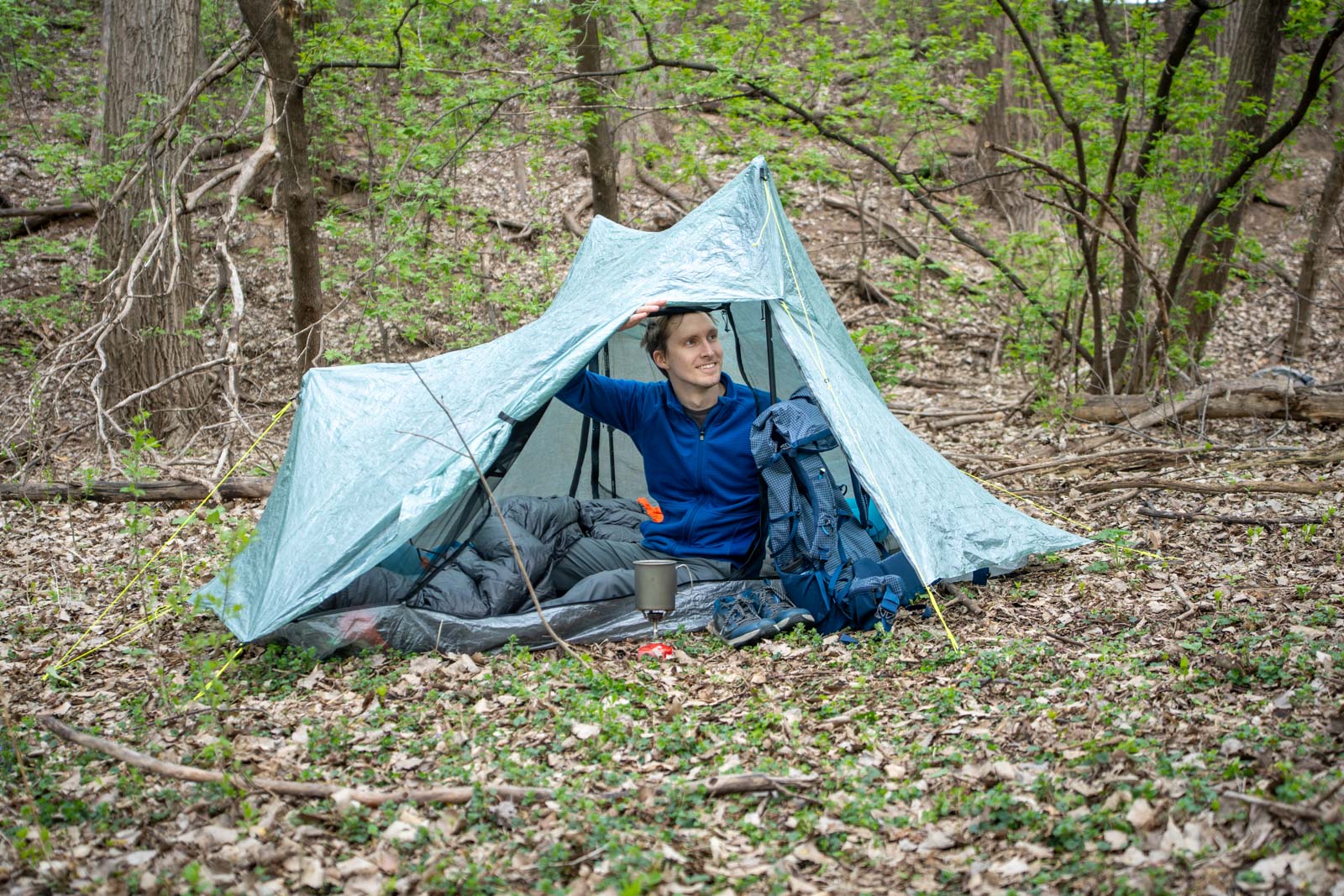
When testing in Utah during early summer and at Glacial Lakes State Park in the Midwest, we loved the spacious interior, especially not worrying about a wet footbox or our heads brushing the walls. The Pivot Duo should be comfortable for people up to 6 feet tall, and although we didn’t test heights above that, Zpacks rates it for individuals up to 6 feet, 6 inches tall.
The biggest downside is its expense, even for a Dyneema Composite Fiber (DCF) tent. It’s among the most expensive we tested in our lineup. But it’s worth noting that this tent is laser-focused on long-distance thru-hikers who will use it night after night for months on end. It represents a worthwhile investment for that purpose or for those who prioritize performance over price in their gear selection process. Additionally, there are a few negatives in the pocket design, low entry height, and tight vestibules that we’d like to see improved, but aren’t dealbreakers.
What we’re left with is a tent that delighted us during testing. It’s roomy, lightweight, well-made, and would be a great choice for sharing with someone on a long adventure.
Note: This review was originally for the ZPacks Offset Duo, which was discontinued in favor of the Pivot Duo. They share enough design philosophy to be considered a product upgrade, and we think the Pivot made great design choices to improve the Offset.
Quick Specs
Zpacks Pivot Duo
Incredible Balance of Comfort and Weight for Two
CleverHiker Rating: 4.7/5.0
Price: $849
Weight: 1 lb. 5.1 oz.
Dimensions (LxWxH): 84 x 50 x 52 in.
Floor Area: 29.2 sq ft
Pros
- Great interior space
- Super lightweight
- Mesh at foot end reduces wet footboxes
- Straightforward setup for a trekking pole tent
Cons
- Bulky packed size but in-line with other DCF tents
- Door entry height a bit low and tight vestibules
- Small and insecure interior pockets

Comfort
After years of the Zpacks Duplex being branded as a “two-person” tent yet primarily used by one, we’re pleased that the Zpacks Pivot Duo’s slight adjustments to a classic design have yielded significant comfort gains. This tent comfortably accommodates two people, end of story. There’s a reason we’re beginning with a comparison to the Duplex. The Pivot Duo feels like a thoughtful response to perhaps the most popular ultralight tent of all time, aiming to create a tent where “two people can actually be comfortable.” It updates the design choices, replaces a few features, and ultimately leaves us with a winning product.
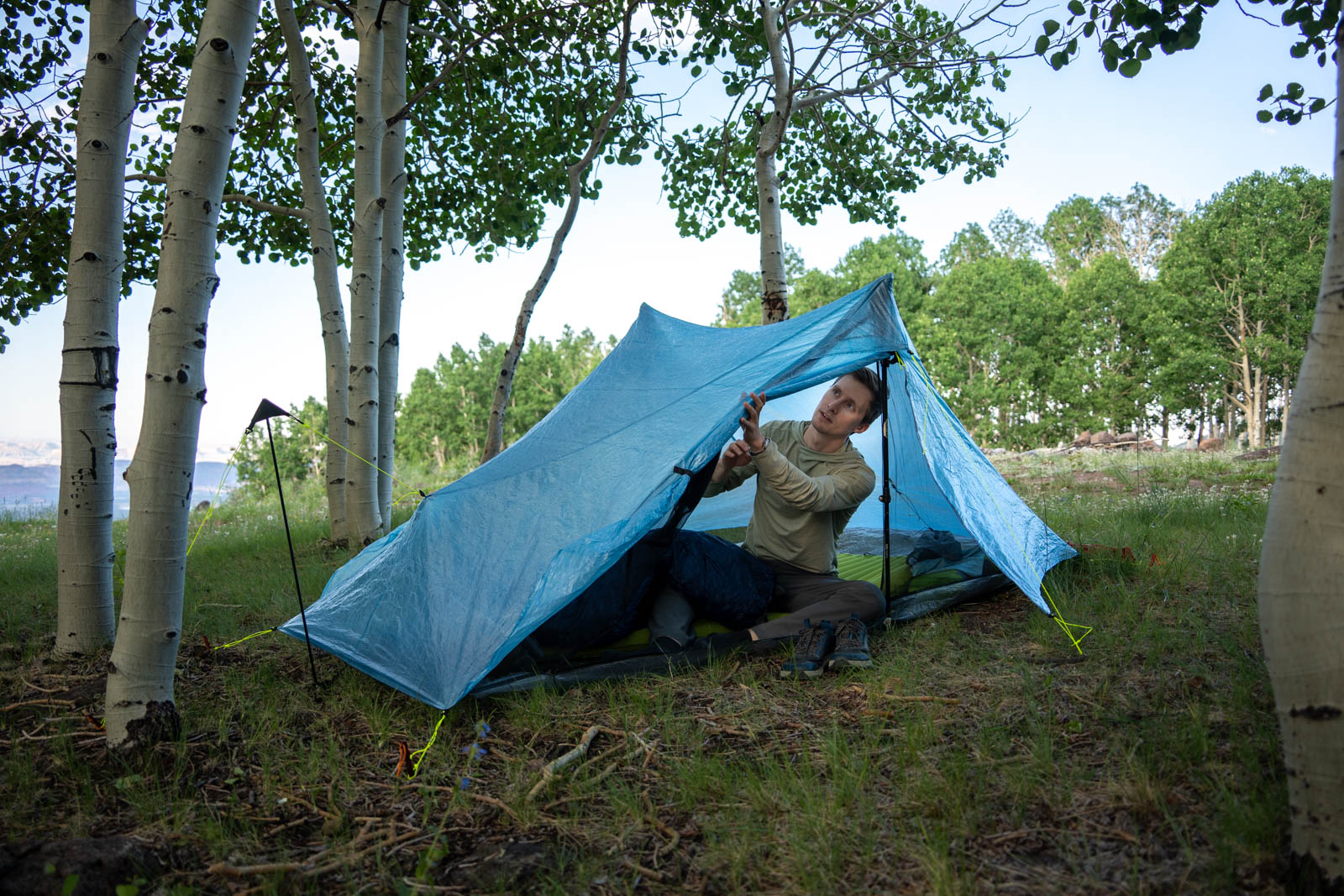
The biggest change is the Pivot poles. In a classic A-frame, the trekking poles are positioned in the middle of the tent body, creating a symmetrical design that reduces both headroom and footroom. The Pivot Duo shifts this high point to one side, providing significantly more headroom, and uses a short interior carbon fiber pole at the foot end. This adjustment greatly enhances the tent’s livability. With a floor space of 29.2 square feet and a peak height of 52 inches, the resulting interior is spacious enough for two people.
The improvements extend to the door designs. The trekking poles aren’t positioned in the middle of the doorway, making entry and exit easier. And they also accommodate large L-shaped doors. We love this design because it lets you unzip just the bottom section to quickly grab something in the vestibule without letting in a ton of bugs. Bonus: We never have to worry about netting falling to the ground, as with top-separating rainbow door designs. The vestibules are large and spacious, providing ample gear storage, and the water-resistant #3 zippers feel wonderful.
We managed to fit two standard 20-inch sleeping pads and two three-season quilts inside without any issues. When adjusting the quilt ends to a comfortable distance from the exterior walls, we still had enough headroom for someone around 6 feet tall.

Weight
The most appealing thing about the Zpacks Pivot Duo is its incredibly low weight of 23.3 ounces. And you can reduce that another ounce by omitting the end pole and using a spare trekking pole, which we suspect most people will have since this is a two-person shelter. We recognize the value of having a dedicated pole here, and we’re glad Zpacks included it.
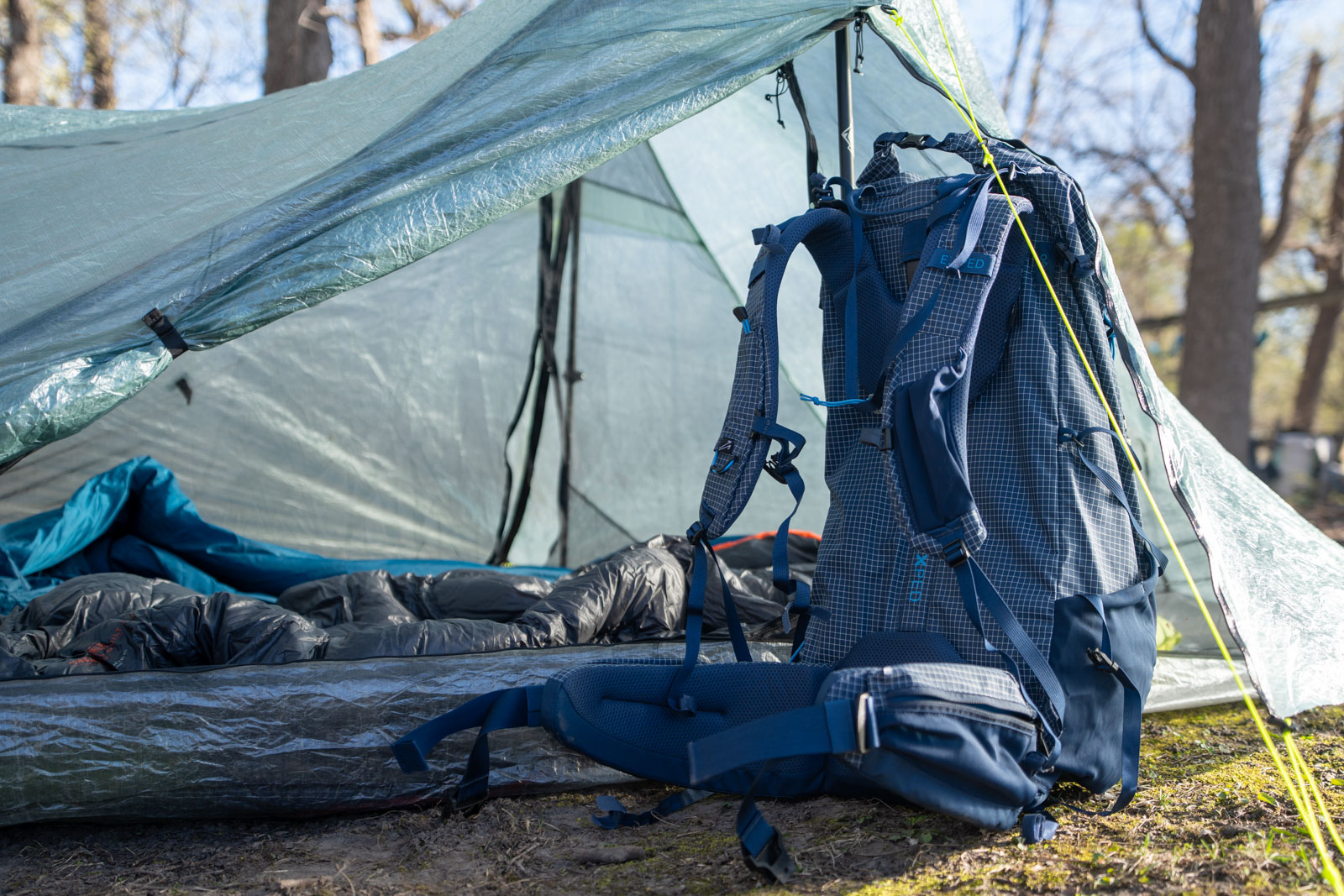
The switch from an exterior pole on its predecessor, the Offset Duo, to an interior pole is greatly appreciated in areas with wildlife that enjoy snacking on tasty cork handle grips. No longer will users have to worry about exposed cork since the handle is now protected by the fly.
The Pivot Duo uses Dyneema Composite Fiber (DCF) fabric throughout its construction to achieve an incredibly low weight. The “lite” configuration features 0.55oz/sqyd DCF for the fly and 0.75oz/sqyd for the floor; however, the standard version comes with a thicker 0.75oz/sqyd fly and 1.0oz/sqyd floor to provide extra peace of mind. We’d advise most purchasers to get the standard version unless they’re experienced with caring for DCF and are aware of the durability trade-offs, especially on the floor.
While DCF is lightweight, it is unfortunately a rather bulky material, and Zpacks rates the packed size at 5 by 12 inches when rolled. This is larger than competing silnylon or silpoly shelters, but considering the other benefits of DCF, we believe it’s a minor issue that most people won’t mind.
Ease of Use
Despite the deviations from the classic A-frame design, we found the Zpacks Pivot Duo equally easy to use. The setup was straightforward, using four corner stakes to secure the doors and two trekking poles at the peaks. Both the vent and the door connect to the same stake via a guyline. While the guyline can be a bit fiddly at times, that’s a minor nitpick that should become second nature over time.
One slight downside to the doors is the low entry height of 40 inches, which means crouching quite a bit when entering and exiting. Speaking of those doors, the magnetic closure mechanism is excellent here too, snapping together with a satisfying click and not getting tangled near the mesh magnet door mechanism. Related to the doors are the small vestibules, which struggle to fit larger packs. Since this is aimed at ultralight hikers with presumably ultralight backpacks, we don’t think this is a big issue.
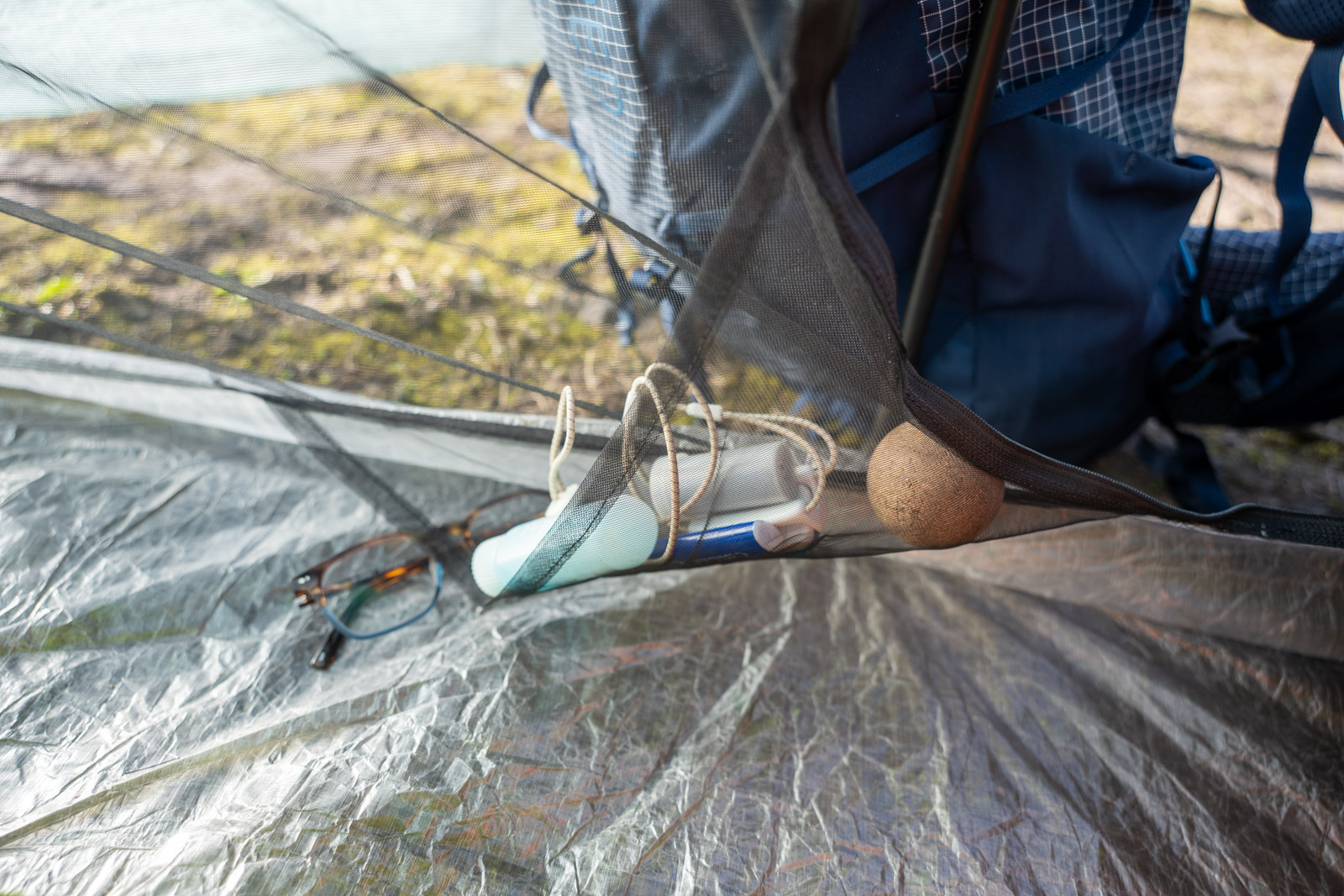
Another downside is the pockets. They’re small and triangular, attached near the door, and can barely hold a headlamp and a cork massage ball before things start falling out. We wish they were proper rectangular pockets positioned higher up on the mesh.
If you are transitioning from a traditional pole tent to a trekking pole style like this one, it will take some time to adjust to how these types of shelters pitch. We recommend practicing with a tent like this before taking it on an adventure, but once you master the fundamentals, we find it just as fast (if not faster) than a traditional pole tent.
Weather Resistance
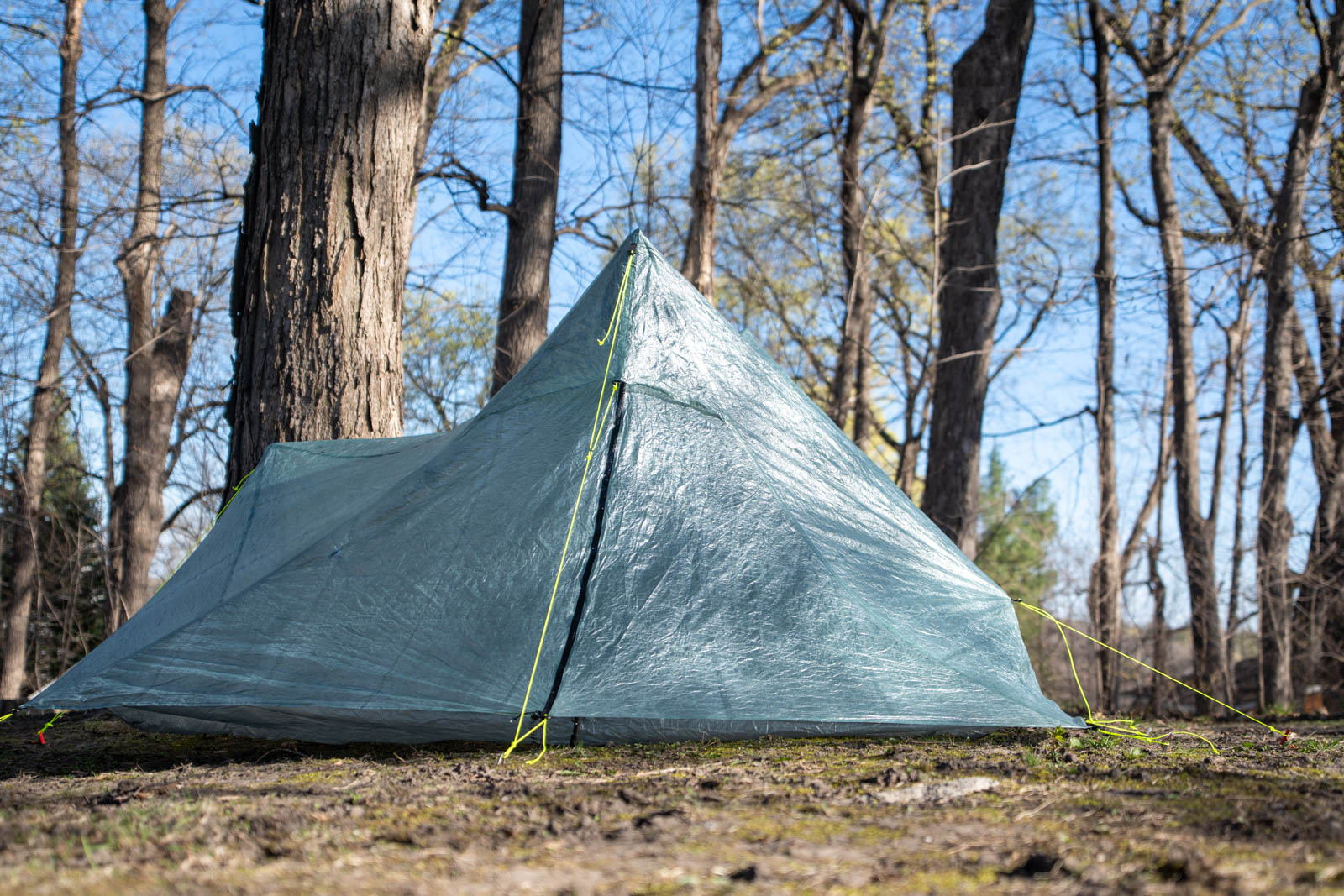
DCF is one of the strongest fabrics available, making the Zpacks Pivot Duo a solid tent for weathering storms. It doesn’t stretch or sag with added water, ensuring a secure pitch that should last as long as your stakes hold firm. The only downside is the large exposed panel on the front. Although the geometry is broken up by the foot pole more than if it weren’t there, it’s still a substantial section of fabric that will catch the wind. This isn’t enough to deter us from taking the Pivot Duo on a long trail, but it wouldn’t be our first choice for a trail known for being very windy.
We wish Zpacks had included attachment points at the peaks for guylines. During harsh weather, these can significantly enhance tent stability. Since this tent primarily targets long-distance trail hikers rather than being specifically designed for harsh weather, we believe the level of weather resistance is appropriate.
The vestibules pitch lower to the ground than other Zpacks tents, which should help significantly with splashback in rain. Splashback occurs when rain falling on the ground next to the tent splashes under the rain fly and onto the tent. It can also splash tiny flecks of mud onto gear, which can add up to a soiled backpack and shoes over the course of the night.
While the vestibules still don’t go as low as we’d prefer for optimal protection, they’re definitely better than what we’ve seen with other tents. These lower vestibule heights do sacrifice some airflow, but fortunately, the Pivot Duo has a good vent design that we believe more than compensates for this. The two vents are large, and although they’re not particularly deep, they’re held open by a guyline, which we find to be a clever feature.
Durability
The use of DCF construction with time-tested thicknesses for the rainfly and floor suggests that the Zpacks Pivot Duo should have a decent lifespan. Although we haven’t taken it on a full thru-hike to test its durability firsthand, several factors instill confidence that it should last for a significant period.
The type of DCF used is the same as that on the Zpacks Duplex and other Zpacks tents, which are known to endure at least a solid thru-hike of a 2,000-mile trail. This longevity will vary based on how rough you are with gear, campsite selection, and whether you cowboy camp on top of your tent (please avoid this to prevent pinhole punctures). Furthermore, the tent’s overall fit and finish are excellent. Zpacks has improved its quality in recent years, addressing its past reputation for quality-control issues, and we love seeing it here.

Should You Buy the Zpacks Pivot duo?
Although we want to consider the Zpacks Pivot Duo on its own, it’s difficult not to compare it to the popular Zpacks Duplex, as it seems to improve upon that tent in nearly every way. For that reason, the primary group of people we recommend the Pivot Duo to are prospective Duplex buyers. Unless you’re counting grams or love some other aspect of the Duplex, we boldly claim that the Pivot Duo is a better tent for most people.
That is, of course, if price isn’t an issue. The Pivot Duo is one of the most expensive tents in our lineup and even costs a premium over the already pricey Duplex. For those sharing the tent on a thru-hike that lasts months, we believe investing in a comfortable sleeping experience is a wise use of your resources.
If you’re not focused on the lightest weights or are just searching for a tent for casual backpacking, we wouldn’t recommend this tent either. Not because it isn’t great for weekend excursions, but simply because it’s excessive. We have other excellent tents better suited for casual use that we’d suggest, and the Pivot Duo is priced for those investing in a long-distance trail. However, if you are looking for your next long-distance tent and love the Pivot Duo’s design, we can give it a strong endorsement.
What Other Ultralight Tents Should You Consider?
If the Zpacks Pivot Duo isn’t the perfect fit, our best ultralight tents guide has many other options.
Durston X-Mid Pro 2+ Review: The Pivot Duo and X-Mid Pro 2+ are remarkably similar in their goals, aiming to create a truly livable and well-designed ultralight tent for two. They both achieve this in different ways, and in our opinion, they both succeed fantastically. However, when it comes down to it, we enjoyed the X-Mid just a bit more for our style of backpacking.
3FUL Lanshan 2 Pro Review: If the Pivot Duo is pricey enough to make you think ultralight gear isn’t for you, the Lanshan 2 Pro offers a compelling counterargument. While it may not be as featherlight due to its full silnylon design, it’s more than adequate for two people and comes at a significantly lower price than the Pivot Duo. What you receive for that price isn’t a subpar experience either; it’s a solid tent.
Zpacks Pivot Solo Review: If you appreciated the overall feel of the Pivot Duo but don’t require the extra space for a second person, they actually offer a Pivot Solo. It features a similar full-length pole at the door and a second shorter interior pole at the foot end to create a nice overall interior. While it isn’t our favorite one-person shelter overall due to a slightly trickier setup, it’s so close that for anyone who truly enjoys what Zpacks is doing with the Pivot Duo, we believe the Pivot Solo will delight them.