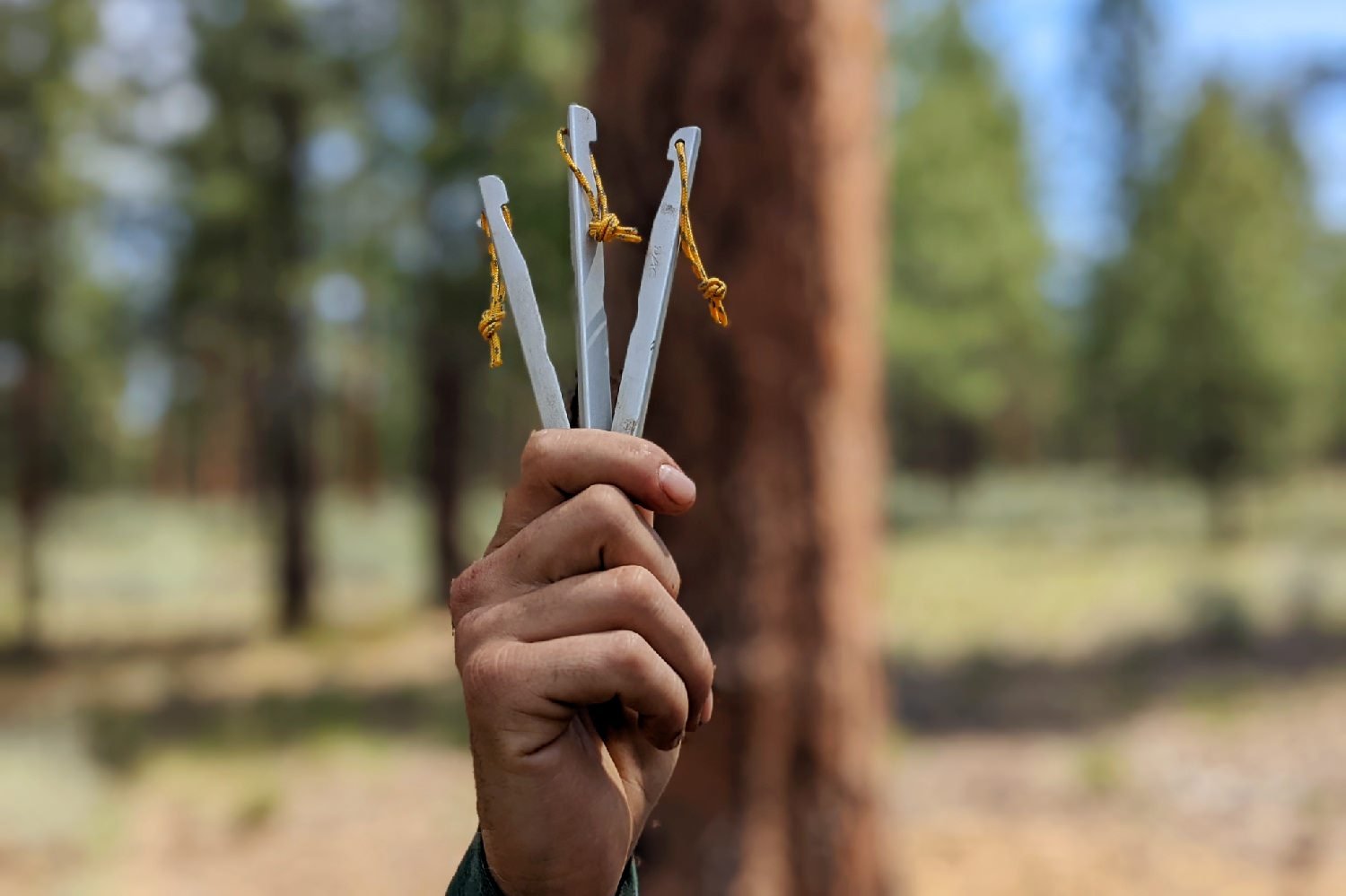


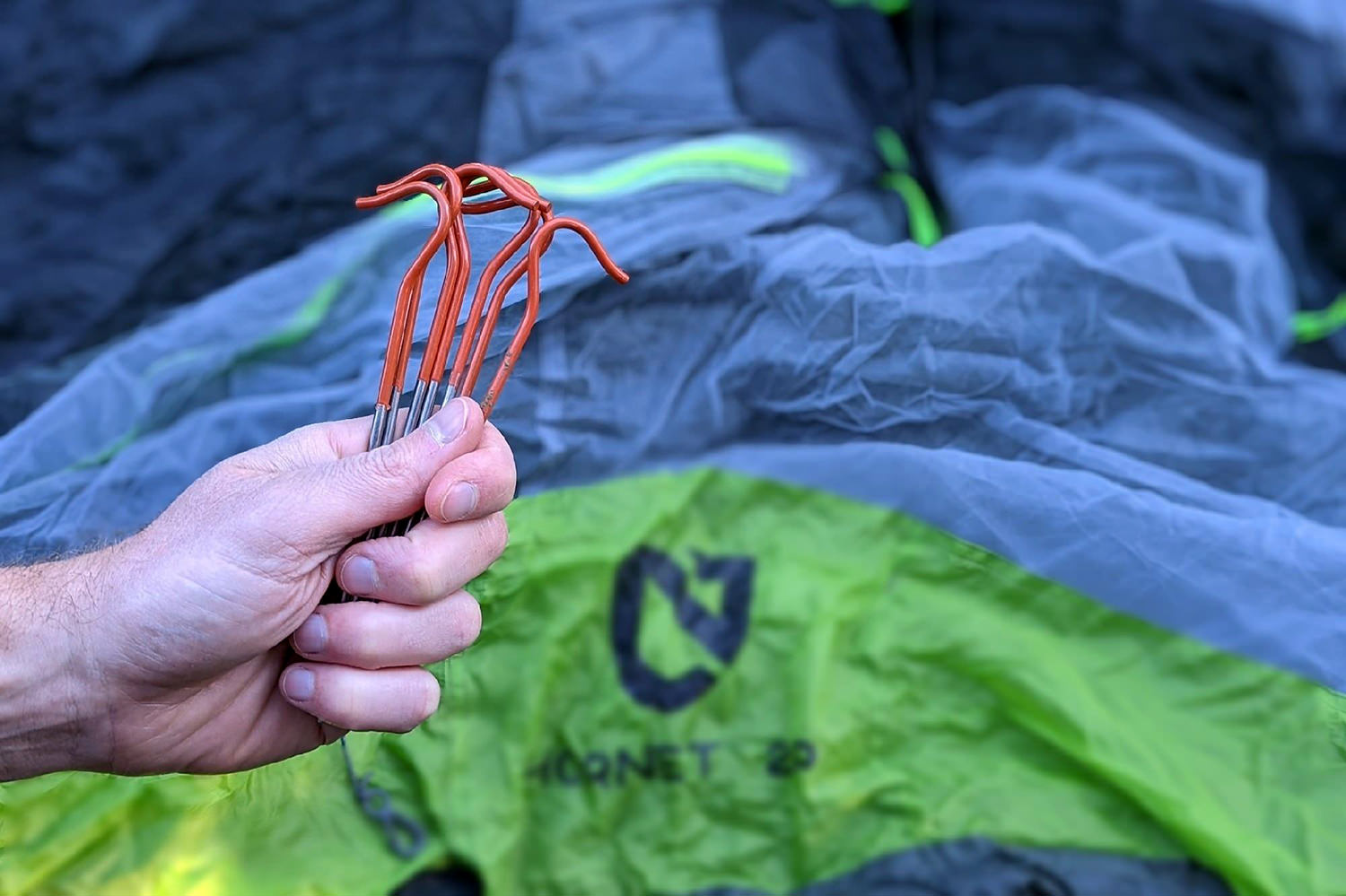
We’ve researched over 80 tent stakes and tested dozens of designs from the crusty earth of the High Sierra to the loamy soils of New England. For this gear guide, we reviewed and ranked 12 top contenders for their weight, packability, durability, holding power, and ease of use.
Editor’s Note: We updated this article on August 7, 2026, to to ensure the accuracy of product pricing and technical specifications. We also expanded our section on How to Choose Tent Stakes.
How We Test Tent Stakes
Our team of gear experts has logged more than 3,000 nights in the backcountry testing tents and all the accessories that go with them – stakes included. For this guide, gear analyst Brett Kretzer tested and reviewed 12 tent stakes from leading brands like MSR, Nemo, REI, Zpacks, and more. He compared them side by side in the field, closely evaluating their weight, packability, durability, holding power, and ease of use to paint an accurate picture of all-around performance.
And for more info, check out some of our other popular gear guides:

#1. Best Tent Stakes Overall
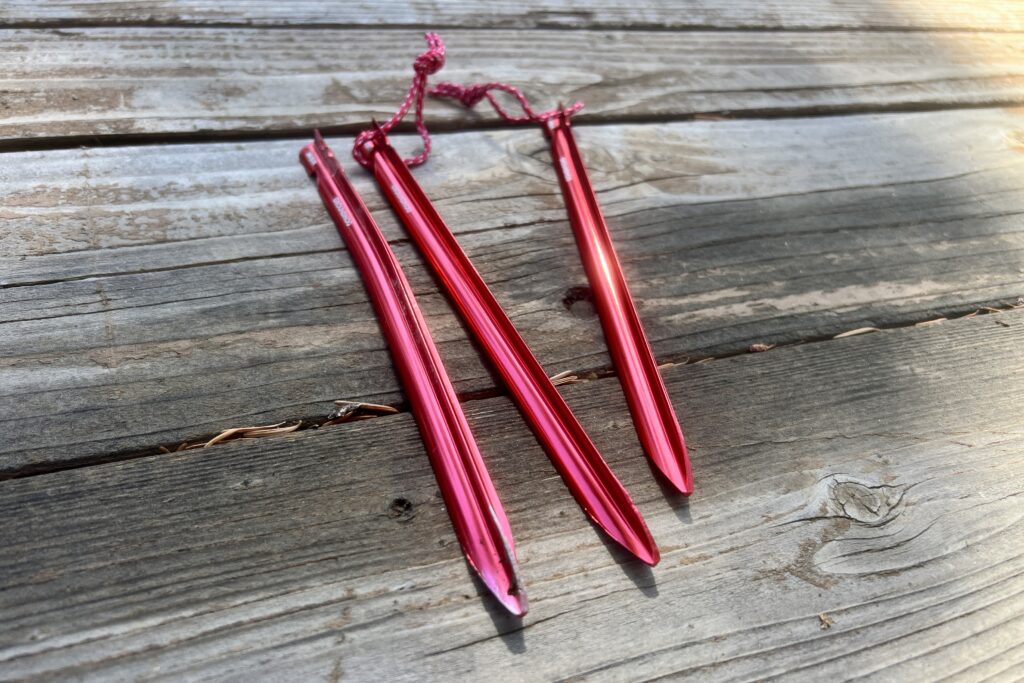
The MSR Groundhog earned our top billing for its hard-to-beat balance of weight, durability, and holding power. We’ve relied on these stakes on countless backpacking trips and have yet to experience any issues with structural integrity – even during gnarly storms.
Quick Picks for Tent Stakes
Check out this quick list of our favorite tent stakes if you’re in a hurry, or continue scrolling to see our full list with in-depth reviews.
Editor’s Note: All prices listed below are per stake, rounded to the next whole dollar.
1. Best Tent Stakes Overall: MSR Groundhog ($7) / Mini-Groundhog ($6)
2. Most Innovative Tent Stakes: NEMO Sweepstake ($5)
3. Best for Quick Adjustments: NEMO Airpin ($5)
4. Best Bang for Your Buck: All One Tech Aluminum ($1)
5. Best for Anchoring Large Shelters: Orange Screw Ultimate Ground Anchor ($7)
6. Best Ultralight Tent Stakes: MSR Carbon-Core ($13)
7. Best Balance of Weight & Holding Power: TOAKS Titanium V-Shaped Peg ($4)
8. Best in Snow & Sand: REI Snow Stake ($8)
9. Most Durable Tent Stakes: REI Steel Stake ($3)
10. Best Hook Tent Stakes: REI Aluminum Hook Stake ($3)
11. Most Packable Tent Stakes: Zpacks 6″ Ultralight Titanium Stake ($3)
12. Best Ultralight Stakes for Rocky Ground: Vargo Titanium Stake ($4)
MSR Groundhog & Mini-Groundhog
Best Tent Stakes Overall
CleverHiker Rating: 4.6/5.0
Cost Per Stake: $7 / $6
Weight: 0.49 oz. / 0.33 oz.
Length: 7.5 in. / 6 in.
Best Use: Backpacking
Pros
- Ultralight
- Great value
- Excellent holding power
- Very durable for how light they are
- High-visibility
- Pull cord for easy removal
Cons
- Y stakes can be a little more difficult to use in rocky terrain
- Pricey
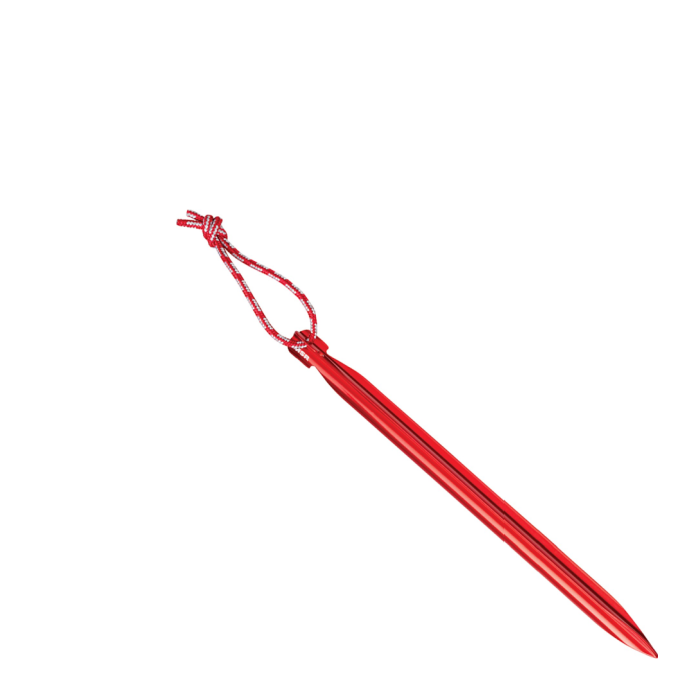
The MSR Groundhogs and Mini-Groundhogs have long been favorites among backpackers because they’re ultralight and have excellent holding power. We’ve put both the standard and Mini versions through rigorous testing across diverse terrain over multiple seasons. They continue to impress us with their exceptional performance-to-weight ratio.
Priced at $6 to $7 per stake, the Groundhogs and Mini-Groundhogs are on the pricier side compared to other alternatives. However, after experiencing their resilience during unexpected storms, we’re happy to report that ultralight doesn’t mean ultra-compromised.
The Y-beam construction is essentially impossible to bend by hand. Although we were eventually able to get them to bend after whacking them with a hammer, we’ve never experienced any lack of structural integrity over years of real-life use.
Where these stakes truly distinguish themselves is their exceptional holding power for their weight. The Y-shaped design provides excellent resistance in soft soil and herculean strength in compact, rocky ground. Their decent length provides adequate stability in sand, too – though they don’t quite measure up to specialized options in this area.
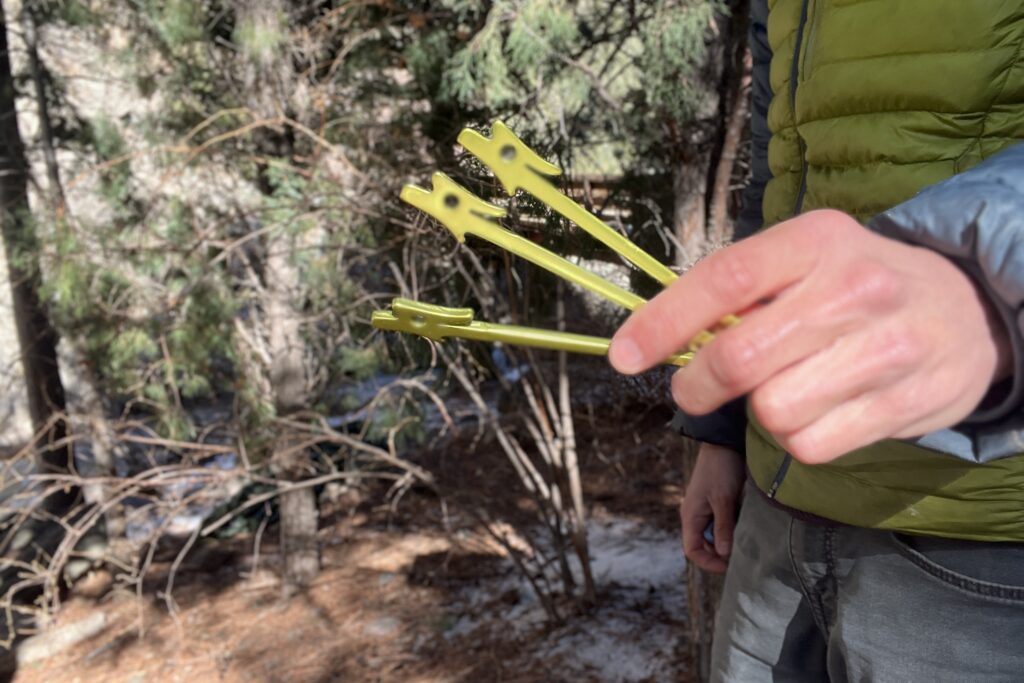
Each stake comes with an attached high-visibility pull cord. The visibility is handy for finding your stakes in the morning. Plus, the pull cord makes them easier to remove.
If the best holding power possible in a lightweight package is your goal, go with the full-size Groundhogs. If saving every last gram – and a little money – is most important to you, the Mini-Groundhogs are a great choice.
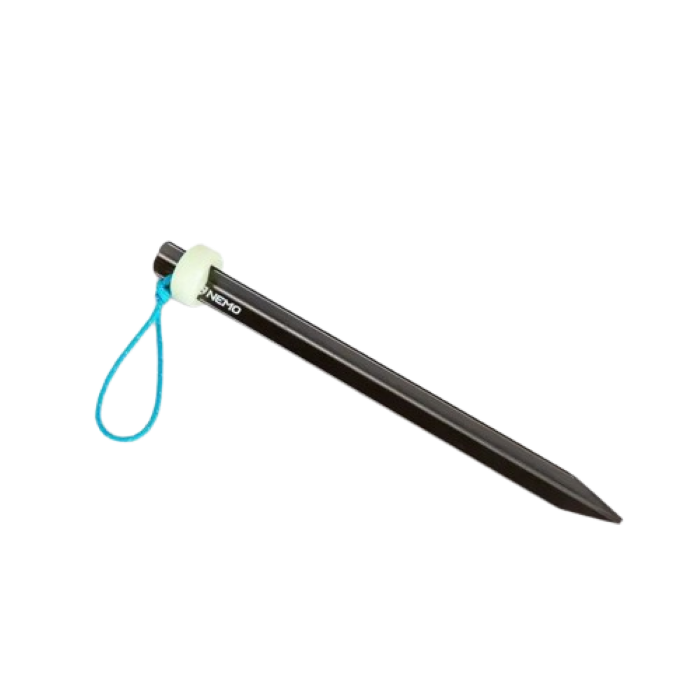
NEMO Sweepstake
Most Innovative Tent Stakes
CleverHiker Rating: 4.6/5.0
Cost Per Stake: $5
Weight: 0.7 oz.
Length: 7 in.
Best Use: Tenting in mud
Pros
- Great holding power
- Uniquely designed stake cleaner
- Glow-in-the-dark top
- High-visibility pull cord
- Very durable
Cons
- Heavier than other backpacking stakes
- Slightly bulky
The NEMO Sweepstake features one of the most unique and thoughtful designs we’ve seen in a tent stake – great for backpackers who like to nerd out on their gear.
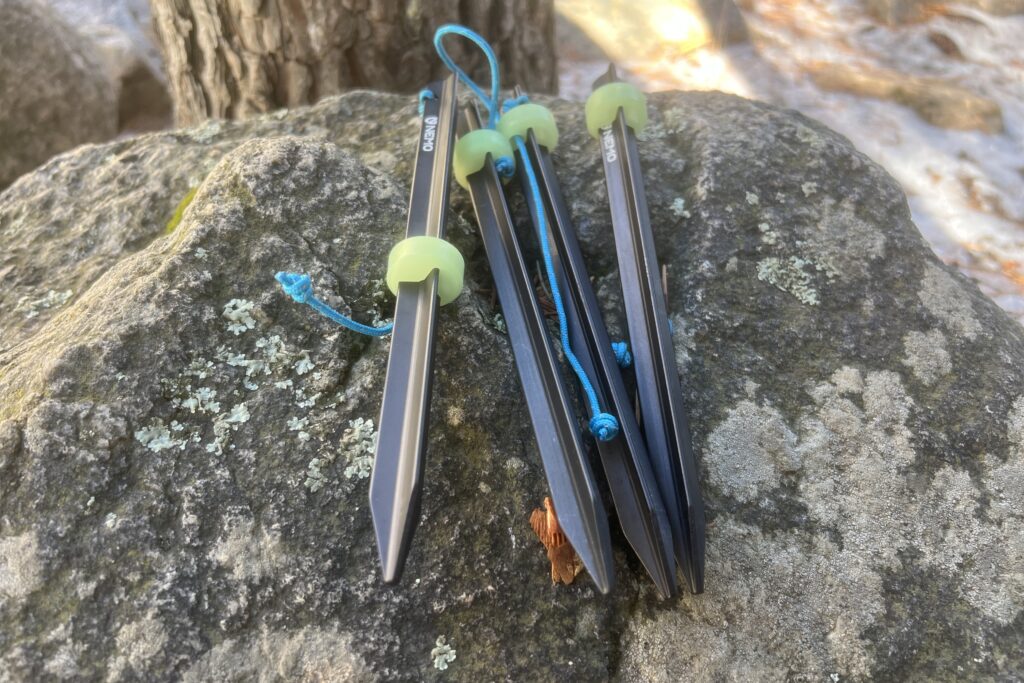
These stakes are designed with a built-in pull cord and glow-in-the-dark stake cleaner. The glow-in-the-dark feature is obviously nice for packing up in the dark, and the stake cleaner prevents you from carrying extra weight in the form of mud. Just pull the stakes out of the ground, slide the cleaner to the end of the stake, and carry on with clean stakes (and clean hands).
The Y-shaped design is one of the most durable of its kind, holding up to every bit of abuse we put it through. Even after multiple blows with a mallet, the stake retained its straight shape. At 7 inches long, the Sweepstake has excellent holding power in varied terrain, especially compact soil.
The biggest trade-off to the Sweepstake’s impressive durability and creative design features is weight. Though not the heaviest option here at 0.7 ounces per stake, most ounce-counters would turn up their noses at a weight approaching a full ounce.
Despite its intelligent engineering, the NEMO Sweepstake is relatively affordable at $5 per stake. The design is a bit niche, but gear nerds will appreciate the ingenuity and well-executed features.
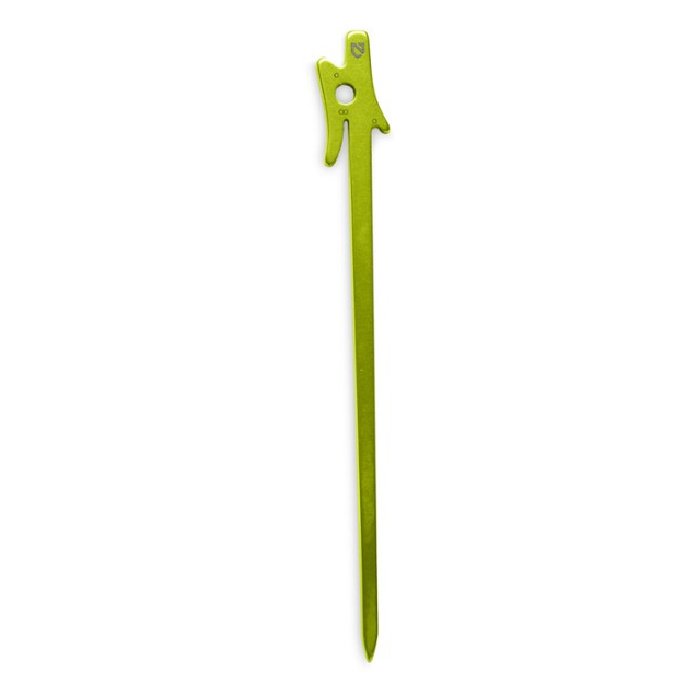
NEMO Airpin
Best for Quick Adjustments
CleverHiker Rating: 4.5/5.0
Cost Per Stake: $5
Weight: 0.18 oz.
Length: 6 in.
Best Use: Backpacking, especially in compact/rocky terrain
Pros
- Ultralight
- Very durable for how light they are
- Thin design makes them easy to get between rocks/roots
- Eliminates the need for knots/tensioners on guylines
Cons
- Expensive
- Holding power isn’t as good in soft ground
The NEMO Airpin is an ultralight backpacker’s dream, with a unique design that’s particularly well suited for compact, rocky terrain.
At just 0.18 ounces each and 6 inches in length, these stakes provide an exceptional balance of weight savings and durability – great for those looking to minimize pack weight without sacrificing performance. The self-tensioning cleat head allows you to secure guylines without the need for knots or additional tensioners, simplifying setup and saving even more weight.
Another standout feature is the thin design, which makes the Airpins incredibly easy to drive between rocks or roots – where traditional, thicker stakes might struggle to penetrate the ground. Despite their low weight, these stakes are surprisingly durable, holding up well to repeated use.
Although they excel in compact and rocky terrain, the Airpin’s holding power in soft ground isn’t as impressive as longer stakes. But for anyone committed to ultralight backpacking or hammocking, the Airpins are a worthwhile investment for their practical design, low weight, and solid performance where it counts.
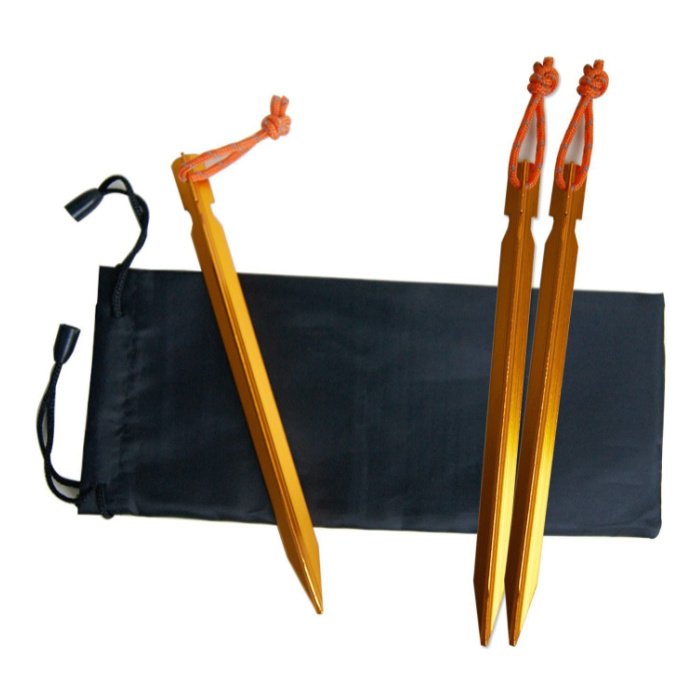
All One Tech Aluminum
Best Bang for Your Buck
CleverHiker Rating: 4.5/5.0
Cost Per Stake: $1
Weight: 0.49 oz.
Length: 7 in.
Best Use: All-around
Pros
- Affordable
- Lightweight
- Versatile
- Good holding power
- High-visibility pull cord for easy removal
- Stuff sack included
Cons
- More difficult to use in rocky terrain
- Not as durable as other Y stakes
For those on a budget, the All One Tech Aluminum Stakes are an excellent choice for all-around use. These 7-inch, Y-shaped stakes provide sufficient holding power across a range of soil types and are light enough for backpacking.
These aluminum stakes offer solid structural integrity in most camping scenarios. They aren’t flimsy enough to be bent by hand, but they’re fragile enough to warp under multiple whacks of the mallet. Their Y-shaped profile provides more strength than shepherd’s hooks, though they’re not the strongest Y-shaped stakes available.
The All One Tech’s holding power is pretty balanced across various soil conditions. The 7-inch length and Y-shaped cross-section create impressive stability in soft, loamy environments and adequate performance in sandy terrain. In compact, rocky soil, they maintain good holding power once in the ground, but getting them in requires some effort.
At 0.5 ounces per stake, these stakes are heavier than ultralight titanium options but significantly lighter than traditional steel stakes. The included stuff sack is a handy addition that helps with packability.
These stakes are easy to use thanks to their Y-shaped design. The wide head surface also makes an easy target for a mallet. Plus, the integrated pull cord provides something to hold for yanking.
The All One Tech Aluminum Stakes are an incredible value for their performance. Their balance of durability, versatility, and weight is simply hard to find at this price.

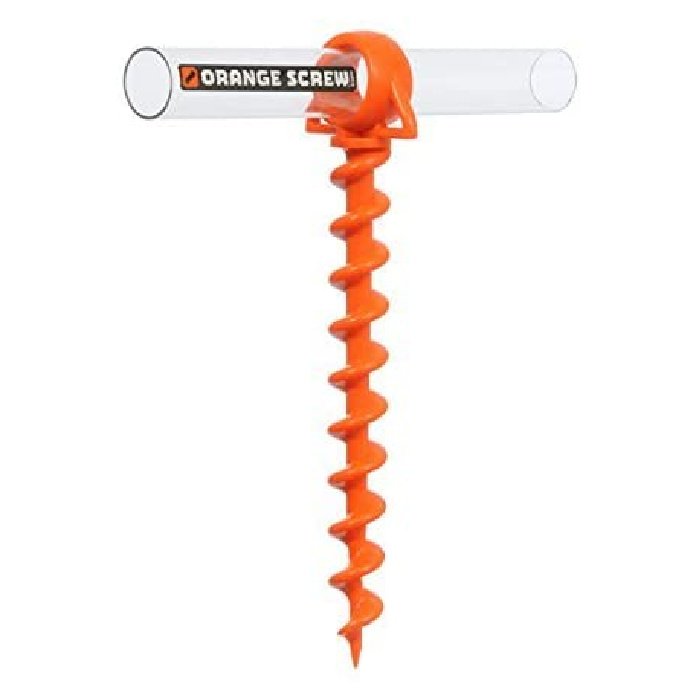
Orange Screw Ultimate Ground Anchor
Best for Anchoring Large Shelters
CleverHiker Rating: 4.5/5.0
Cost Per Stake: $7
Weight: 1.8 oz.
Length: 9.5 in.
Best Use: Anchoring large shelters
Pros
- Excellent holding power in soft ground
- Easy to screw into soft ground
- Eliminates the need for a stake mallet
Cons
- Expensive
- Difficult to screw into rocky soil
- Too heavy and bulky for backpacking
For windy days on the beach, we wouldn’t be caught without our Orange Screw Ultimate Ground Anchors. These stakes are perfect for anchoring down your camping tent or sun shade in loose sand or sediment, providing a more secure hold than any other stake type.
We also like that the screw-in design means we can leave the stake mallet at home. Likewise, there’s no need to drive the stakes into the ground with our flip-flops. In other words, the design is both a time-saver and a comfort.
The large heads provide ample space to secure multiple guylines. The stakes also come with a helpful plastic tube to add more leverage for screwing in.
These ground anchors work best in moderately compact soil. In super firm soil, they tend to upheave the ground and can take a few tries to seat properly. In loose sand or snow, it’s best to tamp down the area with your foot first. Once the anchors are seated firmly, they’ll hold down heavy shelters in significant wind.
At 1.8 ounces per stake, the Ultimate Ground Anchors are competitively light considering their holding strength but not ideal for backpacking trips. The plastic material is durable, but it can snap under high stress, especially if the screw isn’t fully buried and is torquing at a severe angle.
At $7 per stake, the Orange Screws are more expensive than most standard stakes and best reserved for car camping with larger shelters. However, for basecamping outings with severe weather in the forecast, the added peace of mind is worth the slight weight and price penalties.
MSR Carbon-Core
Best Ultralight Tent Stakes
CleverHiker Rating: 4.5/5.0
Cost Per Stake: $13
Weight: 0.2 oz.
Length: 6 in.
Best Use: Ultralight backpacking
Pros
- Ultralight
- High-visibility top
- Easy to drive into compact soil
Cons
- Expensive
- Holding power isn't as good as others
- Can be hard to remove
- Carbon fiber breaks instead of bending under stress
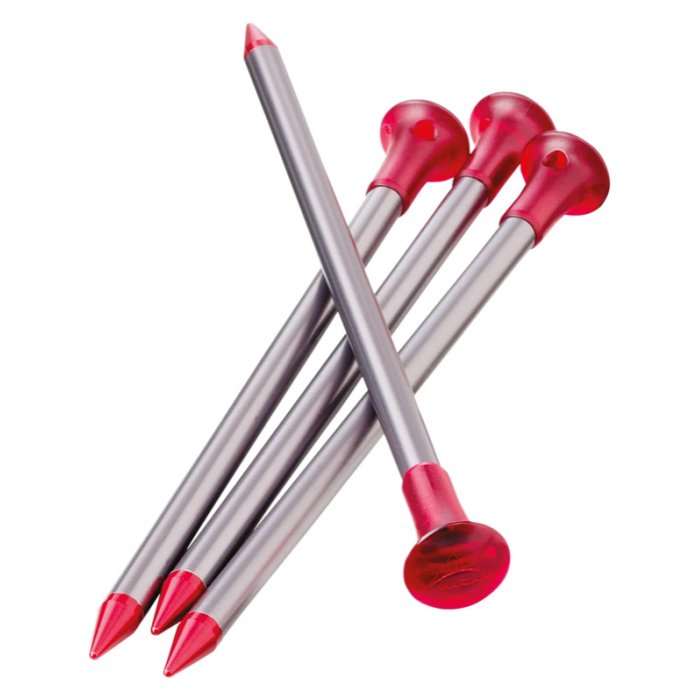
The MSR Carbon-Cores are some of the absolute lightest tent stakes on the market – so it’s no surprise they come at a real premium. These 6-inch stakes weigh just 0.2 ounces each and cost a whopping $13 per stake.
These carbon fiber stakes hold extremely well in compact or rocky soil and go in easily thanks to their pointed tip. They excel in firm soil, but their holding power isn’t great in soft or loose ground – that’s where a longer, V- or Y-shaped stake would perform better. In soft soil, the meager 6-inch length and nail-shaped design don’t provide much surface area for security.
The high-visibility plastic top is easy to see and provides a nice, flat surface for driving the stake into the ground. Although it doesn’t come with an attached pull cord, there is a hole for adding one or even permanently attaching guylines. The downside to the plastic top is its fragility. We don’t recommend whacking this stake with a giant rock.
Although carbon fiber is very rigid and strong, it tends to break under stress instead of bending. These stakes may snap if you try to drive them too hard or if they encounter heavy resistance in a severe storm.
Though these are a standout option for gram counters, we don’t recommend them as the sole stake type in your kit. For trips where saving every gram counts, we might bring four or five of these and two or three titanium or aluminum stakes to account for varying soil types.
TOAKS Titanium V-Shaped Peg
Best Balance of Weight & Holding Power
CleverHiker Rating: 4.5/5.0
Cost Per Stake: $4
Weight: 0.4 oz.
Length: 6.5 in.
Best Use: Backpacking
Pros
- Excellent holding power
- Durable for the weight
- Comes with a stuff sack
Cons
- Hard to drive into rocky soil
- Doesn't include a pull cord
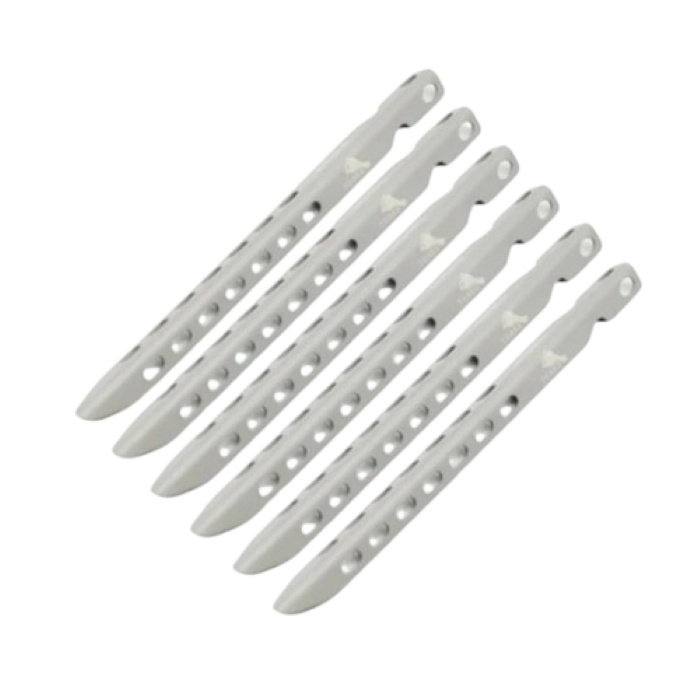
The TOAKS Titanium V-Shaped Pegs strike an impressive balance between weight and holding power. They weigh in at just 0.4 ounces per stake and perform among the best in both soft soil and compact soil. The V-shaped design penetrates most soil types with ease and has ample surface area for hammering in. They even come close to rivaling the REI Snow Stakes below in the loosest substrates.
Despite being ultralight, these stakes are tough enough to hold up in less-than-ideal conditions. Though we weren’t able to bend the stakes by hand, the neck proved to be a weak spot that can buckle under the stress of a rock or mallet.
In addition to being very lightweight, these stakes pack together nicely and come with a small stuff sack to keep them organized and protected.
Unfortunately, they can be difficult to drive into rocky soil. Unlike thinner stakes, they can’t slip as easily between rocks and roots and don’t have the durability to withstand blows from a mallet. The V shape does a great job holding if you can get them in, but in tough ground, you might find yourself struggling to get them deep enough. And they don’t come with a pull cord, but it’s easy to add your own.
At $4 per stake, the TOAKS Titanium V-Shaped Stakes are a solid, affordable, and versatile option for backpacking in most conditions.
REI Snow Stake
Best in Snow & Sand
CleverHiker Rating: 4.4/5.0
Cost Per Stake: $8
Weight: 1 oz.
Length: 9.6 in.
Best Use: Camping in snow/sand
Pros
- Durable
- Good value compared to other snow stakes
- Excellent holding power in loose sand/snow
- High-visibility color
Cons
- Not suitable for compact ground
- More expensive than standard stakes
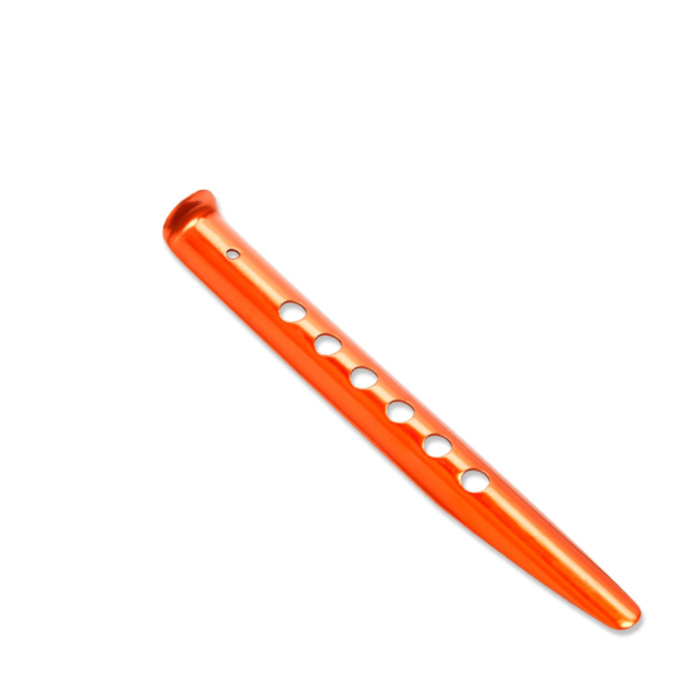
The REI Snow Stakes are a must-have for anyone planning to camp in snow or sand, offering exceptional holding power where traditional stakes struggle. With a weight of just 1 ounce and a length of 9.6 inches, these stakes strike a great balance between weight and performance in loose terrain.
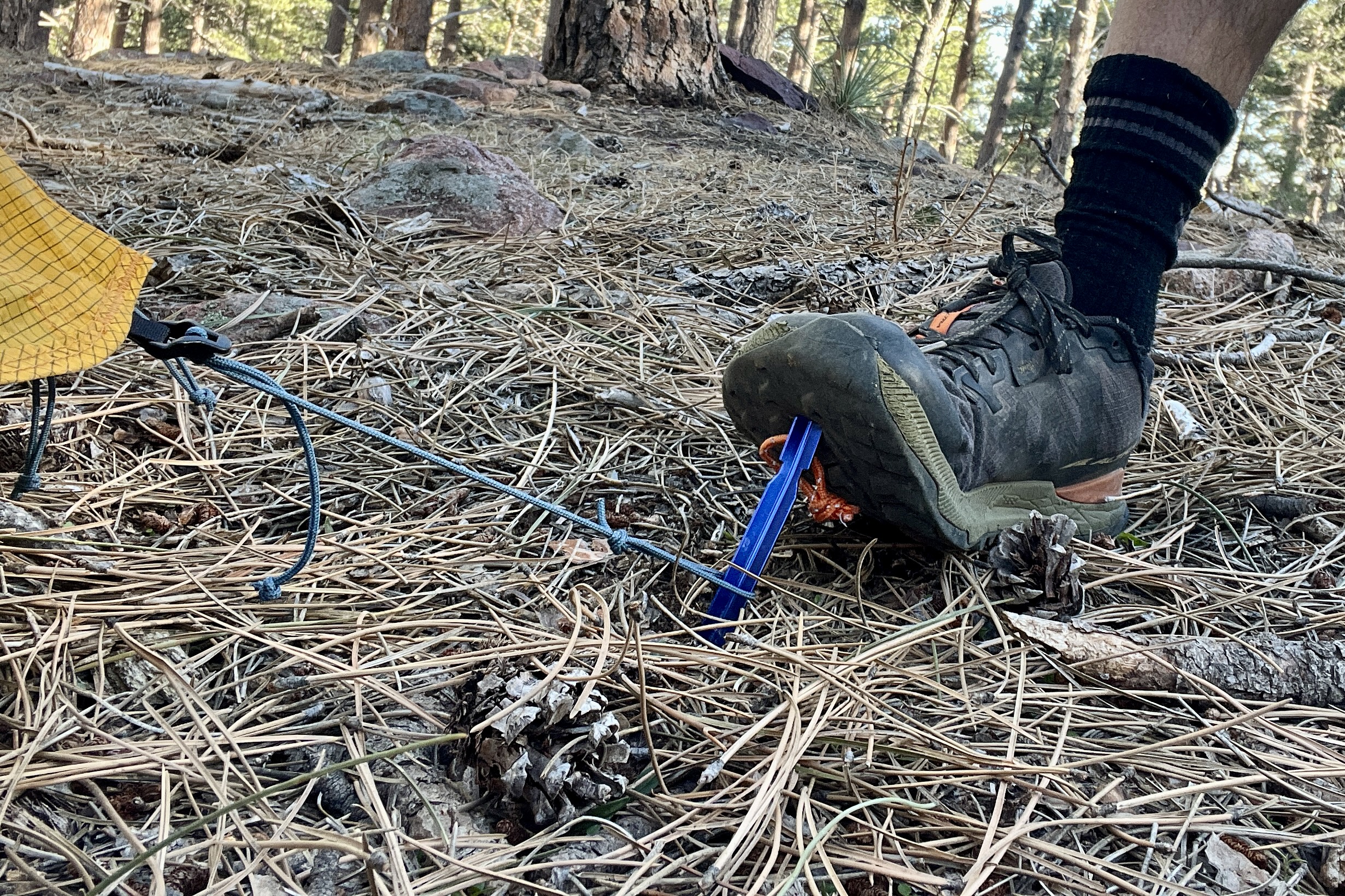
Designed with a flat top, the Snow Stakes are easy to drive into soft sand or snow with your shoe. Their high-visibility color is easy to spot, which is very handy in loose ground. Some members of the CleverHiker team even carry one of these stakes on almost every backpacking trip, as they can double as a trowel to dig catholes.
The Snow Stakes don’t thrive in compact or icy ground. Although they easily penetrate some softer soils and pine duff, we struggled to get them into the rocky soil of Colorado’s high desert. In some cases, it was virtually impossible. Their wide tip makes them impractical for such situations unless you’re willing to go through the hassle of digging out a hole to use them as deadman anchors.
At $8 per stake, the REI Snow Stakes are more expensive than many standard alternatives. Considering their specialization for snow and sand, however, they strike us as a solid all-around value – great for tossing into your winter or beach camping kit.
REI Steel Stake
Most Durable Tent Stakes
CleverHiker Rating: 4.3/5.0
Cost Per Stake: $3
Weight: 2.7 oz.
Length: 8.3 in.
Best Use: Car camping
Pros
- Affordable
- Durable
- Easy to drive in/pull out
- Lenght provides good holding power
Cons
- Heavy for backpacking
- Difficult to drive in without a mallet
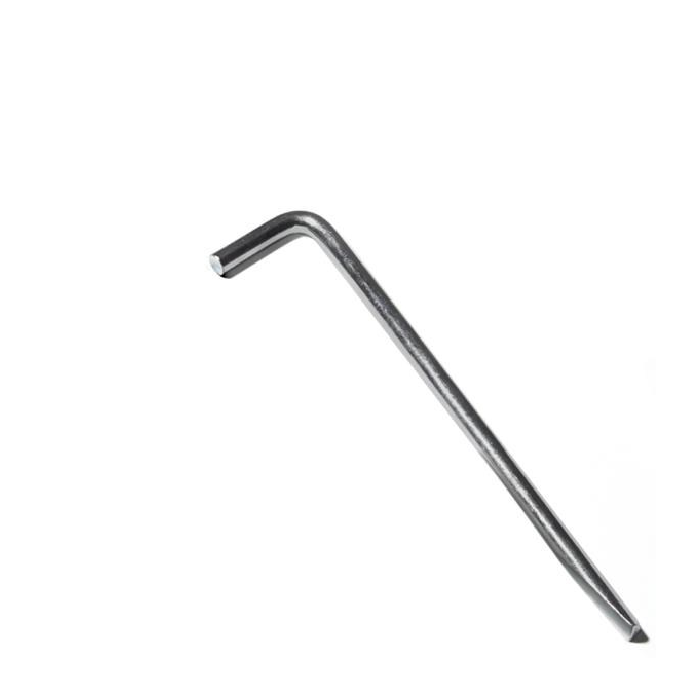
The affordable and durable REI Steel Stakes are our go-to for car camping when weight savings take a backseat to bombproof stability. These heavy-duty stakes are over 8 inches long, providing excellent holding power in pretty much any type of terrain, from soft soil to rocky ground.
What really sets these stakes apart is their strength. You can pound the heck out of them with a mallet without worrying about bending or breaking, even in tough, rocky soil. The 8.3-inch length provides confidence-inspiring holding power, especially in windy conditions where shorter stakes tend to fail.
However, the blunt ends do require more force to drive into the ground – that’s where a mallet comes in handy. Without one, it can be a struggle to get them in deep enough, particularly in compact soil.
Although the Steel Stakes do a great job securing your tent, the simple, right-angle end design doesn’t hold guylines as securely as some other stakes. It’s a little inconvenient but not a dealbreaker, in our opinion.
For the price, you’d be hard-pressed to find better durability or reliability. Ounce-counting backpackers will want to look elsewhere, but these stakes are a strong value for car campers looking to maximize performance for their dollar.
REI Aluminum Hook
Best Hook Tent Stakes
CleverHiker Rating: 4.3/5.0
Cost Per Stake: $3
Weight: 0.5 oz.
Length: 7.3 in.
Best Use: All-around
Pros
- Affordable
- Lightweight
- Versatile
- Durable
- Length/width means they'll hold well in most terrain
- Easy to drive in/pull out
Cons
- Not as good in loose sand
- The head is difficult to strike with a mallet
- No stuff sack
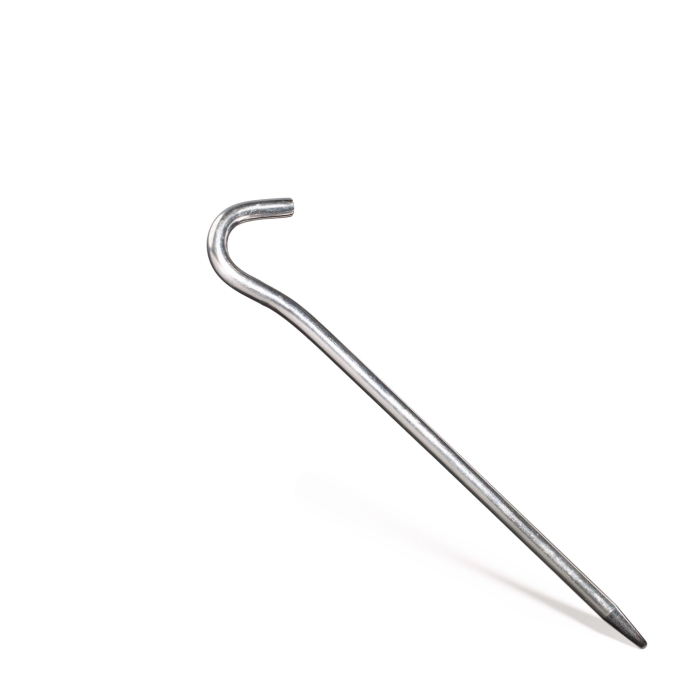
We’ve tested the REI Aluminum Hooks across all sorts backcountry environments, and they have continually impressed us from a value standpoint. At $3 per stake, these classic shepherd’s hooks provide versatile performance at a reasonable price.
These 7.3-inch aluminum stakes are both lightweight and quite durable. Although we were able to bend them slightly by hand when we gave it our all, the stakes stayed pretty solid when being driven in with a rock or foot. As long as you don’t go crazy trying to pound them into rocky soil, they should keep their basic shape for a long time.
At about 0.5 ounces per unit, the Aluminum Hooks toe the line between ultralight stakes and robust car camping anchors. Though dedicated gram-counters might prefer featherweight titanium or carbon alternatives, most recreational backpackers should find the minor weight penalty entirely acceptable considering these stakes’ enhanced reliability and palatable price.
The 7.3-inch length is a bit on the longer side, providing plenty of meat to maximize security. The shepherd’s hook design penetrates soft, loamy soil with ease and offers moderate holding power. In more challenging, compacted ground, the width of the stakes makes them significantly harder to drive in.
Though the head is difficult to hit with a mallet, the hook makes it easy to securely attach guylines. Unfortunately, the stakes do not come with an included stuff sack, but that’s not a huge downside for most folks.
Zpacks 6″ Ultralight Titanium
Most Packable Tent Stakes
CleverHiker Rating: 4.2/5.0
Cost Per Stake: $3
Weight: 0.19 oz.
Length: 6 in.
Best Use: Backpacking
Pros
- Ultralight
- Very packable
- Good in compact/rocky soil
- Easy to remove
Cons
- Not the best holding power
- Bends easily
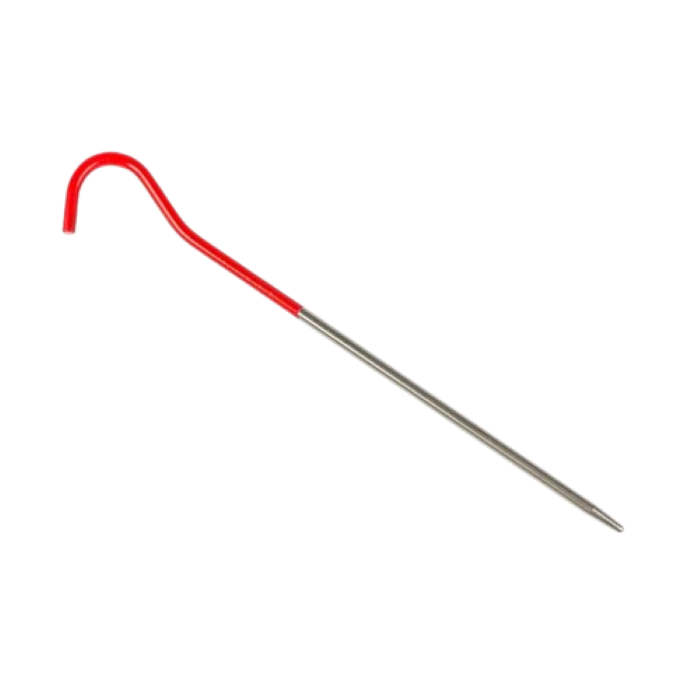
The Zpacks 6″ Ultralight Titanium stakes are among the lightest you’ll find, making them ideal for discerning ounce-counters. Despite their low weight, they offer very respectable performance in compact or rocky soil. The titanium construction provides strength without adding bulk, and their classic shepherd’s hook shape is tried-and-true.
One of the biggest advantages of the Ultralight Titanium stakes is their thin profile. It makes them ideal for slipping between rocks or roots, where bulkier stakes struggle. The stakes go in with ease, even in moderately firm soil, and they pack down incredibly small. The bright-orange heads are a thoughtful touch, making the stakes highly visible and less likely to get lost in the dirt.
That said, these stakes have minimal holding power in loose or soft soil, so you’ll likely need to use rocks or additional weight to hold them down. They’re also very easy to bend, so we recommend being careful when pushing them into hard ground (never pound on them with a rock). Thankfully, titanium is very strong for its weight, so it’s unlikely you’ll actually snap the stakes.
At $3 per stake, the Ultralight Titanium stakes are a solid value for backpackers looking to lighten their load. They’re not the most versatile or robust choice, but they should have a decent lifespan if you treat them with care.
Vargo Titanium Stake
Best Ultralight Tent Stakes for Rocky Ground
CleverHiker Rating: 4.2/5.0
Cost Per Stake: $4
Weight: 0.28 oz.
Length: 6.5 in.
Best Use: Backpacking, especially in compact/rocky terrain
Pros
- Ultralight
- Thin design makes it easy to get between rocks/roots
- High-visibility top
- Easy to drive in/pull out
Cons
- Bends easily
- Holding power isn't as good in soft ground
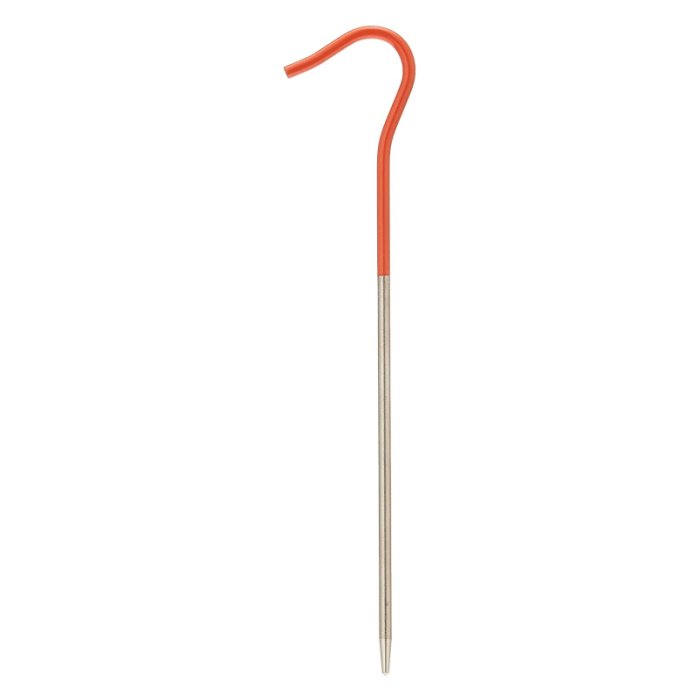
The Vargo Titanium stakes are an excellent choice for ultralight backpacking in the Mountain West. Weighing just 0.28 ounces and measuring 6.5 inches in length, these stakes feature a thin design that makes them adept at slipping between rocks and roots, which can be a real challenge with bulkier, thicker stakes.
One handy feature is the rubber coated, high-visibility top, which makes the stakes easy to spot when it’s time to pack up. The thin profile and classic shepherd’s hook shape make them just as easy to remove as they are to put in.
Because they are so thin, they are prone to bending. At the same time, the strong titanium construction means they will bend quite a bit before they break. This can be an issue if you need to really pound them into the ground in tough conditions.
Though they are decently long, their holding power isn’t as strong in soft or sandy soil, where a heavier, more robust stake would provide better anchoring. That said, you can still make these work in soft ground by supplementing with rocks or natural anchors.
At $4 per stake, the Vargo Titanium stakes are a decent value compared to other ultralight options, some of which cost nearly three times as much. You can certainly spend up for a higher level of performance, but weight- and price-conscious backpackers in rocky environments like Colorado will find a lot to like.

Product Comparison Table
| oSort | Product | Cost Per Stake | Weight | Length | Best Use | Durability | Weight & Packability | Holding Power | Ease of Use | 0 |
MSR Groundhog & Mini-Groundhog View MSR Groundhog View MSR Mini-Groundhog |
$7 / $6 | 0.49 oz. / 0.33 oz. | 7.5 in. / 6 in. | Backpacking | 4.6 | 4.5 | 4.7 | 4.6 | 1 |
NEMO Sweepstake View at REI View at Amazon |
$5 | 0.7 oz. | 7 in. | Tenting in mud | 4.7 | 4.2 | 4.5 | 4.8 | 2 |
NEMO Airpin View at REI View at Amazon |
$5 | 0.18 oz. | 6 in. | Backpacking, especially in compact/rocky terrain | 4.5 | 4.7 | 4.2 | 4.6 | 3 |
All One Tech Aluminum View at Amazon |
$1 | 0.49 oz. | 7 in. | All-around | 4.5 | 4.5 | 4.5 | 4.6 | 4 |
Orange Screw Ultimate Ground Anchor View at Amazon |
$7 | 1.8 oz. | 9.5 in. | Anchoring large shelters | 4.5 | 3.7 | 4.9 | 4.7 | 5 |
MSR Carbon-Core View at Amazon View at Backcountry |
$13 | 0.2 oz. | 6 in. | Ultralight backpacking | 4.4 | 4.9 | 4.3 | 4.4 | 6 |
TOAKS Titanium V-Shaped Peg View at Amazon View at TOAKS |
$4 | 0.4 oz. | 6.5 in. | Backpacking | 4.3 | 4.6 | 4.6 | 4.3 | 7 |
REI Snow Stake View at REI |
$8 | 1 oz. | 9.6 in. | Camping in snow/sand | 4.5 | 3.8 | 4.8 | 4.3 | 8 |
REI Steel Stake View at REI |
$3 | 2.7 oz. | 8.3 in. | Car camping | 5.0 | 3.5 | 4.5 | 4.3 | 9 |
REI Aluminum Hook View at REI |
$3 | 0.5 oz. | 7.3 in. | All-around | 4.5 | 4.3 | 4.2 | 4.1 | 10 |
Zpacks 6″ Ultralight Titanium View at Zpacks |
$3 | 0.19 oz. | 6 in. | Backpacking | 3.8 | 5.0 | 4.0 | 3.9 | 11 |
Vargo Titanium Stake View at Amazon View at Garage Grown Gear |
$4 | 0.28 oz. | 6.5 in. | Backpacking, especially in compact/rocky terrain | 3.8 | 4.7 | 4.3 | 3.9 |
|---|
Analysis & Results
Which Tent Stakes are the Best Value?
We interpret value as the average of all testing metrics compared with price to find the absolute best bang for your buck.
Without question, the All One Tech Aluminum Stakes deliver the most value. They are the cheapest option on our list and boast solid all-around performance. They have decent holding power in various soil types, check in at a reasonable weight, are easy to use, and last a long time.
A similar stake to the All One Techs – but with a touch more practical functionality – is the MSR Groundhog. It’s more expensive but notably more durable and stable in various substrates, likely due to its extra half-inch of length.
A few other stakes worth mentioning are the REI Steel Stake, REI Aluminum Hook, and TOAKS Titanium V-Shaped Peg. All three designs outperform their price tags, in our experience. They are not without downsides, of course, but we consider them high-quality options for camping (the REI Steel Stake) and backpacking (the REI Aluminum Hook and TOAKS Titanium).
Which Tent Stakes are the Most Durable?
As with most ultralight gear, durability is almost directly correlated to weight. More durable gear is usually made from thicker and heavier materials, thus the trade-off.
It doesn’t get more durable than the solid steel of the REI Steel Stakes. Although their blunt tips hinder them from easily penetrating the earth, they make up for it by being able to handle severe abuse from a heavy mallet.
The most durable of the lightweight tent stakes on our list in the NEMO Sweepstake. The Y-shaped design is incredibly rigid. It won’t show much wear beyond some scratches from normal use, and we couldn’t even get it to bend significantly after hammering it into rocky soil.
The MSR Groundhog also impressed us with its balance of weight and durability. As a similarly Y-shaped stake, it’s slightly less durable than the Sweepstake but a little lighter.
Which Tent Stakes are the Lightest & Most Packable?
The lightest tent stakes are typically made of titanium or carbon fiber, but the most common is lightweight aluminum. Heavier metals like steel are usually reserved for applications where weight is less important, such as car camping.
The lightest stakes on our list are the Nemo Airpins (0.18 ounces per stake), followed closely by the Zpacks 6″ Ultralight Titanium (0.19 ounces each). On our scale, the Airpins weighed a little more at 0.3 ounces each, while the Zpacks were very close to their listed weight at 0.2 ounces. Both designs are 6 inches long, although the Zpacks are a little less bulky – which can add up if you’ve got several of them in your kit.
The MSR Carbon Core stakes are of similar weight (0.2 ounces each) but don’t pack down quite as small due to their thicker construction and wide top. Still, they are a great option for ultralight backpackers who don’t mind making some sacrifices in the name of weight savings.
The Vargo Titanium stakes are also competitively lightweight. However, they are half an inch longer than the options mentioned above and carry a little extra weight from their painted top. They still pack down very neatly.
Which Tent Stakes Have the Best Holding Power?
When planning a backpacking trip, it’s important to take into consideration the type of soil (and weather) you’ll be encountering, so you can choose the proper stake to secure your gear.
It’s not surprising that the corkscrew shape of the Orange Screw Ultimate Ground Anchor has the best holding power to anchor the heaviest shelters in the harshest storms. They prefer moderately compact soil, but once seated properly, they are all but bombproof.
The REI Snow Stakes have the second-best overall holding power with their 9.6-inch length and U shape. They are specifically designed for snow and sand but will hold fast in any type of soil you can get them into.
Among the unspecialized tent stakes, the MSR Groundhog performed the best all around. Their Y-shaped construction provides enough holding power for most backpacking purposes, and they go in pretty easily, too.
Which Tent Stakes are the Easiest to Use?
The NEMO Sweepstake is one of the most unique and practical tent stake designs we’ve ever seen. Its Y-shaped profile with a pointed tip makes it easier to get into firm, stubborn ground. The shape also naturally creates a wide, flat top for pushing on with a rock or shoe. However, the most unique element of the Sweepstake is its dedicated, glow-in-the-dark stake cleaner. It not only helps you find your stakes in the dark but cleans the mud off the stake in a fraction of a second.
Though many stakes may have you trying a slew of methods to get them to penetrate the earth – stomping with your shoe, pushing with a rock, taking your frustrations out on it with a hammer – the Orange Screw Ultimate Ground Anchors are built with a corkscrew design that requires nothing more than a turn of the wrist. They even include a little handle for better leverage.
Our favorite shape for hassle-free tent stakes is the Y shape. They hold strong in most soil types, are easy to hit with a rock, and are durable. The All One Tech Aluminum Stake and MSR Groundhog are both designed with this shape and even come with a pre-attached, high-visibility pull cord.
Last but not least, the NEMO Airpin utilizes a unique head shape that eliminates the need for knots or automatic tensioners. It takes a little getting used to, but with some practice, it offers lightning-fast adjustability.
How to Choose Tent Stakes
Which Material is Best for a Tent Stake?
The answer to this question will largely depend on your intended use(s) and preferences on weight versus durability and cost.
Plastic stakes are typically the most affordable, but they’re also some of the least durable and versatile. Plastic can snap and break easily, which can be problematic when you’re deep in the backcountry. They may get the job done for car camping, but we would recommend having some backups in your kit.
Steel stakes are another affordable option for frontcountry camping. They are super durable, so you can pound them in with a mallet without worrying about bending or breaking. However, most steel stakes are heavier than we prefer for backpacking.
Aluminum stakes are a great value because they balance low weight, durability, and versatility. Aluminum stakes are typically a good choice for backpackers who aren’t concerned with saving every gram of pack weight.
Ultralight tent stakes made from titanium and carbon fiber often weigh just fractions of an ounce but can get pretty spendy. Durability can be a concern, too. Titanium bends relatively easily, while carbon fiber is prone to snapping. Once you press too hard in the wrong direction, there’s no going back.
Which Shape Tent Stake Should You Choose?
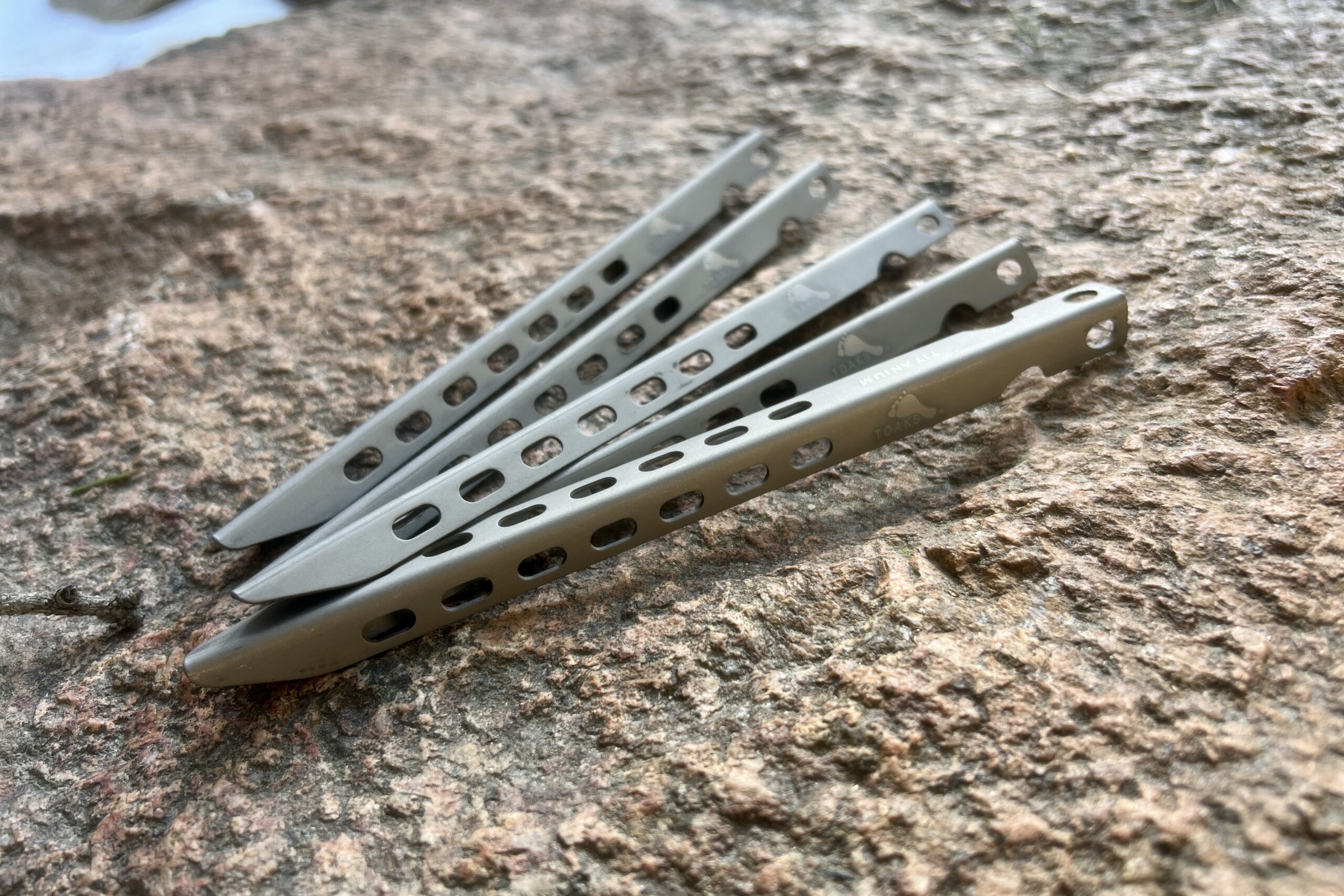
Generally, the longer the tent stake and the more surface area it has, the better the holding power. Y-shaped stakes provide excellent security in all types of terrain. They’re more durable and harder to bend than other stake shapes, but they can be tougher to get around rocks buried in the ground.
V stakes are well suited for loose terrain. Sand and snow settle into the holes in the shaft, giving them excellent holding power in soft ground. However, V stakes made from aluminum or titanium may bend easily if driven too hard into compact ground or rocks.
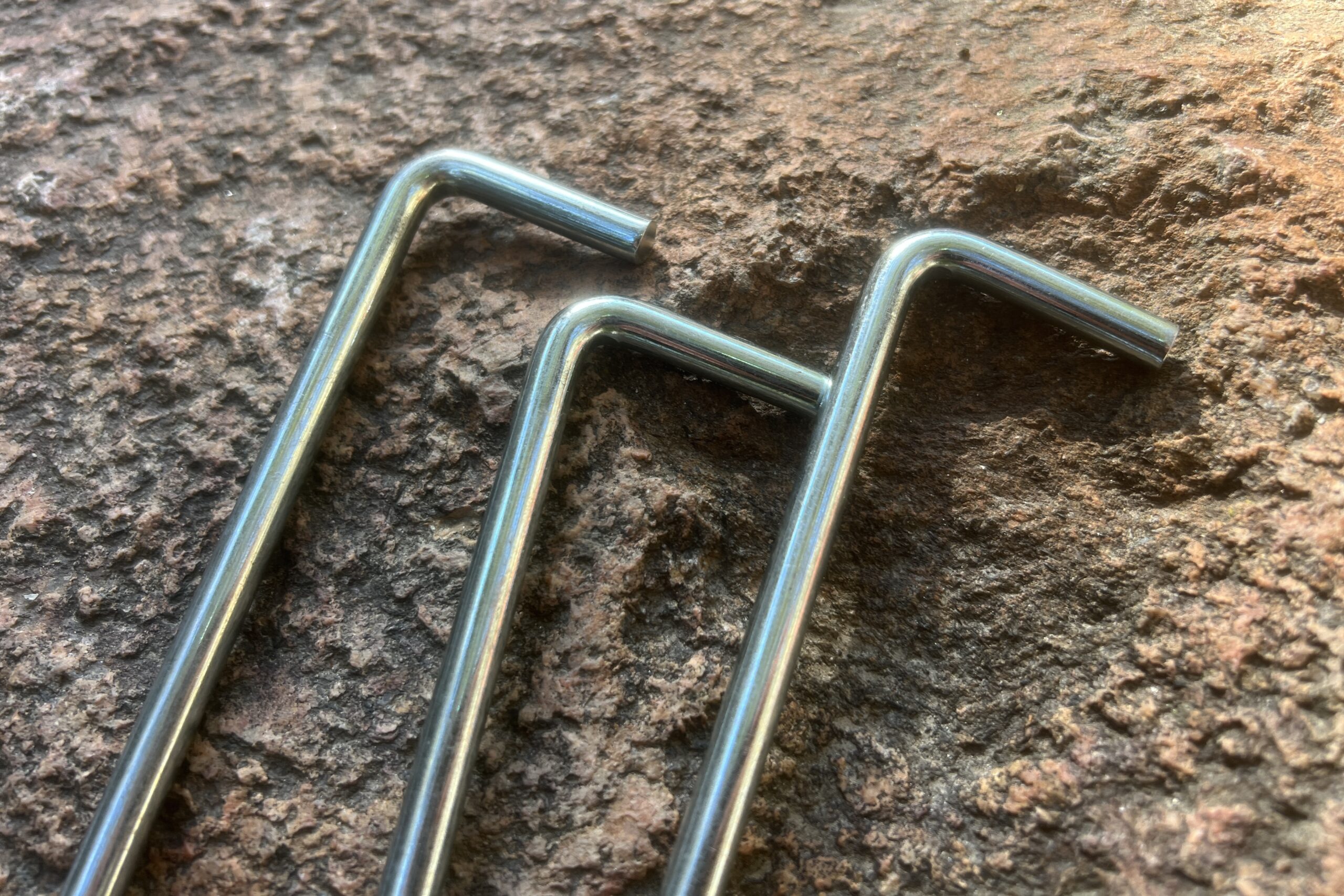
Shepherd’s hook stakes are typically very lightweight. They’re thinner than Y and V stakes, so they’re easier to slip in between roots and rocks. That said, the thin diameter reduces their holding power and makes them more susceptible to bending.
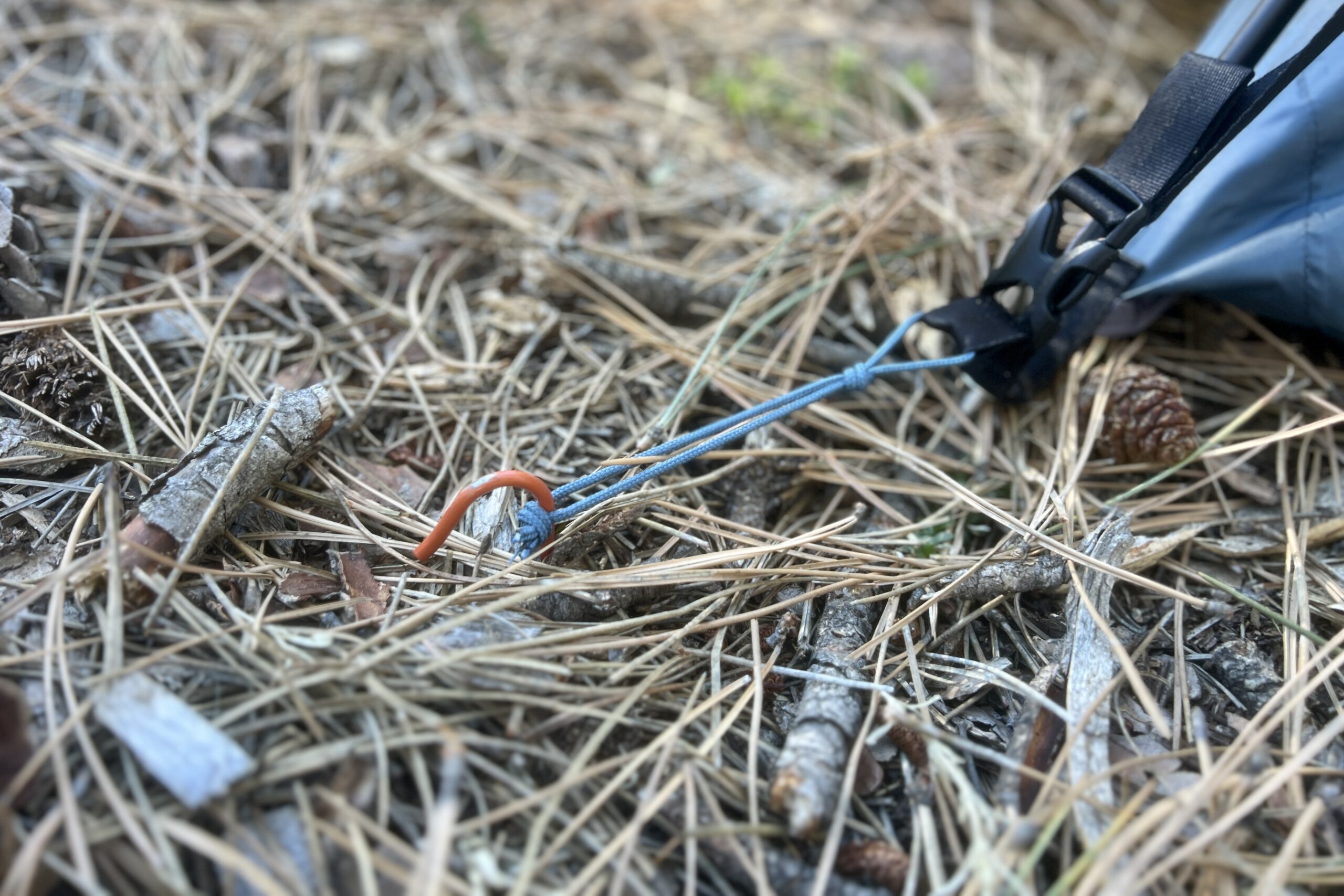
Nail stakes are typically very lightweight, but they usually have a less prominent notch for securing a guyline. Nail stakes with thicker diameters will have decent holding power, but they will generally need to be reinforced with a rock.
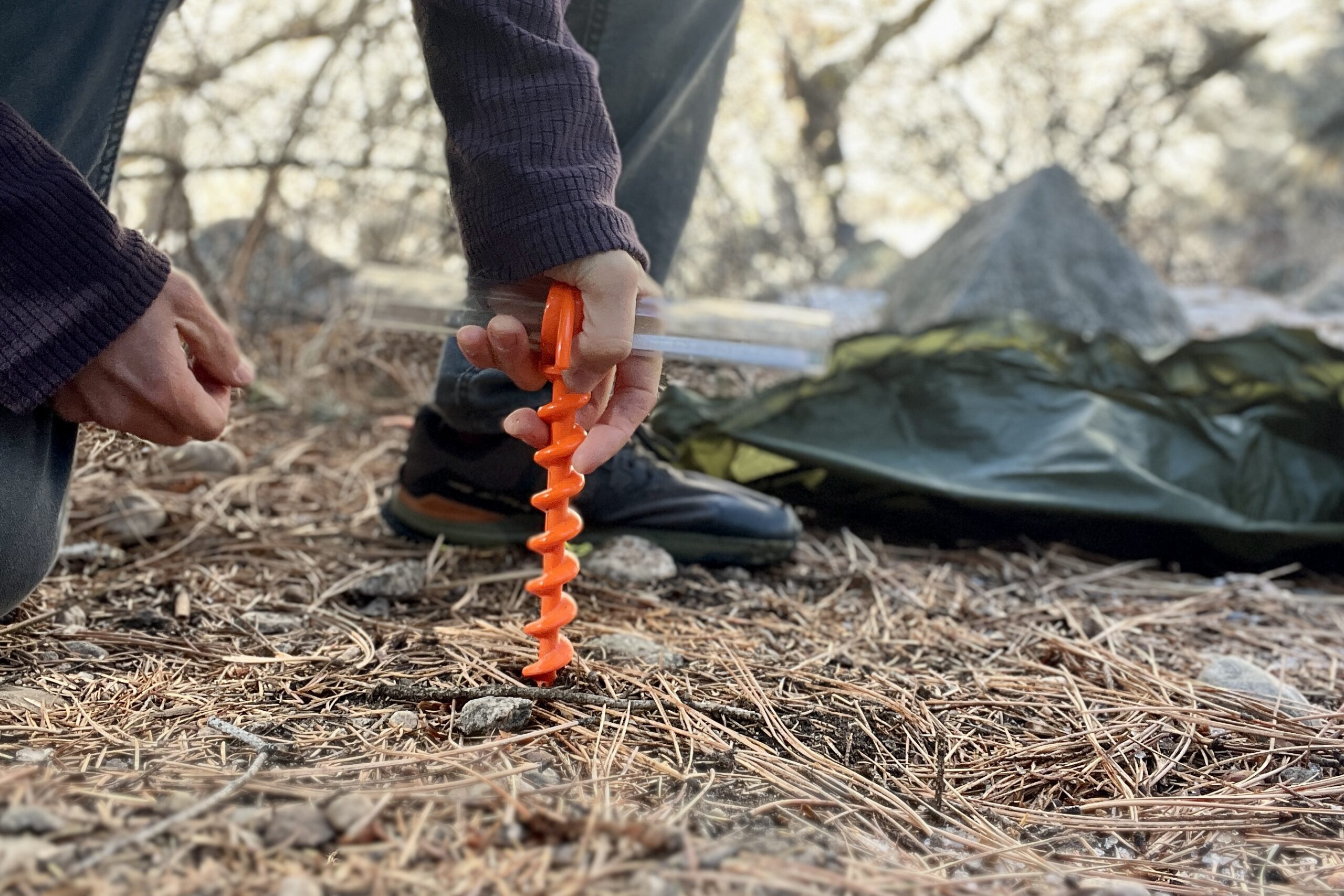
Screw stakes have a specialized shape that will provide excellent hold in any type of ground you’re able to drive them into. We often turn to screw stakes for car camping or securing sun shades in sand.
How Much Should Tent Stakes Weigh?
The short answer is that it depends on your use case. Starting at the ultralight end of the spectrum, stakes around 0.2 ounces each (or less) will appeal to weight-conscious backpackers who count every gram. They often make sacrifices in areas like durability and holding power but take up minimal space and aren’t a burden to carry over long distances.
For general backpacking, stakes in the 0.3- to 0.5-ounce range are perfectly acceptable. The added weight and bulk won’t be noticeable for most, and you can expect added benefits in the form of increased longevity and improved security.
For car camping, weight and bulk are less of a concern, so you can get away with much heavier stakes. There really is no weight limit here, but some of our favorites for car camping check in at well over an ounce each. Some steel stakes are closer to 2 or 3 ounces. If you plan to do a lot of camping in sand, snow, or windy weather, you can expect to be looking in this range, as longer stakes generally weigh more (see the next section for more info on length).
What’s the Best Length for Tent Stakes?
There’s no one-size-fits-all length for tent stakes – the ideal length will depend on factors like terrain type, conditions, what what type of structure you are trying to secure. For most backpacking purposes, 6- to 7-inch stakes are standard. They can be hammered deep enough into the earth to provide adequate holding power in most terrain.
If you will be camping on sand, snow, or other very soft surfaces, a longer stake (7.5 to 9.5 inches) will offer increased holding power. This can be helpful in extremely windy environments, too. The added material often translates to increased weight and bulk, but the boost in security can be invaluable whether you’re camping on the beach or hunkering down in a snow storm.
Why Trust CleverHiker
Gear analyst Brett Kretzer has spent years backpacking through diverse landscapes, from the rocky terrain of the Spanish Pyrenees to the mossy, rooted boreal forests of New England. He’s completed thru-hikes like the Long Trail, Colorado Trail, and the GR11, along with sections of the Pacific Crest and Appalachian trails. Brett also has spent over half a decade testing and scrutinizing backpacking gear.
Testing Methodology
How Do We Measure Durability?
Most people have experienced the frustration of using a tent stake that is severely bent from excessive use. To determine a stake’s durability, we noted whether or not we could simply bend it by hand and then took our frustrations out on it with the heaviest mallet we had. We paid attention to scratches, deformation, and other indicators of wear throughout testing.
Though durability might hold little to no importance for ultralight backpackers tenting in mostly soft to moderately compact soil, it’s paramount in other situations, such as car camping with large shelters on tough ground – where you have to muscle your stakes in with a heavy-duty mallet.
How Do We Assess Weight & Packability?
When you’re hoofing it through the mountains for 10 to 20 miles day after day, each and every ounce makes a difference. Our score for this metric is a combination of the stake’s measured weight and how small it packs down. We compared our measurements to the manufacturers’ stated specifications, noting any sizable discrepancies. Some stake sets even come with a handy stuff sack, which we factored in.
How Do We Evaluate Holding Power?
To gauge holding power, we considered each stake’s shape and overall design and evaluated its performance in varied terrain. Each style has its strong suits and weaknesses (e.g., Y-shaped stakes hold really well in packed soil but can be a pain to get into rocky terrain), which we factored into our rankings. We staked down backpacking tents, camping tents, and sun shades. If a stake performed well across the board, it received bonus points for versatility.
How Do We Gauge Ease of Use?
Most tent stakes are pretty straightforward to use, but some are designed to make your life just a little bit easier. They may have integrated pull cords, a wide and flat top for hitting with a mallet, high-visibility elements, or even a dedicated stake cleaner to sweep off the mud. We consider this the lowest-priority metric, but a practical design gains a few bonus points.
Conclusion
When the weather turns unexpectedly or the ground gets tricky, having the right stakes can make all the difference in keeping your shelter secure. Our favorite stakes for backpacking effectively balance weight, packability, and holding power, while our go-to car camping stakes are unapologetically beefy and tough. Each shape has its pros and cons, but Y-shaped stakes are arguably the most versatile and well rounded option for most. We hope this guide has led you one step closer to dialing in your perfect backpacking or camping kit!