
Bottom Line
The REI Trailmade 60 (men’s / women’s) is a straightforward first backpack for someone who values durability and simplicity over premium suspension or low weight. We grew to appreciate how quickly its layout makes sense: bottle pockets are accessible, hipbelt storage is generous, and solid-material construction avoids some of the snag-prone mesh used elsewhere in the category.
Its suspension is competent rather than exceptional, with less refined pressure distribution than the Gregory Paragon and less airflow than the Osprey Exos. The current Trailmade makes its strongest case to newer backpackers who want a durable, familiar pack that asks very little of them on trail.
Editor’s Note: The REI Trailmade has been updated since our review, and our coverage below reflects the past model. The two designs are largely similar, though the front shove-it pocket has changed, and there is now U-shaped access to the main compartment.
How We Tested
On Minnesota trails, Taylor Passofaro evaluated the current Trailmade 60 with an emphasis on its foam-and-frame suspension, lumbar feel, bottle and hipbelt-pocket access, material durability, and beginner-friendly organization. We also paid attention to how easily a new backpacker could fit, load, adjust, and use the pack without a complicated setup routine.
Quick Specs
- Best for: beginner backpackers who want durable construction, simple organization, and good value
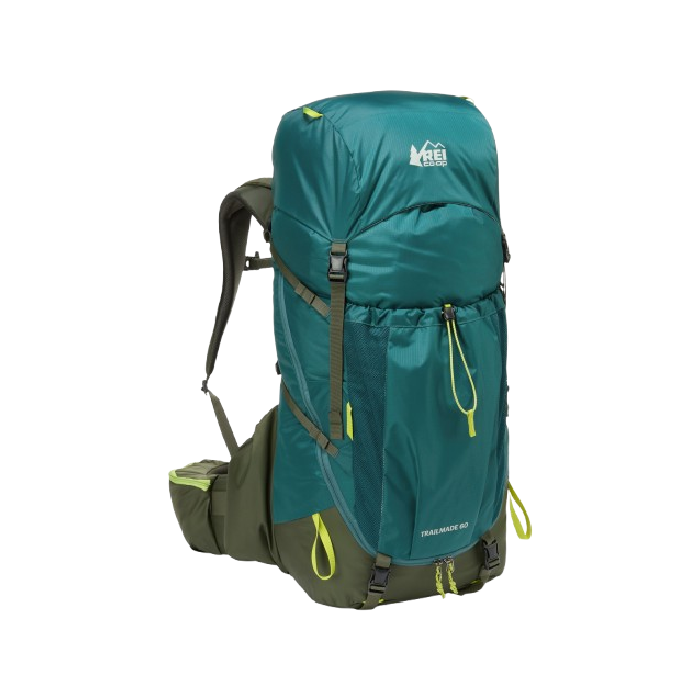
REI Trailmade 60
Backpacking Pack with Classic Styling & Great Price
CleverHiker Rating: 4.4/5.0
Price: $189
Measured Weight: 3 lb. 4.5 oz.
Volume: 60 L
Max Weight Rec.: 35 lb.
Pros
- Durable material selection and construction
- Good water bottle access
- Great feature set for beginners
Cons
- Too close in price to lighter and more featured packs
- Average comfort

Comfort
The Trailmade’s suspension is competent enough for ordinary backpacking loads, but comfort is not what elevates this pack. Its straightforward foam, frame, and lumbar channel kept the load controlled and add some airflow, yet pressure distribution feels less refined than the Gregory Paragon or Deuter Aircontact Ultra. That gap is why comfort settles at 3.9 rather than becoming a selling point.
The Trailmade uses a conventional suspension: broad foam on the back, a substantial hipbelt, and reasonably thick shoulder straps. That approach does not create a dramatic first impression, but it handled a 30-pound test load without making the frame feel overloaded. The hipbelt tightened easily and carried weight on the hips as intended. We also appreciated that the back panel spreads contact over broad foam sections rather than concentrating force on narrow ridges.
The gap through the lumbar padding is intended to create some airflow, although that same shape could become a pressure point for someone whose lower back does not line up well with the design. This is the main reason we describe comfort as average rather than poor. The Trailmade provides competent support for beginner-oriented loads, but it lacks the more refined pressure distribution, ventilation, and fit tuning found on the category leaders.
Comfort Score: 3.9 / 5.0

Features
Beginners get the right kinds of storage without having to decode a complicated pack. Large hipbelt pockets, reachable bottle pockets, a sleeping-bag compartment, and familiar exterior storage cover the basics cleanly, which is enough for a 4.3 feature score. More advanced packs add faster access and modularity, but the Trailmade’s restraint is useful for someone still learning which features matter.
For a beginner pack, the Trailmade provides the systems most people expect without forcing the user to learn a complicated layout. Large hipbelt pockets, accessible side bottle pockets, familiar external storage, compression, and a separate lower compartment create an intuitive place for the common categories of backpacking gear. The water-bottle pockets are especially successful because they are easy to reach while wearing the pack, which is not a given at this price.
The front stretch area also handles a puffy or wet layer without needing to open the main compartment. What the Trailmade lacks is the modularity of the Flash, the side access of the Paragon, or the huge organization suite of the Atmos. That simplicity is appropriate for its intended buyer, but experienced hikers with established packing routines may miss specialized attachment or access options.
Features Score: 4.3 / 5.0

Durability
Solid materials do more for the Trailmade’s case than flashy features. Nylon replaces exposed stretch mesh in several high-use areas, and the hipbelt pockets feel less vulnerable than thin mesh alternatives, giving the pack a 4.6 durability score. That matters for newer backpackers who may be less precious about setting a pack down or brushing against rough surfaces.
REI makes an unusually conservative material choice here, and that is one of the strongest reasons to recommend the Trailmade to new backpackers. The pack largely avoids mesh, which removes a common snag and abrasion point from the side pockets and external storage. We pulled on seams during testing and found them tight and well constructed, and the face fabric feels substantial enough to tolerate the ordinary mistakes beginners make when setting a pack on rough ground or brushing against trees.
The use of recycled fabrics and Bluesign-certified materials is a secondary benefit, but the primary takeaway is structural simplicity. There are fewer delicate panels to protect and fewer high-tension mesh zones to fail. That does not make the Trailmade expedition gear, but for established trails and occasional weekend trips, the construction inspires more confidence than many similarly priced packs.
Durability Score: 4.6 / 5.0

Ease of Use
The Trailmade makes sense almost immediately, which is a meaningful advantage for a first pack. A conventional harness, good bottle access, practical hipbelt pockets, and familiar organization keep setup simple enough for a 4.6 ease-of-use score. It sacrifices advanced access and customization, but fewer systems also means fewer things for a beginner to misconfigure.
The Trailmade’s usability is rooted in familiarity. The harness is easy to fit, compression straps work the way most backpackers expect, and the organization pattern does not require explanation. Bottle pockets can be reached while walking, hipbelt storage is practical, and the lower compartment gives beginners an obvious home for a sleeping bag or other bulky item. The pack also avoids the unusual rerouting, removable modules, and dense adjustment systems found on more technical designs.
That means a new backpacker can focus on load placement and fit rather than remembering how a proprietary feature works. The downside is that simplicity limits speed in a different way: there is less specialized access to buried gear, fewer ways to customize exterior carry, and less adaptability as a user’s kit changes. For its intended audience, however, the low learning curve is one of the Trailmade’s clearest strengths.
Ease of Use Score: 4.6 / 5.0

Should You Buy the REI Trailmade 60?
The Trailmade 60 makes sense for a first-time backpacker who wants a durable, uncomplicated pack and does not want to spend much time learning a complex adjustment system. Its bottle access, large hipbelt pockets, and simple organization work well from the first trip. Hikers who expect to backpack frequently may outgrow it sooner because the suspension and feature set are more basic than the category leaders. The REI Flash 55 is the better long-term option for someone already thinking about a lighter, more adaptable kit.

What Other Backpacking Backpacks Should You Consider?
REI Flash 55 Review: Spending more on the Flash buys lower weight, a more adaptable feature set, and a pack with more room to grow alongside a lighter kit. The Trailmade remains simpler and durable, but the Flash is easier to recommend for backpackers who expect their kit and ambitions to evolve.
Kelty Asher 55 Review: The Asher is worth considering if keeping the purchase price as low as possible matters more than polished access and material refinement. It surprised us with decent load comfort, while the Trailmade offers the cleaner beginner experience overall.
Gregory Paragon 60 Review: Frequent backpackers will notice the Paragon’s major jump in suspension refinement and trail access over this beginner-oriented design. It costs substantially more, but its smoother load transfer and better-rounded feature set make sense for frequent backpackers.