Bottom Line
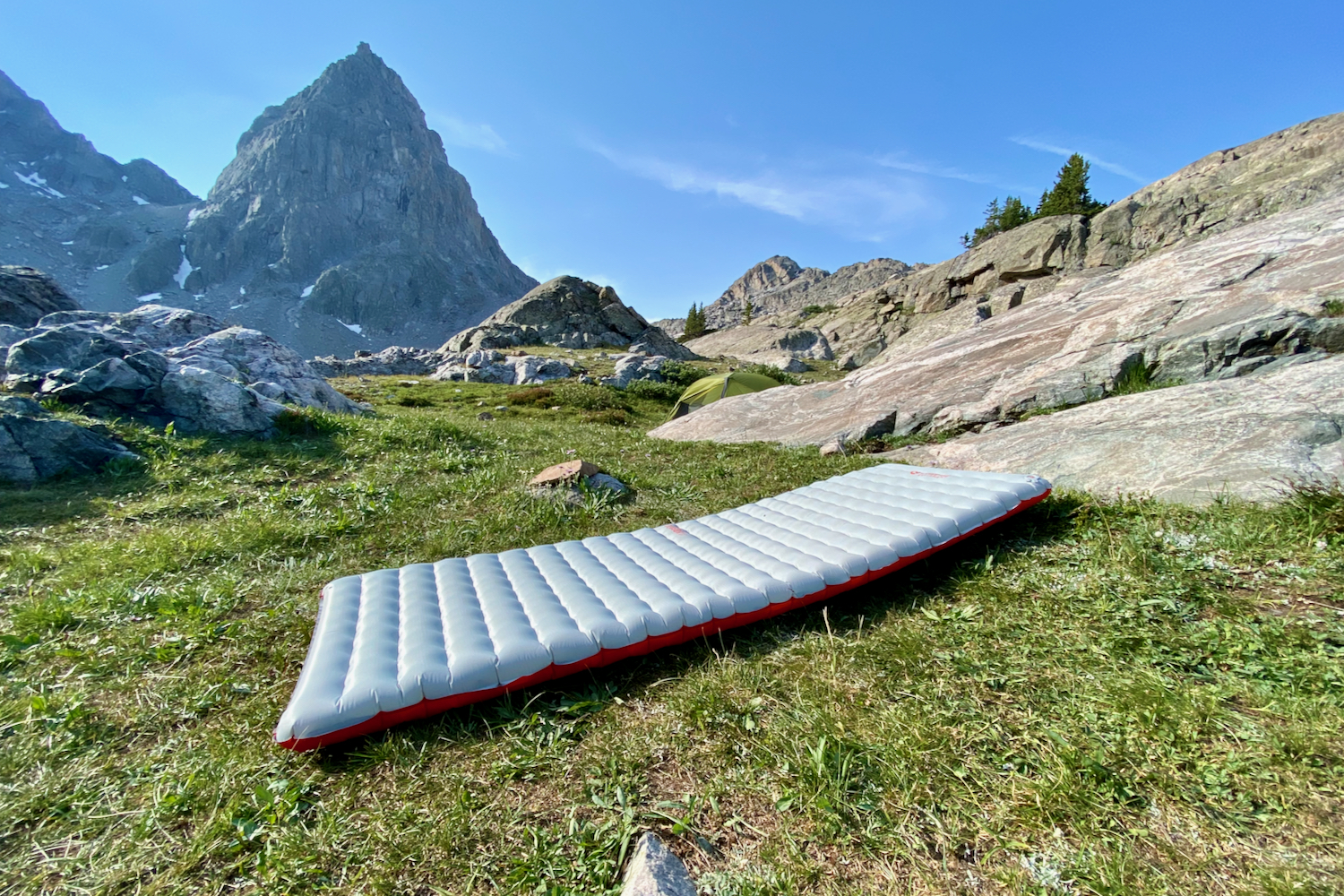
The NEMO Tensor All-Season is our favorite overall backpacking sleeping pad. After more than 29 nights of testing from warm summer trips to snowy nights around 23°F, it stands out for the balance we want most in a backcountry pad: excellent comfort, plenty of warmth, low weight, impressive durability, quiet performance, and one of the easiest inflation and packing systems we’ve used.
The Therm-a-Rest NeoAir XLite NXT remains an extremely close competitor and saves 1.1 ounces in comparable Regular Mummy sizes. But we think the Tensor earns that small weight penalty. It’s slightly more comfortable, has a higher R-value, and its Vortex pump sack and quick-deflating valve make daily setup and breakdown noticeably easier. It’s also currently about $10 cheaper in those comparable sizes.
It isn’t the absolute lightest pad, and dedicated winter campers should step up to something warmer for truly frigid conditions. But for backpackers who want one premium pad that can handle almost everything from summer trips through cold shoulder seasons and some mild winter use, the Tensor All-Season is exceptionally hard to beat.
Quick Specs
- Best for: Backpacking, lightweight backpacking, cold three-season and shoulder-season trips
- Tested size: Long Wide rectangular
- Tested dimensions: 76 x 25 x 3.5 in.
- Fabric: 20D nylon top / 40D nylon bottom
- Included: Vortex pump sack, stuff sack, Velcro strap, repair patches
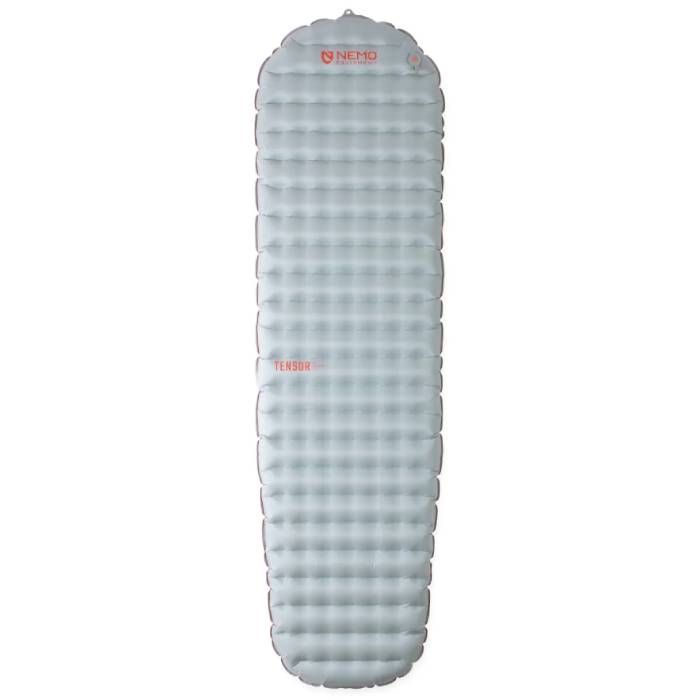
NEMO Tensor All-Season
Best Backpacking Sleeping Pad Overall
CleverHiker Rating: 4.7/5.0
Price: $200
Weight: 14.1 oz., Regular Mummy
R-Value: 5.4
Thickness: 3.5 in.
Packed Size: 4 x 10 in.
Pros
- Exceptionally comfortable
- Excellent warmth-to-weight balance
- Very lightweight for an R-5.4 pad
- Vortex pump sack is fast and easy to use
- Quick, simple deflation and packing
- Quiet for an insulated air pad
- Tougher 40D fabric on the bottom
- Excellent durability throughout our testing
- Wide range of sizes and shapes
Cons
- Not the absolute lightest ultralight option
- Premium price compared with entry-level pads
- Not our first choice as a stand-alone pad for severe winter conditions
- 20D top requires normal care around sharp objects and animal claws


Comfort
Tensor All-Season is one of the most comfortable backpacking pads we’ve used. Its 3.5 inches of cushioning give side sleepers plenty of space between their hips and shoulders and the ground, while the internal structure feels stable instead of bouncy or waterbed-like.
Our lead tester is 6’2″, changes sleeping positions throughout the night, and prefers the Long Wide rectangular version. At 76 by 25 inches, it provides enough room to move around without constantly losing an arm, leg, or foot over the side.
We also really like how easy it is to adjust the firmness. Our preferred method is to inflate the Tensor fairly hard, lie down, and use the Laylow valve to bleed out small amounts of air until the support feels right. That gives it a broad sweet spot between overly firm and so soft that hips or shoulders begin to bottom out.
The NeoAir XLite NXT comes very close, but we give the comfort edge to the Tensor. The extra half-inch of thickness and the Tensor’s sleeping surface make a small but noticeable difference over repeated nights.
Comfort Score: 4.7 / 5.0

Weight & Packability
The Tensor All-Season manages to offer substantial warmth and comfort without becoming heavy. The manufacturer-listed Regular Mummy weight is 14.1 ounces, which is exceptionally light for a 3.5-inch pad with a 5.4 R-value.
It isn’t quite the lightest premium option. A comparable NeoAir XLite NXT Regular weighs 13 ounces, so the Tensor carries a 1.1-ounce penalty. For hikers chasing the lowest possible base weight, especially those building sub-10-pound kits, that difference may be enough to favor the XLite.
For us, it isn’t. We’re highly weight-conscious, but we gladly accept the extra ounce for the Tensor’s additional warmth, slight comfort advantage, and much better inflation and packing experience.
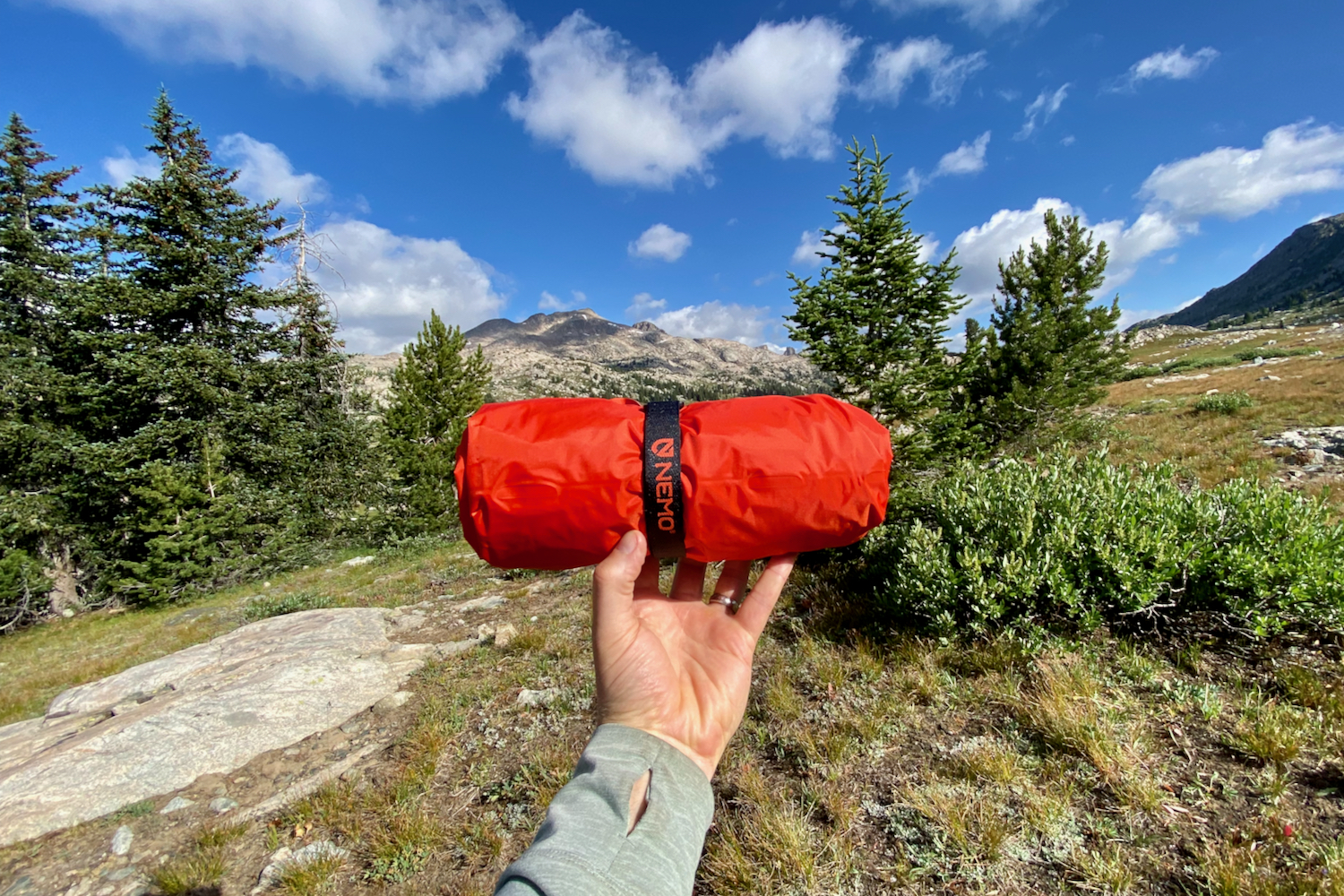
It also packs small enough that bulk has never been a meaningful concern. The listed packed size is 4 x 10 inches.
Weight Score: 4.6 / 5.0

Durability
After more than 29 wilderness nights, our test pad has had no leaks, valve issues, seam failures, noticeable abrasion, coating wear, or other deterioration.
That testing has included rocky camps, high-alpine terrain, and plenty of ordinary backcountry debris. We still use reasonable care when choosing a tent site, as we would with any lightweight inflatable pad, but nothing in our experience has made us question the Tensor’s longevity.
We particularly like NEMO’s decision to use lighter 20D nylon on top and tougher 40D nylon underneath. The bottom is the surface most likely to encounter small rocks, sticks, and other puncture hazards, so putting the more durable material there makes sense to us.
The 20D top could theoretically be more vulnerable to a dog claw or a sharp object tossed into the tent, but we consider that normal-care territory rather than a meaningful weakness. We haven’t experienced any damage there.
Durability Score: 4.6 / 5.0

Warmth
Warmth is one of the biggest reasons the Tensor All-Season works so well as a one-pad solution. Its R-value of 5.4 gives it considerably more insulation than many ultralight three-season pads without adding much weight.
We’ve slept on it down to roughly 23°F, including about five nights at or below freezing and overnight light snow. It remained warm and dependable throughout that testing.
That insulation has also changed how we think about the rest of our sleep system. Our lead tester can often pair the Tensor with a 30°F sleeping bag rather than bringing a warmer, heavier bag, and would consider a 40°F bag for appropriate summer conditions. That’s a personal sleep-system judgment rather than a temperature guarantee, but it shows how useful a warm pad can be beyond simply keeping your backside off cold ground.
We’d characterize the Tensor All-Season as an outstanding three-season and shoulder-season pad that can also handle mild winter use. It wouldn’t be our first choice as a stand-alone pad for very cold winter camping, especially when temperatures are dropping into the low teens, single digits, or below zero.
For those conditions, we’d move to a dedicated winter model such as the NEMO Tensor Extreme Conditions or Therm-a-Rest NeoAir XTherm NXT. Another common winter option is to put a foam pad underneath the Tensor. Pairing it with roughly R-2 of foam brings the combined system into approximately the R-7 range and makes it much more capable over snow and frozen ground.
Warmth Score: 4.7 / 5.0

Ease of Setup
This is the category that helped push the Tensor ahead of the XLite for us.
NEMO’s Vortex pump sack is one of the best pump sacks we’ve used. Instead of tediously blowing directly into a narrow sack, you can blow toward its opening from several inches away and pull a much larger volume of surrounding air into it. Our Long Wide pad generally takes only about four or five fills.
The Laylow valve also works very well for fine-tuning pressure once we’re lying on the pad.
Breaking camp is even better. Opening the Tensor’s deflation valve releases air quickly, and we can usually roll it tightly and put it away without fighting trapped pockets of air.
That contrasts with our experience with the NeoAir XLite NXT. Its included pump sack is basic enough that we generally don’t think it is worth carrying, and packing the pad takes more work. We often need to roll it once to force most of the air out, flatten it again, and then roll it a second time before it packs cleanly.
Those sound like little details at home. After a long trail day, or when trying to leave camp quickly in the morning, they matter.
Ease of Setup Score: 4.7 / 5.0

Noise
Inflatable sleeping pads make some noise. We don’t consider any of them genuinely silent.
Noise never bothered us in testing, and we found the Tensor slightly quieter than the NeoAir XLite NXT. Neither pad is noisy enough that we view sound as a dealbreaker, but the Tensor gets the edge.

Should You Buy the NEMO Tensor All-Season Sleeping Pad?
most backpackers willing to invest in premium gear, yes. This is our favorite overall backpacking sleeping pad because it does essentially everything well without forcing a major compromise.
It’s an especially strong choice if you backpack regularly, sleep on your side, camp across a wide range of temperatures, or appreciate small conveniences that make repeated nights on trail easier.
We wouldn’t automatically recommend spending $200 or more on a sleeping pad to someone who backpacks once a year or isn’t sure whether they even enjoy backpacking yet. Borrowing, renting, or starting with a less expensive pad can make more sense.
But there’s another side to that calculation: the price gap between the Tensor and several heavier alternatives isn’t enormous anymore. If you already know backpacking will be a regular part of your life, buying the Tensor once rather than upgrading later is easy to justify.

What Other Backpacking Pads Should You Consider?
Check out our full list of the Best Backpacking Sleeping Pads for all our top recommendations.
Therm-a-Rest NeoAir XLite NXT Review: The XLite NXT is the closest competitor and our runner-up. Its Regular size weighs 13 ounces versus 14.1 ounces for the Tensor Regular Mummy, so choose the XLite if every ounce matters.
For most other backpackers, we prefer the Tensor. It’s slightly more comfortable in our experience, warmer at R-5.4 versus R-4.5, easier to inflate and pack, and slightly quieter. At current pricing, the comparable Tensor Regular Mummy is also about $10 less, though that difference is small enough that we wouldn’t let price drive the decision.
Therm-a-Rest NeoAir XTherm NXT Review: If your trips regularly involve sleeping directly on snow, sustained temperatures in the teens or single digits, or genuinely harsh winter environments, choose a dedicated winter pad.
The Tensor All-Season can cover a surprising range, especially when paired with a foam pad, but there’s no reason to stretch a generalist pad into expedition-level conditions when warmer purpose-built options exist.
Big Agnes Rapide SL Insulated Review: The Rapide SL is worth considering if comfort is a high priority and you want to spend a little less.
The numbers favor the Tensor for lightweight backpacking, though. A comparable Regular Rapide is around 18 ounces and about $170. That saves roughly $30 but adds almost 4 ounces versus the Tensor Regular Mummy. At that small price difference, we’d spend the extra money for the Tensor.
REI Helix Insulated Air Review: The Helix makes more sense as an entry-level alternative. It offers a thick, warm sleeping surface for less money, and its current Medium has a 4.9 R-value and 3 inches of cushioning.
But our biggest complaint is weight. The current Medium weighs about 1 pound 5 ounces, roughly 7 ounces more than the Tensor Regular Mummy, while saving only about $30 at current prices. We also find it clunkier to set up and don’t have the same confidence in its durability.
For someone simply trying backpacking without making a large investment, the Helix can work. For someone who expects to backpack regularly, we think the relatively small jump in price to the Tensor is money well spent.
More Photos

Minor gripe is that the pump sack doesn’t double as a waterproff compression bag. – Photo credit: Dave Collins (CleverHiker.com)

valves can be little portals to utter frustration, but NEMO does a great job of making these openings easy, durable, and secure. – Photo credit: Dave Collins (CleverHiker.com)

Just about a nalgene’s worth of pack space, but oh so worth the beauty rest. – Photo credit: Dave Collins (CleverHiker.com)

You’ll be packed before your water even boils with how quickly the deflation and packing process goes with the Nemo tensor all-season. – Photo credit: Dave Collins (CleverHiker.com)

If you must find a fault in this pad, it might be the location of the valve, which some analysts wished was in a different location. – Photo credit: Dave Collins (CleverHiker.com)

home is where your sleeping pad is. – Photo credit: Dave Collins (CleverHiker.com)

The valve and square baffles are some of the innovative design elements we love from NEMO. – Photo credit: Dave Collins (CleverHiker.com)

When you remove the pump sack, just be sure you don’t accidentally pull the dump valve. It blows. – Photo credit: Dave Collins (CleverHiker.com)

We think this pad a great investment. – Photo credit: Dave Collins (CleverHiker.com)

The Tensor All-Season’s innovative design and thick construction will keep you warm and cushioned, perfect for side sleepers and tosser-turners. – Photo Credit: Ian Krammer (CleverHiker.com)

This pad’s R-value of 5.4 makes it a great choice for 3-season use and mild winter nights, with solid insulation for low temps in the backcountry. – Photo Credit: Ian Krammer (CleverHiker.com)

This pad compresses quickly and easily, making it a great option for folks willing to carry a little extra weight for a good night’s sleep. – Photo Credit: Ian Krammer (CleverHiker.com)

Although the NEMO Tensor All-Season is a tad heavier and bulkier than other pads, its 3.5-inch thickness provides stellar comfort for its weight. – Photo Credit: Ian Krammer (CleverHiker.com)

The Tensor All-Season’s tough exterior resists punctures and abrasions and is built to last for years.- Photo Credit: Ian Krammer (CleverHiker.com)

Whether you sleep on your belly, back, or side, the Tensor All-Season offers tons of cushioning with a low-profile design for a comfy sleep surface – Photo Credit: Ian Krammer (CleverHiker.com)

Enjoy the warmth without the weight – the Tensor All-Season’s exceptional insulation makes it a dream for cool-weather backpacking. – Photo Credit: Ian Krammer (CleverHiker.com)

The Tensor All-Season’s valve is simple and user-friendly with a single valve lid for quick adjustments to fine-tune the pad’s firmness. – Photo Credit: Ian Krammer (CleverHiker.com)