
Bottom Line
The Coleman Skydome 4 is the tent we recommend to occasional campers who care more about simplicity and price than premium materials. Its integrated pole system removes much of the guesswork from setup: the poles stay attached to the body, fold outward, and slide into the corner sleeves with very little sorting.
For two people, the interior is roomy. Three can sleep comfortably enough, while four will feel tight. The 56-inch peak height is too low for most adults to stand, but the large door and mostly mesh body keep the tent from feeling claustrophobic in fair weather.
This is still an entry-level shelter. The plastic fly clips feel flimsy, storage is limited to a single pocket, ventilation becomes poor with the fly on, and the carry bag does not inspire confidence for long-term use. For first-time campers and a few summer weekends each year, those compromises may be perfectly acceptable.
How We Tested
For the Skydome 4, we concentrated on the questions that matter most to a first-time or occasional camper: how easy it is to pitch, how livable the interior feels, and where the budget hardware starts to show. During a dry Colorado spring, CleverHiker’s Ben Dawson used the Skydome 4 on mud, sand, and typical campground surfaces and repeatedly set it up both solo and with a partner. That gave us a clear read on setup simplicity, ventilation, usable interior space, hardware quality, and everyday campground performance.
Quick Specs
- Capacity: 4-person
- Floor area: 56 sq. ft.
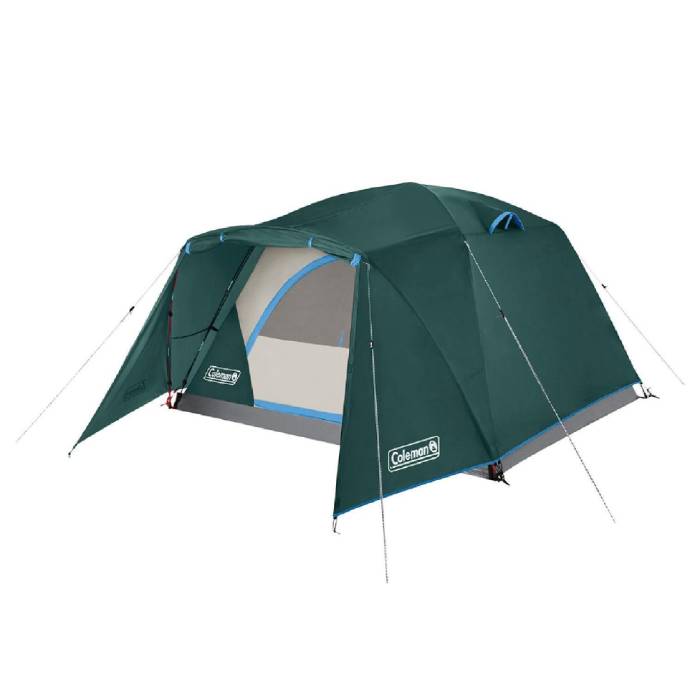
Coleman Skydome 4
Best Budget Tent for Casual Campers
CleverHiker Rating: 3.9/5.0
Price: $190
The size we tested feels: Luxurious for 2, comfortable for 3, tight for 4
Measured Weight: 13 lb. 11.2 oz.
Dimensions (LxWxH): 96 x 84 x 56 in.
Pros
- Affordable
- Integrated poles simplify setup
- Large door
- Functional vestibule
- Full-coverage fly on our tested version
- Useful E-port
Cons
- Low peak height
- Flimsy plastic fly clips
- Only one storage pocket
- Poor ventilation with the fly installed

Spaciousness & Comfort
The Skydome 4 is compact, and buyers should treat its four-person capacity as a maximum rather than a comfort target. The 96-by-84-inch floor will hold a queen-size air mattress, but that leaves little room around it for duffels or loose gear. Two campers have plenty of space, three can make the layout work comfortably enough, and four will use nearly every inch.
The 56-inch peak height is also low for a car-camping tent. Most adults cannot stand inside. Our 6-foot-2 tester could kneel without hitting his head, which helps, and the more upright wall shape preserves a bit more usable room than a sharply sloping dome. Still, this is a shelter for sleeping and sitting rather than walking around.
The wide front door improves the experience. It opens almost completely and tucks into a built-in pocket, so campers are not fighting loose fabric when entering with bedding or gear. That detail makes a small tent feel more accessible.
Ventilation is excellent when the fly is removed because much of the body is mesh. With the full-coverage fly installed, the tent becomes considerably warmer and stuffier. Two kickstand vents and an open vestibule door help, but this would not be our first choice for hot, humid summer nights that also require rain coverage.
Storage is sparse. A single interior pocket plus a gear loft cannot organize much for a group. The Skydome is therefore most comfortable for one or two people who want inexpensive shelter and easy setup, rather than a family seeking a roomy place to spend long periods inside.
Comfort Score: 4.1 / 5.0

Ease of Setup
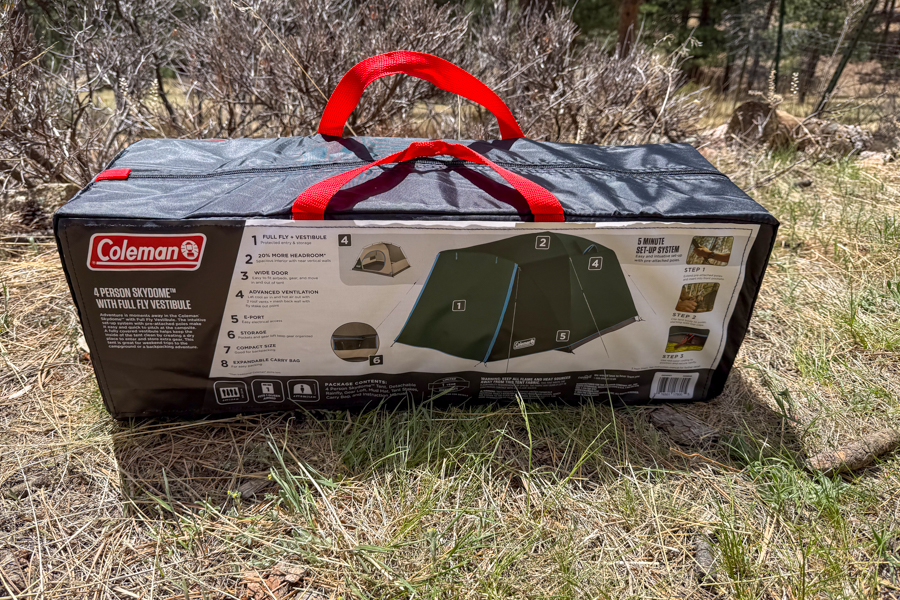
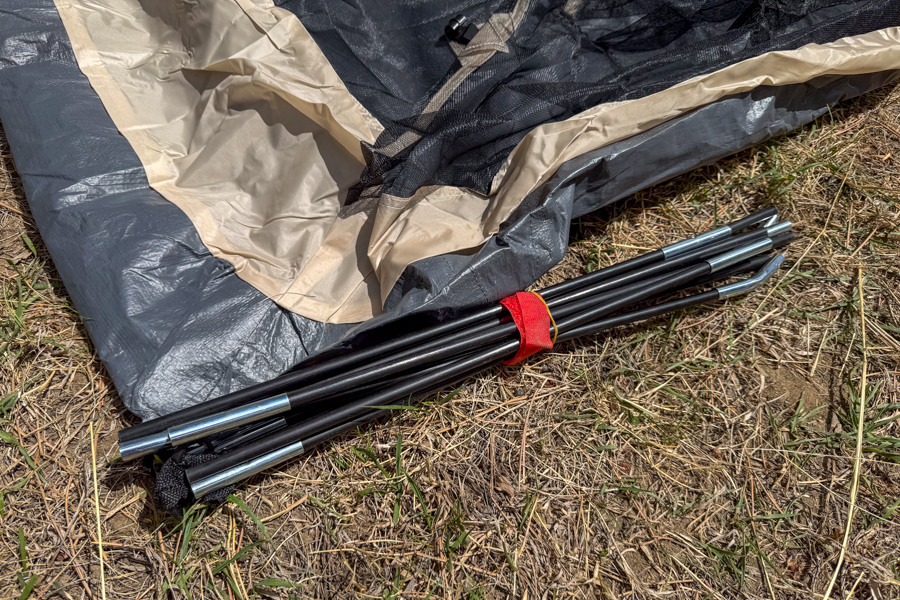
Ease of setup is the Skydome 4’s clearest advantage. Coleman attaches the main poles to the tent body, so there is far less sorting than with a traditional loose pole set. The poles fold outward from the corners and slide into dead-end sleeves, which makes it obvious where each component belongs. For first-time campers, that integrated system removes much of the uncertainty that can make a new tent frustrating.
We pitched and packed the Skydome repeatedly during a dry Colorado spring, both solo and with a partner. The process remained simple across mud, sand, and standard campground surfaces. The low 56-inch height also helps because no one needs to reach far overhead to attach the final clips.
The fly is straightforward to orient, and one color-coded corner reduces the chance of rotating it incorrectly. A separate vestibule pole adds a step but does not make the structure confusing. Because the tent is smaller than most family models, one camper can manage the fly without the wrestling required by tall six-person shelters.
Breakdown is equally simple until it is time to use the carry bag. The bag feels cheap and less durable than the rest of the system, so we would not treat it roughly or overstuff it repeatedly.
The integrated poles are convenient, though they also mean you cannot simply replace the packing method with a completely separate pole bag. For the Skydome’s intended buyer—new or occasional campers—the trade is worthwhile. It is one of the least intimidating tents in the guide to take from the car to a finished pitch.
Ease of Setup Score: 4.0 / 5.0
Weather Resistance
The full-fly version of the Skydome 4 handled moderate Colorado rain without leaking in our testing. Coleman’s WeatherTec construction provides a decent baseline of protection with welded corners, a tub-style polyethylene floor, and taped seams on the rainfly. The fly also covers the body more completely than the cheaper partial-fly Skydome versions, while the front vestibule gives the entry some protection from weather.
The frame also did better than expected in gusty conditions when all of the pre-attached guylines were deployed. Coleman rates the structure for winds around 35 mph, and based on our testing that figure does not feel wildly optimistic. The limitation is duration and material quality: the fly is thin, so sustained downpours and repeated hard-weather use are where we expect this budget design to show its limits.
The materials are still the limiting factor. Thin fly fabric, plastic connection hardware, and budget stake-out components give us less confidence in repeated hard-weather use than aluminum-poled premium tents. The Skydome is better matched to developed campgrounds and forecasts where strong storms are not the norm.
Ventilation becomes a weather-related compromise when rain requires the fly. The mesh body is extremely airy on dry nights, but airflow drops substantially with the full fly closed. Two kickstand vents help, as does opening the vestibule when rain direction allows it, yet the interior can still become warm and stuffy.
For occasional summer trips, normal showers, and moderate breeze, the Skydome covers the basics. We would still use a footprint or ground tarp to protect the floor and add another layer of assurance in wet conditions. Campers planning exposed desert, mountain, or frequent shoulder-season trips should move up to a more weather-capable design.
Weather Resistance Score: 3.6 / 5.0

Durability & Quality
The Skydome 4 feels like an entry-level tent, and the places where Coleman saves money are easy to identify. The fly is thinner than the fabrics on higher-ranked camping tents, and the plastic clips that secure it to the body do not inspire the same long-term confidence as more robust hardware. Some stake-out points use shock cord instead of standard webbing, which works but creates another component that may fatigue with repeated use.
The carry case is another weak point. It feels less durable than the shelter itself and may be one of the first components to show wear if the tent is packed tightly and used often. That does not affect a weekend at camp, but it matters when evaluating years of ownership.
The integrated pole system simplifies setup, though it also ties the frame more closely to the tent body. We did not experience a pole failure during our test period, and the fully guyed structure handled gusts better than the price might suggest. Even so, this is not a build we would choose for dozens of hard-use nights every season.
The tent body, seams, and floor were adequate during testing on different campground surfaces. As with any budget shelter, clearing sharp debris before pitching and avoiding unnecessary abrasion will help extend its life.
The important buying distinction is frequency. For a first tent used a few weekends each summer, the construction can be perfectly reasonable and keeps the price accessible. For frequent campers, the higher upfront cost of aluminum poles, stronger fabrics, and better hardware on the Aurora Highrise or Tungsten is likely to pay off over time.
Durability Score: 3.6 / 5.0
Features
The Skydome 4 keeps its feature list short, which fits its beginner-friendly purpose. The integrated pole system is the most important feature because it directly simplifies setup. Instead of matching several loose poles to sleeves or grommets, campers unfold the attached frame and build from the corners.
The front door is another success. It opens wide enough to move a queen air mattress or bulky bedding through the entry and tucks into a dedicated pocket when open. The vestibule provides a modest covered area for shoes and a small amount of gear, which is useful because the interior does not have much spare space.
An E-port allows an extension cord to enter the tent without leaving the main door partially unzipped. At developed campgrounds, that can be useful for charging electronics or running a small fan. The full-coverage fly on the version we tested is also worth noting because cheaper Skydome configurations use less protective coverage.
Interior organization is the biggest feature gap. One pocket is not enough for several campers, and although the gear loft adds some overhead space, the tent quickly feels cluttered when multiple people bring headlamps, phones, layers, and small items inside.
Two kickstand vents help with airflow when the fly is installed, but they cannot completely offset the heat buildup of full coverage on a warm day. Overall, the Skydome focuses on easy pitching, basic rain protection, and a useful entry rather than premium organization or specialized features. That simplicity is appropriate for its low price and occasional-camping audience.
Features Score: 4.0 / 5.0

Should You Buy the Coleman Skydome 4?
The Skydome 4 makes sense for first-time campers, occasional family trips, festivals, and people who want a simple shelter without spending much. Its easy setup is the strongest reason to buy it.
Frequent campers should spend more. The Wireless 6 offers much more space and better overall quality, while the Mineral King 3 is a stronger small-group option for weather, durability, and portability.

What Other Camping Tents Should You Consider?
Kelty Wireless 6 Review: Families who have outgrown the Skydome’s compact interior but still want to stay in the value end of the category should consider the Wireless 6 as the natural step up. It adds true standing height, a much larger floor, dual vestibules, and a more useful family layout without jumping into premium-tent pricing. It is heavier and costs more, but the extra money buys substantially better livability for repeated family camping.
Mountain Hardwear Mineral King 3 Review: The Mineral King 3 makes sense for one or two campers who would rather buy a smaller, better-built shelter than maximize floor space. It is fast to pitch, highly ventilated, and has much stronger materials and weather performance than the Skydome in our experience. You still cannot stand inside it, and it costs considerably more, but the overall build is better suited to frequent use.
Kelty Daydreamer 6 Review: The Daydreamer 6 is the alternative for budget-minded families who need far more interior room and care about sleeping past sunrise. Its 77-inch peak height, large floor, and darkened Twilight Tech fly make it much more comfortable for kids, naps, and longer campground stays. The price increase also brings more bulk and a hotter interior with the fly on, so the Skydome remains the simpler option for occasional two-person trips.