
Bottom Line
The NEMO Flyer Cloud gives campers a practical way to save weight and storage space without settling for the thinnest pad possible. Its three-inch air-and-foam design was comfortable enough on our camping trip into New Mexico’s Gila Wilderness, and its R-5.1 insulation expands usefulness beyond warm nights.
But our testers had mixed reviews of the alternating contours of its sleeping surface. People seeking a perfectly smooth, plush bed should spend more on a four-inch luxury mattress. Our best camping mattresses guide explains the value and comfort differences.
How We Tested
Gear Analyst Jory Brass tested the Flyer Cloud during camping in the Gila Wilderness and at home alongside higher-priced mattresses. He evaluated its distinctive foam-and-air contours, inflation and deflation, multifunction storage/pump sack, comfort, and compact storage. The team used it in indoor and outdoor temperatures of roughly 25°F to 75°F, allowing an assessment beyond a single summer weekend.
Quick Specs
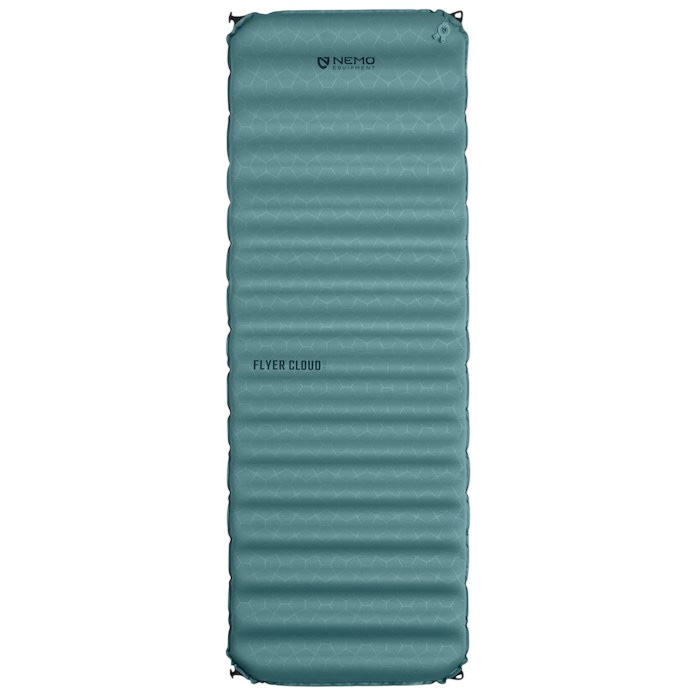
NEMO Flyer Cloud
Best Mid-Range Camping Mattress
CleverHiker Rating: 4.3/5.0
Price: $190
Dimensions (LxWxH): 72 x 25 x 3 in.
Weight: 2 lb. 9 oz.
Style: Self-inflating
R-Value: 5.1
Pros
- Comparatively light and packable
- Rippled texture
- Included stuff/pump sack is also a dry bag
- Insulated for four-season camping
- Eco-friendly (bluesign-approved)
Cons
- The texture is not for everybody
- Lower loft at 3 inches

Comfort
NEMO combines foam and air in a patterned sleeping structure that feels unlike a flat rectangle of thick memory foam. The result was supportive enough for our field nights, but our testers disagreed about the raised ridges. Some people may find the contours pleasantly supportive; others notice them every time they change position.
Three inches of height are adequate for many campers, not comparable to the five-inch Big Agnes Captain Comfort Deluxe. In our tests at home and in the Gila Wilderness, this foam-and-air mix was noticeably more forgiving than minimal backpacking pads but could not match the four-inch campground comfort standard our team prefers. Its 25-inch regular-wide cut supplies more room than compact mummy pads, making it a credible middle ground for sleepers who pack into a small car. Buyers should consider whether they value a smoother surface more than small size and low weight.
Comfort Score: 4.2/5.0

Ease of Use
The reduced bulk makes the Flyer Cloud simpler to inflate and compress than much larger premium mattresses. We liked NEMO’s clear valve instructions, which take some guesswork out of the setup. Its sack combines storage, pump function, and a roll-top dry bag, keeping separate accessories to a minimum. Our tester forgot that the sack doubled as a pump during a trip in the Jemez Mountains; the instructions printed near the valves, on the sack, and inside its label make it easier to remember the next time. To deflate, rolling once flat and a second time folded helped squeeze out enough air for easy storage.
Ease of Use Score: 4.5/5.0

Warmth
NEMO’s current R-value specification is 5.1. That is meaningful resistance to heat loss, and our team used the mattress through a broad range of temperatures. It does not make a sleeping bag or suitable camping clothing optional, but it is more versatile than a lightly insulated summer airbed.
Warmth Score: 4.5/5.0

Packed Size
Twelve by eight inches is a manageable package in a small trunk or a crowded camping closet, and the two-pound-nine-ounce weight is far below the foam-heavy luxury models. Our tested regular-wide version occupied less than 10 liters when rolled, making it closer in bulk to an oversized backpacking pad than a luxury campground bed.
The stuff sack’s dry-bag function is a thoughtful secondary benefit, since the pump and storage features share a single piece of equipment. This portability is the Flyer Cloud’s clearest selling point. It may also appeal to campers carrying their sleep system a little farther from the car.
Packed Size Score: 4.5/5.0

Should You Buy the NEMO Flyer Cloud Sleeping Pad?
Pick it if packed volume, reasonable price, and adequate insulation carry more weight in your decision than absolute plushness. If surface texture bothers you, the smooth cushion of a larger mattress is worth the extra space and money.

What Other Camping Mattresses Should You Consider?
If the Flyer Cloud isn’t in your wheelhouse, consider some alternatives from our camping mattresses guide:
Sea to Summit Camp Plus Review: The $99 Camp Plus saves $91 while packing slightly smaller than the Flyer Cloud. Its R-5.3 insulation is marginally higher on paper, but the mummy-shaped 22-inch width gives you less sleeping room than the Flyer’s 25 inches. Choose it when cost and minimum storage are more important than extra width.
Exped MegaMat Review: The MegaMat is a clear upgrade in cushion and sleeping space for someone camping close to a vehicle. We have used its smooth four-inch surface for years, and its R-8.1 insulation substantially exceeds the Flyer Cloud’s R-5.1. It also packs to a far longer roll, so the Flyer remains preferable when trunk space or a short carry matters.