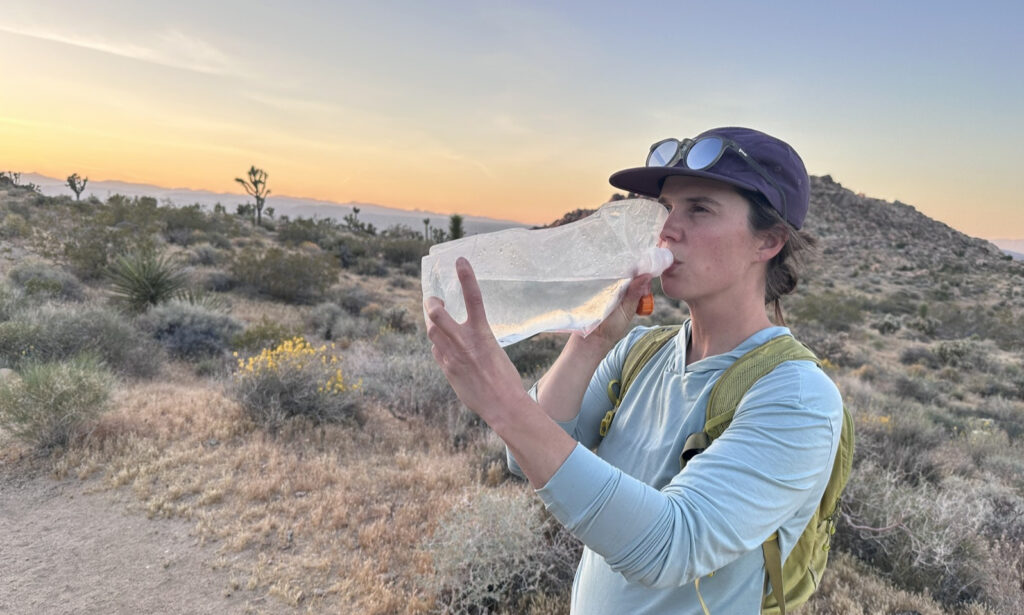


We’ve used just about every type of filtration and purification method available in our 100,000 miles of hiking over the past decade. For this guide, we tested filters from Sawyer, Katadyn, MSR, and more. Whether you’re looking for ultralight filtration for your next big adventure or a reliable purifier for overseas travel, our team of experts will help you find the perfect water treatment for your needs.
Editor’s Note: We updated this post on June 8, 2026, to add two new filters to the list: the LifeStraw Peak Squeeze and Katadyn Hiker Pro.
How We Test Water Filters
Our gear analysts have treated thousands of liters of water with dozens of different methods. We sampled the most challenging sources including silty glacial runoff, cowpie-infested waters, and mine runoff. We looked at six dimensions of performance during our rigorous field testing: water quality, ease of use, treatment time, weight, maintenance, and longevity.
And for more info, check out some of our other popular gear guides:

#1. Best Backpacking Water Filter Overall
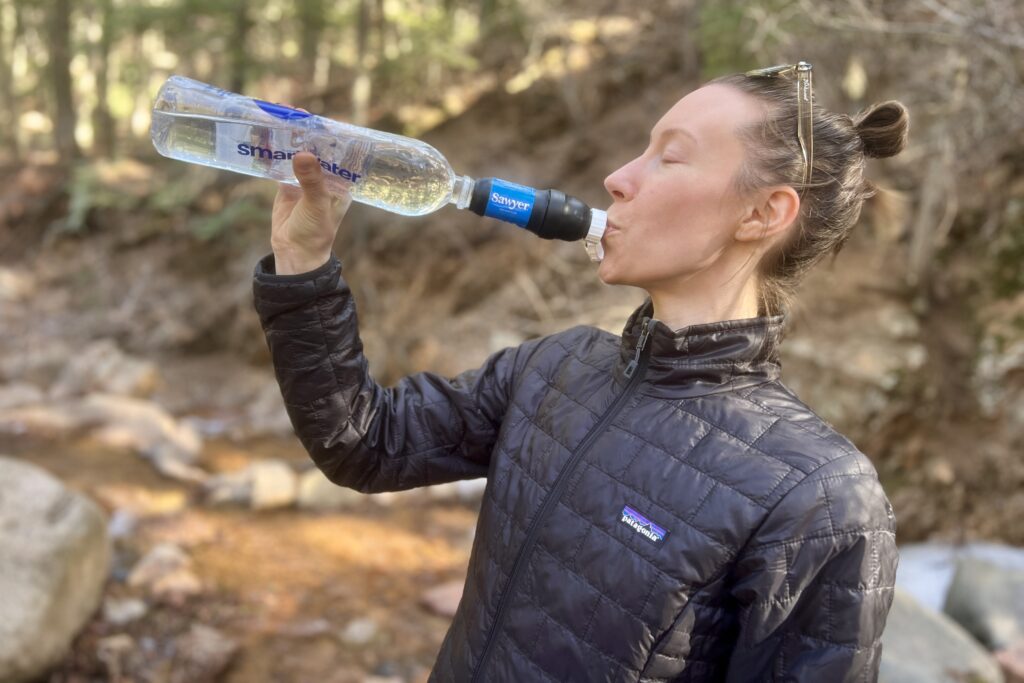
The Sawyer Squeeze is lightweight and easy to use. We’ve used this filter for over 800 miles in the backcountry, and it’s still the best option for clean drinking water.
Quick Picks for Water Filters
Check out this quick list of our favorite water filters, or continue scrolling to see our full list with in-depth reviews.
1. Best Backpacking Water Filter Overall: Sawyer Squeeze ($46)
2. Squeeze Filter with the Best Out-of-Box Flow Rate: Katadyn BeFree ($53)
3. Most Versatile Water Filter: LifeStraw Peak Squeeze ($44)
4. Best Filter for Purifying the Worst of the Worst Water: MSR Guardian ($400)
5. Durable Squeeze Filter with a High-Quality Reservoir: Platypus QuickDraw ($55)
6. Best Gravity Filter for Group Camping & Backpacking: Platypus GravityWorks ($135)
7. Best Chemical Water Purification: Katadyn Micropur Tablets ($18)
8. Best Straw Water Filter: Lifestraw Peak Straw ($25)
9. Best UV Light Water Purifier: Katadyn Steripen Ultra ($135)
10. Best Chlorine-Dioxide Drop Purification: Aquamira ($15)
11. Best Pump Water Filter: Katadyn Hiker Pro ($100)
12. Lightweight Filter that Works Well in Shallow Water: MSR TrailShot ($70)
Sawyer Squeeze
Best Backpacking Water Filter Overall
CleverHiker Rating: 4.6/5.0
Price: $46
Weight: 2.5 oz.(filter only)
Flow Rate: 1.7 L/min
Filter Pore Size: 0.1 microns
Lifetime Volume: 378,000 L
Pros
- Ultralight
- Compact
- Well priced for its performance
- Easy to use
- Great flow rate
- Fits a variety of bottels
Cons
- Included pouches aren't durable
- Requires a syringe to backflush
- Not rated for viruses (which many want on international trips)
We’ve trusted the Sawyer Squeeze to filter our water over more than 8,000 miles of our backpacking trips – including a thru-hike of the Continental Divide Trail as well as multiple thru-hikes of the Pacific Crest Trail – because it’s one of the lightest options available, has a fast flow rate, and is so easy to use.
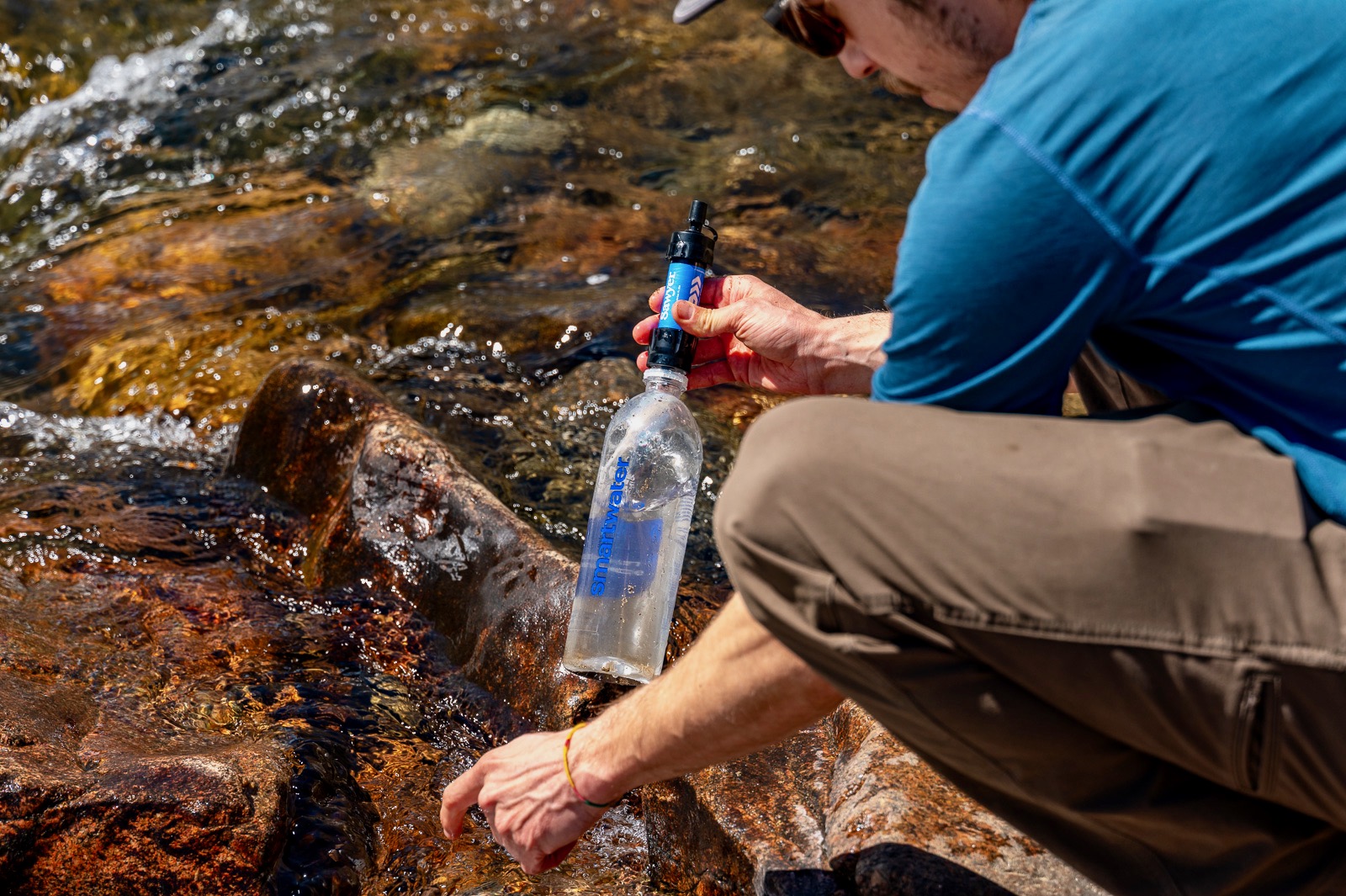
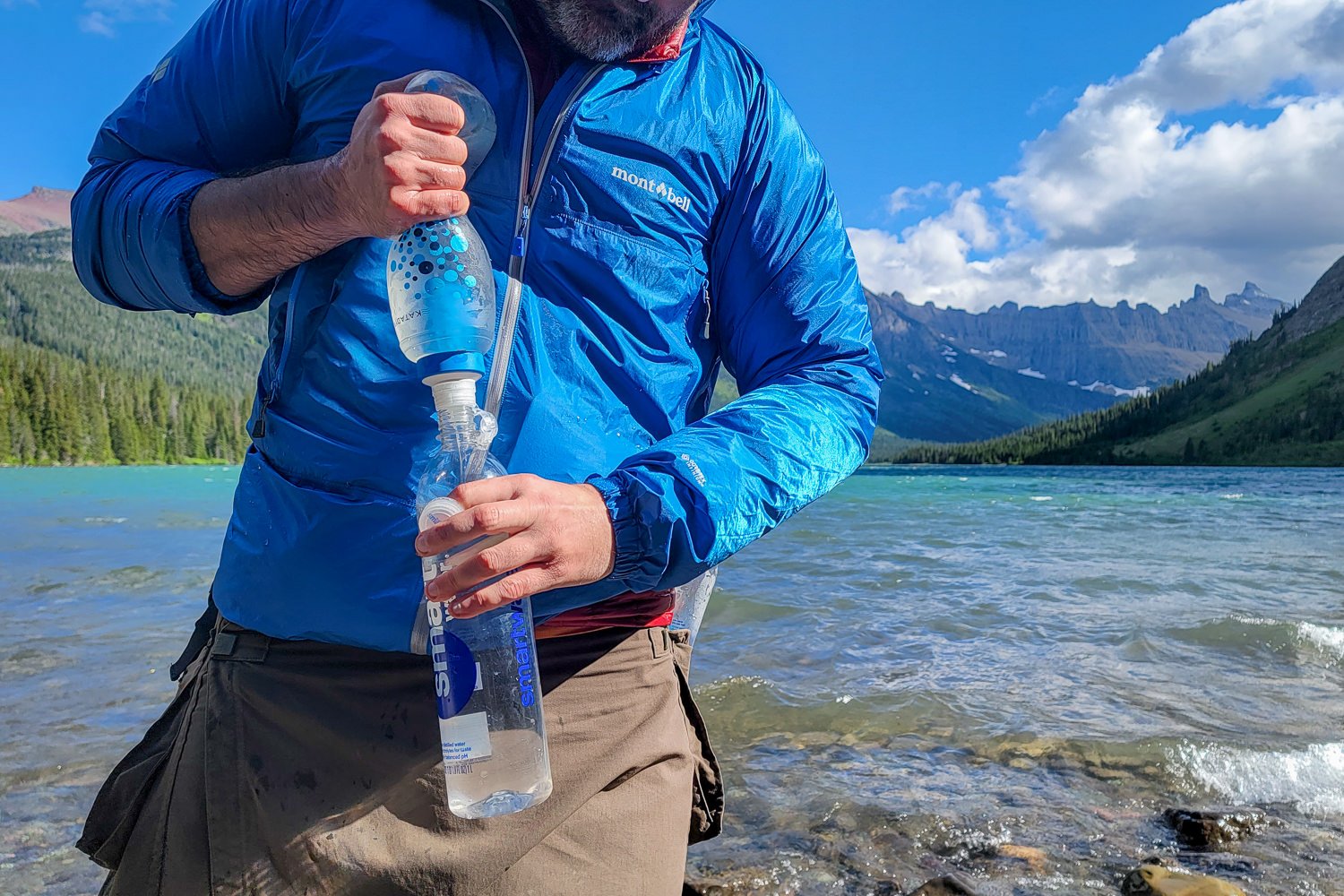
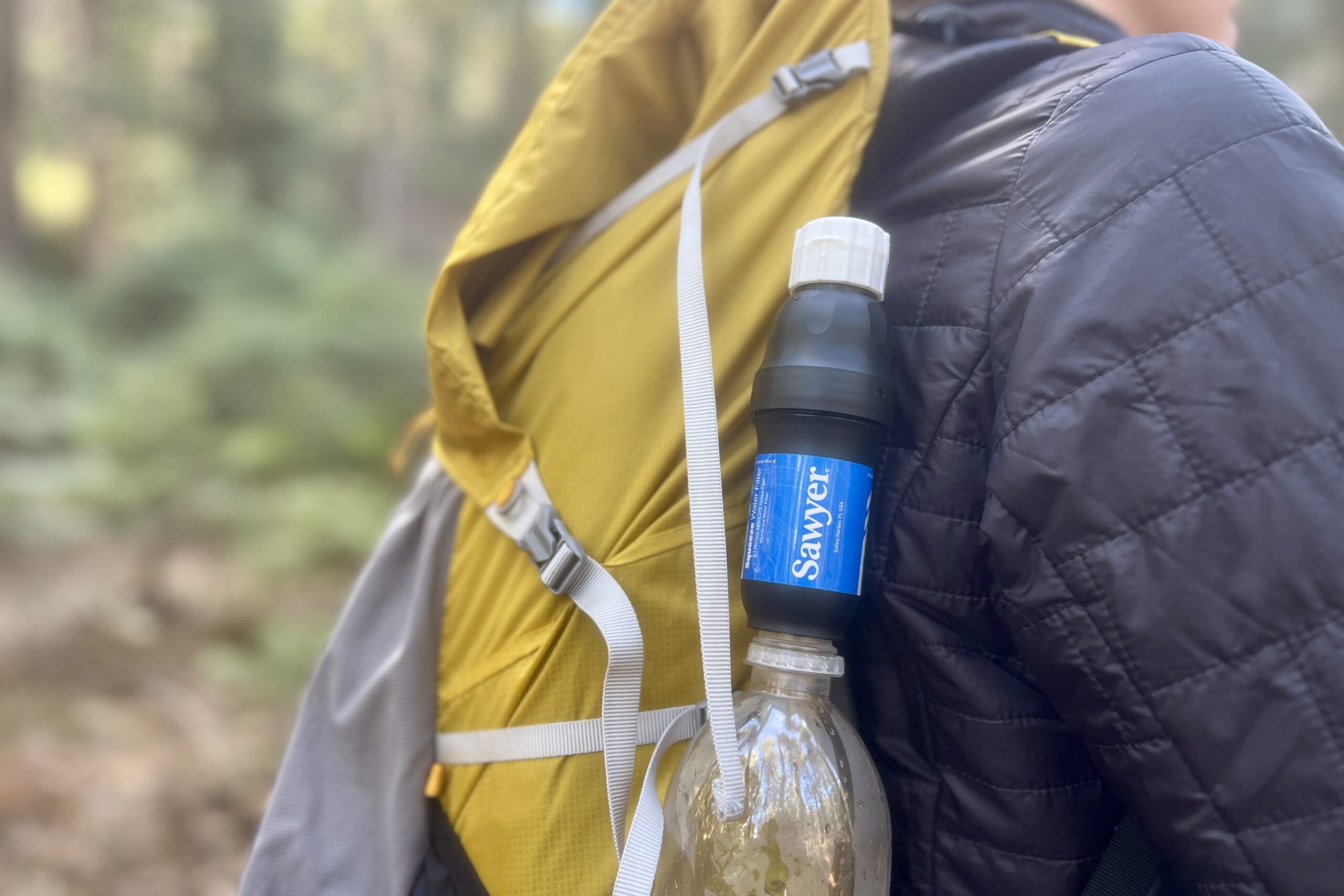
This filter pairs with a variety of vessels, but we typically use the Squeeze with a Smartwater bottle because it makes for an ultralight and decently durable water filtration system. We’ll often drink straight from the sport cap on the Squeeze to cut out the step of filtering into a different bottle. Keep in mind that you’ll still need an extra bottle to squeeze clean water into if you want to use hydration mixes or other water supplements since you don’t want that stuff to go through your filter.
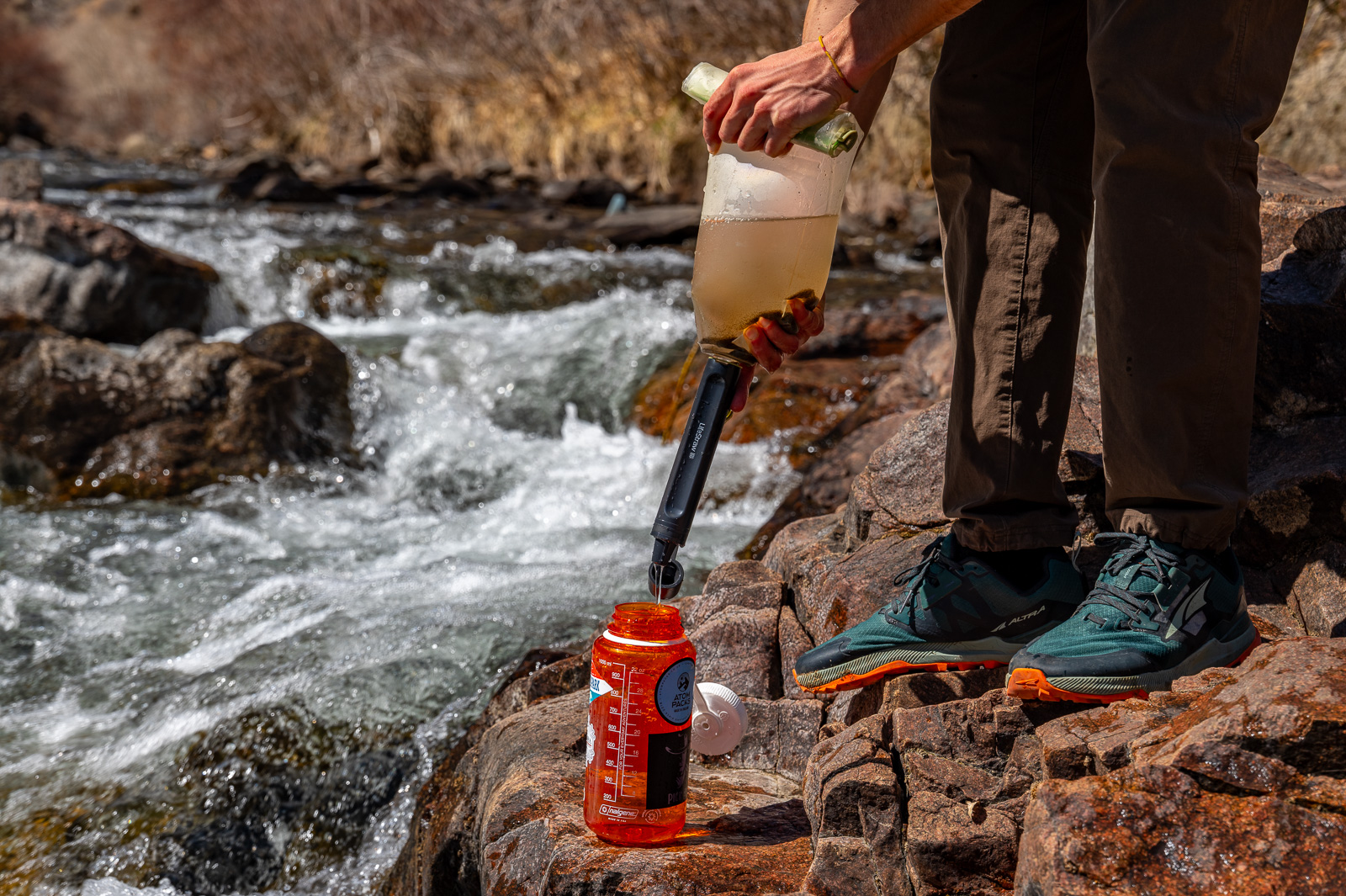
One of the primary downsides is that the flow rate can slow down over time – especially if you encounter a lot of silty sources. It’s a good idea to use the included syringe to backflush your filter every so often to extend its life and keep it flowing fast. For multi-week hikes on long-distance trails, we’ve had good luck finding one of the Sawyer syringes at hostels or in hiker boxes to use during town stops.
We’ve kept multiple Squeeze filters going for several thousand miles by keeping the hollow-fiber membrane protected in freezing temperatures (just tuck it in your sleeping bag on especially cold nights) and backflushing regularly, so this is a great investment for hikers on a budget.
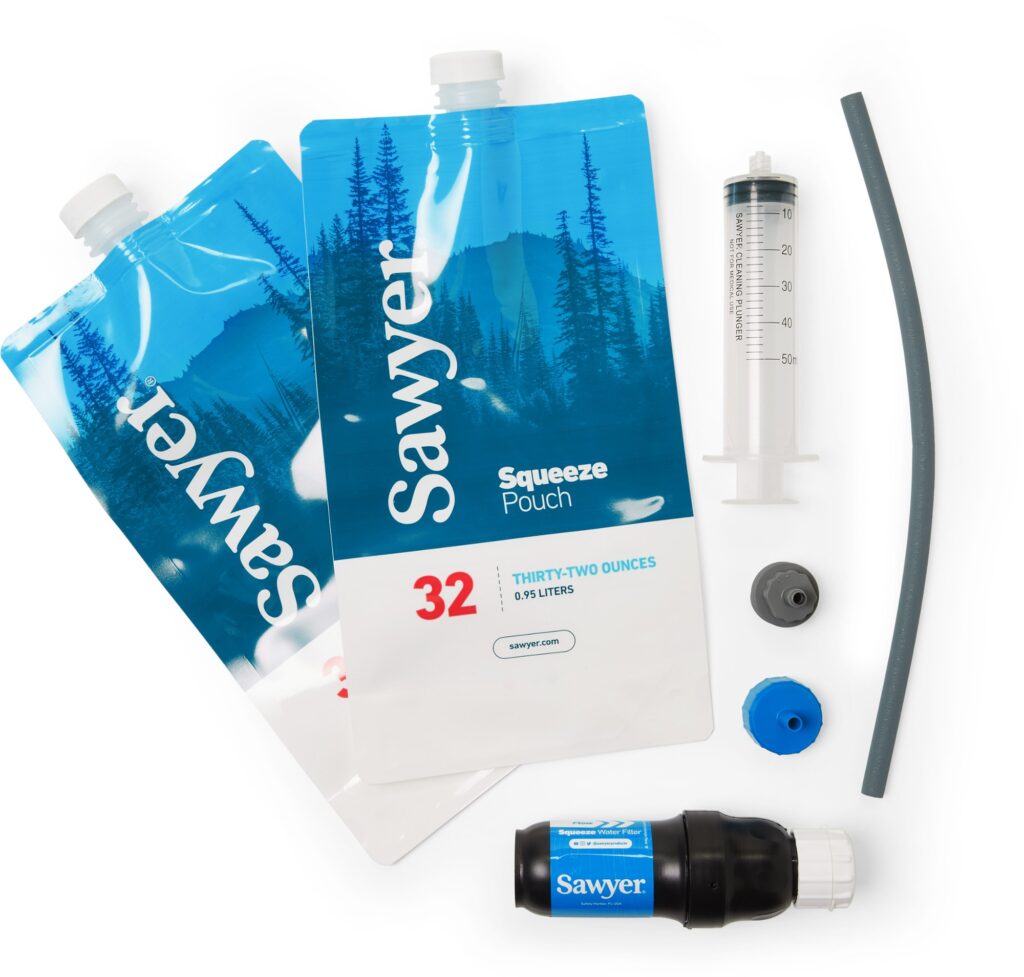
The pouches that come with the Squeeze can wear down relatively quickly, so you should carry a replacement if you choose to use the included squeeze bags (the filter comes with two).
Sawyer also makes this filter in the smaller Mini and Micro versions. These are both lighter than what we typically use. Though we love shaving ounces from our pack weight when possible, we recommend going with the standard Squeeze for its faster flow rate. The Micro and Mini aren’t bad options, but they clog a lot easier than the Squeeze.
More: Sawyer Squeeze Full Review
More: Sawyer Micro Squeeze Full Review
Katadyn BeFree
Squeeze Filter with the Best Out-of-Box Flow Rate
CleverHiker Rating: 4.6/5.0
Price: $53
Weight: 2.3 oz.(including 1 L soft bottle)
Flow Rate: 2 L/min
Filter Pore Size: 0.1 microns
Lifetime Volume: 1,000 L
Pros
- Relatively affordable
- Excellent flow rate
- Ultralight
- Compact
- Easy to clean in the field
- Simple to use
Cons
- Limited bottle compatibility
- Clogs easily
- Not rated for viruses
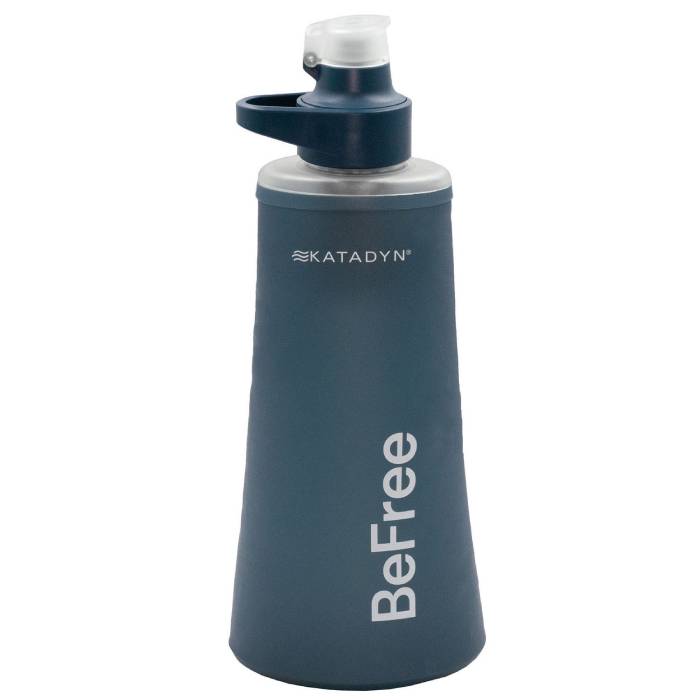
The Katadyn BeFree is an affordable, ultralight water filter that has an incredible flow rate for how small it is. You can drink directly from this filter while you’re on the go thanks to its sports bottle-style top.
We’ve tested this filter for more than 2,000 miles of backpacking – including thru-hikes of the Long Trail, Colorado Trail, and Spain’s GR11, where clean water sources are sparse. We sometimes have a slight preference for the Katadyn over the Sawyer Squeeze since the BeFree is easier to clean on trail without having to carry extra components. It’s also a bit lighter, and the flow rate is faster.
To clean the BeFree in the backcountry, you only need a clear water source to dip water from. Fill your vessel about halfway, screw the filter on, then shake it vigorously for a couple of minutes. Dump the water out – as it will have collected lodged debris from the filter element – and you’re ready to filter again with a restored flow rate. This is one of our favorite features of the BeFree since it’s so easy to get working like new again.
That said, the BeFree does have a tendency to clog a little easier than the Squeeze, and some hikers may find this loss of flow rate and the steady need to clean it to be a pain.
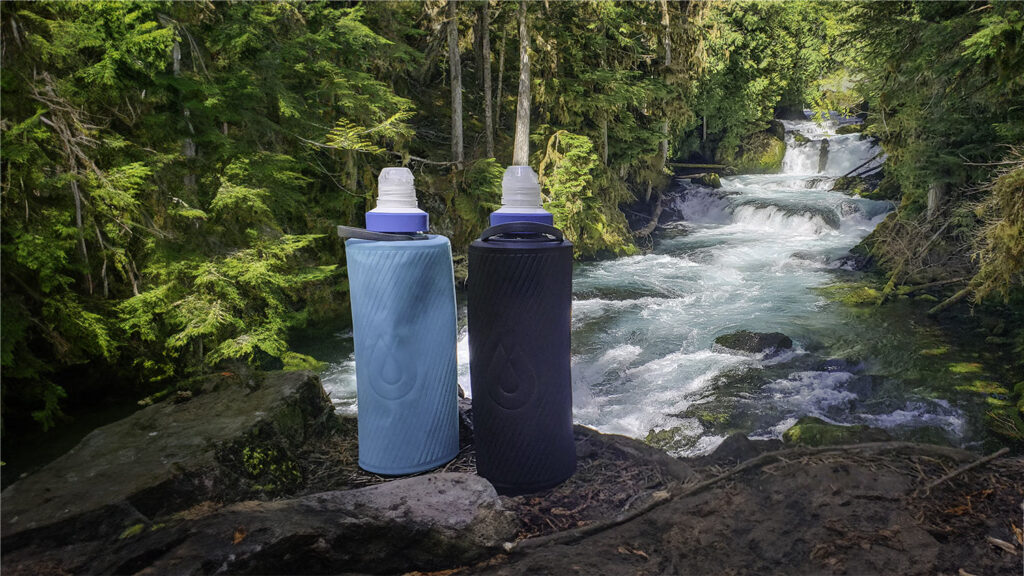
Although the soft bottle that comes with the BeFree is pretty durable, we like to pair this filter with the more versatile HydraPak Flux soft water bottle. The Flux’s handle makes it a bit easier to gather water, a flat bottom that allows it to sit upright, and a more durable, thicker material. If you choose to go this route, we recommend buying the replacement filter only – which doesn’t include the BeFree bottle – to save some cash.
Ultralight backpackers seeking the best combination of weight and flow rate are sure to love the Katadyn BeFree.
LifeStraw Peak Squeeze
Most Versatile Water Filter
CleverHiker Rating: 4.6/5.0
Price: $44
Weight: 2.4 oz.(filter only)
Flow Rate: 1.75 L/min
Filter Pore Size: 0.2 microns
Lifetime Volume: 2,000 L
Pros
- Works with a variety of bottles and bladders
- Good flow rate
- Ultralight
Cons
- Requires frequent cleaning
- Middling flow rate
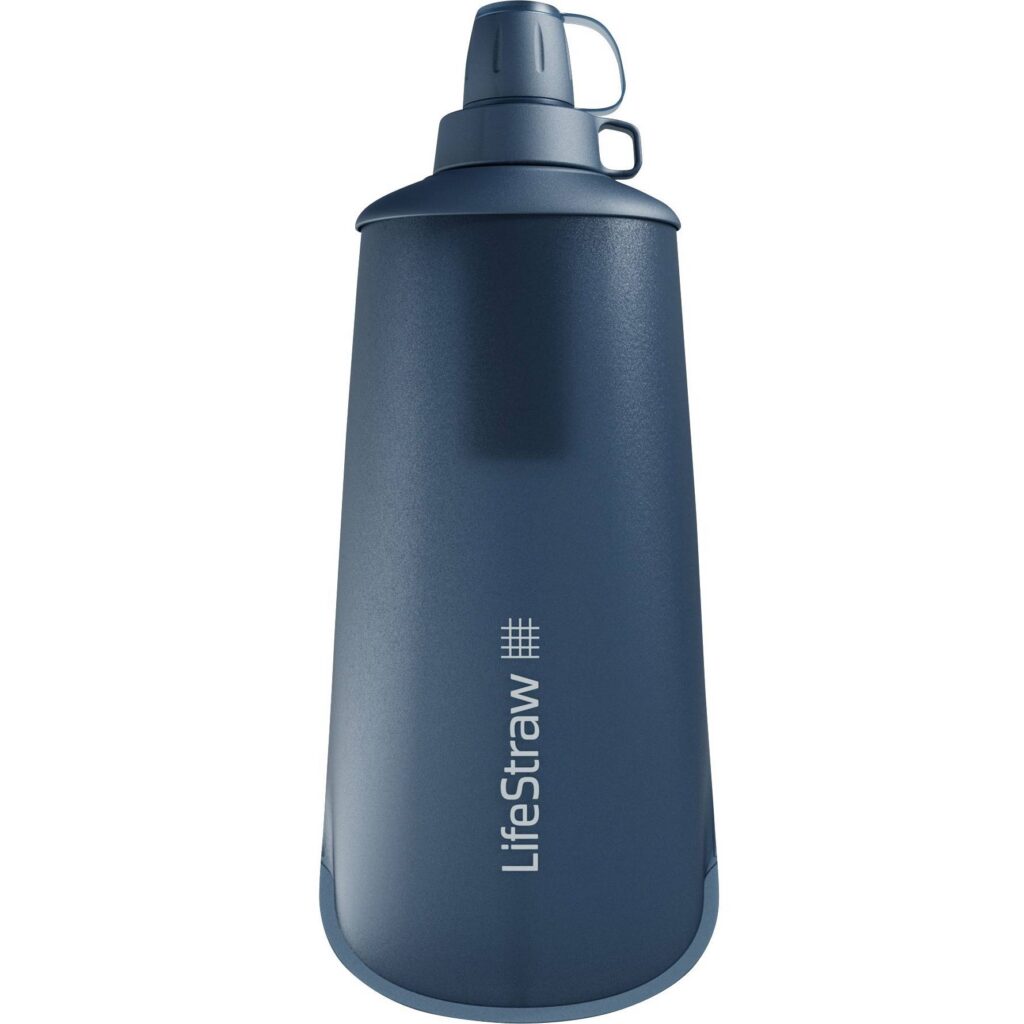
The LifeStraw Peak Squeeze is a lightweight backpacking water filter that stands out mostly for its versatility and durability. In a market crowded with squeeze-style filters that all accomplish roughly the same task, the Peak Squeeze manages to separate itself with a flexible design that adapts well to different hiking styles and bottle sizes.
One of its biggest strengths is compatibility. The filter works with both standard 28-millimeter bottles (like Smartwater bottles) and larger 42-millimeter soft flasks. This flexibility makes it easy to tailor the setup to your preferences without needing multiple filters or adapters.
The included soft bottles are another highlight. They feel thicker and more durable than many ultralight squeeze flasks while still packing down small when empty. The filter housing itself is also sturdy and protective, especially compared to filters with exposed hollow fibers.
In terms of filtration performance, the Peak Squeeze uses a standard 0.2-micron hollow-fiber membrane capable of removing bacteria, parasites, microplastics, and other contaminants found in backcountry water sources. It even improves taste by reducing chlorine.
The main downside is flow rate and maintenance. Filtration speed is decent but not especially fast, and the filter tends to clog somewhat quicker than some competitors, especially in silty water. Regular backflushing is necessary to avoid frustratingly slow flow rates.
The weight of the Peak Squeeze falls comfortably within ultralight territory, even with the included bottles and accessories. Overall, the Peak Squeeze offers a well-rounded balance of weight, durability, adaptability, and reliable filtration, making it a strong option for most backpackers.
MSR Guardian
Best Filter for Purifying the Worst of the Worst Water
CleverHiker Rating: 4.6/5.0
Price: $400
Weight: 1 lb. 1.3 oz.
Flow Rate: 2.5 L/min
Filter Pore Size: 0.02 microns
Lifetime Volume: 10,000 L
Pros
- Rated for international backpacking
- Great flow rate
- Very durable
- Self-cleans as it filters
- Purifies water (including viruses)
Cons
- Heavy and bulky
- Very expensive
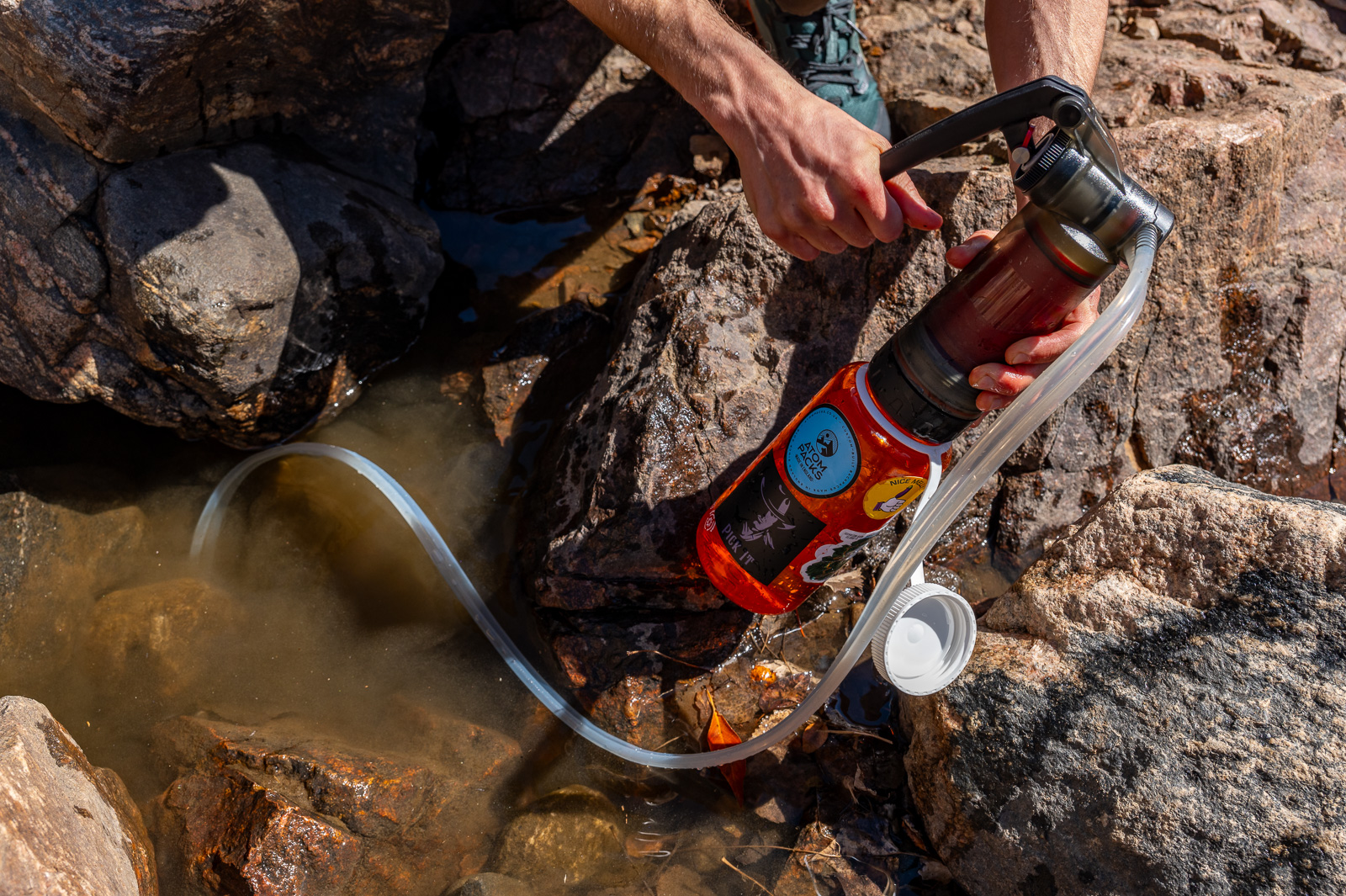
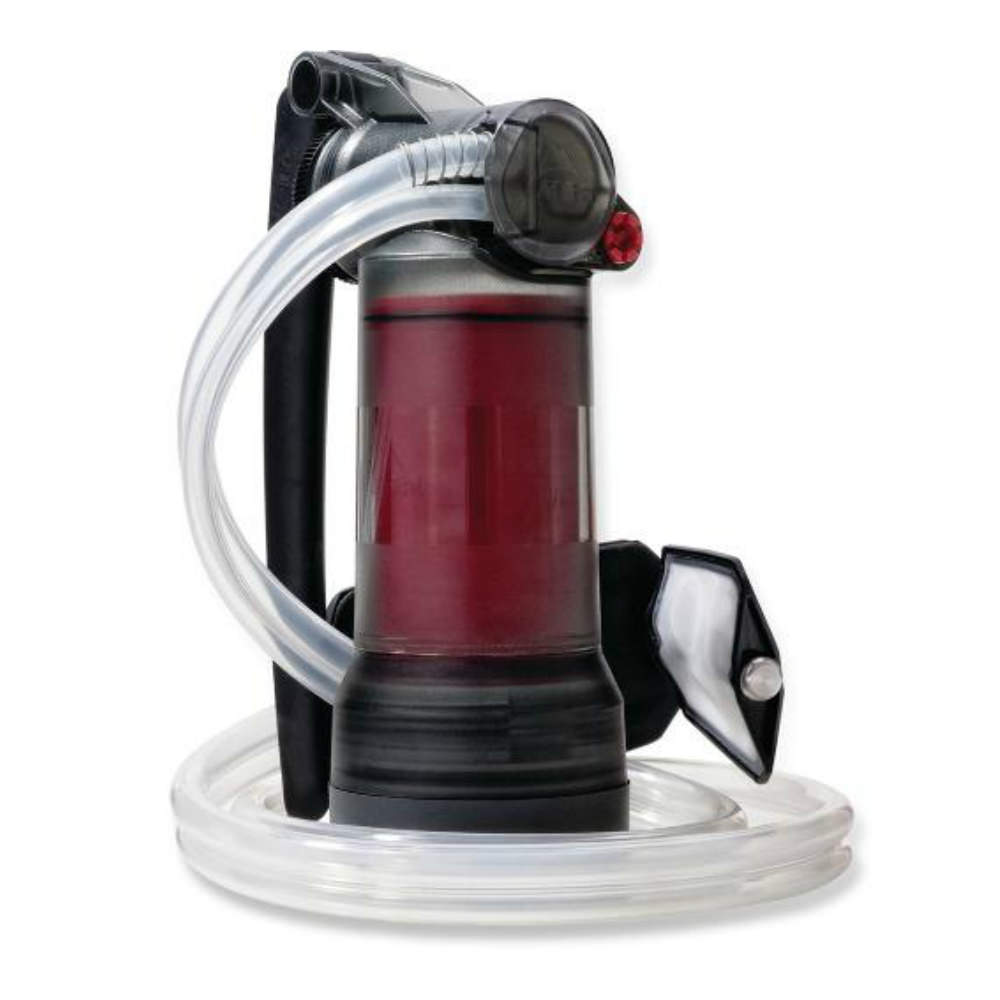
The MSR Guardian is a top-of-the-line pump purifier built for the harshest conditions. Since the Guardian is able to kill viruses, it’s particularly useful for remote international destinations.
One of the best features of the Guardian is the fact that it self-cleans with each stroke. Every pump circulates trapped dirt back out of the system to keep the flow rate high, pumping fatigue down, and maintenance to a minimum. And, like most pump filters, it features a burly pre-filter at the inlet that prevents most of the muck from making it to the filter element in the first place.
Though it’s built to withstand many years of rugged use, the upfront cost of this purifier is pretty staggering. It’s also too heavy to justify bringing on most backcountry trips. But ultimately it can save you money (and a ton of plastic waste) in the long run versus buying bottled water on trips where clean water is harder to come by.
If you’re looking for best-in-class protection from a purifier that’ll pull clean drinking water from the murkiest mud puddle on this planet, the Guardian is a go-to. For ease of use, this filter works best paired with a Wide-Mouth Nalgene bottle.
More: MSR Guardian Full Review
Platypus QuickDraw
Durable Squeeze Filter with a High-Quality Reservoir
CleverHiker Rating: 4.5/5.0
Price: $55
Weight: 3.6 oz.(including 1 L reservoir)
Flow Rate: 3 L/min
Filter Pore Size: 0.2 microns
Lifetime Volume: 1,000 L
Pros
- Excellent flow rate
- Lightweight
- Compact
- Easy to use
- Durable filter and reservoir
- Fits a variety of bottles
Cons
- Heavier and bulkier than other microfilters
- Slows down over time
- Not rated for viruses
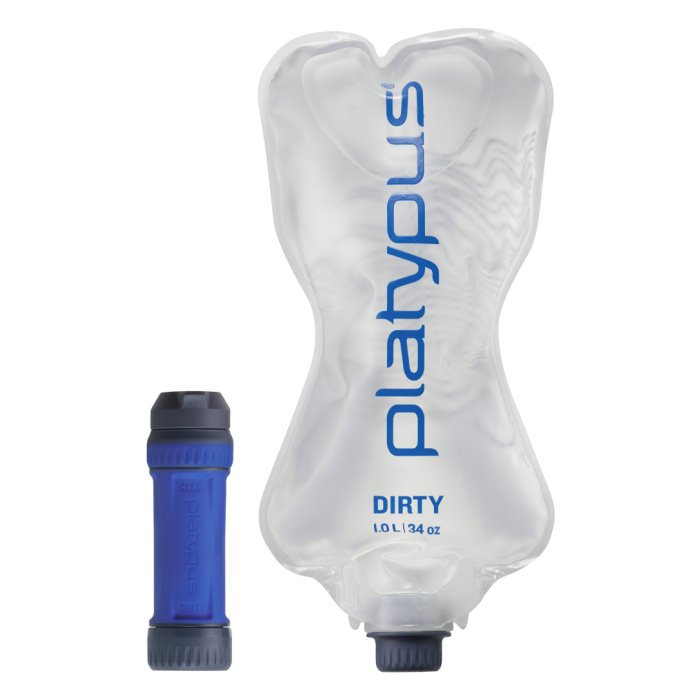
The Platypus QuickDraw Filter System is more durable and has a faster flow rate than other squeeze filters on the market, so it’s a great choice for thru-hikers or anyone who’s tough on gear.
The reservoir that comes with the QuickDraw is sturdy and has a convenient handle that makes fill-ups easy. It’s a significant step up in quality from the reservoirs included with the Sawyer Squeeze and Katadyn BeFree above. The filter cartridge is threaded to fit a variety of water vessels, so you can use the QuickDraw with a Smartwater bottle if you prefer.
The QuickDraw’s flow rate is excellent and slightly faster than the leading competition. Although Platypus’ 3-liters-per-minute claim feels like a stretch to us – save for maybe the very first use out with a clean water source – we’re still happy with this filter’s performance. We timed it on a testing trip in Glacier National Park and found that we could squeeze 1 liter of water from the average source in about 40 seconds.
The QuickDraw is slightly heavier than the Sawyer Squeeze and Katadyn BeFree, which we view as a minor downside. But its tough build, fast flow rate, and premium reservoir help make up for the small weight penalty. Overall, the QuickDraw is an excellent filtration option for hikers looking to go light.
Platypus GravityWorks
Best Gravity Filter for Group Camping & Backpacking
CleverHiker Rating: 4.5/5.0
Price: $135
Weight: 11.5 oz.(including two 4 L reservoirs)
Flow Rate: 1.75 L/min
Filter Pore Size: 0.2 microns
Lifetime Volume: 1,500 L
Pros
- Very easy to use
- Convenient for pairs and groups
- Good flow rate
- Can filter a large amount of water at once
- Easy to clean in the field
Cons
- Heavy
- Bulky
- Expensive
- Slows down over time
- Not rated for viruses
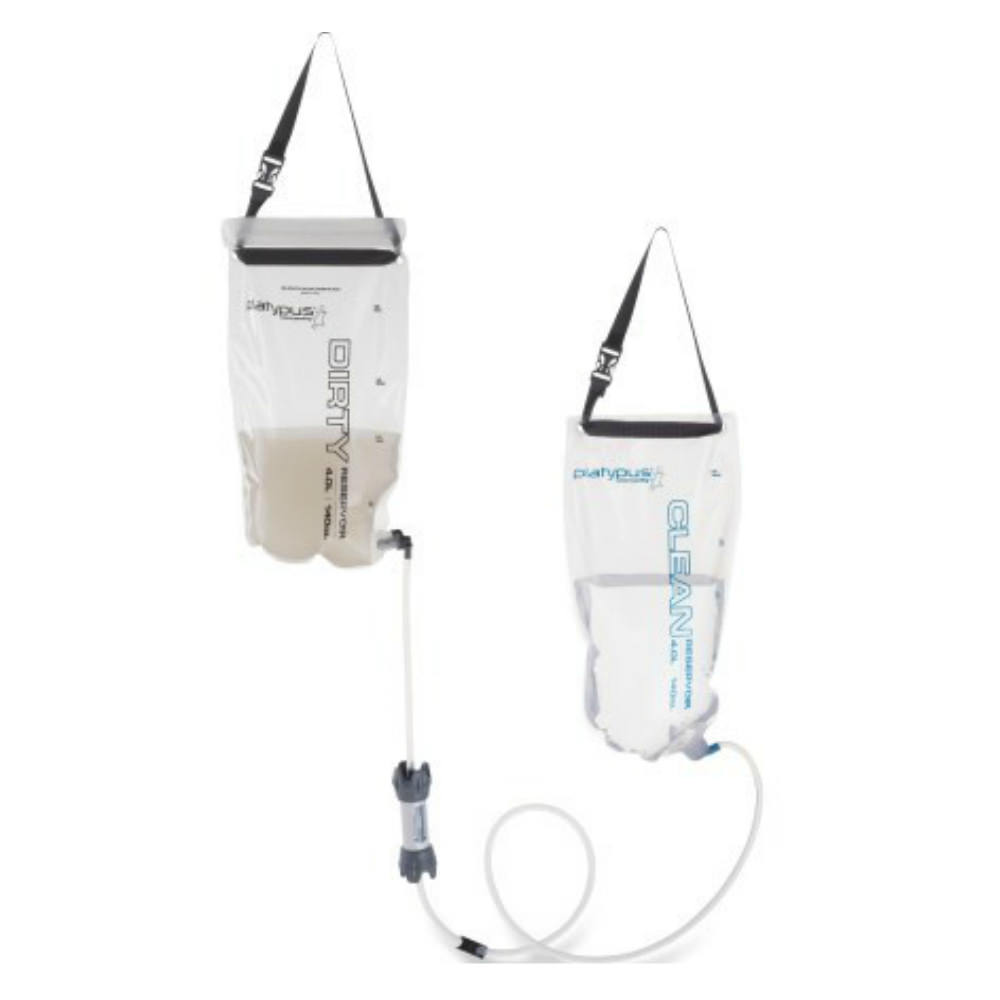
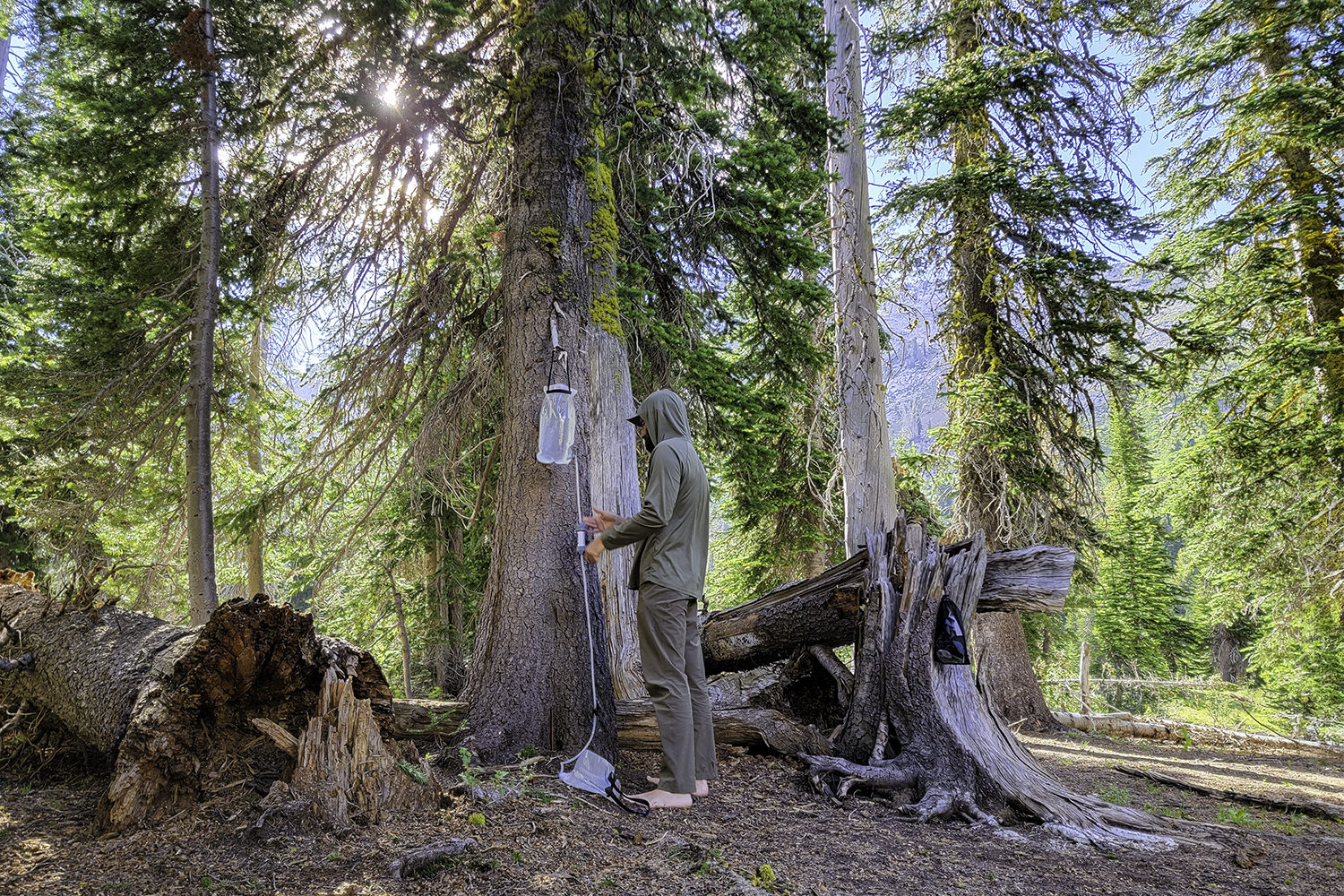
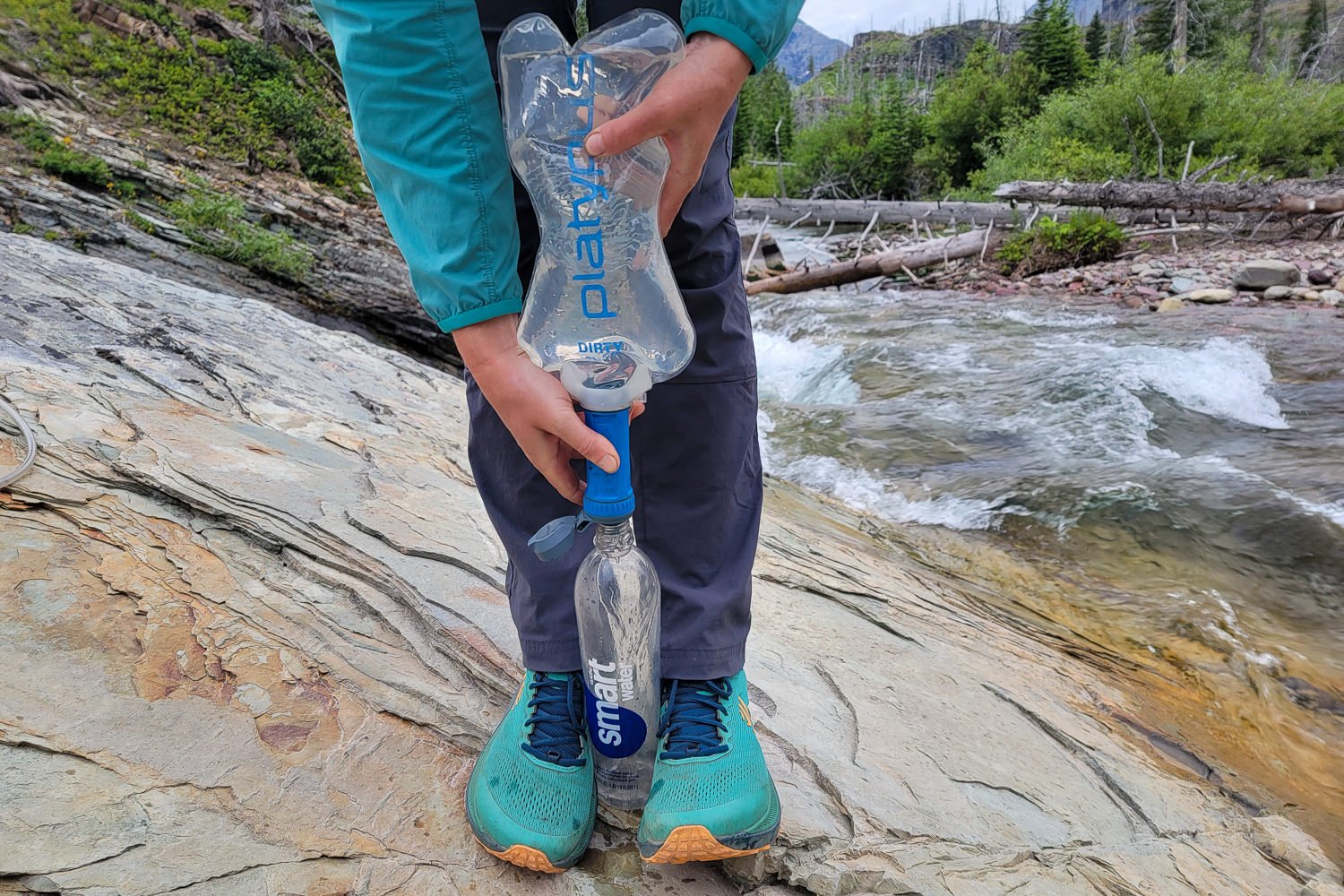
The convenience of the Platypus GravityWorks is tough to beat, especially for pairs or groups. To use the GravityWorks, simply fill up the “dirty” water bag, hang it above the “clean” bag, and let gravity do its thing.
The main benefit: No tedious pumping or squeezing is required. This is especially handy for groups since filtering multiple liters of water at once can be time-consuming.
CleverHiker analyst Heather Eldridge opted for the GravityWorks when she took five of her family members backpacking in Oregon’s Eagle Cap Wilderness. It saves a lot of time and effort on trips like these when you need a lot of water for drinking and cooking.
The GravityWorks is heavier than most of the other options on our list, so it’s not our first choice for solo trips. But it’s not too bad when you can share the weight with a partner, and it could be well worth trading that bit of weight for the boost in convenience.
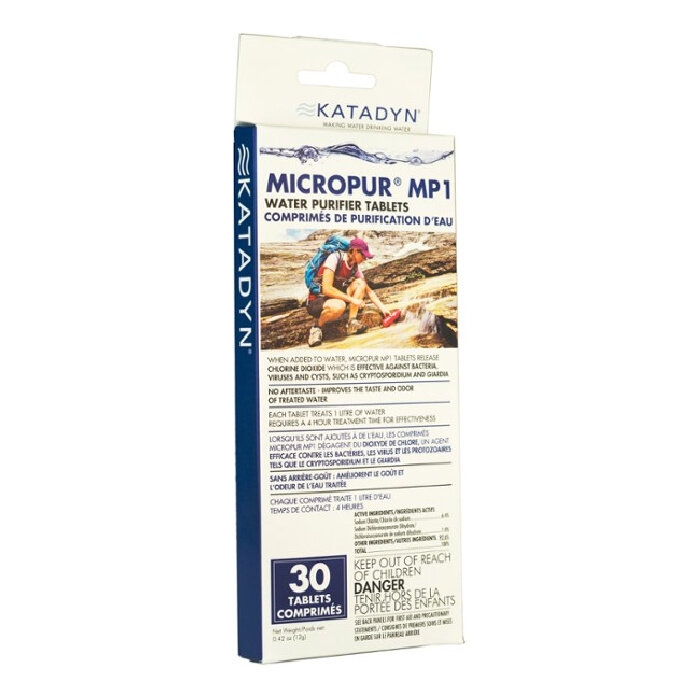
Katadyn Micropur
Best Chemical Water Purification
CleverHiker Rating: 4.5/5.0
Price: $18
Weight: 0.9 oz.(30 tablets)
Flow Rate: N/A
Filter Pore Size: N/A
Lifetime Volume: N/A
Pros
- Ultralight
- Compact
- Easy to use
- Affordable
- Purifies water, including viruses
- Can't break
Cons
- You’ll have to wait for clean water
- Has a slight aftertaste
Katadyn’s Micropur tabs are our top choice for those who want the lightest possible method of water purification, are in areas with a lot of livestock, or want a backup in the event their main filter fails.
The active ingredient in these tablets is chlorine dioxide, which will eliminate the risks posed by microorganisms, bacteria, cysts (giardia and cryptosporidium), and viruses. We never hit the trail in areas with heavy agricultural use without packing a few of these since contamination from cattle and human waste are some of the most common ways waterborne illness spreads.
Gear analyst Brett Kretzer carried Micropur tabs as a secondary treatment method on his 500-mile GR11 Trail thru-hike. The trail passes through a ton of pastureland, and many of the water sources are shared with cattle. The Micropur tabs added extra peace of mind and a valuable layer of protection.
The biggest thing to keep in mind with this treatment method is that it requires a wait time to work properly. You’ll need to let the tabs do their magic for a minimum of 15 minutes before your water is good to go. But you’ll have to wait a full four hours for the chemical to kill cryptosporidium – a fairly rare parasite – in areas where water is heavily contaminated with feces.
Luckily, microfilters – like the Sawyer Squeeze and Katadyn BeFree above – can filter out crypto, so it could be worth it to bring both means of water treatment on trails with questionable water to eliminate the really long wait.
We love this treatment method because it’s affordable, easy to use, and nearly hassle-free. There’s a slight swimming pool taste with chlorine dioxide, so we recommend throwing a packet of hydration mix in if that bothers you.

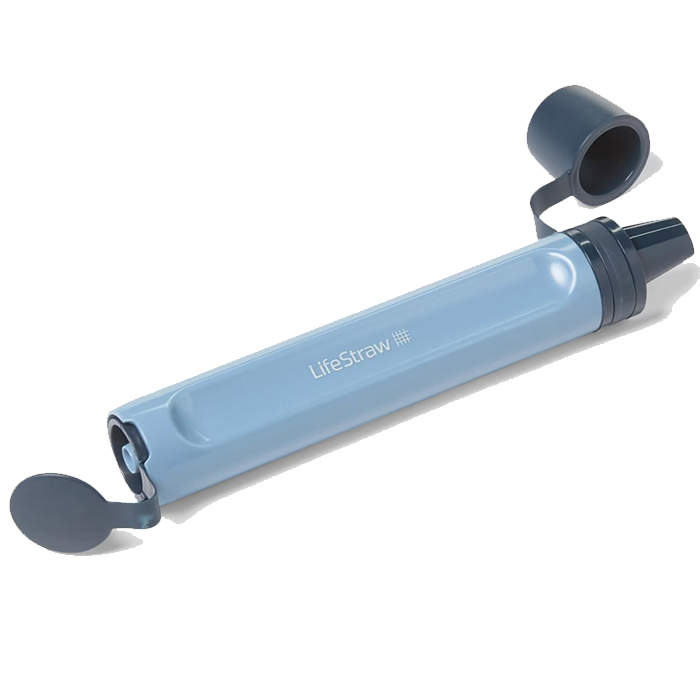
LifeStraw Peak Straw
Best Straw Water Filter
CleverHiker Rating: 4.4/5.0
Price: $25
Weight: 2.3 oz.
Flow Rate: 1.5 L/min
Filter Pore Size: 0.2 microns
Lifetime Volume: 4,000 L
Pros
- Good flow rate
- Compatible with a variety of bottles
- Ultralight
- Compact
- Can be used as a straw
- Affordable
- Easy to clean in the field
Cons
- Bulky
- Clogs easily
- Not rated for viruses
The LifeStraw Peak Straw filter is ideal for trail runners or anyone hiking in a water-abundant area who doesn’t need to carry extra water in their pack. The nearly eight-inch length and ergonomic mouthpiece make it perfect for sipping water straight from the source. For even more length, attach an extra hose to the end.
The Peak Straw works via hollow-fiber membranes with 0.2-micron pores that filter out 99.999999% of harmful bacteria and 99.999% of parasites, microplastics, sand, and silt. These tiny pores eliminate almost all of the earthy flavor caused by tiny organic matter, making for delicious drinking water in the backcountry. It doesn’t filter out viruses or heavy metals, but those usually aren’t a concern for most backpacking trips.
Despite being specifically designed as a straw filter, the Peak Straw also works impressively well as a gravity and squeeze filter. Its flow rate stacks up strongly with our favorite squeeze filters, and it filters via gravity surprisingly fast, as well. The downside is that it clogs more quickly than other filters, so frequent cleaning in the field is necessary to keep it flowing.
Although it doesn’t last quite as long as Sawyer filters, if you clean it regularly, the Peak Straw should be able to filter up to 4,000 liters of water before it stops allowing water to flow, indicating that the filter is shot. The Peak Straw should also be protected from freezing temperatures to keep the filter in working condition.
The LifeStraw Peak Straw filter represents a solid option for hikers, backpackers, and trail runners alike. It meets the most common standards for a backpacking filter and is the best choice for a straw. Best of all, it only weighs 2.3 ounces.
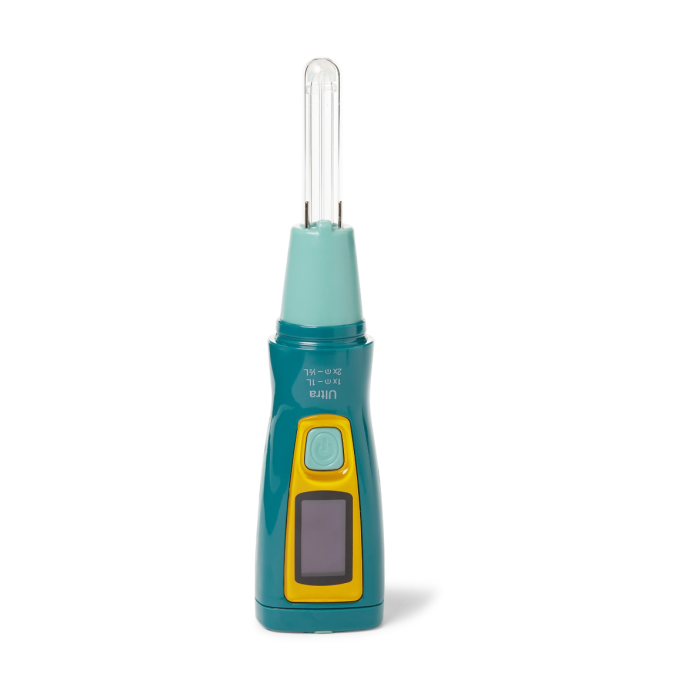
Katadyn Steripen Ultra
Best UV Light Water Purifier
CleverHiker Rating: 4.4/5.0
Price: $135
Weight: 4.9 oz.
Flow Rate: N/A
Filter Pore Size: N/A
Lifetime Volume: 8,000 activations
Pros
- Lightweight
- Compact
- Easy to use
- Purifies quickly
- Kills viruses
Cons
- Expensive
- You'll need to keep the battery charged
- Not effective in murky water
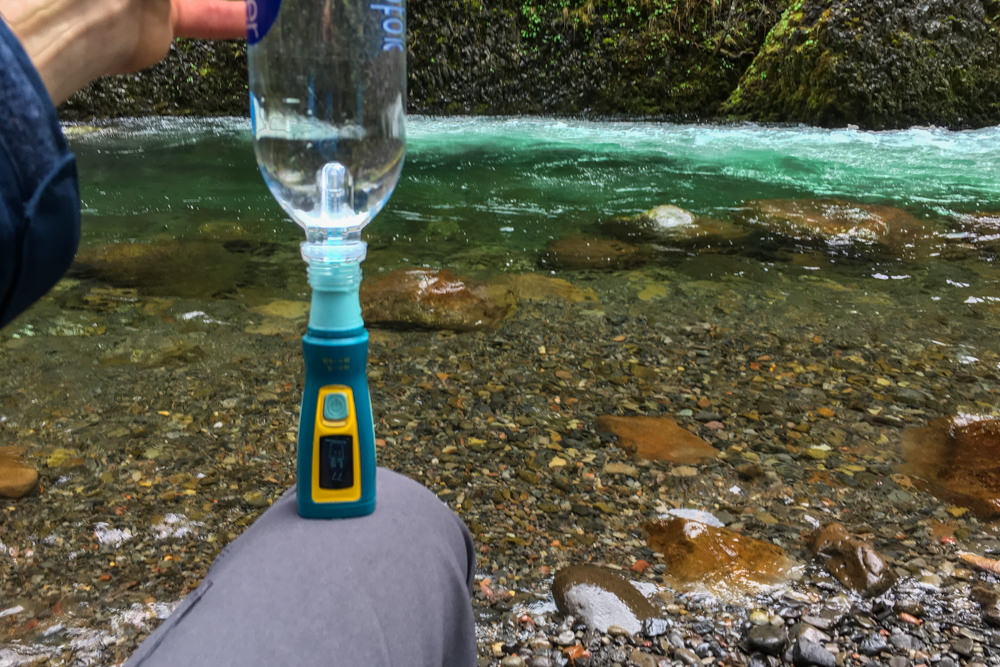
We love the convenience and speed of the Katadyn Steripen Ultra UV light purifier. Paired with a small-mouth, one-liter plastic bottle, the Ultra is just about the fastest and easiest water treatment method we’ve ever used. Simply place the Ultra in your water bottle, flip it upside down, gently agitate for 90 seconds, and you’ve got a clean liter of water.
We can purify about five days of water for two people (over 50 liters) with the Ultra’s rechargeable internal battery. We don’t love that its functionality hinges on a battery, but we always carry a chemical purification method – like Katadyn Micropur or Aquamira – as a backup. We also always bring a power bank for charging important electronics, so we’ve never had a problem keeping the Ultra’s battery charged on trail.
The biggest downside with UV treatments like the Ultra is that they don’t work in murky water. The light needs to be able to penetrate the water molecules, so anything dirtier than a slight cloudiness will render the Ultra ineffective. For this reason, we reserve this water purifier for traveling in places where we’ll want to purify the tap water and for trips where clear streams and springs are the main sources.
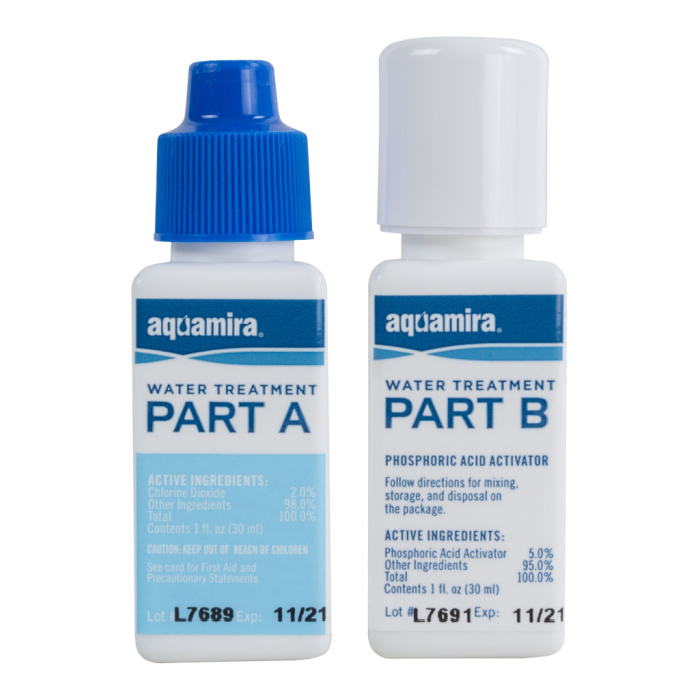
Aquamira
Best Chlorine-Dioxide Drop Purification
CleverHiker Rating: 4.4/5.0
CleverHiker Rating: 4.4
Price: $15
Weight: 3 oz.
Flow Rate: N/A
Filter Pore Size: N/A
Lifetime Volume: 114 L
Pros
- Ultralight
- Compact
- Easy to use
- Affordable
- Purifies water (including viruses)
- Can't break
Cons
- Wait time necessary
- Affects the taste of water
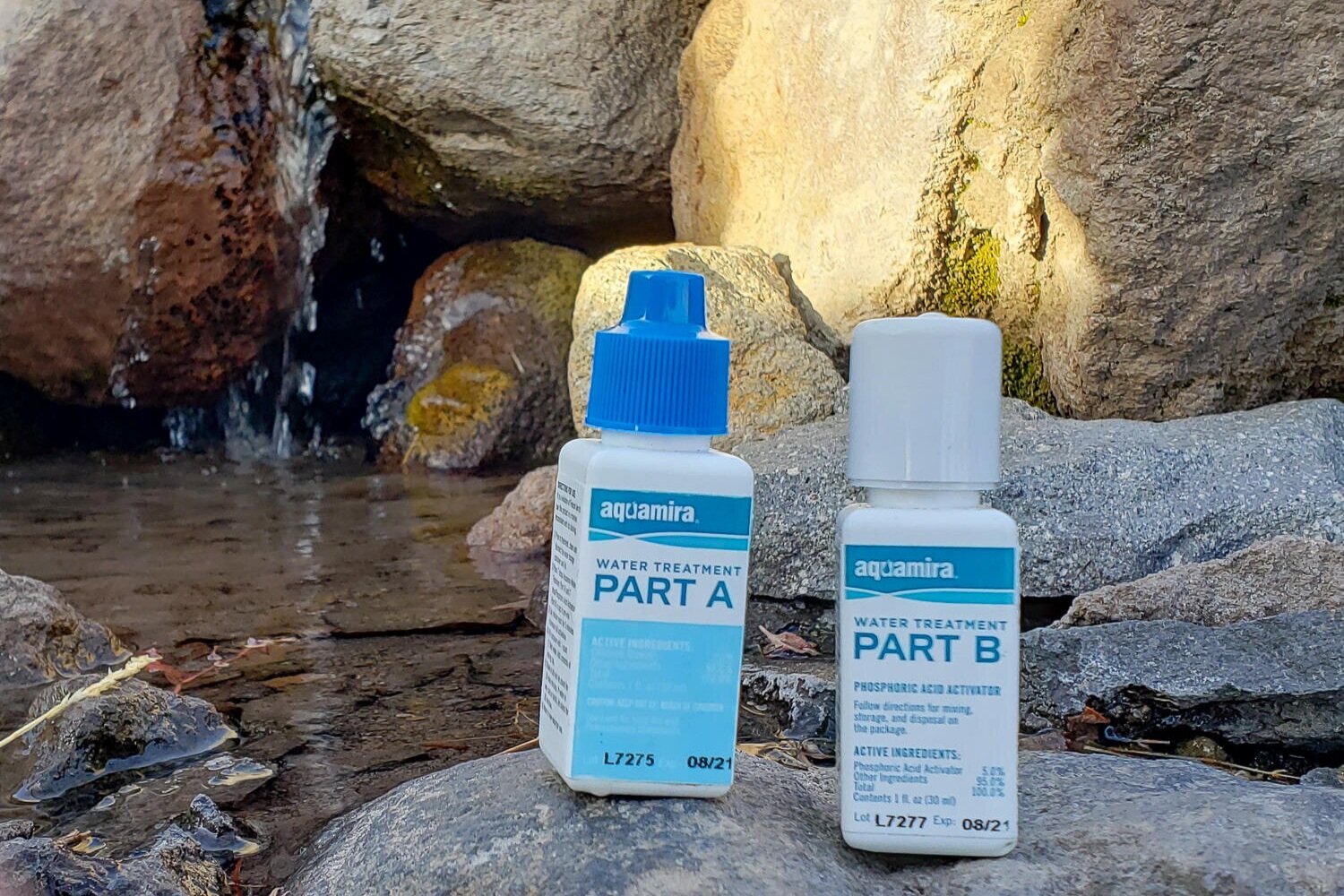
Like the Katadyn Micropur tabs above, Aquamira is a chlorine-dioxide treatment that purifies your water of any harmful microorganisms, bacteria, cysts (giardia and cryptosporidium), and viruses.
We prefer Micropur over Aquamira, but this liquid form does have some advantages over the tabs – the biggest pro being cost per use. Micropur costs about $0.60 per liter, whereas Aquamira costs around $0.13, so the savings is significant over time. The other glaring difference is the taste of the water after treatment. Though both forms of chlorine dioxide can leave a chemical taste behind, the pool-water flavor was far less noticeable with Aquamira.
Why do we prefer Micropur? It really comes down to weight and convenience. Since we’re often carrying chemical treatment as a precaution, we like the fact that we can bring only the amount of tablets we need for a trip instead of having to bring all three ounces of the drops.
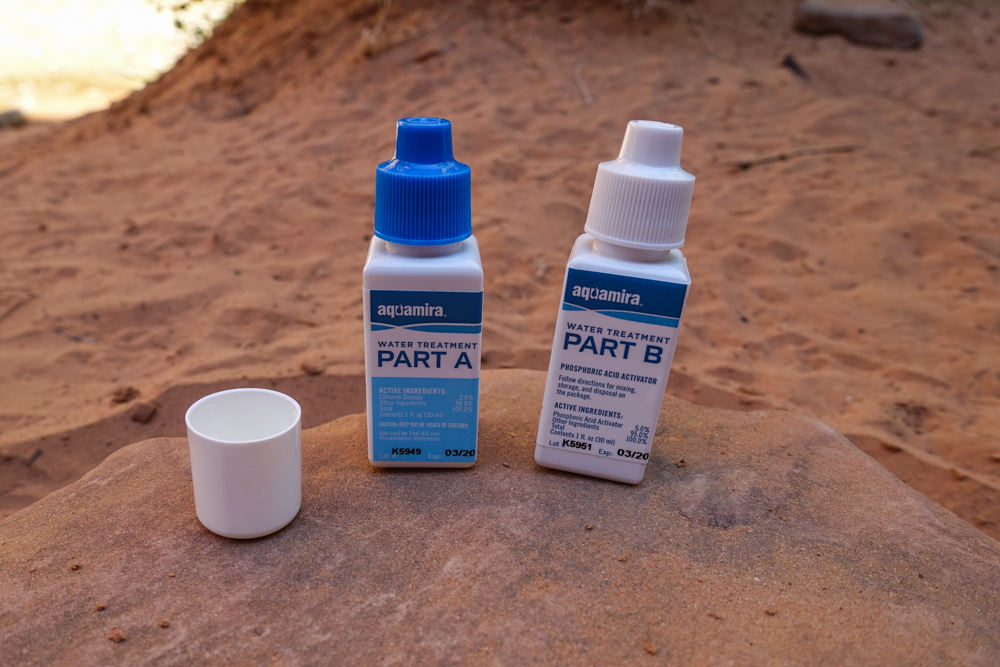
The tabs are also more convenient – you open the package, throw one in your water, and wait the appropriate amount of time. Aquamira requires you to mix drops from the two bottles, let that sit, then put it in your water and wait again for it to work.
Ultimately, both chemical purification methods will get the job done, and you should base your decision on what’s most important to you. If you want to maximize savings per treatment, go with Aquamira. If you prioritize convenience and efficiency over all else, choose Micropur.
More: Aquamira Full Review
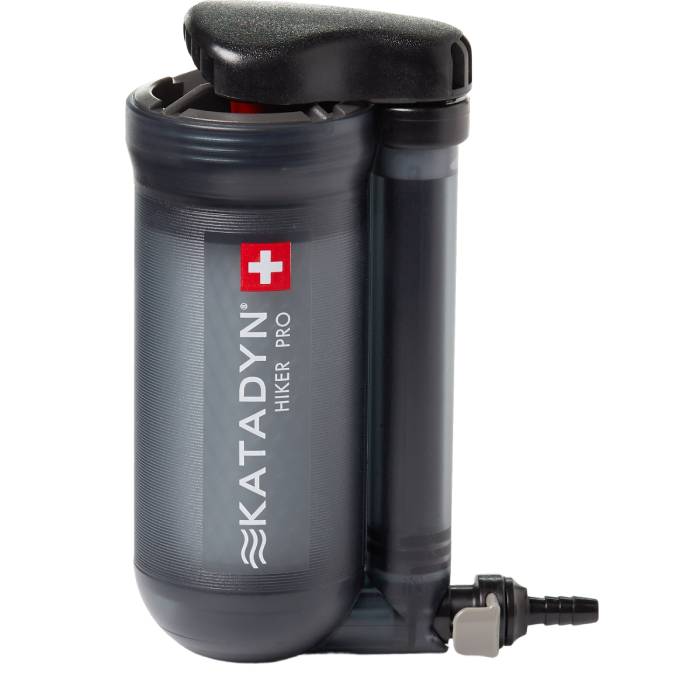
Katadyn Hiker Pro
Best Pump Water Filter
CleverHiker Rating: 4.4/5.0
Price: $100
Weight: 12.8 oz.
Flow Rate: 1.3 L/min
Filter Pore Size: 0.2 microns
Lifetime Volume: 1,150 L
Pros
- Good for shallow sources
- Easy to use if kept clean
- Very durable
- Replacement filter elements available
- Effective against chemicals and pesticides
Cons
- Heavy and bulky
- Hard to pump after heavy use
- Not rated for viruses
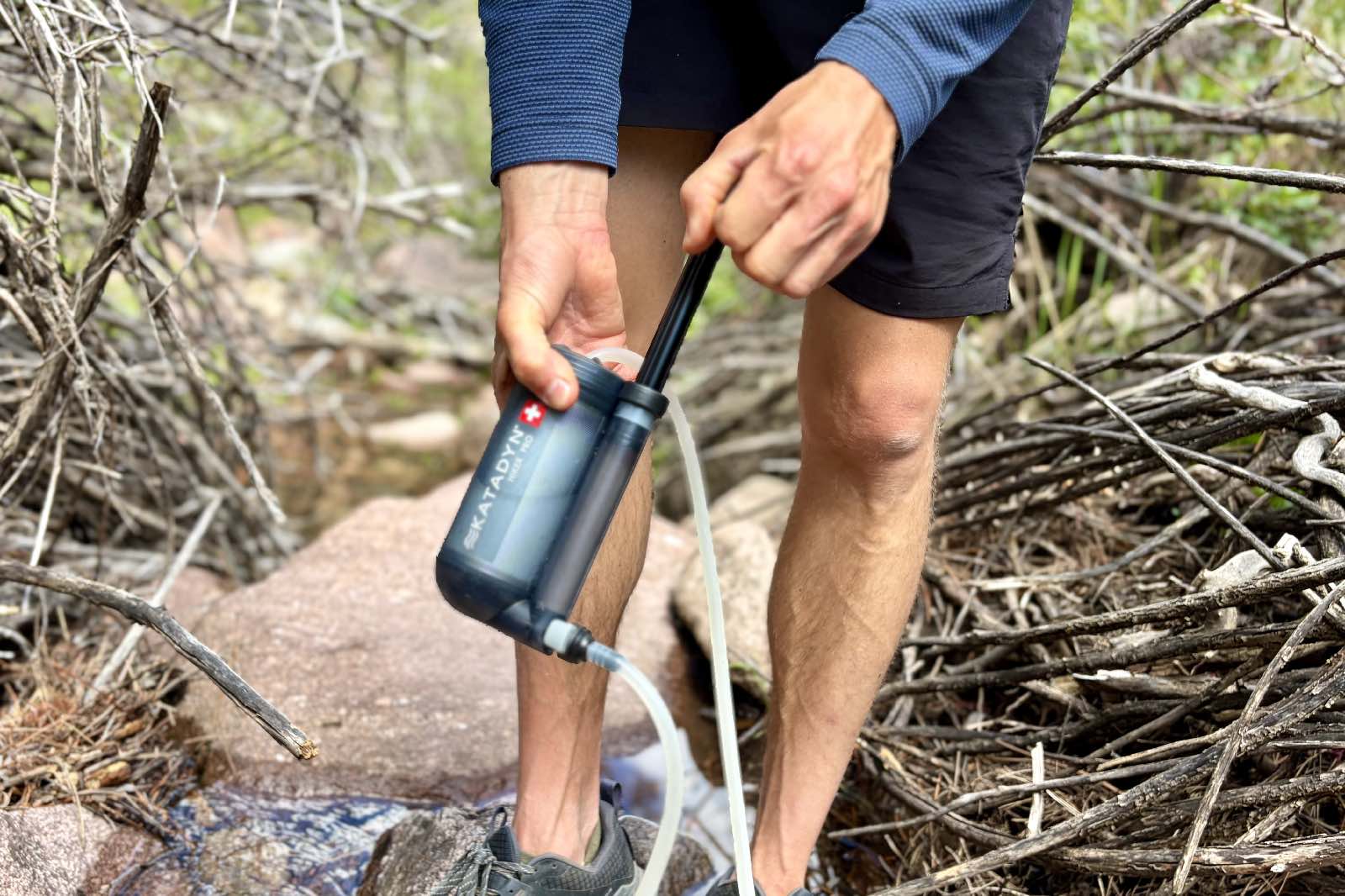
For those who still prefer a hand pump setup over squeeze or chemical options, the Katadyn Hiker Pro (aka the Hiker Pro Transparent or Hiker Pro Clear) provides a lightweight, easy-to-use design at a fairly reasonable price. It effectively filters out harmful bacteria and protozoa, and its activated-carbon core absorbs chemicals and pesticides.
The glaring shortcoming of most other filtration types is that they struggle to get clean water from very shallow sources, but the Katadyn Hiker Pro is designed to draw water from any depth, making quick and easy work of filtering small puddles and similar sources.
The main advantage of the Hiker Pro is its longevity. Though it’s one of the pricier filters on our list, it features smart design elements that make it a good investment for those wanting something that will last for years. The inlet side includes a pre-filter that catches large debris, helping keep the main filter element clean. When you return from your trip, you can open the entire unit and rinse each part separately to remove accumulated dirt. The clear housing shows your current water and filter quality.
The durability of this filter is the reason we’ve trusted it on several long-distance hiking trails. The sturdy housing can withstand a lot of hard use, and the filter element can be replaced for less than the cost of buying a whole new Hiker filter once it’s met its end.
Though the weight and bulk of this filter may deter lightweight hikers, backpackers seeking the best long-term bang for their buck won’t find a better option.
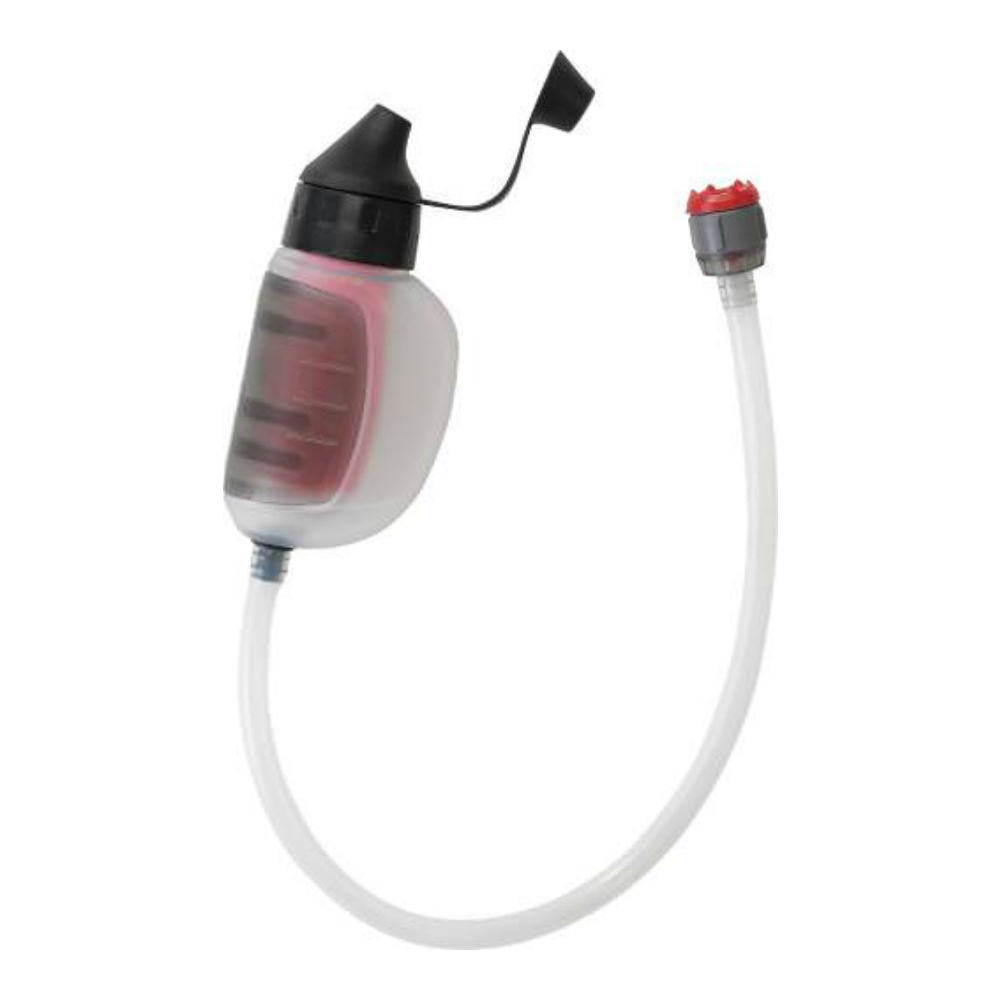
MSR TrailShot
Lightweight Filter that Works Well in Shallow Water
CleverHiker Rating: 4.3/5.0
Price: $70
Weight: 5.2 oz.
Flow Rate: 1 L/min
Filter Pore Size: 0.2 microns
Lifetime Volume: 2,000 L
Pros
- Good for shallow water sources
- Easy to clean in the field
- Very durable
Cons
- Hand pumping can be tiring
- Pumping becomes difficult as the filter gets dirty
- Heavier than others
- Not rated for viruses
The MSR TrailShot is a lightweight pump filter with the ability to draw water from shallow streams and puddles, making it a good choice for hikes in drought-prone areas.
The days of using a sad, curled-up leaf to scoop water from shallow sources are over. The TrailShot is designed with an inlet that pulls from any depth with a simple squeeze of the filter element housing. The pump action creates suction that takes in water and cleans it at a rate of one liter per minute, so it’s a real time-saver on trails where deep-flowing streams are scarce.
As is the case with most pump/squeeze filters, hand squeezing six liters per day with the TrailShot can get annoying, but it’s not as bad as some of the more traditional pump filters we’ve used. We’ve pumped more than 200 liters of water through the TrailShot, and we’ve been very pleased with how long it maintains its flow rate.
Because the inlet pre-filters water and prevents larger debris from making it to the main filter element, it can handle pretty dirty sources without becoming difficult to pump. And when the flow rate does decrease, shaking the TrailShot a couple of times does wonders to restore the flow. The filter housing is also very durable, and the filter cartridge can be replaced once it’s reached the end of its usefulness.
Product Comparison Table
| oSort | Product | Price | Weight | Flow Rate | Filter Pore Size | Lifetime Volume | Effective Against | Removes Particulates | Water Quality | Ease of Use | Treatment Time | Maintenance & Longevity | Weight Score | 0 |
Sawyer Squeeze View at REI View at Amazon 
|
$46 | 2.5 oz. (filter only) | 1.7 L/min | 0.1 microns | 378,000 L | Bacteria, protozoa, microplastics | Yes | 4.7 | 4.5 | 4.5 | 4.5 | 4.7 | 1 |
Katadyn BeFree View at REI View at Amazon
|
$53 | 2.3 oz. (including 1 L soft bottle) | 2 L/min | 0.1 microns | 1,000 L | Bacteria, protozoa | Yes | 4.7 | 4.5 | 4.8 | 4.4 | 4.7 | 2 |
LifeStraw Peak Squeeze View at REI View at Amazon
|
$44 | 2.4 oz. (filter only) | 1.75 L/min | 0.2 microns | 2,000 L | Bacteria, parasites, microplastics | Yes | 4.6 | 4.6 | 4.6 | 4.5 | 4.6 | 3 |
MSR Guardian View at REI View at Amazon |
$400 | 1 lb. 1.3 oz. | 2.5 L/min | 0.02 microns | 10,000 L | Bacteria, protozoa, viruses, sediment | Yes | 4.9 | 4.7 | 5.0 | 4.8 | 3.5 | 4 |
Platypus QuickDraw View at REI View at Amazon |
$55 | 3.6 oz. (including 1 L reservoir) | 3 L/min | 0.2 microns | 1,000 L | Bacteria, protozoa | Yes | 4.5 | 4.5 | 4.6 | 4.4 | 4.5 | 5 |
Platypus GravityWorks View at REI View at Amazon |
$135 | 11.5 oz. (including two 4 L reservoirs) | 1.75 L/min | 0.2 microns | 1,500 L | Bacteria, protozoa | Yes | 4.5 | 4.5 | 4.6 | 4.4 | 4.5 | 6 |
Katadyn Micropur View at REI View at Amazon 
|
$18 | 0.9 oz. (30 tablets) | N/A | N/A | N/A | Bacteria, protozoa, viruses | No | 3.9 | 4.9 | 3.9 | 5.0 | 4.9 | 7 |
LifeStraw Peak Straw View at REI View at Amazon
|
$25 | 2.3 oz. | 1.5 L/min | 0.2 microns | 4,000 L | Bacteria, parasites, microplastics | Yes | 4.6 | 4.7 | 4.6 | 4.0 | 4.7 | 8 |
Katadyn Steripen Ultra View at REI View at Amazon |
$135 | 4.9 oz. | N/A | N/A | 8,000 activations | Bacteria, protozoa, viruses | No | 3.9 | 4.7 | 4.3 | 4.7 | 4.4 | 9 |
Aquamira View at REI View at Amazon
|
$15 | 3 oz. | N/A | N/A | 114 L | Bacteria, protozoa, viruses | No | 3.9 | 4.4 | 3.9 | 5.0 | 4.6 | 10 |
Katadyn Hiker Pro View at REI View at Amazon |
$100 | 12.8 oz. | 1.3 L/min | 0.2 microns | 1,150 L | Protozoa, bacteria, pesticides, chemicals | Yes | 4.6 | 4.4 | 4.5 | 4.3 | 3.9 | 11 |
MSR TrailShot View at Amazon View at Backcountry |
$70 | 5.2 oz. | 1 L/min | 0.2 microns | 2,000 L | Bacteria, protozoa | Yes | 4.5 | 4.1 | 4.4 | 4.2 | 4.4 |
|---|
Analysis & Results
In this section, we outline the top performers in each metric after our rigorous hands-on testing and compare different features, facets, and specifications of each to help you decide which one is right for you.
Which Water Filter is the Best Value?
We compare each filter’s cost to its total score to find you the best value. Without question, squeeze filters tend to provide the most value with minimal investment.
The Sawyer Squeeze is hard to beat with a lifespan of over 380,000 liters and an easy-to-use, ultralight design. For one of the least expensive filters on our list, it’s also among the most durable. The LifeStraw Peak Straw and LifeStraw Peak Squeeze offer a lot of versatility at a similar price but with considerably less longevity.
For a slightly bigger investment, the Katadyn BeFree delivers significantly better performance upfront. It has a higher flow rate and is easier to clean. Both the Sawyer Squeeze and Katadyn BeFree are among the most popular on the trail for good reason.
The Katadyn Micropur tablets and Aquamira are great options for affordable chemical treatments, especially for short trips, but the cost can add up during extended backpacking adventures. Their reliability, however, is unmatched.
If pump filters are your jam, the MSR TrailShot is the most affordable option. It can draw water from very shallow sources and still offers some of the convenience of a squeeze or straw filter. For an affordable, traditional hand-pump filter, the Katadyn Hiker Pro is built with a durable design to last a long time, though replacement filters can be costly.
From there, improved performance becomes exponentially more costly. The MSR Guardian is one example, with its ability to filter out tiny viruses. Whatever your preferred filtration style is, any option on our list is sure to be a smart investment.
Which Filters Produce the Highest-Quality Water?
When it comes to water quality, the MSR Guardian is the only filter on this list that also purifies water. Its super-small, 0.02-micron hollow-fiber filter removes particulates, bacteria, protozoa, and viruses, making it one of the few portable filters effective against viruses. During tests, the Guardian excelled at providing clean, clear water with no noticeable offensive taste, and we’ve never had any reason to doubt its effectiveness.
The Sawyer Squeeze filters out bacteria, protozoa (such as giardia), and microplastics. Although its 0.1-micron filter is too large to remove viruses, it still produces crisp, fairly clear, neutral-tasting water, even from silty sources. The Katadyn BeFree is very similar with a 0.1-micron hollow-fiber filter that is good for bacteria and protozoa.
The LifeStraw Peak Straw, LifeStraw Peak Squeeze, MSR TrailShot, Katadyn Hiker Pro, Platypus GravityWorks and Platypus QuickDraw all come very close to the water quality of the top squeeze filters, but they have an ever-so-slightly-larger pore size of 0.2 microns. For most purposes, this difference is negligible.
If you are looking for alternative treatment methods, the Aquamira drops, Katadyn Micropur tablets, and Katadyn Steripen Ultra are all reliable virus killers. The biggest downside is that these don’t address particulates – if you have a silty, organic-tasting source, the treated water will be silty and organic-tasting. Additionally, chemical treatments leave behind a chlorine taste, which is reassuring but unappealing for many. And the UV light of the Steripen requires a certain level of pre-treated clarity to work effectively, so we prefer the added security of mechanical filtration or chemical treatments.
Which Water Treatment Methods are the Easiest to Use?
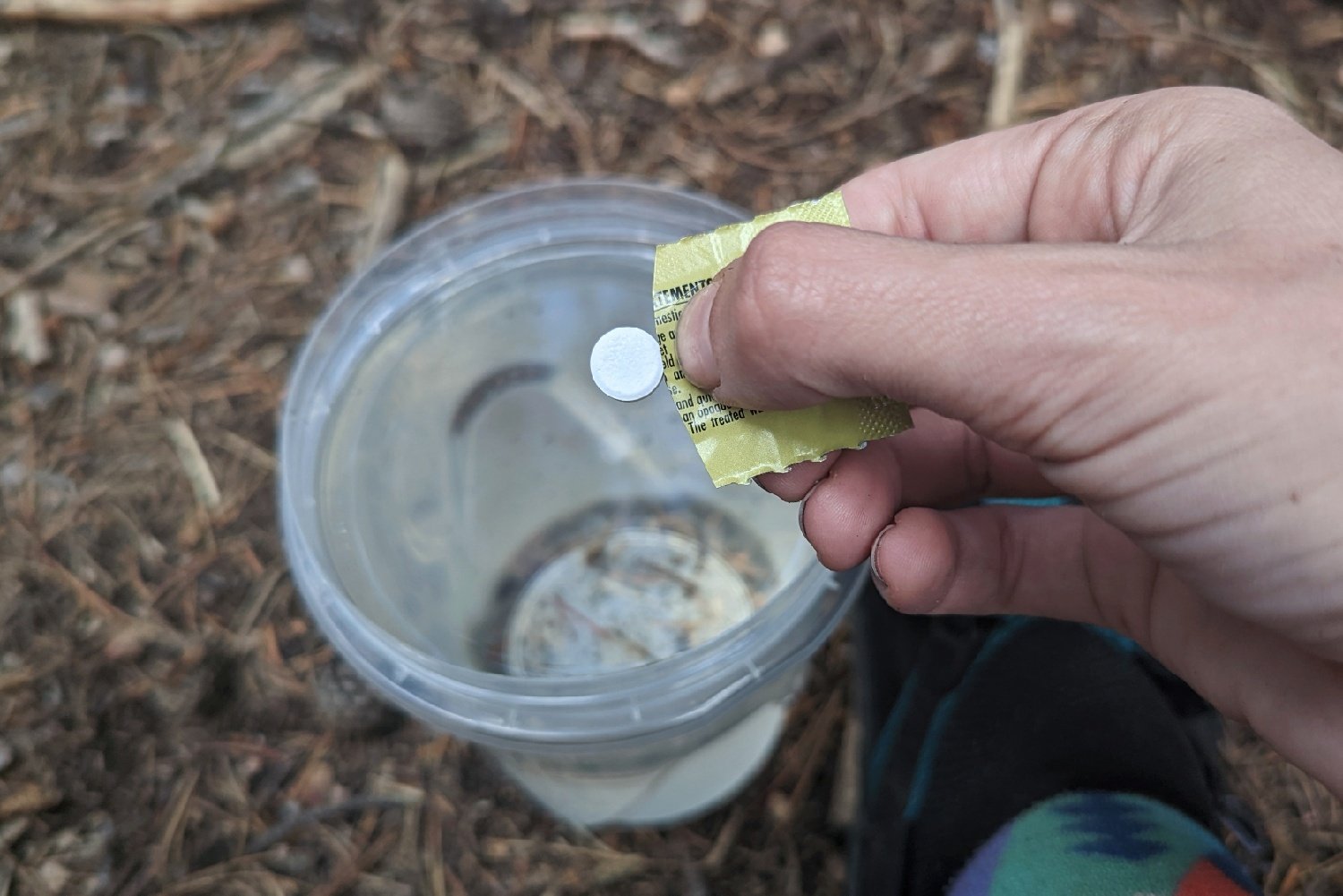
For ease of use, it’s hard to beat Katadyn Micropur tablets. You simply drop one tab into a liter of water and wait the necessary time (15 to 30 minutes for bacteria and protozoa; four hours for viruses). It also works with any container: bottle, bladder, or even a Ziploc bag. There are no moving parts, and beyond dropping the tablet in and sealing the container at the end, the treatment process is completely passive.
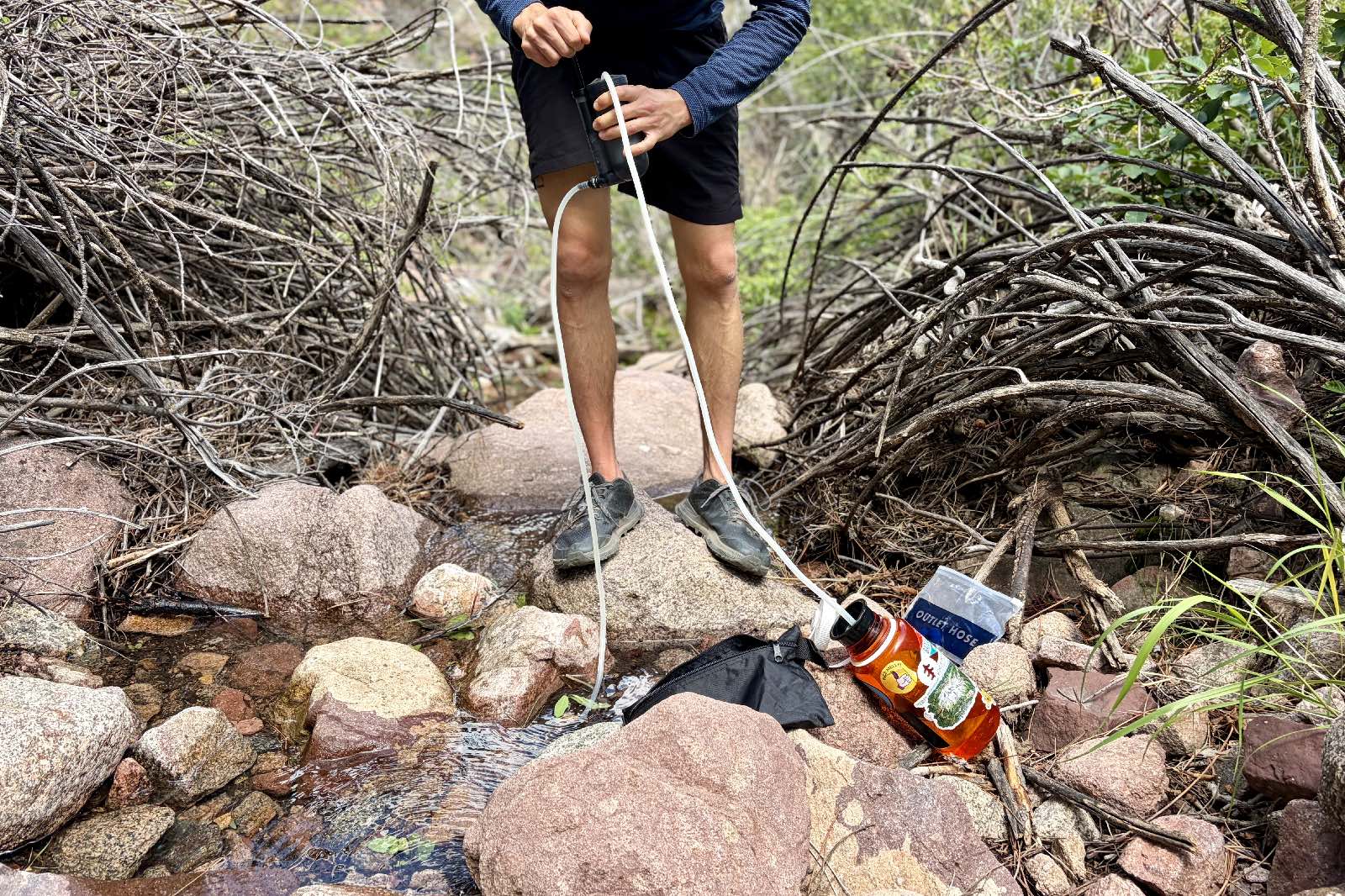
Although it takes a little time to understand initially, the Platypus GravityWorks is easy to set up. Once you hang it, gravity does the rest, with the untreated pouch flowing into the clean water reservoir below it. It comes with a four-liter dirty reservoir and a four-liter clean reservoir, but you can use it with other containers with the right attachments.
The Katadyn Steripen Ultra is altogether different from anything else on this list but intuitive to use. Just turn it on, insert it into water, and stir for 90 seconds. We appreciate that the device signals when the process is finished. Although it’s much easier to use with wide-mouth bottles like Nalgenes (or, honestly, a pot), it only requires a minute and a half of active stirring.
The MSR Guardian and Katadyn Hiker Pro both require pumping. However, they are compatible with a range of bottles and bladders, so all in all, they are still relatively easy to use compared to others on the list that require even more effort to squeeze for even less water.
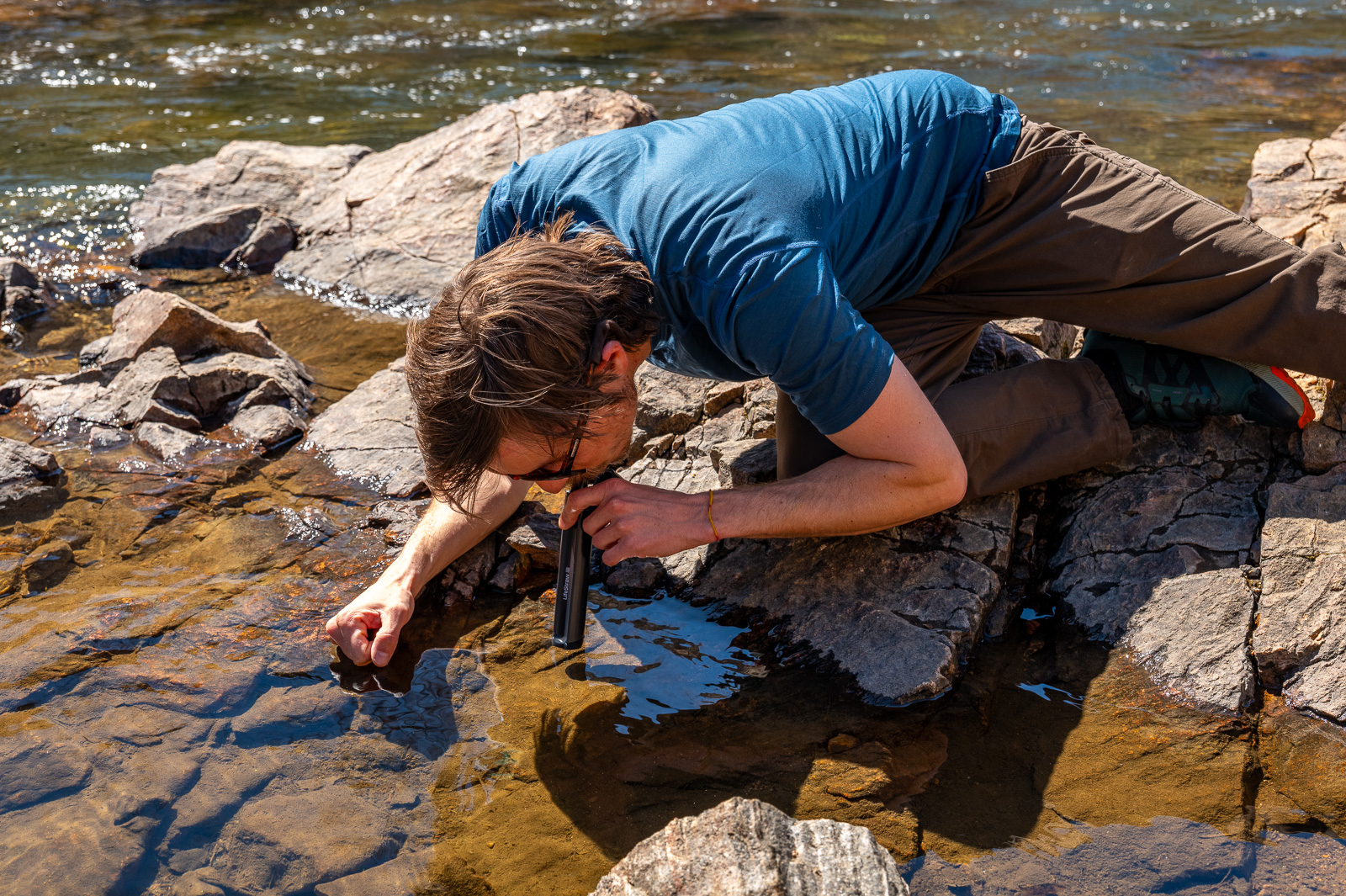
The LifeStraw Peak Straw offers convenience unmatched by any other filter. Its long housing and comfortable mouthpiece are designed so you can drop a knee and sip water straight from the source within seconds. Some other filters offer similar capability, but none are as efficient as the Peak Straw.
Squeeze-style filters have become the most popular option on long-distance trails thanks to their low weight and straightforward usability. Of these, the LifeStraw Peak Squeeze offers the best versatility. It’s compatible with 28-millimeter Smartwater bottles as well as 42-millimeter soft flasks.
Which Water Filters are the Fastest?
The MSR Guardian stands out here with the fastest flow rate, filtering up to 2.5 liters per minute, making it incredibly efficient for filtering large quantities of water.
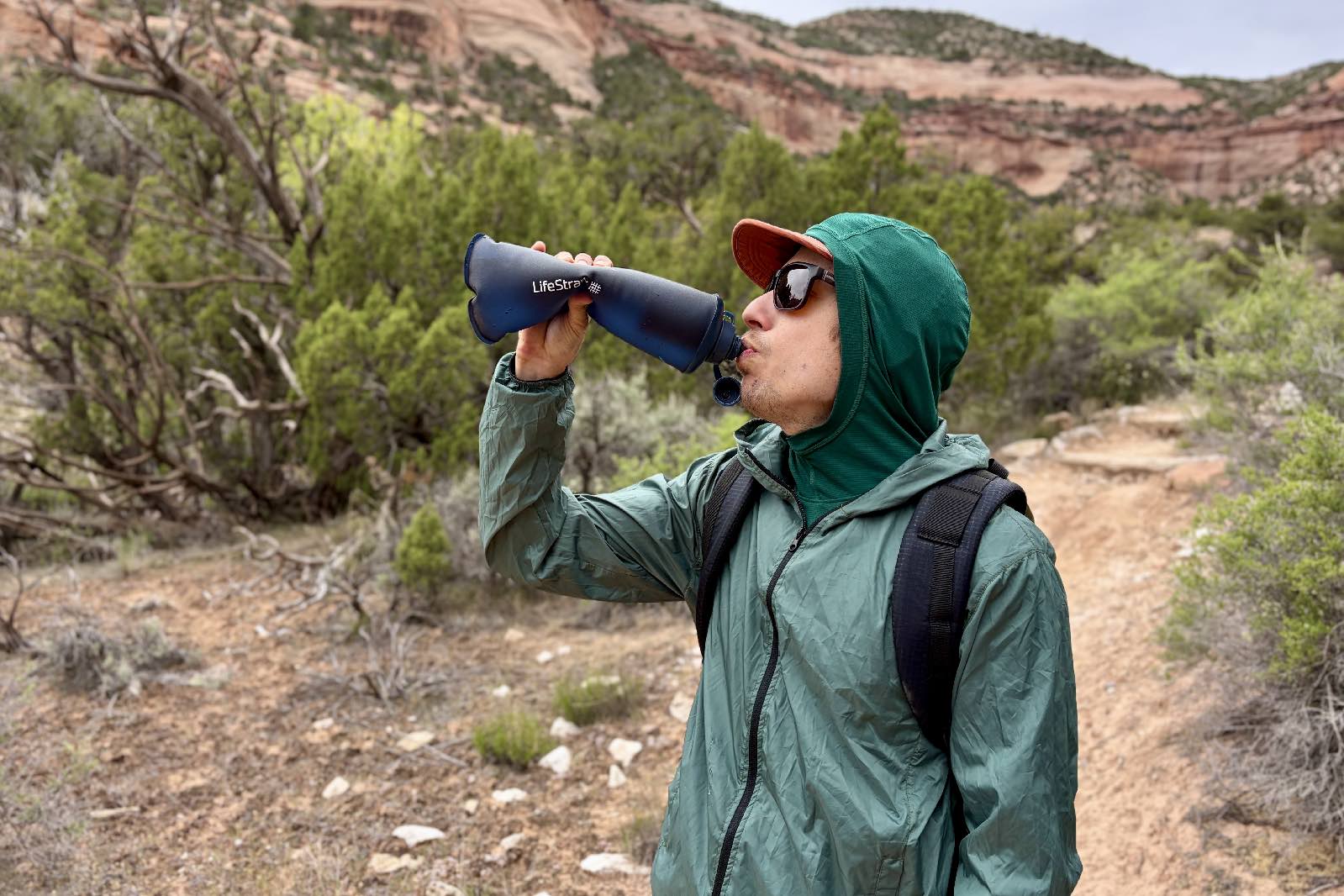
The Katadyn BeFree, LifeStraw Peak Squeeze, and Sawyer Squeeze are comparable, with the BeFree treating up to 2 liters per minute (30 seconds per liter) and the Sawyer Squeeze handling about 1.7 liters per minute (35 seconds per liter). All three of these filters are fast, but the Peak Squeeze and BeFree’s flexible designs and ease of squeezing often make them feel quicker and more convenient. (However, both can take much longer if they haven’t been cleaned in a while.) The Katadyn Hiker Pro falls within these flow rates, as well, but has some assembly time.
The LifeStraw Peak Straw filters about 1.5 liters per minute when squeezed through a bladder. And unlike most squeeze filters, it actually has a pretty impressive gravity flow rate of about 2.5 minutes for a single liter. The Platypus QuickDraw claims a flow rate of up to 3 liters per minute, but the best we could get out of it was about half that.
The Platypus GravityWorks treats 1.75 liters per minute, meaning its four-liter capacity can be finished in under three minutes. Although this method is slower than some more active ones, its capacity allows you to produce more water in less time because you don’t need to refill anything.
In contrast, the Katadyn Steripen Ultra is done in 90 seconds flat for one liter. Although its “flow rate” isn’t as fast as mechanical methods, there’s no jostling with multiple containers, and it provides a consistent time throughout a trip since it can’t clog.
Which Water Filters are the Lightest?
Among the lightest options, Katadyn Micropur stands out for its minimal weight: less than an ounce for a package of tabs. The discreet blister packs make them highly convenient for ultralight backpacking and emergency situations, allowing you to choose exactly how many to take, which gives you greater flexibility to adjust weight.
Though it is a liquid -treatment option, a pair of part A and part B Aquamira bottles comes in at 3 ounces, making it an excellent choice for those who need a lightweight but effective chemical treatment method. Additionally, the bottles become lighter as you go, unlike a mechanical filter.
The Sawyer Squeeze is a clear favorite for its compact and lightweight design, checking in at just 2.5 ounces. The Katadyn BeFree weighs a hair less at 2.3 ounces. Its flexible bottle also allows it to compress when empty, saving space in your pack. And at 3.6 ounces, the Platypus QuickDraw is another versatile and lightweight system that includes a collapsible reservoir.
The LifeStraw Peak Straw is similar to the other squeeze options, weighing 2.3 ounces, but its longer design is a little more cumbersome to pack, especially when attached to a bladder or Smartwater bottle. Its sibling, the LifeStraw Peak Squeeze, is much more compact and versatile. It’s also a very lightweight filter, weighing just 2.4 ounces not including a bottle.
The Platypus GravityWorks is significantly heavier with its two four-liter bladders and additional components. However, it might be worth the extra weight for certain uses, given how much water it can filter at once.
Which Water Filters Require the Least Maintenance?
At the top of the list, Katadyn Micropur tabs and Aquamira drops require zero maintenance. The only thing to remember is shelf life. The Micropurs usually last about five years if stored properly. Aquamira has a similar usage window of around four to five years for an unopened package but needs to be used within a year after opening.
The MSR Guardian, Katadyn Steripen Ultra, Sawyer Squeeze, LifeStraw Peak Squeeze, and Platypus GravityWorks require varying levels of maintenance but offer significant longevity. Anyone who is hard on gear will appreciate the particularly durable soft flasks that come with the Peak Squeeze.
The Guardian features an effective self-cleaning system that recirculates some of the pumped water through the device, reducing the need for manual backflushing. Each filter cartridge lasts up to 10,000 liters, making it a sturdy choice for long-term use.
The Steripen obviously doesn’t require any backflushing, which is a big advantage, but it does need to be charged, and the bulb has a lifespan of about 8,000 liters. On the other hand, the Sawyer Squeeze requires regular backflushing with the included syringe. It claims to last up to 380,000 liters, but in reality, we always end up swapping it out well before that due to clogging.
Other squeeze filters, such as the Platypus QuickDraw, Katadyn BeFree, and LifeStraw Peak Straw and Peak Squeeze are similar in most aspects but have a much shorter lifespan than the Sawyer Squeeze. The BeFree and Peak Straw are especially easy to clean, although they tend to clog quickly. Lastly, the Platypus GravityWorks system also benefits from periodic backflushing to maintain flow rate. Its filter can treat up to 1,500 liters before replacement.
How to Choose a Backpacking Water Filter
Do You Need a Water Filter or Water Purifier?
If you go to an outdoor specialty shop to buy a water treatment system for backpacking, the first thing they should ask you is “where will you be going?” That’s because they need to know if you need a water filter – or a water purifier – for your specific adventures.
This gear guide emphasizes water filters, which strain small sediments and some microorganisms from your water, such as bacteria and protozoa. Filters are typically enough for treating water sources in the United States and Canada. For backpacking, you need a microfilter made to remove contaminants down to 0.2 microns.
Water purifiers provide more protection because they also neutralize viruses, which are much smaller than protozoa and bacteria and therefore pass through the pores of standard water filters. You may need to purify water (not just filter it) if you’re traveling to countries with less developed sanitation infrastructures or backcountry sites contaminated with human or animal feces. Most backpackers purify water by boiling it, treating it with chemical tablets or ultraviolet light, or using a physical purifier. For more on this important distinction, check out MSR’s guide to water filters vs. purifiers.
What are the Pros & Cons of the Different Filter Types?
Hollow-Fiber Filters
- Filters out (most) bad stuff and lets clean water pass through
- Allows you to drink clean, cold water right away
- Many require work (pumping, squeezing, etc.)
- Gravity filters don’t require much effort and can be good for groups
- Not effective against viruses, such as Hepatitis or Norovirus
- Prices vary – pump and gravity filters tend to be more expensive than squeeze filters
- Weights vary – pump and gravity filters tend to be heavier than squeeze filters
- Some maintenance is generally required (backflushing, cleaning, etc.) to keep up flow rates
- The flow rate of nearly every filter will decrease with use – the dirtier the water source, the faster the flow rate will drop and the sooner the filter will need to be replaced
- Freezing will break most filtration units, making them unsafe to use
Chemical: Chlorine Dioxide
- Purifies water by killing the bad stuff with chemical drops or pills
- Kills bacteria, protozoa, and viruses
- Very lightweight and easy to use
- Relatively affordable (drops normally cost less than pills)
- Relatively foolproof (no clogging, breaking, or maintenance)
- Four-hour wait time required for cryptosporidium (more info below)
Note: There are other chemical treatment options, but we recommend chlorine dioxide drops or purification tablets because they’re effective against cryptosporidium, while most others are not.
In order for chlorine dioxide to be effective against cryptosporidium, a four hour wait time is required. Giardia, bacteria, and viruses are all killed in about 30 minutes, but crypto takes longer to kill. When we judge a backcountry water source to be clean, we normally just wait the 30 minutes. If we don’t trust the water source, we wait the full four hours. Obviously, this is a personal choice that’s up to you.
UV Light Purifiers
- Works by sterilizing the bad stuff with ultraviolet light
- Kills bacteria, protozoa, and viruses
- Allows you to drink clean, cold water right away
- Requires minimal effort and works quickly
- Tends to be more expensive
- Requires batteries and could malfunction in the field
- Clear water required; not a good choice for murky sources
Boiling Water
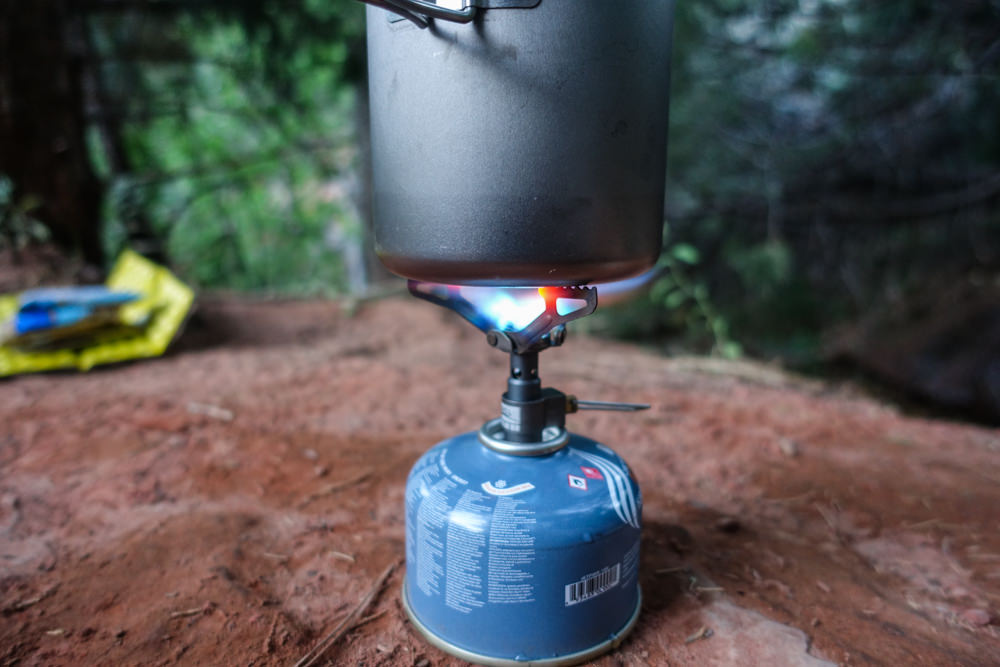
- Boil water for one minute (or three minutes over 6,500 feet) to kill bacteria, protozoa, and viruses
- Requires extra stove fuel and cooling time
- Not a primary treatment method but useful when you’re already cooking
What Should You Pay for a Water Filter?
The price of different filtration and purification methods varies widely, but the top consideration should always be getting the most effective and reliable option for your needs.
If you’re backpacking overseas and need a water purifier (not just a filter), it’s worth spending up for the right tool rather than buying a $20 filter that won’t kill viruses. If you’re backpacking in the U.S. and Canada where you don’t need a water purifier, however, a water purifier is a waste of money.
Chemical treatments are often the cheapest option upfront, squeeze and pump filters are typically a good value for backpackers, and UV purifiers tend to be on the more expensive side.
What’s the Best Ultralight Filtration Option?
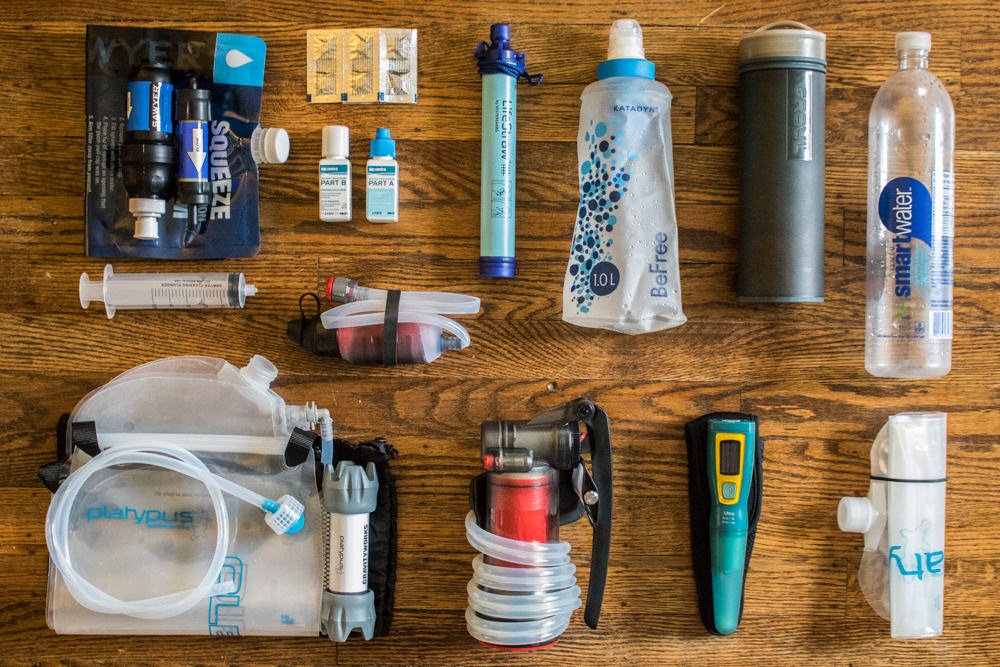
Squeeze filters and chemical treatments are a lightweight and convenient way to get clean water in the backcountry. Squeeze filters are the most common ultralight option since most backpackers find the occasional cost of replacement worth the weight savings over gravity and pump filters.
What’s the Easiest Way to Get Clean Water?
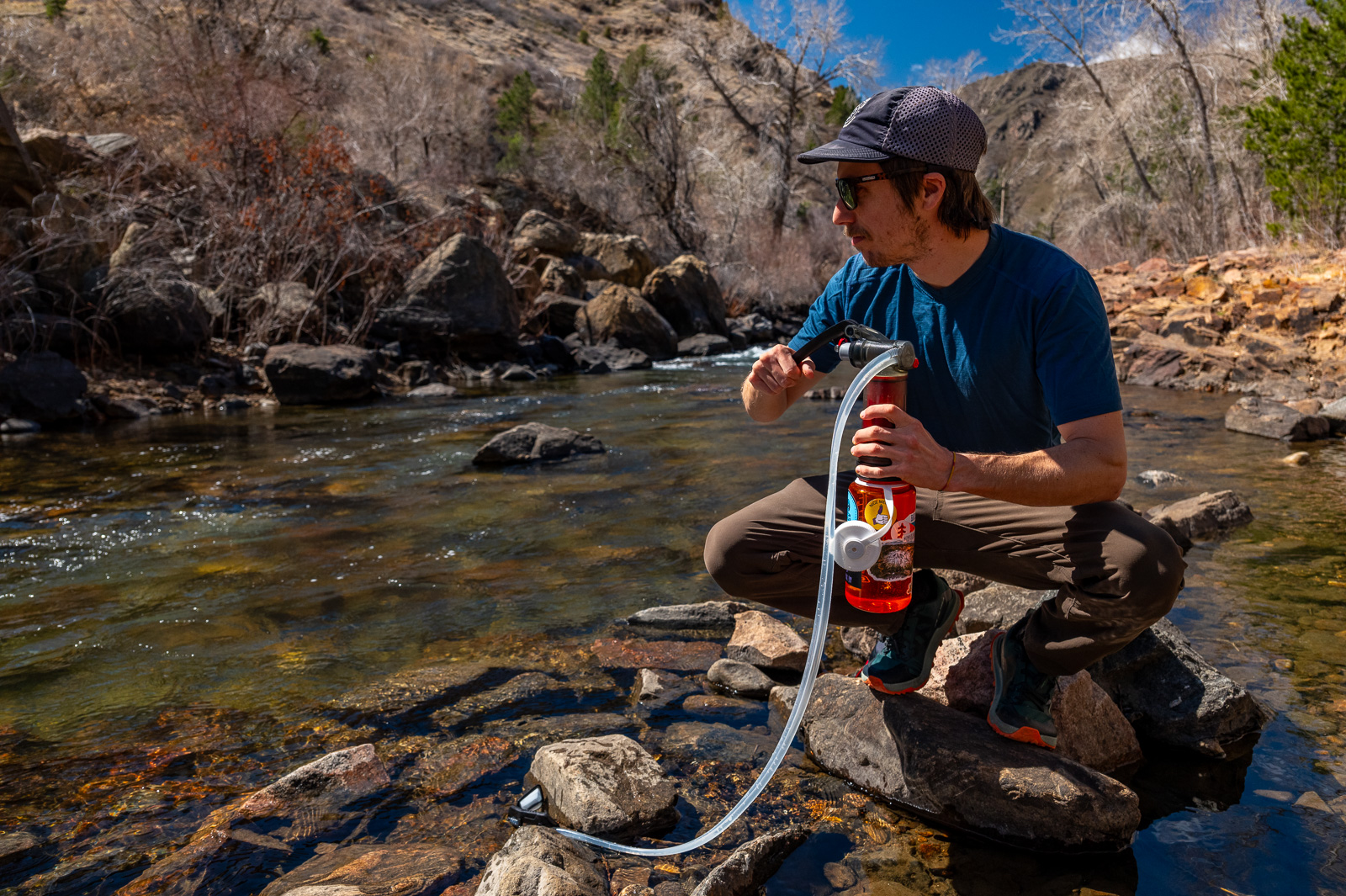
You’ll need to treat water multiple times a day in the backcountry. If your purification method is obnoxious, you’re bound to get annoyed with it quickly. We always prioritize treatment options that are easy to use.
Chemical treatments, squeeze filters, and gravity filters (for groups) are usually the most convenient ways to get clean water, but UV purifiers are also simple to use as long as you keep the battery fresh.
Do You Need a Backup Filtration Method?
Just like any important backcountry tool, you’ll want to have a backup plan if your water treatment method fails. Water filters can clog, squeeze bags can break, and UV purifier batteries can die. So, regardless of your treatment method, we always recommend bringing backup chemical treatment pills. We’ve had to rely on backup pills several times and have always been happy to have them.
How Do You Choose a Water Source?
Choosing clean water sources is one of the best ways to avoid contamination in the backcountry. When choosing a water source, look for clear, cold, flowing water. Medium-size streams are usually ideal. Lakes can be a good choice, as well, but sediment and bacteria tend to accumulate around shorelines, so flowing water is preferable.
Feces tends to be the biggest culprit in water contamination, so always avoid areas with lots of human or animal activity (pastures or meadows, for example). Rain can make matters worse by washing contaminants and sediment into water sources. Snow should always be boiled for about one minute or melted and treated, because it can contain contaminants, as well.
Do You Need to Pre-Filter Your Water?
Small bits of organic matter (leaves, algae, etc.) usually pose no threat, but you can use a pre-filter (bandana, pantyhose, etc.) to strain out debris before treating your water. When water sources are clear, we don’t bother with pre-filtering, but we often bring a small clipping of pantyhose just in case. Pre-filtering will make any water treatment process more effective and will extend the life of your water filter.
Why Trust CleverHiker
Our team has treated 100,000 liters of water across our backcountry adventures using nearly every type of treatment technology available.
Gear analyst Brett Kretzer has hiked thousands of miles around the world, including some of the hottest, driest deserts in the U.S. From sharing water sources with cattle in the Spanish Pyrenees to filling up from beaver-infested ponds on the Long Trail, he has had to rely on a wide range of filters and chemicals to stay hydrated. More than once, he’s learned the hard way what works and what doesn’t. His hands-on experience and extensive time as a gear expert give him a unique perspective in evaluating the treatments in this lineup.
Testing Methodology
How Do We Test Water Quality?
In assessing water quality, we consider two things: what kinds of harmful organisms, viruses, and chemicals a treatment type removes, as well as what the resulting water looks like and tastes like. Products that neutralize a wider range of hazards are often more appealing.
We check manufacturer claims in conjunction with our real-world experience to validate the efficacy of each product. To test for clarity and taste, we simply sample from a water source and compare the before and after treatment results for each, looking for clear water free from visible organic material. We also drink side by side and assess each purified liter for any unpleasant taste or odor.
How Do We Assess Ease of Use?
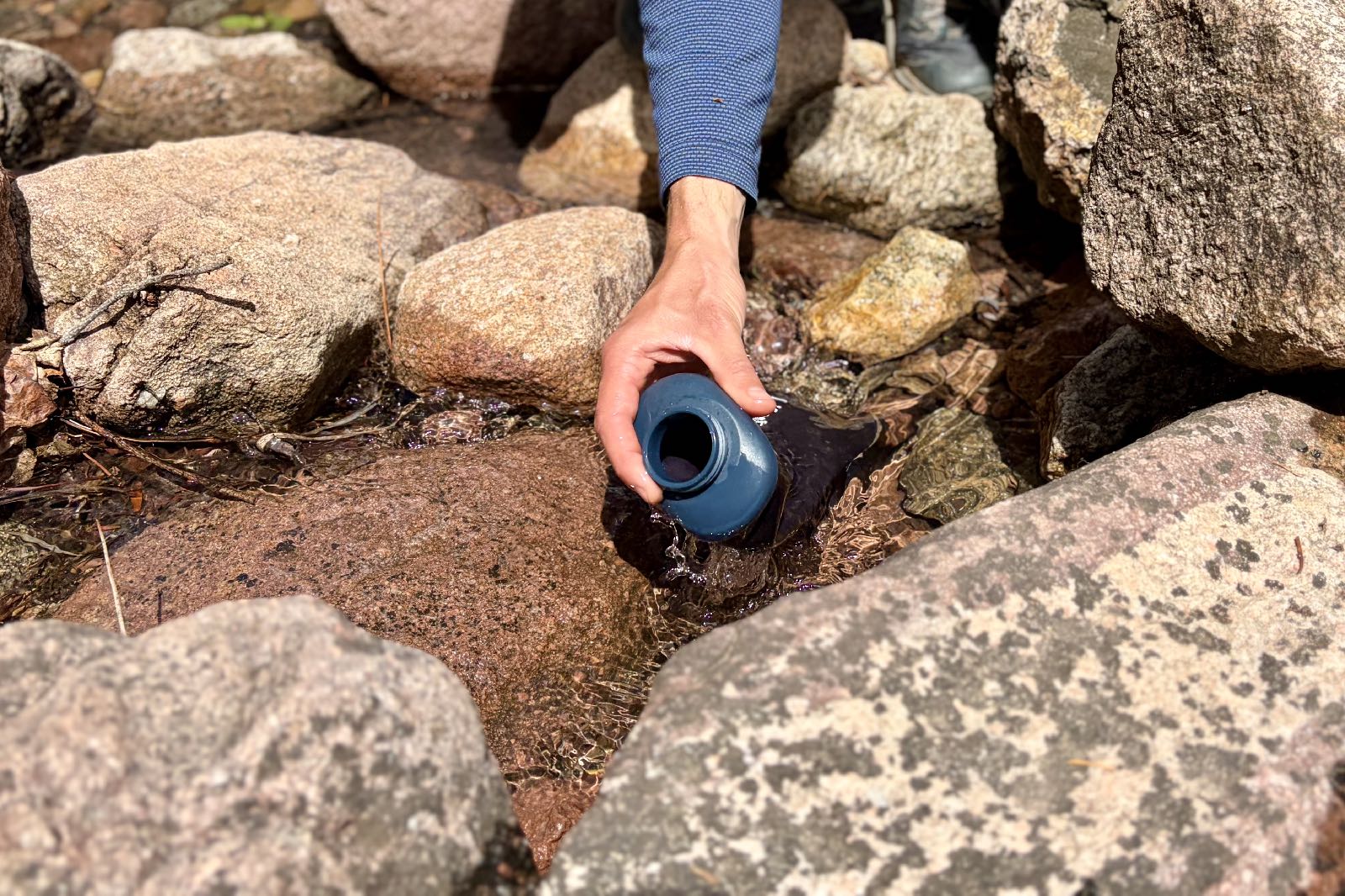
For ease of use, we consider how long it takes and how intuitive it is to start the filtering process. We consider the level of compatibility of each treatment with different types of bottles, bladders, and other containers. We also look at moving parts: the level of assembly required, as well as the amount of active work involved in treatment versus passive waiting.
How Do We Evaluate Treatment Time?
To determine treatment time, we take a liter of water from a source and measure how long it takes from the start of treatment to when the full liter is safe to consume. We also assess flow rates to determine whether a certain model is well suited for larger groups or if it is best for solo use.
How Do We Measure Weight?
As with many other pieces of backcountry gear, we look at manufacturer claims and weigh each model on our own scale. We note what type of container each treatment type comes with and consider that in the overall weight.
How Do We Determine Maintenance & Longevity?
We use our experience to determine how often a treatment type requires maintenance (e.g., through backwashing or battery changing) with regular use. We compare the original flow rate to the actual flow rate after pumping through 50 liters of typical backcountry water from a variety of sources. We also assess how much effort it takes to clean a particular product and get it working like (or as close to) new as we can. We take into consideration expiration dates, claimed lifetime flow volume, and other risks inherent to the type of product (e.g., filters freezing).
Conclusion
Having a reliable method of treating water is essential in the backcountry or any time you need confidence in the quality of the water you’re drinking. There is a lot to sift through, from squeeze and pump filters to chemical tabs, drops, and UV options. We hope this guide has you well on your way to finding the best option for your next adventure.