
Bottom Line
The Osprey Talon 22 and Tempest 22 are our top overall hiking daypacks because they balance comfort, organization, support, and durability better than the rest of the field. Their adjustable, gender-specific fits and AirScape back panels work especially well for hikers who carry moderate loads and want a close-to-body feel without giving up useful ventilation.
The biggest strength is organization. Large hipbelt pockets, a stretch-mesh front pocket, security storage, and accessible trekking-pole carry keep high-use gear easy to reach. The structured framesheet also manages weight more effectively than frameless budget packs, while remaining lighter and more agile than heavy internal-frame models.
The tradeoff is weight and bulk. At 2 lb. 6.1 oz. for the Talon and 2 lb. 4.3 oz. for the Tempest, these are not minimalist packs, and the framesheet limits compressibility. Still, for hikers who want one versatile daypack for regular trail use, the Talon and Tempest remain the most complete options we tested.
How We Tested
CleverHiker has years of field experience with the Talon and Tempest, including thousands of trail miles across mountain, desert, and everyday hiking conditions. Our long-term testing has included steep summit hikes, 20-plus-mile days, hot-weather desert use, technical routes, and repeated carries with more than 20 pounds of gear.
We evaluated the current 22-liter models against the rest of our daypack field for comfort, organization, support, weight, and packability. Testing focused on how the adjustable harness and AirScape back panel handled long days and heavier loads, how quickly we could access water and small essentials, and how the framesheet affected both load stability and portability.
Quick Specs
- Best for: All-around day hiking
- Material: 100D recycled ripstop nylon (body), 420D recycled nylon (bottom)
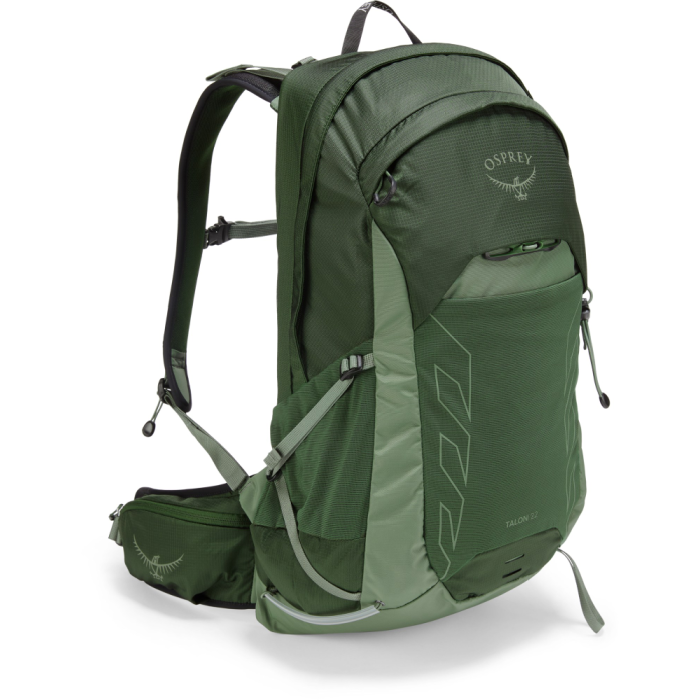
Osprey Talon 22 / Tempest 22
Best Daypack Overall
CleverHiker Rating: 4.7/5.0
Price: $175
Weight: 2 lb. 6.1 oz. / 2 lb. 4.3 oz.
Capacity: 22 L / 22 L
Frame: Internal framesheet
Pros
- Great balance of weight savings and support
- Ventilated back panel
- Stretch-mesh front pocket
- Hipbelt pockets fit smartphones
- Adjustable and gender-specific fit
- Accessible trekking-pole carry
- Durable
Cons
- Narrow hydration sleeve
- Side pockets fit Nalgenes better than Smartwater bottles


Comfort
The Talon and Tempest are comfortable across a wide range of day-hiking loads, especially for hikers who prefer a close-to-back fit. Their ergonomic shoulder straps, adjustable sternum strap, and torso adjustment make it easy to dial in the harness, while the women’s Tempest and men’s Talon provide distinct fit options. Our testing found that this adjustability matters on long days because it reduces the need to compromise between shoulder comfort and load stability.
Osprey’s AirScape back panel is a major reason these packs work so well. A semi-rigid foam sheet adds structure, while ventilation channels keep air moving from the upper back toward the lumbar area.
It does not create as much airflow as a suspended-mesh system such as the Stratos/Sirrus, but it feels more stable when scrambling or moving quickly because the load stays close to the body. We have used the Talon on hot desert hikes as well as steep mountain routes and consistently found the back panel supportive without feeling overly rigid.
The main comfort compromise is that the structured harness adds weight and bulk. Minimalists may feel more comfortable in a lighter pack such as the REI Flash 22 when carrying very little. For moderate loads, though, the Talon/Tempest’s padding, adjustability, and load control make the extra ounces worthwhile. That balance is why they score near the top of our daypack field for comfort rather than specializing only in ultralight or heavy-hauling use.
Comfort Score: 4.5 / 5.0

Organization
Organization is the Talon and Tempest’s clearest advantage and the best in our current daypack field. The two large hipbelt pockets hold high-use items such as a phone, snacks, or lip balm, while the stretchy front shove-it pocket is ideal for gloves, a hat, or a layer you expect to take on and off. A zippered security pocket and key clip keep smaller valuables from disappearing into the main compartment.
Technical storage is equally thoughtful. We have used the on-the-go trekking-pole system on steep and exposed terrain where freeing both hands matters. The packs also provide conventional rear pole storage, side pockets for bottles, and attachment options for other gear. The updated internal hydration sleeve accommodates more reservoir shapes than the previous design, although it remains comparatively narrow and is not our favorite feature.
The downside to this feature set is complexity. Hikers who want one cavernous compartment and very few straps may prefer the REI Flash 22, while commuters may get more daily-use value from the Osprey Daylite Plus. For dedicated hiking, however, the Talon/Tempest makes unusually good use of its 22-liter capacity. Most important items have an intuitive home, and the things we reach for most often can be accessed without fully unpacking the bag.
Organization Score: 4.9 / 5.0

Support
The Talon and Tempest strike a strong middle ground between frameless minimalist packs and heavier internal-frame daypacks. Their semi-rigid framesheet keeps the load from collapsing against the back, and the substantial hipbelt helps stabilize moderate weight. In our side-by-side daypack ranking, that support is clearly stronger than casual options such as the REI Flash 22, Daylite Plus, and Cotopaxi Batac, which rely much more heavily on the shoulders.
The close-to-body AirScape design also helps control the load during scrambling and quick movement. We have carried 20-plus-pound loads in the Talon on steep hikes, and the pack stays composed without the loose, floppy sensation common to frameless designs. The harness does not transfer weight as decisively as the perimeter-frame Gregory Zulu or the Osprey Stratos/Sirrus, but it is far less bulky and still provides enough structure for normal all-day hiking loads.
That distinction matters when choosing between categories. Hikers carrying winter equipment, a camera kit, or unusually large water loads may prefer a heavier frame-oriented pack. Hikers carrying only a jacket and snacks can save weight with a simpler model. For the broad middle of day hikers, the Talon/Tempest offers the most useful compromise: meaningful load management without turning a 22-liter daypack into a miniature backpacking pack.
Support Score: 4.5 / 5.0

Weight & Packability
At 2 lb. 6.1 oz. for the Talon and 2 lb. 4.3 oz. for the Tempest, these are not lightweight leaders in our daypack lineup. The structured back panel, durable fabrics, padded harness, hipbelt pockets, and extensive organization all add ounces. Compared with the 12-ounce Cotopaxi Batac or 14-ounce REI Flash 22, the difference is obvious on a scale and when packing for travel.
The framesheet also limits compressibility. Side compression straps can slim the profile when the pack is partially loaded, but the bag cannot roll or fold down like a frameless daypack. That makes it less attractive as a suitcase stuffer, summit side-pack, or secondary bag carried inside a larger backpack. Hikers who prioritize packability above load control have better options in this guide.
The reason the Talon/Tempest still scores well is that its weight buys real trail performance. The pack feels stable and agile under loads that make ultralight daypacks sag or pull at the shoulders, and the durable construction has held up through long-term use. For frequent day hikers, the relevant question is not whether it is the lightest pack, but whether the additional structure and organization are worth carrying. For most of our testers, they are.
Weight & Packability Score: 4.3 / 5.0

Should You Buy the Osprey Talon 22 / Tempest 22?
Yes, if you want one highly versatile hiking daypack and value fit, organization, and moderate-load support more than ultralight packability. The Talon/Tempest is especially well suited to frequent hikers, peak-baggers, and anyone who likes fast access to water, poles, layers, and small essentials.
Skip it if your kit is extremely light, you need a pack that disappears inside luggage, or you regularly haul loads heavy enough to justify a full perimeter frame. Those users will get a better fit from a minimalist pack or a heavier support specialist.

What Other Daypacks Should You Consider?
Deuter Speed Lite Pro 25 / Speed Lite Pro 23 SL Review: The Deuter is a better fit for hikers who prioritize low weight, speed, and a close athletic carry. Its vest-style shoulder straps add on-the-go storage and keep the load stable when moving quickly, and it weighs substantially less than the Talon/Tempest. You give up some heavy-load support and the Osprey’s more complete pocket layout, so we prefer the Deuter for fast hiking and scrambling rather than general-purpose day hiking.
Osprey Stratos 24 / Sirrus 24 Review: Choose the Stratos/Sirrus when ventilation and heavier-load comfort matter more than weight. Its suspended AirSpeed back panel creates more airflow than the Talon/Tempest’s close-to-body AirScape system, and the internal frame and substantial hipbelt transfer more weight to the hips. The downside is a much heavier, bulkier pack. For winter gear, extra water, or camera equipment, that tradeoff can be worthwhile.
REI Flash 22 Review: The Flash 22 is the stronger choice for minimalists, budget shoppers, and travelers who want a pack that nearly disappears when empty. At only 14 ounces, it is dramatically lighter and more compressible than the Talon/Tempest. It also costs much less. What you give up is equally clear: less padding, ventilation, organization, and load support, so it works best with a small, disciplined kit.