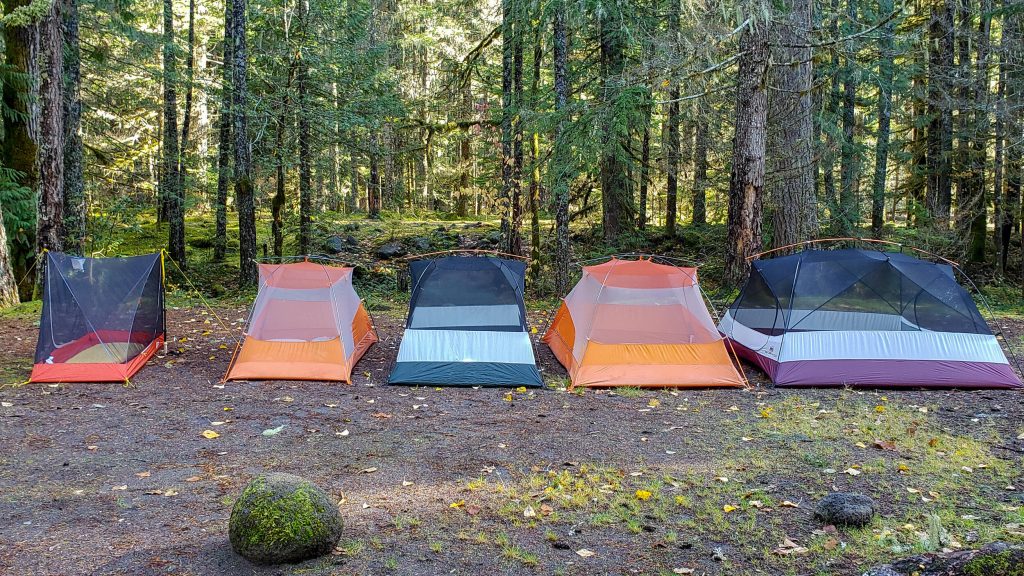



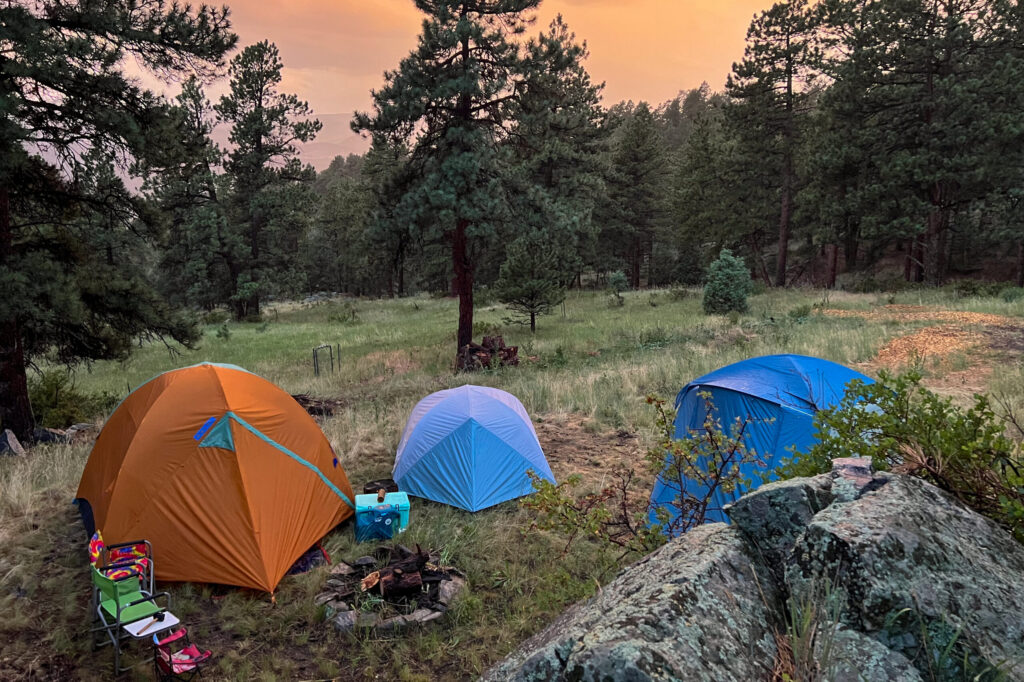
Our team of professional gear experts spent countless hours researching and testing over 50 camping tents to narrow it down to the most promising models. We’ve put tents from NEMO, REI, Marmot, The North Face, and more through dozens of nights of car camping.
Editor’s Note: This article was updated on May 12, 2026, to add a few new tents to our list (the REI Westward, REI Base Camp, and Coleman Skydome), revamp our coverage on the Kelty Wireless 6, and sprinkle in recent insights from testing.
How We Tested
We set up and broke down these tents in everything from rain to snow to strong Colorado winds. We snoozed, napped, and overnighted in variable conditions to assess comfort, durability, weather resistance, ease of setup, and feature-forwardness. Our team has collected over 3,000 nights of tent camping to give an accurate review.
For those who need an inexpensive but quality tent for two, we have also tested and reviewed the top budget backpacking tents available.
For more info, check out some of our other most popular gear guides:

#1. Best Camping Tent Overall
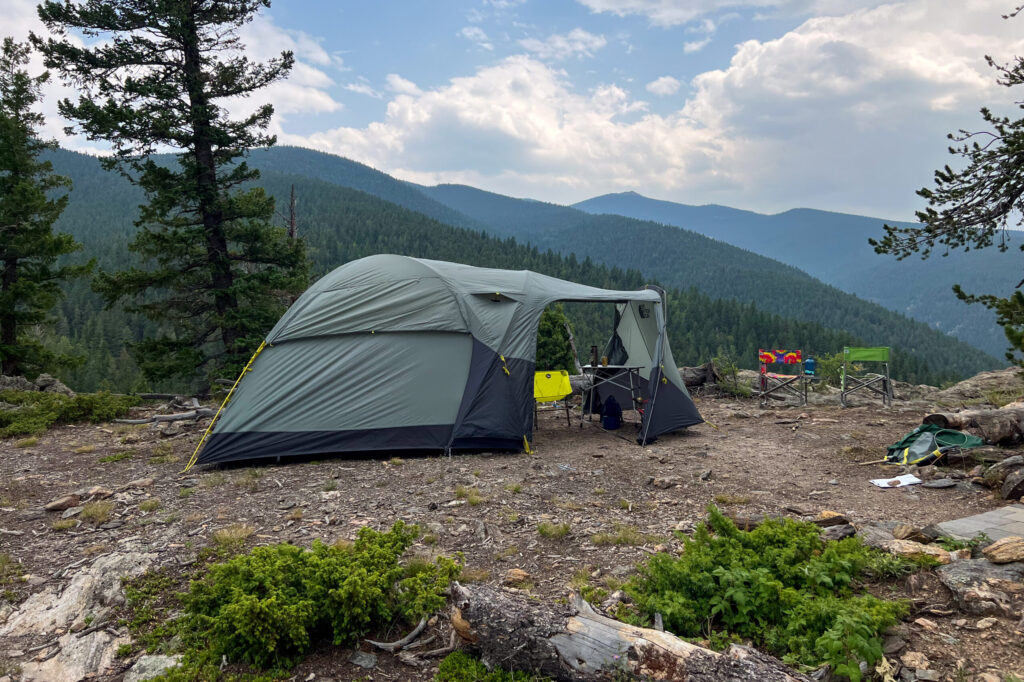
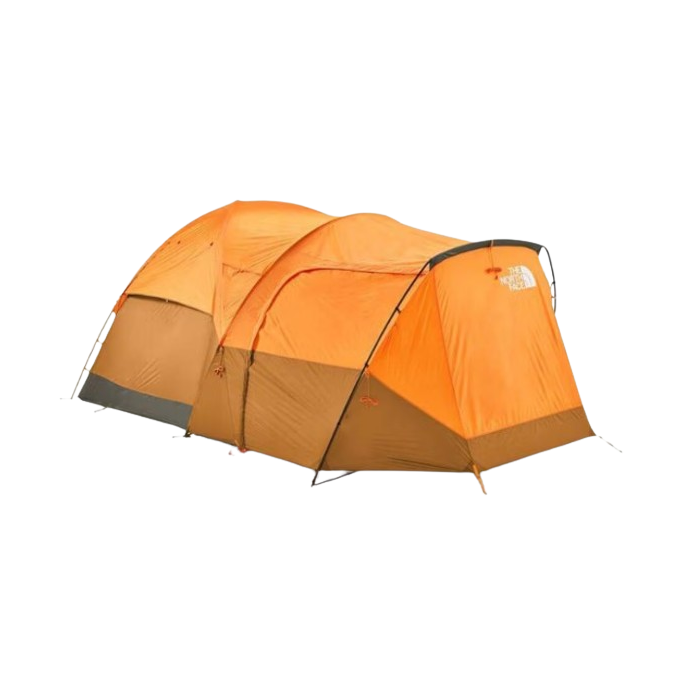
The North Face Wawona 6 earns our top spot because it nails the things that matter most for family camping: lots of livable space, a tall interior most adults can stand up in, and a massive vestibule that makes camp life easier. After testing more than 50 tents over dozens of nights in Colorado, the Wawona 6 is the one we keep coming back to.
Quick Picks for Camping Tents
Check out this quick list of our favorite camping tents, or continue scrolling to see our full list with in-depth reviews.
1. Best Camping Tent Overall: The North Face Wawona 6 ($585)
2. Best Camping Tent for Two: Mountain Hardwear Mineral King 3 ($400)
3. Best Luxury Camping Tent: REI Westward 6 ($549)
4. Best Tent for Easy Setup & High-Quality Materials: NEMO Aurora Highrise 4 ($400)
5. Best Crossover Choice for Camping & Backpacking: REI Half Dome 3 ($399)
6. Best Tent for Internal Storage REI Base Camp 6 ($569)
7. Best Bang for Your Buck: Kelty Wireless 6 ($280)
8. Best Tent That’s Built to Last: Mountainsmith Conifer 5+ ($450)
9. Best Low-Profile, High-Volume Camping Tent: Marmot Tungsten 4 ($449)
10. Best Tent for Light-Sensitive Sleepers Kelty Daydreamer 6 ($270)
11. Best Budget Tent for Casual Campers: Coleman Skydome 4 ($190)
The North Face Wawona 6
Best Camping Tent Overall
CleverHiker Rating: 4.8/5.0
Price: $585
The size we tested feels: Luxurious for 3-4, comfortable for 5, and tight for 6
Weight: 19 lb. 7.1 oz.
Dimensions (LxWxH): 116 x 94 x 76 in.
Pros
- High-quality fabric and poles
- Huge interior space
- Smart pockets and organization
- Many guyline attachment points
- Tall ceiling
- Massive vestibule
- Effective vents
Cons
- Heavy
- Hard to pitch in windy conditions
- Takes time to pitch
- Footprint not included
If you want tons of covered space for gear, group hangouts, or family trips, The North Face Wawona 6 is hard to beat. Its massive vestibule makes it feel more like a basecamp than a basic camping tent.
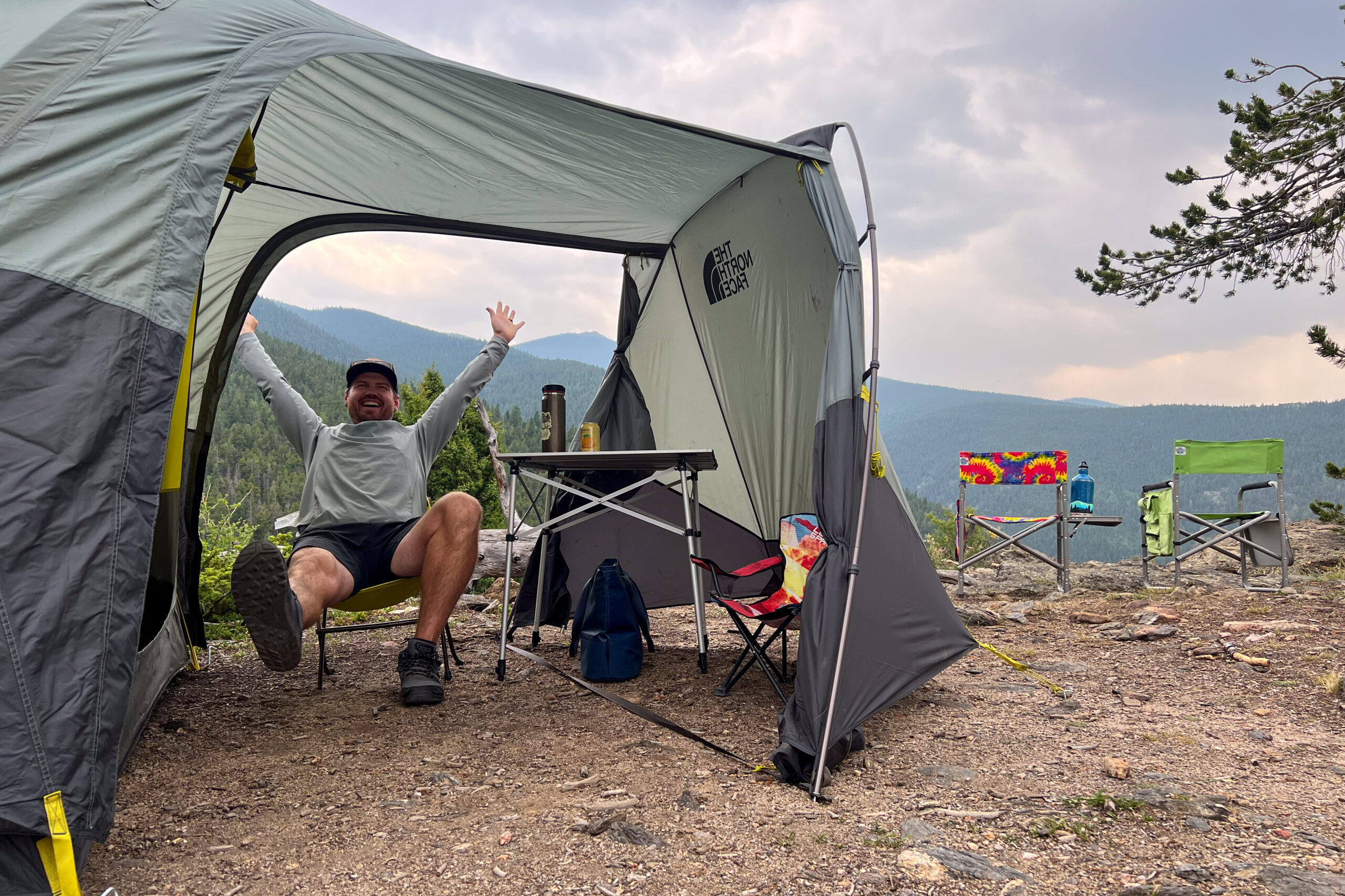
When it comes to vestibule size, the Wawona is in a class of its own: The front vestibule is a whopping 44.7 square feet, creating an additional covered space big enough to sleep in. The other side is about half as big but still very functional.
In addition to swallowing the typical muddy shoes, wet gear, and bulky items like backpacks, the spacious vestibule can accommodate multiple bicycles, bins of gear, or up to three camping chairs and a small table to relax during a rainy afternoon. Although neither side has a separate screen to keep out bugs, it hasn’t been a dealbreaker for us.
We appreciate the plentiful pockets and different-sized storage pouches throughout the tent for stuffing everything from light jackets and hats to lighters and charging wires. Other handy extras include a lantern loop in the center ceiling, color-coordinated poles for easy setup, and an all-mesh door and vent kickstands to keep air moving and prevent condensation from building up on humid nights.
That said, we found the Wawona a bit more challenging than average to pitch, so we highly recommend finding an extra set of hands to help speed up the process. The tall height of the tent makes it vulnerable in high winds, so knowing how to secure it properly is essential for gusty weather and storms.
The biggest cons of the Wawona 6 are its price and weight. This is one of the priciest camping tents we tested – and one of the heaviest as well. That said, we don’t carry it too far from our vehicles, and it offers outstanding value. The excellent use of space and storage, durable build, and oversized vestibules make it an unmatched basecamp tent for two to five people and a dog.
The generous 76-inch ceiling height, burly aluminum poles, and enormous vestibule could make this your go-to tent for years to come. If you’re the type of camper who likes to set up for days at a time (or longer) and satellite from that location for your outdoor adventures, this option is worth every penny.
Mountain Hardwear Mineral King 3
Best Camping Tent for Two
CleverHiker Rating: 4.7/5.0
Price: $400
The size we tested feels: Luxurious for 1, comfortable for 2, and tight for 3
Weight: 7 lb. 13.7 oz.
Dimensions (LxWxH): 90 x 68 x 48 in.
Pros
- Lightweight
- Easy and intuitive to pitch
- Huge doors with an out-of-the-way stuff pocket
- Pre-bent poles create plenty of internal room
- Dual zippers on the fly with a kickstand for ventilation
- Fly rolls up halfway
- Plenty of pockets
- Packs down small
Cons
- Lower ceiling height
- Guyline steaks are not included
- Especially difficult to pitch in windy conditions
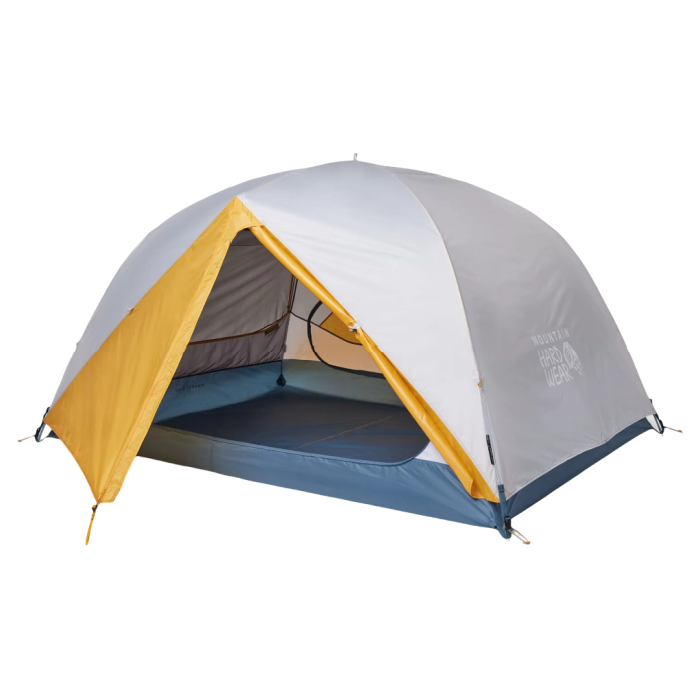
The Mountain Hardwear Mineral King 3 remains one of our favorite crossover tents for its thoughtful design and ease of use. It’s light enough for backpacking in a pinch – especially if you split the weight between hikers – but excels as a comfortable car camping tent for one or two people.
This version of the Mineral King 3 includes smart improvements like a better-fitting rainfly that reduces sag in wet weather and a HangTight gear-hanging system that improves internal organization and stability. The stuff sack has also been upgraded to a zippered, duffel-style design that makes packing up far easier. And both the head and foot walls now feature long mesh pockets that run the full width of the tent, providing a big boost in organization.
We love the all-mesh canopy for warm-weather camping – it offers incredible ventilation and stargazing potential. The fly can roll up halfway so you can enjoy the view, and it’s quick to deploy when weather rolls in. With dual kickstand vents and large doors on each side, airflow is excellent, even with the fly on. The doors now stash neatly into overhead pockets – a small change that makes a big difference in livability.
Although it doesn’t have the tallest peak height, there’s still enough headroom to sit up comfortably. It’s compact but functional, with enough space for two adults and even manageable for a small family. For campers who prioritize ventilation, portability, and ease of use, the Mineral King 3 continues to be a standout in its category.
REI Westward 6
Best Luxury Camping Tent
CleverHiker Rating: 4.6/5.0
Price: $549
The size we tested feels: Luxurious for 2, comfortable for 3-4, and manageable for 5-6
Weight: 19 lb. 10 oz.
Dimensions (LxWxH): 120 x 97 x 77 in.
Pros
- Big front vestibule
- Large doors for easy access
- Enclosed pole sleeves for added wind resistance
- Vents well
- Color-coded for easy setup
- Handy external storage pockets
Cons
- Partial fly offers less protection in extended rain
- Solo pitching the fly can be challenging due to the height
- Sloppy carry bag
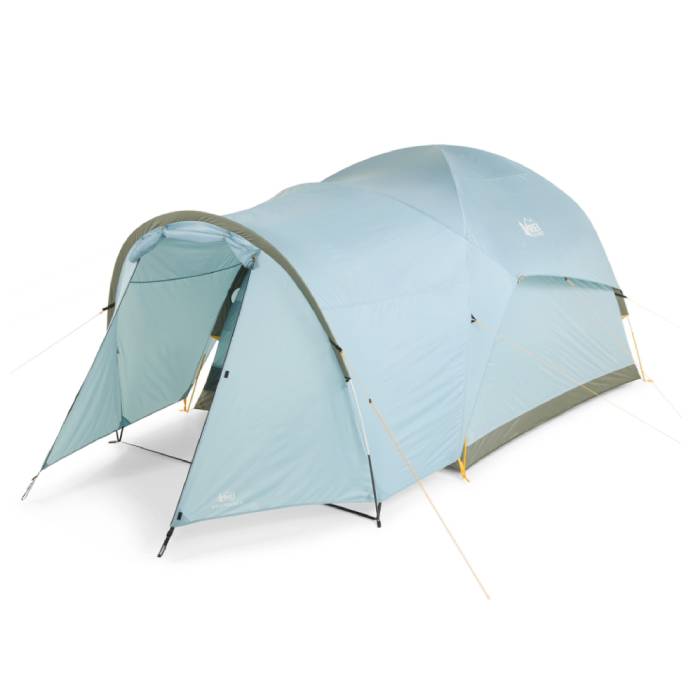
The REI Westward 6 is a roomy, well-built family tent that makes a lot of sense for campers who want a big, comfortable shelter in mild to moderate conditions. It’s also one of the closest competitors to The North Face Wawona, our top pick. Like the Wawona, it offers a tall interior that most adults can comfortably stand up in and a large vestibule that adds bonus hangout space at camp rather than just a place to toss muddy shoes.
REI did a lot right here. The materials feel solid, the 77-inch peak height promotes an open feel inside, and the 35.1-square-foot vestibule adds enough covered space to make camp feel a lot more functional.
As for ease of use, the color-coded poles, sleeves, and webbing help take some of the sting out of setup. And we appreciate that the poles feed through sleeves instead of relying only on clips – especially helpful for a tent this tall. Both doors have half-moon zippered windows for extra airflow, and there’s even a storage pocket outside the main door for a few grab-and-go items.
The Westward 6’s partial fly promotes excellent ventilation, which is a real advantage on warm days. In direct sun with a breeze, it stayed cooler than many of the more enclosed tents we tested. However, this also means the tent isn’t as protective in long stretches of rain, and it does not hold in warmth well when temperatures dip. The guylines also don’t come pre-attached, and REI does not include enough stakes for them, which feels like an odd omission for a tent this tall.
For families who mostly camp in fair to moderate weather and want a spacious tent with good airflow and solid build quality, the Westward 6 is a strong pick. But if you camp in rougher weather more often, it may be worth exploring other options.
NEMO Aurora Highrise 4
Best Tent for Easy Setup & High-Quality Materials
CleverHiker Rating: 4.6/5.0
Price: $400
The size we tested feels: Luxurious for 2, comfortable for 3, and tight for 4
Weight: 15 lb. 14 oz.
Dimensions (LxWxH): 100 x 90 x 75 in.
Pros
- High-quality poles and materials
- Two enormous doors with stuff pockets
- Fast and easy setup
- Large livable space
- Excellent ventilation
- Durable construction
- Relatively compact when collapsed
Cons
- Only a half door in the back
- Carrying case is tight
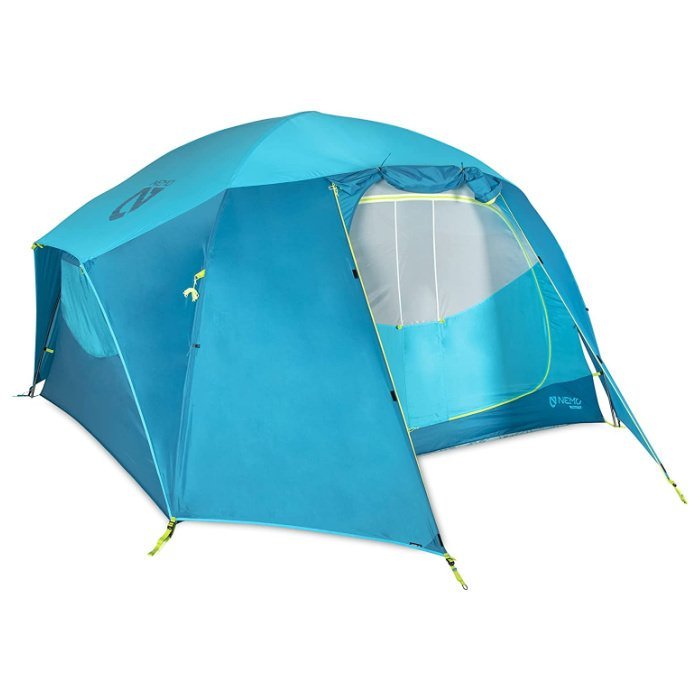
The NEMO Aurora Highrise 4 continues to impress us with its durable build, roomy interior, and user-friendly design. It’s a great fit for couples or small families who want a tent that’s spacious without being a hassle to set up.
We love the giant door on the front and that it stuffs away into a small, non-intrusive pocket. Though the rear door is quite a bit smaller, we’ve found it doubles as an extra-large vent to keep air moving.
The sturdy white mesh of the Highrise also sets it apart. It allows you to see out of the windows on all four sides, even when it’s raining. Surprisingly, it still offers remarkable privacy.
The pole structure of the Highrise is unusual compared to other tents this size, so there’s a bit of a learning curve, but it’s a snap to pitch once you’ve done it a couple times. The walls are steeply inclined, so you can stretch as wide and tall as you want in the morning and not touch the ceiling.
Our main complaint about the Highrise is the carrying case: We like when a tent is easy to store once it’s rolled up, but the Highrise comes with a smaller stuff sack, requiring some extra work to fit everything in. The Highrise also doesn’t include a footprint.
That said, this model is an outstanding value considering its comfort, size, and durability. You can get the six-person capacity for the same price as the smaller version of comparable tents, so we think it’s an excellent buy.
REI Half Dome 3
Best Crossover Choice for Camping & Backpacking
CleverHiker Rating: 4.5/5.0
Price: $399
The size we tested feels: Comfortable for 2 and tight for 3
Weight: 7 lb. 2.5 oz.
Dimensions (LxWxH): 90 x 70 x 44 in.
Pros
- High-quality poles and materials
- Quick and easy to set up
- Smooth zippers
- Good ventilation
- Good pockets
- Footprint included
- Enough stakes to fully guy out the tent
Cons
- Low peak height
- Heavy
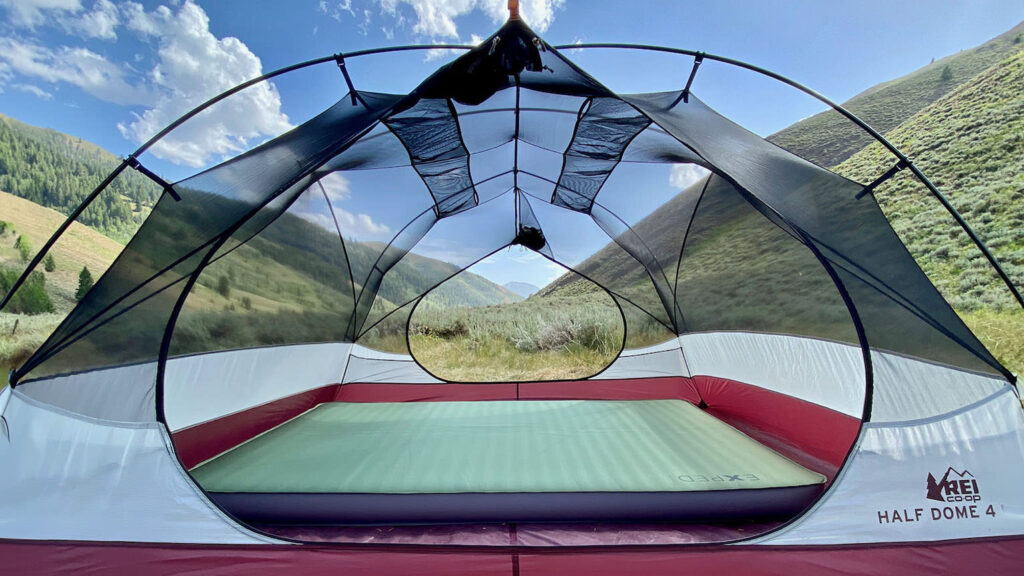
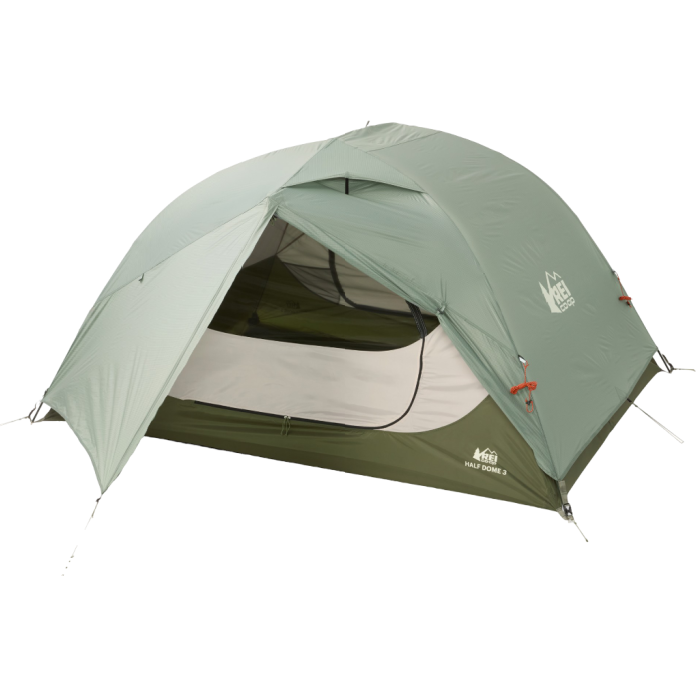
The REI Half Dome 3 scores high marks for durability, comfort, and ease of use, making it a great pick for car campers and casual backpackers who want a versatile tent that doesn’t require a second mortgage. With steep walls, wide doors, and dual vestibules, it feels more spacious than a lot of similarly sized models, and it’s one of the easier tents to set up – even solo.
The included footprint and better-than-average stakes are thoughtful touches that save time and money. We also liked the overall quality of the materials. The fabrics are burly, the zippers run smoothly, and the poles feel solid – no flimsy components here.
In terms of space, it’s ideal for two people and their gear or maybe two adults and a small child. Cramming three adults inside works, but it’s definitely tight, especially on stormy nights. The low peak height (44 inches) means you won’t be standing up inside, but it’s tall enough for sitting up and getting changed without too much hassle.
Ventilation is decent thanks to the mesh canopy, kickstand vents, and fly zippers, though it’s not the most breathable tent we tested. For fair-weather trips, it’s great, but it may feel a bit warm on muggy nights. It also holds its own in wind and light rain, but you’ll want to fully guy it out for the best performance.
If you’re after a dependable, user-friendly tent with solid features at a reasonable price, the Half Dome 3 delivers.
REI Base Camp 6
Best Tent for Internal Storage
CleverHiker Rating: 4.5/5.0
Price: $569
The size we tested feels: Luxurious for 2-3, comfortable for 4-5, and tight for 6
Weight: 20 lb. 11.5 oz.
Dimensions (LxWxH): 110 x 110 x 74 in.
Pros
- Exceptional storage
- Dual vestibules
- Full-coverage rainfly
- Pole sleeves for added wind resistance
- Two large doors for easy access
- Four roof vents plus two low side vents
Cons
- Very flexible poles
- Complex setup
- Not the easiest to pack
- Potential quality control issues
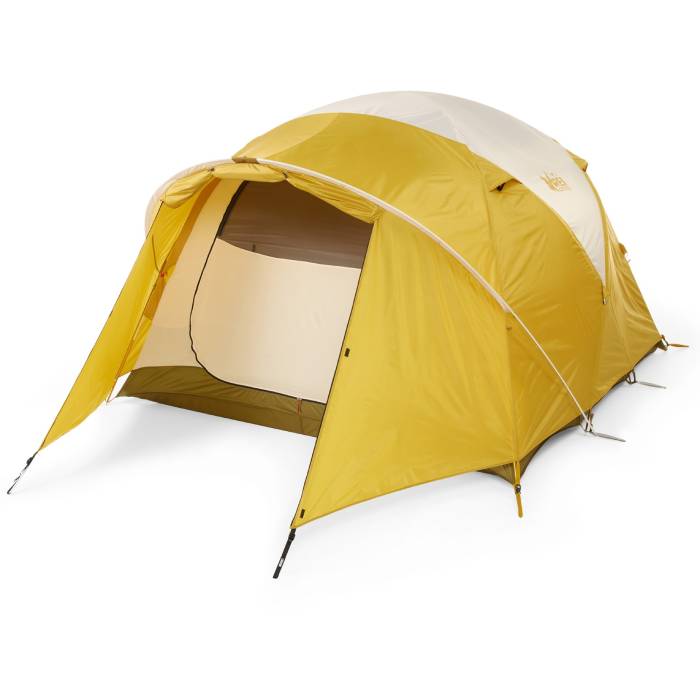
The REI Base Camp 6 is one of the most weather-ready camping tents in our lineup, and it’s also one of the most thoughtfully organized. With 14 interior mesh pockets, an overhead gear loft, and dual vestibules that add a ton of covered storage and living space, it’s especially good for longer trips that require a lot of gear.
The full-coverage fly, taped seams, and lower-to-the-ground dome shape give it a more secure feel in rough weather than most six-person tents we tested. Fully guyed out, it handles wind extremely well.
However, this tent is one of the most involved to pitch in our lineup. There are five poles, eight stake-out points for the tent body alone, and a dead-end sleeve design that’s easy to get wrong the first time. The color coding helps a lot, and it gets much easier after a couple of pitches, but this is not a casual toss-it-up-at-dusk kind of tent. A second person makes the fly much easier to deal with.
Inside, the 74-inch peak height will only be limiting for taller campers. The center is high enough for standing, but the walls angle in a bit, so the sweet spot is finite.
Our biggest hesitation is the poles. Even though they’re aluminum, they bend more easily than we’d expect at this price, and we’ve seen similar concerns from other users.
For families who camp often, deal with mixed weather, and want a tent that feels more protective and more organized than average, the Base Camp 6 is a solid option.
Kelty Wireless 6
Best Bang for Your Buck
CleverHiker Rating: 4.4/5.0
Price: $280
The size we tested feels: Luxurious for 2-3, comfortable for 4, and tight for 5
Weight: 18 lb. 15.4 oz.
Dimensions (LxWxH): 118 x 106 x 74 in.
Pros
- Huge interior
- Color-coded tabs for easy setup
- Affordable
- Intuitive and fast to pitch
- Pre-attached guylines with Velcro stash pockets
- Excellent carrying case
Cons
- Footprint sold separately
- Only a few small internal pockets
- Doesn’t ventilate well
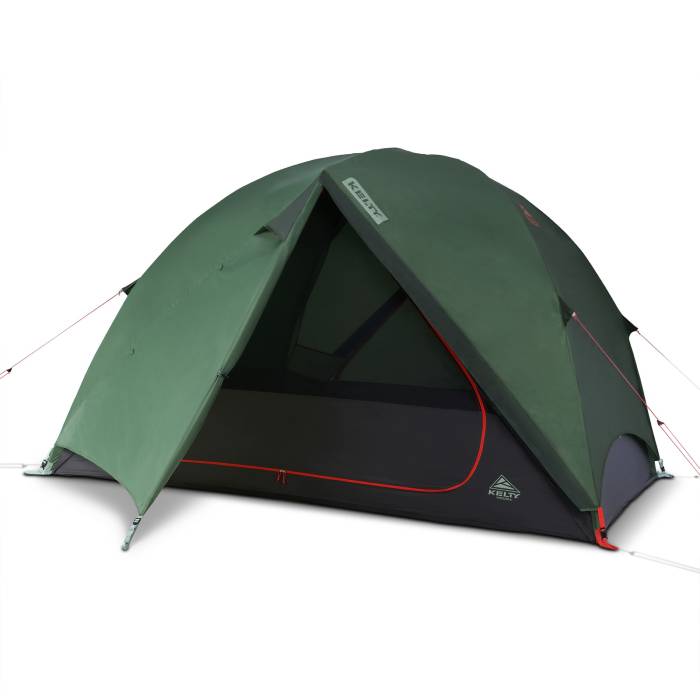
The Kelty Wireless 6 is roomy, straightforward, and one of our favorite budget-minded tents. In a category where prices can get out of hand fast, it’s nice to find a tent that keeps things simple, gives you a lot of space, and won’t break the bank.
The 74-inch peak height gives the Wireless some of the best headroom in our lineup, so most campers can stand up without doing the half-crouch shuffle. The long ridge pole helps a lot, pulling the walls upright to create a more open-feeling interior. For a family of four, there’s plenty of room to spread out without being piled on top of each other. For two people and a dog, it feels downright spacious.
Kelty also did a good job keeping the setup user-friendly. The color coding helps, and we really like the deep pole pockets, which are much easier to work with than tiny grommets, especially when you’re tired or setting up in fading light.
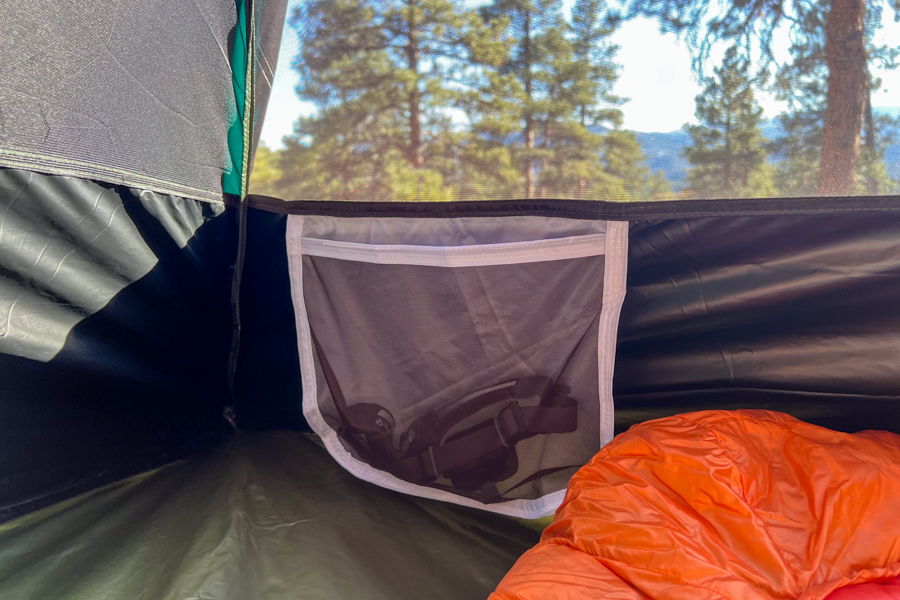
The latest version addresses a few of our complaints about the old model. The pre-attached guylines now tuck into their own Velcro pockets, aluminum stakes are included for the guy-out points, and the new nightlight pockets are a fun upgrade that actually work well – just drop in a headlamp to create a soft, diffused glow.
Ventilation is better this time around, too. Kelty added a lot more mesh to the tent body, along with two kickstand vents in the fly. It can still feel warm on hot days with little to no breeze, but it’s a noticeable improvement over the previous version.
At nearly 19 pounds all in, the Wireless is unapologetically a car camping tent, but the seams are taped, the hardware feels solid, and the Shark Mouth carry bag is one of the easiest we’ve used. If you want lots of room and solid vestibule space at a great price, the Wireless 6 is easy to get behind.

Mountainsmith Conifer 5+
Best Tent That’s Built to Last
CleverHiker Rating: 4.3/5.0
Price: $450
The size we tested feels: Comfortable for 3-4 and tight for 5
Weight: 14 lb. 11 oz.
Dimensions (LxWxH): 120 x 120 x 74 in.
Pros
- Huge front vestibule
- Rear vestibule for additional storage
- Good peak height
- Ample interior storage
- Good ventilation for a frontcountry tent
Cons
- Difficult setup
- Requires a large footprint to pitch
- Must be fully guyed out for a tight pitch
- No window on the rear door
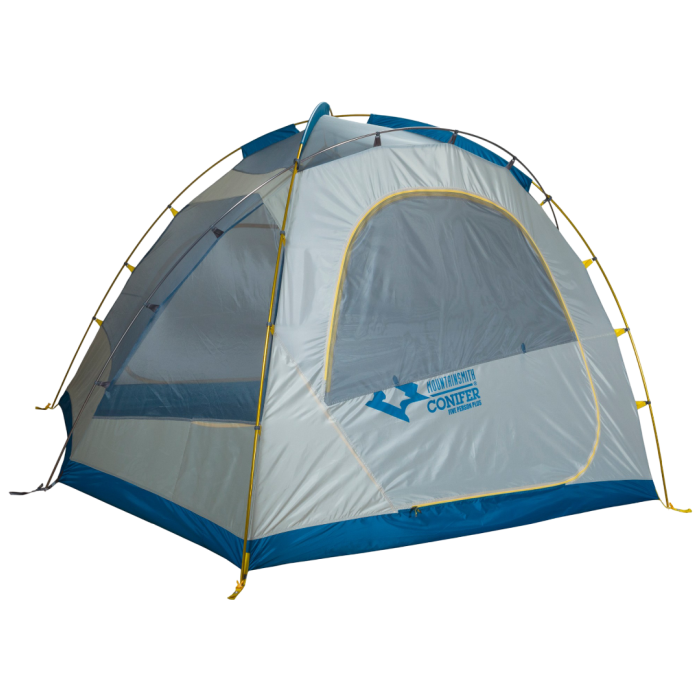
The Mountainsmith Conifer 5+ is one of our favorite roomy basecamp tents for families or groups that want to spread out and get comfortable. It’s not the flashiest tent in the bunch, but it checks a lot of boxes: plenty of interior space, generous headroom, excellent ventilation, and thoughtful features that make camp life easier.
We appreciated the dual vestibules, especially the massive front one, which easily fits a couple of camp chairs and works great as a hangout zone during rainy weather. Inside, there’s room for five people and a dog (or maybe six if you pack in tight). Our taller testers had no issues standing up inside.
The trade-off to all that space? Setup takes a bit more effort than most family tents. You’ll need a large campsite, and the tent really shines when it’s fully staked and guyed out, so be prepared to put in the work. Once it’s up, though, it’s a sturdy and weather-worthy shelter that handles spring storms and warm-weather camping equally well.
We tested the Conifer 5+ during Colorado’s unpredictable early spring, and it impressed us with its performance and livability. It’s not the cheapest tent out there, but for families or groups who prioritize comfort and space and don’t mind a slightly longer setup, it’s a worthwhile investment.
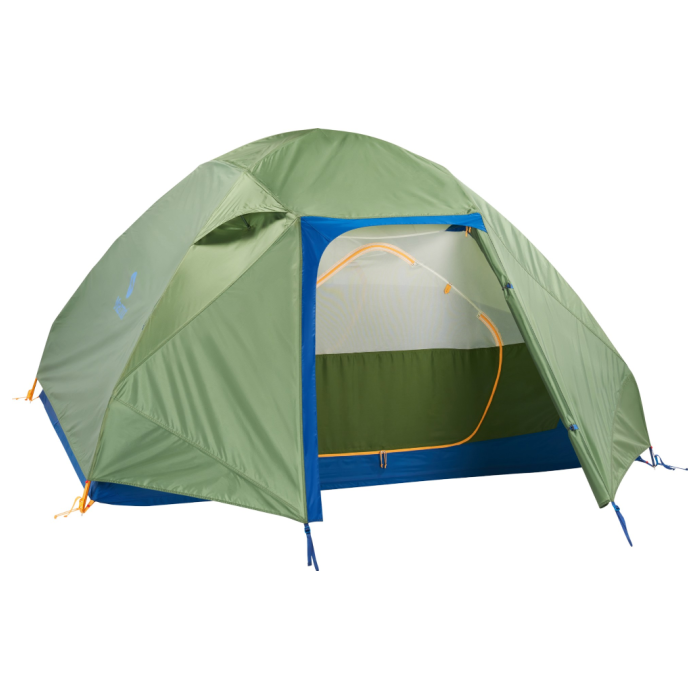
Marmot Tungsten 4
Best Low-Profile, High-Volume Camping Tent
CleverHiker Rating: 4.2/5.0
Price: $449
The size we tested feels: Luxurious for 2, comfortable for 3, and tight for 4
Weight: 7 lb. 14 oz.
Dimensions (LxWxH): 93 x 82 x 53 in.
Pros
- Lightweight
- Fast and easy to pitch
- Spacious interior
- Durable materials
- Rainfly doors roll to the side
- Footprint included
Cons
- Few pockets
- No guylines included
- Not enough stakes included
- Low peak height
If you’re looking for a low-profile tent that’s easy to use, fast to set up, and offers plenty of room for three people (or two people and a dog), the Marmot Tungsten 4 hits a real sweet spot. It’s durable, sharp-looking, and will last for years.
The Tungsten is user-friendly and simple to pitch. We found two people can set up this tent in just a few minutes, and one person can also knock it out with ease. The hubbed pole structure is color-coded and pre-bent to tension the tent perfectly.
The Tungsten is more spacious inside than it looks. It’s not quite tall enough for most people to stand up in, but the lower-profile design performs better in howling winds and rain. For comparison, the Tungsten’s ceiling is about 9 inches taller than the REI Half Dome’s, which means more room to stretch out in the morning. Plus, this tent features two brow poles to maximize headroom when sitting up and moving around.
We like the L-shaped rainfly doors since they can be completely rolled to one side for easy entry and exit. The downside to this design: You sacrifice a bit of storage space in the vestibules. There’s still enough space for shoes and a backpack, but it’s less roomy than comparable tents.
The Tungsten is lower on our list because it only has a few small internal pockets, so we quickly ran out of space to stash extra clothes and small items. Also, Marmot doesn’t include any guylines. If you’re planning on camping on a windy butte in Utah or during a storm in the high Rockies, be sure to pick up your own guylines and a few extra stakes to keep the tent securely attached to the ground.
When it comes to car camping, we love a hassle-free, reliable, and well-built tent, and the Marmot Tungsten fits that bill. For those who don’t mind spending a bit more for a high-quality design that feels big but packs small, this is the tent for you.
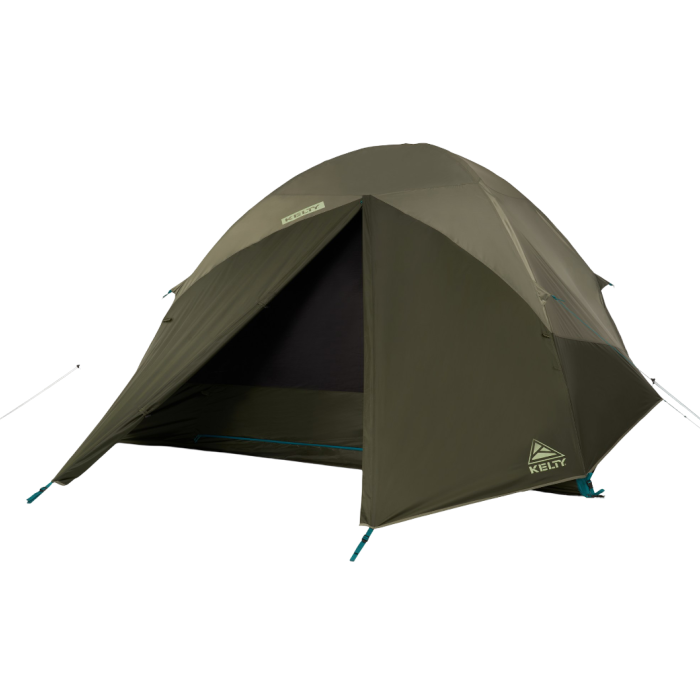
Kelty Daydreamer 6
Best Tent for Light-Sensitive Sleepers
CleverHiker Rating: 4.0/5.0
Price: $270
The size we tested feels: Luxurious for 2-3, comfortable for 3-4, manageable for 5, and tight for 6
Weight: 19 lb. 12 oz.
Dimensions (LxWxH): 120 x 107 x 77 in.
Pros
- Large floor area
- Rainfly blocks out sunlight, streetlights, and rain
- Impressive peak height
- Decently sized front vestibule
- Easy to set up
- Tent body is mostly mesh for good ventilation
Cons
- Poor ventilation when using the rainfly
- Thin floor material
- Fiberglass poles are bulky and not as strong as aluminum
- Low-quality stakes
The Kelty Daydreamer 6 is a solid pick for families and casual campers who prioritize comfort, simplicity, and sleep-friendly features over bombproof weather protection.
What sets this tent apart is its Twilight Tech rainfly, which darkens the interior and blocks ambient light. This is perfect if you’re camping with little ones who nap midday or head to bed before sunset. It really does make a noticeable difference inside the tent, especially in bright conditions.
Comfort-wise, the Daydreamer 6 has a lot going for it. You get a roomy floor plan, tall center height, and mostly mesh tent body that’s great for hot nights and stargazing. Setup is easy enough for one person, with color-coded clips that make things straightforward. The vestibule is modest but useful for shoes and gear, and the interior pockets and gear loft help keep things organized.
That said, ventilation suffers with rainfly on, especially in direct sun. Additionally, the fiberglass poles and thin floor material feel less robust than some of the pricier tents in our guide. It’s not our first choice for harsh weather, but for fair-weather trips and campground getaways, it checks a lot of boxes – especially for families looking to create a darker, more sleep-friendly environment.
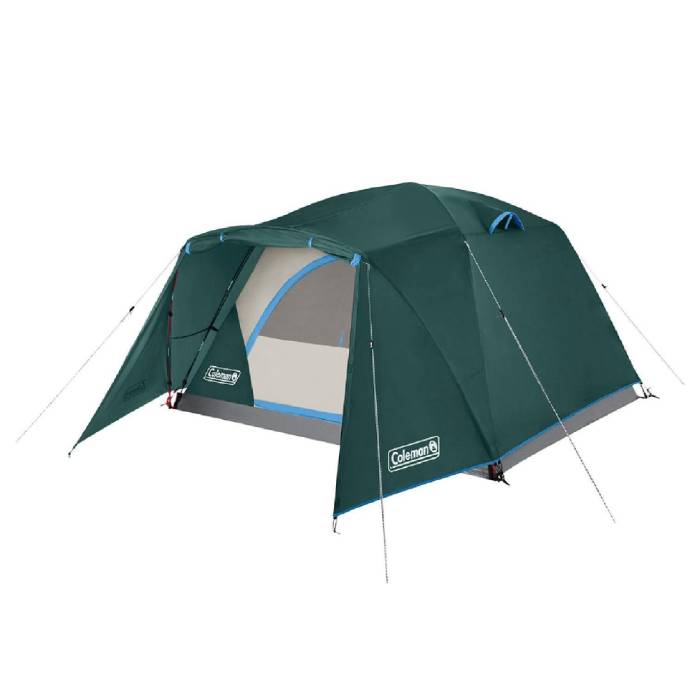
Coleman Skydome 4
Best Budget Tent for Casual Campers
CleverHiker Rating: 3.9/5.0
Price: $190
The size we tested feels: Luxurious for 2, comfortable for 3, and tight for 4
Weight: 13 lb. 11.2 oz.
Dimensions (LxWxH): 96 x 84 x 56 in.
Pros
- Affordable
- Integrated poles make setup quick and easy
- Large door for easy access
- Functional front vestibule
- Full-coverage rainfly (there’s a cheaper version available with a partial fly)
Cons
- Low peak height
- Plastic fly clips feel flimsy
- Only one storage pocket
- Doesn’t vent well with the fly on
The Coleman Skydome 4 is a simple, beginner-friendly camping tent that makes setup about as easy as it gets.
The integrated pole design is the big story here. The poles stay attached to the tent body, fold right out, and slide into the corner sleeves without much fuss. There’s very little guesswork, which is a big deal for first-time campers in particular. The fly is easy to line up thanks to one color-coded corner, and the vestibule only adds one extra pole, so the whole process is refreshingly uncomplicated.
The mostly mesh body promotes a good amount of airflow on dry nights, and the big door opens wide and tucks neatly into its own pocket. The kickstand vents and vestibule door help when the fly is on, though this tent can get pretty warm in the sun.
We also like the E-port for extension cord access. It’s a small feature, but it’s useful if you camp in developed campgrounds and want to run a fan or charge a phone inside.
The drawbacks are pretty standard for an entry-level tent. The center height is only 56 inches, so most adults won’t be able to stand up inside. Storage is pretty limited, too, with just one interior pocket. Long term, our biggest concerns are with the plastic fly clips, shock-cord stake-out points, and carry bag, which feels like it might deteriorate before the tent does.
For first-time campers, occasional family trips, or anyone who wants a simple tent without spending much, the Skydome 4 gets the job done. For more frequent camping or rougher weather, we recommend looking higher up our list.
Product Comparison Table
| oSort | Product | Price | Weight | Dimensions (LxWxH) | Comfort | Ease of Setup | Weather Resistance | Durability | Features | 0 |
The North Face Wawona 6 View at REI View at Amazon 
|
$585 | 19 lb. 7.1 oz. | 116 x 94 x 76 in. | 4.8 | 3.9 | 4.4 | 4.5 | 4.5 | 1 |
Mountain Hardwear Mineral King 3 View at REI View at Amazon
|
$400 | 7 lb. 13.7 oz. | 90 x 68 x 48 in. | 4.3 | 4.7 | 4.7 | 4.4 | 4.2 | 2 |
REI Westward 6 View at REI |
$549 | 19 lb. 10 oz. | 120 x 97 x 77 in. | 4.6 | 4.4 | 4.4 | 4.5 | 4.6 | 3 |
NEMO Aurora Highrise 4 View at REI View at NEMO
|
$400 | 15 lb. 14 oz. | 100 x 90 x 75 in. | 4.4 | 4.8 | 4.4 | 4.8 | 4.7 | 4 |
REI Half Dome 3 View at REI |
$399 | 7 lb. 2.5 oz. | 90 x 70 x 44 in. | 4.3 | 4.7 | 4.4 | 4.7 | 4.4 | 5 |
REI Base Camp 6 View at REI |
$569 | 20 lb. 11.5 oz. | 110 x 110 x 74 in. | 4.7 | 4.0 | 4.5 | 4.5 | 4.6 | 6 |
Kelty Wireless 6 View at REI View at Amazon 
|
$280 | 18 lb. 15.4 oz. | 118 x 106 x 74 in. | 4.5 | 4.7 | 4.4 | 3.9 | 4.4 | 7 |
Mountainsmith Conifer 5+ View at Amazon View at Mountainsmith |
$450 | 14 lb. 11 oz. | 120 x 120 x 74 in. | 4.6 | 3.8 | 4.4 | 4.5 | 4.7 | 8 |
Marmot Tungsten 4 View at REI View at Marmot |
$449 | 7 lb. 14 oz. | 93 x 82 x 53 in. | 4.1 | 4.7 | 4.7 | 4.7 | 4.3 | 9 |
Kelty Daydreamer 6 View at REI View at Amazon |
$270 | 19 lb. 12 oz. | 120 x 107 x 77 in. | 4.6 | 4.6 | 4.3 | 3.9 | 4.3 | 10 |
Coleman Skydome 4 View at REI View at Amazon |
$190 | 13 lb. 11.2 oz. | 96 x 84 x 56 in. | 4.1 | 4.0 | 3.6 | 3.6 | 4.0 |
|---|
Analysis & Results
We evaluate tents based on five criteria: comfort, durability, weather resistance, ease of setup, and features. The comparisons below highlight the top performers in each category.
Which Camping Tent is the Best Value?
For us, value is not synonymous with inexpensive or budget. Though there are certainly good options at a reasonable price, value is overall performance relative to price. There are excellent tents that are justifiably expensive and more affordable ones that outperform expectations.
The Kelty Wireless 6 is one of the best values on our list. Despite being one of the least expensive tents we tested, it is made of surprisingly high-quality materials, has a robust feature set, and comes with several upgrades over most true budget designs. It held up well to heavy rain and thunderstorms across multiple seasons of testing, and the Shark Mouth carry case is one of the best we’ve seen at any price.
If you can stretch your budget, the NEMO Aurora Highrise 4 and Mountainsmith Conifer 5+ are also solid values. The Aurora Highrise combines high-end features with exceptional durability, tons of interior space, and premium components. The Conifer 5+ earns its value through dual vestibules, solid weather performance, and a build that holds up to extended use.
The Mountain Hardwear Mineral King 3 stands out as a strong value for mixed car camping and backpacking. It packs down small, includes a footprint, and has a feature set that outperforms its price. The REI Half Dome 3 fits a similar niche: versatile, well built, and priced competitively for what you get.
At the budget end, the Coleman Skydome 4 is the clear entry-level pick for occasional campers who want a foolproof pitch and basic features without breaking the bank. It’s a noticeable step down in quality and performance, but it will get the job done for infrequent, fair-weather campers.
Which Camping Tent is the Most Comfortable?
The North Face Wawona 6 is the comfort leader in our lineup. Its 76-inch peak height, expansive floor area, and 44.7-square-foot front vestibule give four or more campers real room to move around and store gear. Near-vertical walls maximize usable space, dual doors make entry and exit convenient, and large mesh windows create an open-feeling interior. For families who spend extended time at a single campsite, the Wawona is the benchmark.
The REI Base Camp 6 earns high marks for its interior organization. With 14 mesh pockets lining the walls, a mesh attic, and dual vestibules totaling 44 square feet, it delivers standout storage for longer, gear-intensive trips. The 84-square-foot floor plan feels less tunnel-like than most dome designs. However, the walls slant more aggressively than the Wawona, limiting standing room in the center.
The REI Westward 6 has the tallest peak height in our lineup at 77 inches, along with one of the best ventilation systems we tested. Its partial-coverage rainfly is what makes airflow exceptional. Even in direct sun with a light breeze, the interior stays noticeably cooler than most fully enclosed tents. The 35.1-square-foot, pole-supported vestibule adds functional, covered living/lounging space.
The Mountainsmith Conifer 5+ is a strong comfort pick for groups who need serious square footage and a standing-height interior. The Kelty Daydreamer 6 earns its comfort score differently: Its Twilight Tech rainfly blocks sunlight and ambient light, making a noticeable difference for light-sensitive sleepers and families with young kids.
The Mountain Hardwear Mineral King 3 and REI Half Dome 3 both offer solid comfort for their size, though their lower peak heights mean you won’t be standing upright in either tent.
Which camping tent is the most DURABle?
The NEMO Aurora Highrise 4 leads the pack in long-term durability. Quality aluminum poles, precise seam sealing, reinforced stress points, and meticulous craftsmanship make it one of the most dependable shelters we’ve tested. It’s the tent we expect to still be performing years from now with proper care.
The Marmot Tungsten 4 also earns high marks for durability. Its hubbed aluminum poles, solid fabric, and clean construction have held up to multiple seasons without any significant wear.
The Mountain Hardwear Mineral King 3 rounds out our top durability performers. It features a low-profile design, a fully seam-taped rainfly, and a bathtub-style floor that can handle repeated use and serious weather.
Last but not least, The North Face Wawona 6 and REI Half Dome 3 are both strong long-term performers. The Wawona’s rugged polyester fabric, sturdy aluminum poles, and fully taped seams have held up to multiple seasons of variable Colorado conditions. The Half Dome’s welded corners and thoughtful construction details have made it a consistently reliable tent in our lineup for years.
Which Camping Tent is the Most Weather-Resistant?
The Marmot Tungsten 4 and Mountain Hardwear Mineral King 3 lead our lineup in weather resistance. Both are low-profile designs with fully seam-taped rainflies, bathtub-style floors, and robust pole structures that reliably handle high winds and heavy rain. These are the tents we reach for when the forecast is iffy or just plain inclement.
The REI Half Dome 3 is a similarly low-profile option with a full-coverage rainfly, reinforced corners, and a solid pole architecture that handles heavy rain and wind well. Fully guyed out, it is one of the most stable tents of its size.
The REI Base Camp 6 is the most weather-ready family tent in our lineup. Its dome-style architecture, full-coverage fly, aluminum poles, and fully taped seams create a shelter that holds its shape in conditions that push the limits of taller tents. We tested it at Great Sand Dunes National Park in high winds, and it performed flawlessly. The guylines don’t come pre-attached, and there aren’t enough stakes to use them, so you’ll want to pack extra stakes if you expect blustery weather.
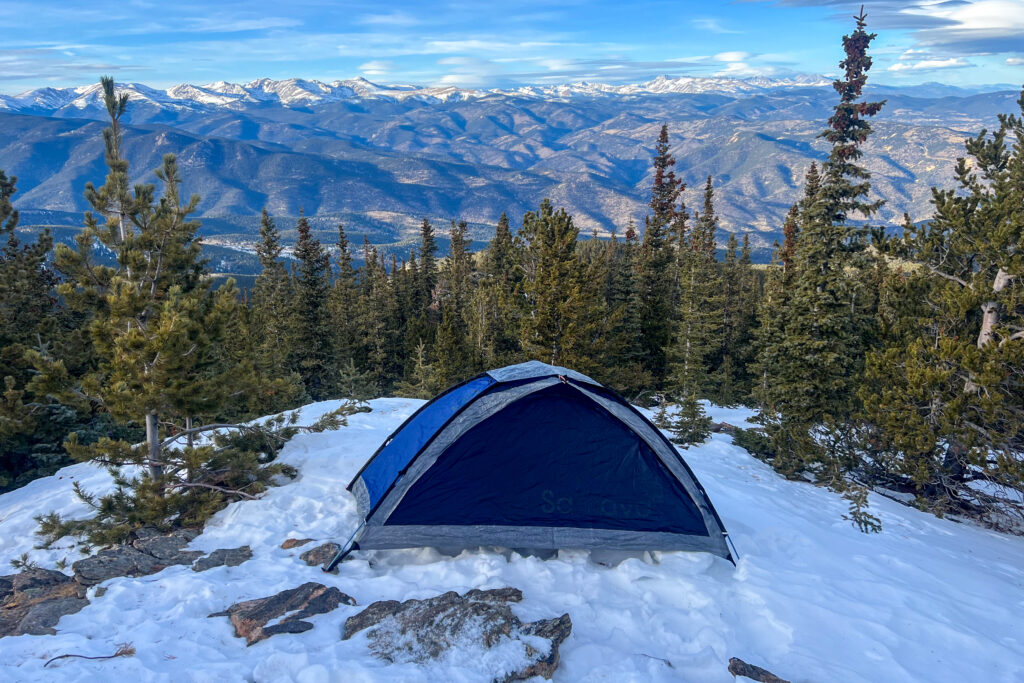
The North Face Wawona 6 performed better in serious weather than its large profile would suggest. We pitched it on an exposed Colorado mountaintop ahead of a monsoon, and it held strong in 40- to 50-mile-per-hour winds. However, it needs to be properly staked and guyed to maximize protection and security.
The Kelty Wireless 6 handled high winds and heavy rain well for the most part, though we experienced some floor seepage after multiple days of sustained rain. The REI Westward 6‘s partial-coverage fly delivers excellent ventilation but less protection in extended or wind-driven rain, which is a real trade-off worth considering before you buy.
Which Camping Tent is the Easiest to Set Up?
The NEMO Aurora Highrise 4 is a standout in the four-person tent category. Long pole sleeves, a familiar structure, and snap-on pole clips make for an efficient and repeatable pitch that one person can handle with ease. There is a slight learning curve to the design, but subsequent pitches go quickly.
The Mountain Hardwear Mineral King 3, REI Half Dome 3, Marmot Tungsten 4, and Kelty Wireless 6 also earn high marks for ease of setup. The Mineral King’s color coding and pre-bent poles make it one of the fastest to pitch in our lineup. The Half Dome’s hubbed pole system and color-coded clips make it speedy to pitch solo, even in inclement weather.
Similarly, the Tungsten’s hubbed, color-coordinated structure goes up fast with two people and is manageable solo. The Wireless 6’s deep pole pockets replace small grommets with secure, easy-to-seat connections, and the pre-attached guylines with Velcro storage pockets (a new addition to the latest version) make guying out faster than the previous model.
Larger tents like The North Face Wawona 6, Mountainsmith Conifer 5+, REI Westward 6, and especially the REI Base Camp 6 are more involved. All of them can be pitched solo with practice, but a second set of hands will make the fly and vestibule portions considerably smoother. The REI Base Camp 6 is one of the most complex to pitch in our lineup – it’s a good idea to practice at home before you take it camping for the first time.
Which camping tent has the best FEATURES?
The NEMO Aurora Highrise 4 and Mountainsmith Conifer 5+ both earn high marks for their features. The Aurora Highrise’s large doors with integrated pockets, effective ventilation system, and sturdy white mesh make it one of the most thoughtfully designed tents we have tested. The Conifer’s massive front vestibule and plentiful interior storage are standout features for a tent at this price point.
The North Face Wawona 6 also excels in the features department, primarily due to its massive front vestibule. At 44.7 square feet, it’s by far the largest vestibule of any tent in our lineup. This space functions as a fully covered outdoor area big enough for chairs, bikes, gear bins, or an entire family taking off muddy boots in the rain. Multiple internal pockets, color-coded poles, and effective kickstand vents round out the extensive, thoughtful feature set.
The REI Base Camp 6 is an organizational standout with 14 interior mesh pockets, a mesh attic, dual vestibules totaling 44 square feet, four roof vents, and a low side vent – all adjustable from inside the tent. There are also two enormous doors that tuck into roof pockets. For families who prioritize having a dedicated place for everything, nothing in our lineup comes close.
The REI Westward 6 also brings a strong feature set, including a massive pole-supported vestibule; half-moon zippered windows on both doors; awnings; an external storage pocket; and an E-port. The partial fly also functions as a ventilation feature that most fully enclosed tents cannot match in warm weather.
Last but not least, the REI Half Dome 3 earns its features score through smart construction details. These include a footprint, enough stakes to fully guy out the tent, smooth zippers, and good interior pockets.
How to Choose a Camping Tent
What size tent do I need?
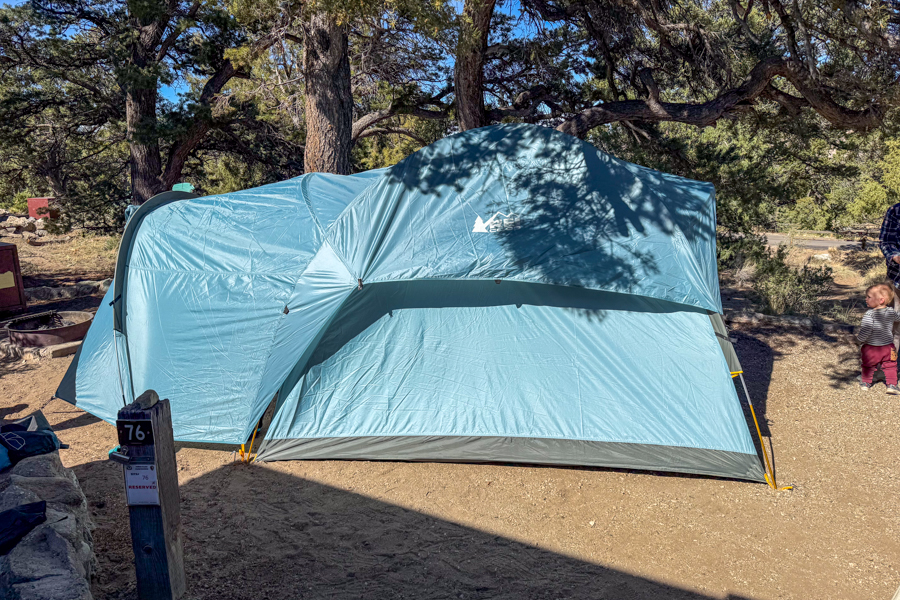
Capacity ratings usually overstate the number of people (and sleeping pads) that fit in a tent, so don’t rely on that number unless you enjoy sleeping like sardines. A good rule of thumb is to go up in size by one or two people for additional gear space and more comfort. If you’re tall, claustrophobic, or often share a tent with children or pets, a little extra elbow room will make your trip much more enjoyable.
You could also consider using multiple small tents in place of one large tent to accommodate groups. In our experience, kids are typically stoked to have their own tent. If you’re unsure what size will work best for your group, check out our Tent Size Guide.
How Much Does Peak Height Matter?
If you’re camping for multiple days, spend a significant amount of time hanging out in your tent, or use it a lot in a season, choose one that’s tall enough to stand and move around in. Tents with high peaks and near-vertical walls have the most usable space, but they are more susceptible in windy and stormy conditions. Be sure to use the appropriate stakes and guylines to help support larger tents and avoid issues.
How many doors do I need in a camping tent?
We think multiple doors are a must for group camping. The freedom to enter, exit, and access gear in the vestibules without disturbing your camping crew makes overnight adventures far more enjoyable. Adequate doorway and vestibule space are essential in inclement weather, when everyone wants to clamber into the tent to get out of their wet or dirty clothes as quickly as possible.
How Important is Ventilation in a Camping Tent?
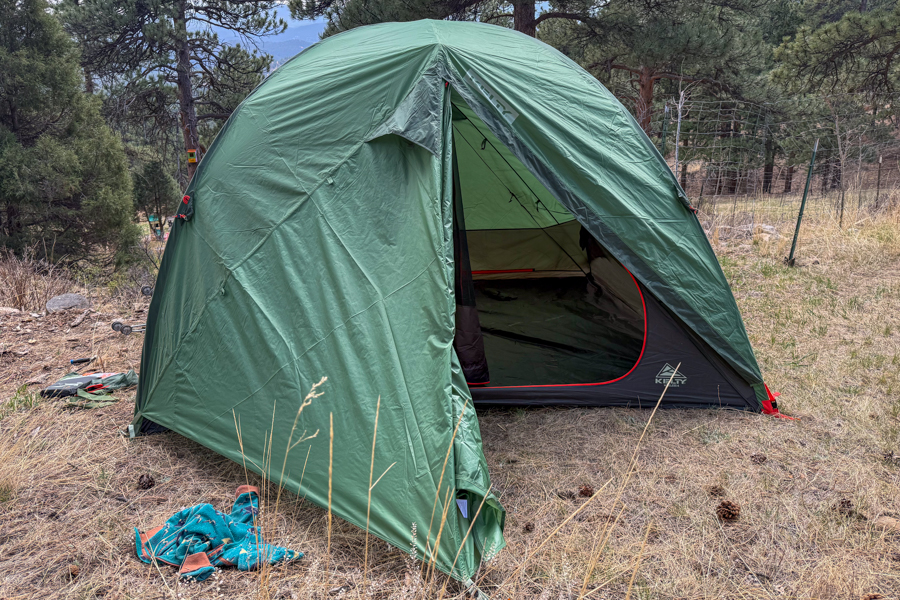
Good ventilation is crucial for controlling internal condensation. Look for tents designed with adequate roof vents that allow fresh air to circulate, rain or shine. It’s not much fun being cooped up in a muggy tent without functional vents when the weather turns foul or temperatures start to fluctuate.
Some tents have zippers that allow you to access top vents with kickstands from the interior of the tent, which comes in handy when high roofs are hard to reach on the outside. Be sure to stake out the sides of your rainfly for better air circulation.
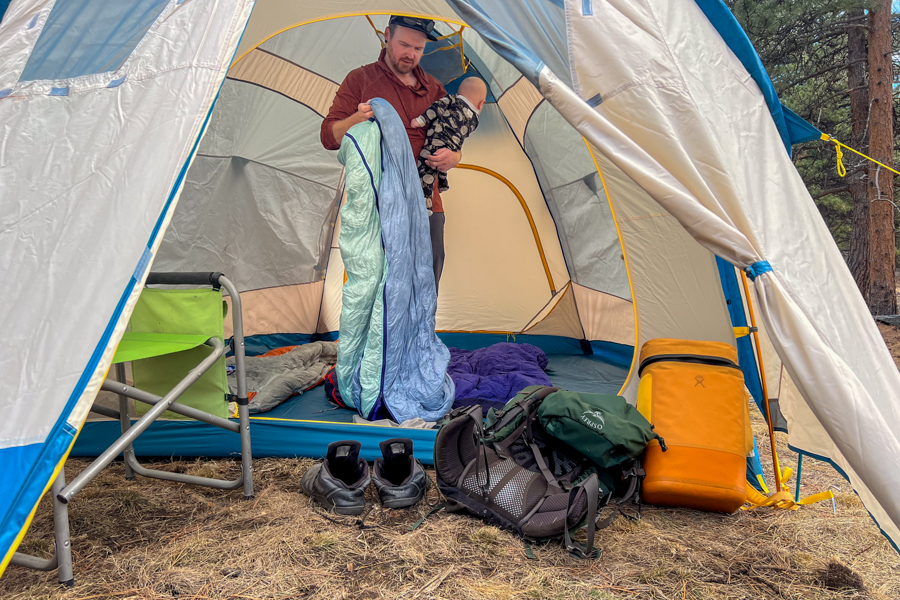
How Much Does EASE OF SETUP matter in a camping tent?
Setting up any tent for the first time can be a challenge, but it always gets easier with practice. Many tents are designed to be intuitive and quick to pitch with color-coded poles, buckle clips, and user-friendly directions.
Be sure to choose a tent that’s a manageable size and weight for you to handle easily, especially if you’ll be pitching it alone, in the dark, or in suboptimal conditions. Large tents can be awesome, but don’t choose one that’s so complex that it takes all the fun out of camping or requires multiple hands to pitch.
Do I need a Fully Waterproof Camping tent?
Most high-quality tents come fully seam-sealed to prevent water from penetrating in the most vulnerable spots (where the fabric has been stitched). If the instructions tell you to seal all the seams to increase weather protection, that means the tent isn’t stormproof – yet.
Seam sealing isn’t difficult, but it can be time-consuming and somewhat tedious, especially on a large tent. If your tent was once seam-taped, but you’ve noticed it starting to leak, it might be time to do some maintenance to extend the life of the tent by waterproofing it properly, including sealing the seams, replacing a peeling polyurethane coating, and refreshing the DWR coating on the rainfly.
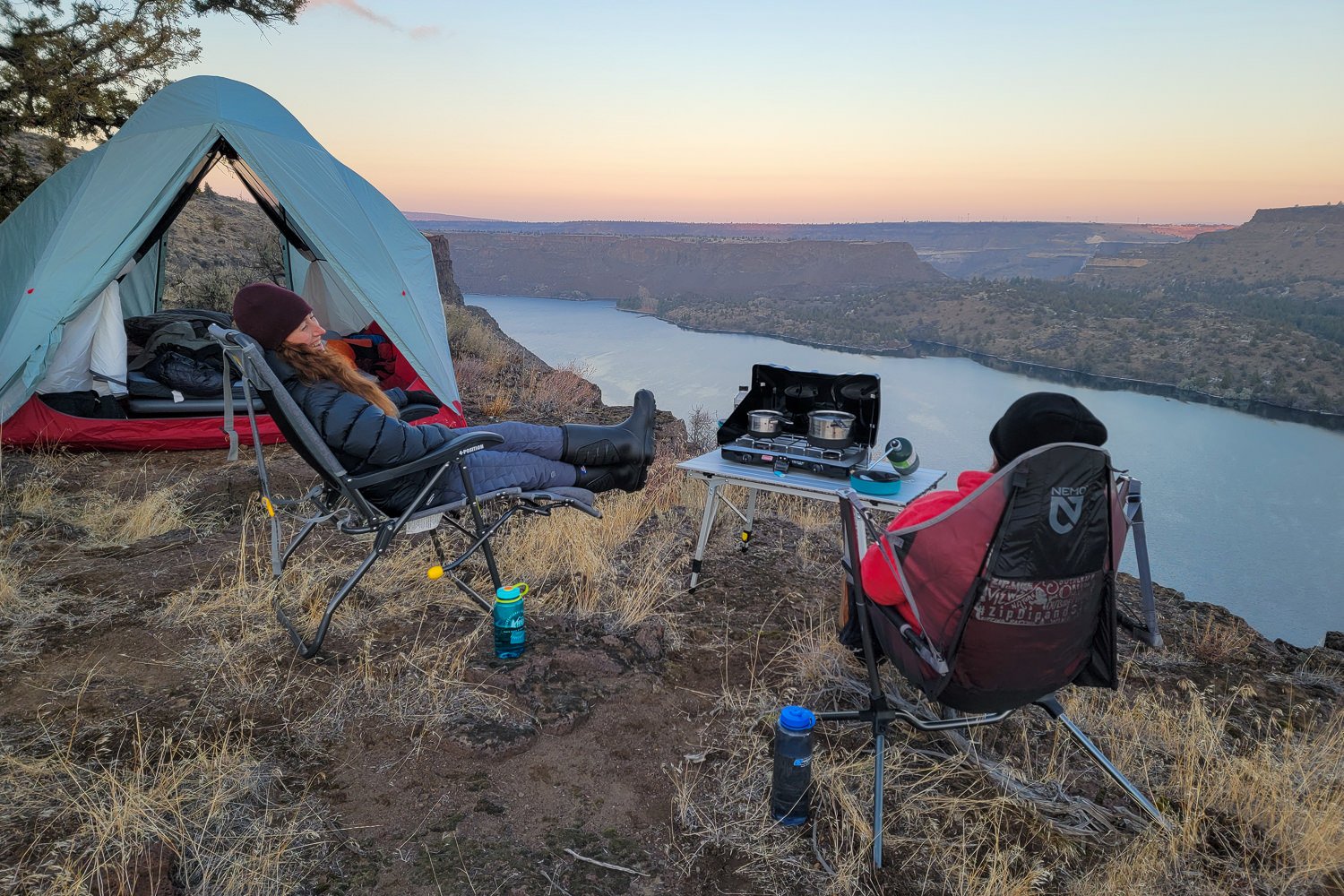
Do I need VESTIBULES & AWNINGS?
Vestibules are covered areas outside your tent doors meant for protecting and storing gear like backpacks and shoes – so you keep the bulk and mess outside of your sleeping area. If you plan to camp in places where it rains often, make sure your tent has one or more big vestibules so you won’t have to bring wet or muddy gear inside your sleeping area.
Some vestibules can also be converted into awnings for shade using pole accessories (not included). Other campers bring a separate shade or screen house that can be set up away from their tent, while others prefer to use an awning directly attached to their tent like a porch.
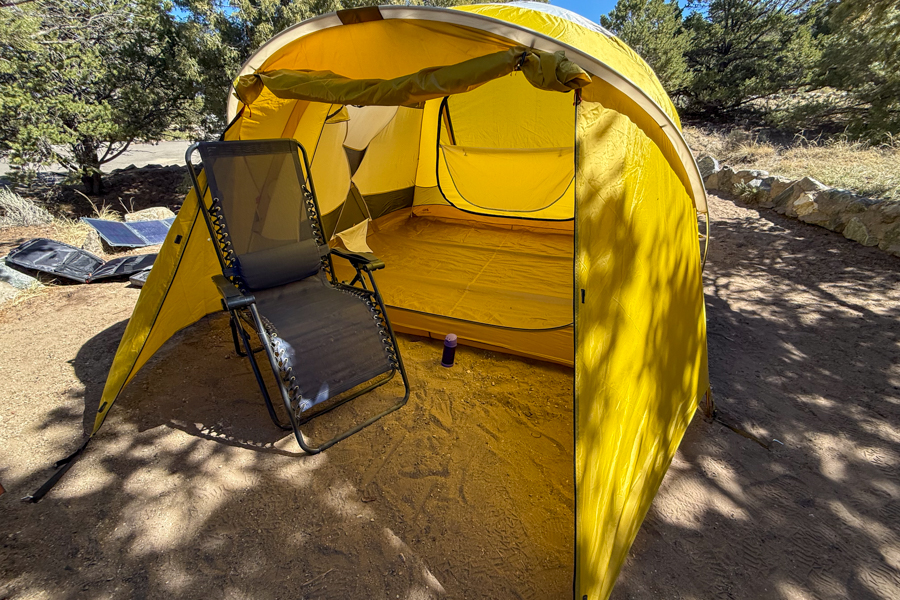
How Much Does PACKED SIZE Matter for a camping tent?
The packed size of your tent is vital for backpacking, but it’s not as important for car camping. Still, it’s smart to consider how much space you’ll have for your gear in your car and at home. A compact tent will be far less cumbersome to maneuver.
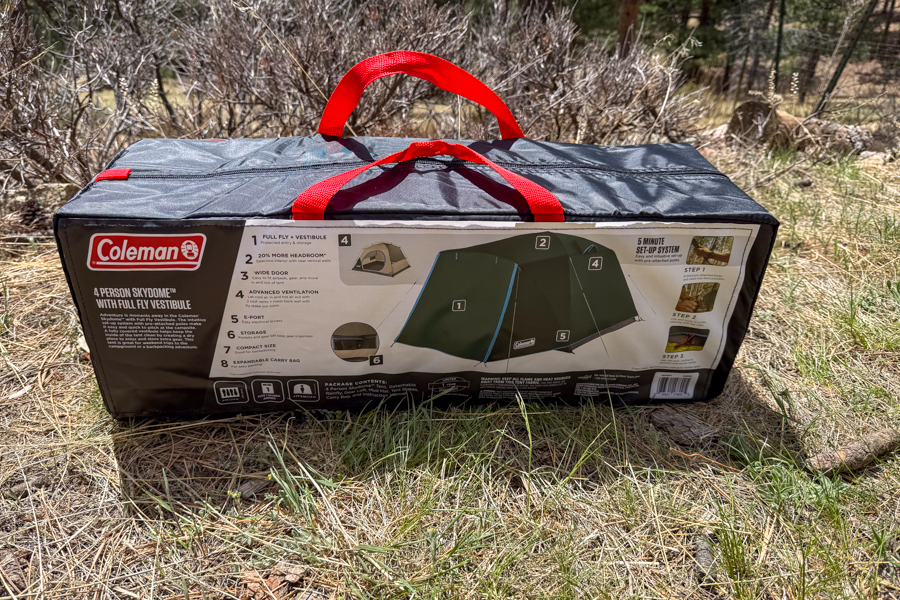
What do SEASON RATINGS mean?
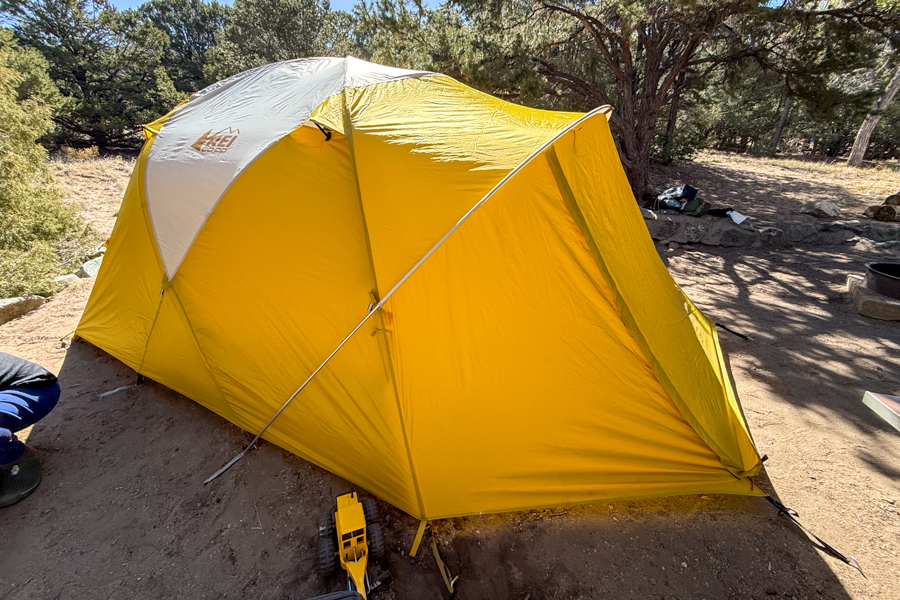
3-Season Tents
3-season tents are the most common type of tent and are typically meant to be used during the summer months when the weather is fair. These tents tend to have good ventilation and will protect you from rain and insects, but they may not be robust enough to withstand intense storms with heavy rain or high winds.
3-4 Season Tents
Some 3-season tents can be used from early spring through late fall, where the signs of winter are still obvious. They’re designed with more weather protection in mind and seek to offer a balance of ventilation, strength, and heat retention. These tents are often dome-shaped to shed rain and light snow with slightly more robust poles to give the structure rigidity to withstand winds. The rainfly is usually full-coverage and extends almost to the ground with one or more vestibules to keep gear and shoes dry.
4-Season Tents
4-season tents are best for those who plan to camp in snow and inclement weather, but they’re overkill for most 3-season car campers since they’re generally much heavier and bulkier. They tend to have lower profiles and are dome-shaped to shed snow and handle high winds. The biggest downside of 4-season tents is they have much less ventilation, which can make the living area too stuffy in warm conditions. Save the 4-season tents for winter camping or extended trips in heavy rains when it’s critical to have a cozy, safe shelter.
What’s the Difference Between Packaged Weight and Minimum/Trail Weight?
Different websites list different specifications for tent weight, and it can be confusing if you’re unsure of the terminology. Unfortunately, there’s no set standard for measuring the weight of tents across the industry – so your confusion is warranted – but we’ve got a few tips to help you navigate measurements:
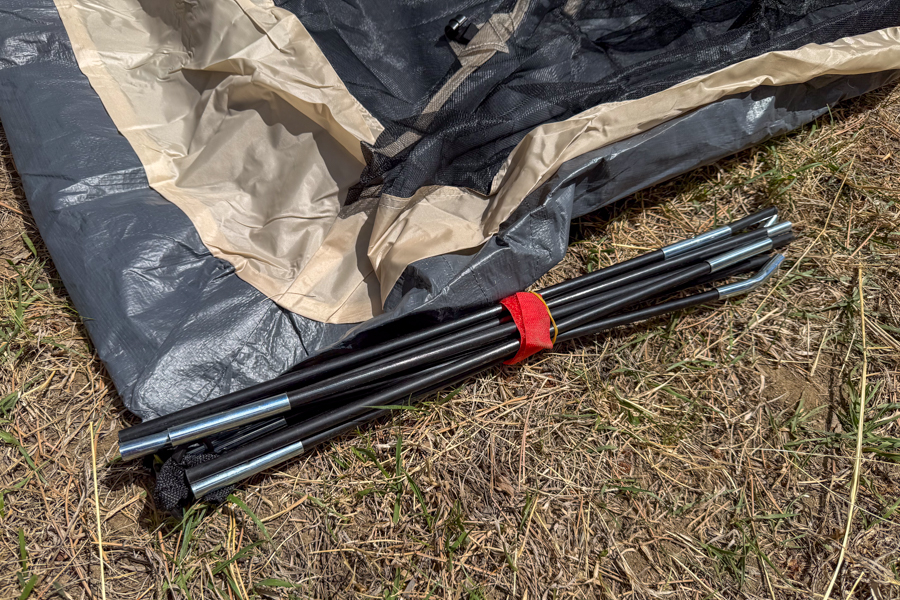
Packaged Weight: This is the number we use to measure total tent weight in this guide. Packaged weight represents the weight of all parts of your tent plus included accessories at the time of purchase. This is the most accurate measurement since it includes everything you’ll need to pitch your tent.
Minimum/Trail Weight: This spec represents the minimum components you’ll need to stay dry in a storm. It usually includes the tent body, rainfly, and poles, but it depends on the tent model and what the manufacturer deems “minimum” or “necessary,” so this measurement is less reliable than packaged weight. This spec leaves out the weight of the stuff sacks, guylines, and tent stakes (unless your tent is semi-freestanding).
Does my Camping tent need a Footprint?
If you’re spending a significant amount of money to buy a quality tent, it’s well worth investing in a footprint to extend the life of the floor fabric. The footprint is a lightweight material that adds just a bit of extra material to increase the durability of your tent floor and create a buffer between your home in the woods and poky branches, sharp rocks, or rogue thorns. If a specific footprint isn’t available for your tent model, a generic one will do.
Just make sure the footprint you get is the right size – a footprint that’s too large can collect water and cause it to pool under your tent, and a footprint that’s too small won’t provide adequate coverage. Check out our post Do You Really Need a Footprint? for more information.
Why are STAKES & GUYLINES important in camping tents?
Fully staking out a tent maximizes interior space and makes the tent sturdier. Taking a few extra minutes to completely stake and guy-out your tent could mean the difference between your tent lasting for years or getting swept away in the wind and ripping to shreds. If your guylines didn’t come pre-attached, the best way to attach them to the rainfly is with a bowline knot.
If your tent has a lot of guylines and stake-out points, consider bringing a small mallet to make the staking process quicker and easier. Many camping tents don’t come with enough stakes and guylines for all of the guy-out points, so it’s a good idea to pick up some extra guylines and tent stakes at the time of purchase or immediately afterward.
Why Trust CleverHiker
Our team has collectively spent over 3,000 nights camping to find the top-performing tents. Gear Analysts and lead testers Ian Krammer and Ben Dawson have pitched tents all over the state of Colorado, camping in almost every national forest, wilderness area, and 4WD-accessible trailhead and basin over the last 15 years. Their extensive experience with camping tents, as well as their history working in comparative research, has refined their ability to meticulously evaluate each tent to identify the best features and potential shortcomings.
Testing Methodology
How do we measure SPACIOUSNESS & COMFORT?
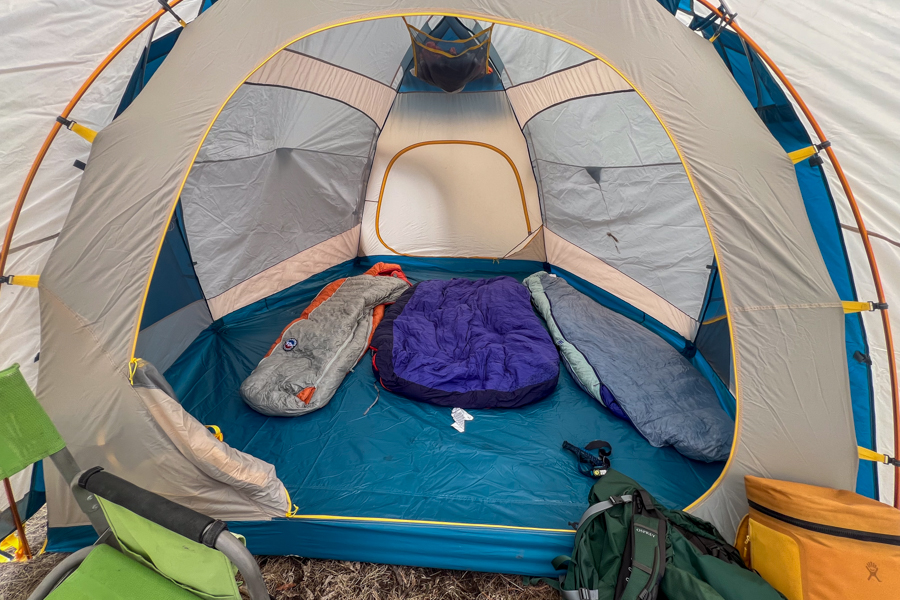
Spaciousness and comfort are about the livability of a tent. We look at the interior dimensions and how many people can comfortably sleep inside. Peak height is also an important factor, and we are sure to assess not only whether or not taller folks can sit up or stand, but how much room is actually available at shoulder height and above. Door size and configuration also play a role here.
How do we score EASE OF SETUP?
The tents that lead in this category have intuitive and clear instructions that streamline and speed up assembly. We scrutinize the weight and packability of the tent, as smaller and lighter models are easier to transport and store. We look for features like color-coded poles and clips that can simplify setup, as well as adjustable guylines and tensioners that help stabilize the tent when the weather turns.
How Do We Evaluate Weather Resistance?
When looking at weather resistance, we examine the materials used to construct the tent, prioritizing the most durable fabrics with robust waterproof coatings that repel rain and moisture effectively. We inspect seams for their quality and check their waterproofing, since seam-sealed stitching prevents water from seeping into the tent during heavy downpours.
Additionally, we look at the tent’s design, accounting for its shape, height, and geometry, to determine how well it handles strong winds and gnarly weather. We take note of features like reinforced guyline attachments and sturdy pole structures that keep the tent stable. We also look carefully at auxiliary features like rainflies and vestibules, which provide added protection for the gear you don’t want in your living area but still need to keep dry.
How do we assess DURABILITY & QUALITY?
Here, we prioritize the strength and durability of a tent’s materials – including poles, fabric, and hardware – to see how they stand up to the elements and how they handle being set up and taken down hundreds of times over multiple seasons. We examine the quality of stitching and seam sealing to make sure there aren’t any leaks, as well as the tent’s structural integrity, since reinforced stress points and heavy-duty zippers can help maximize a tent’s ability to withstand inclement conditions.
How Do We Evaluate Features?
Some models have additional features that go above and beyond the baseline. We test them all, from the number, size, and location of storage pockets to stuff sacks, included footprints, and clothesline systems.
Conclusion
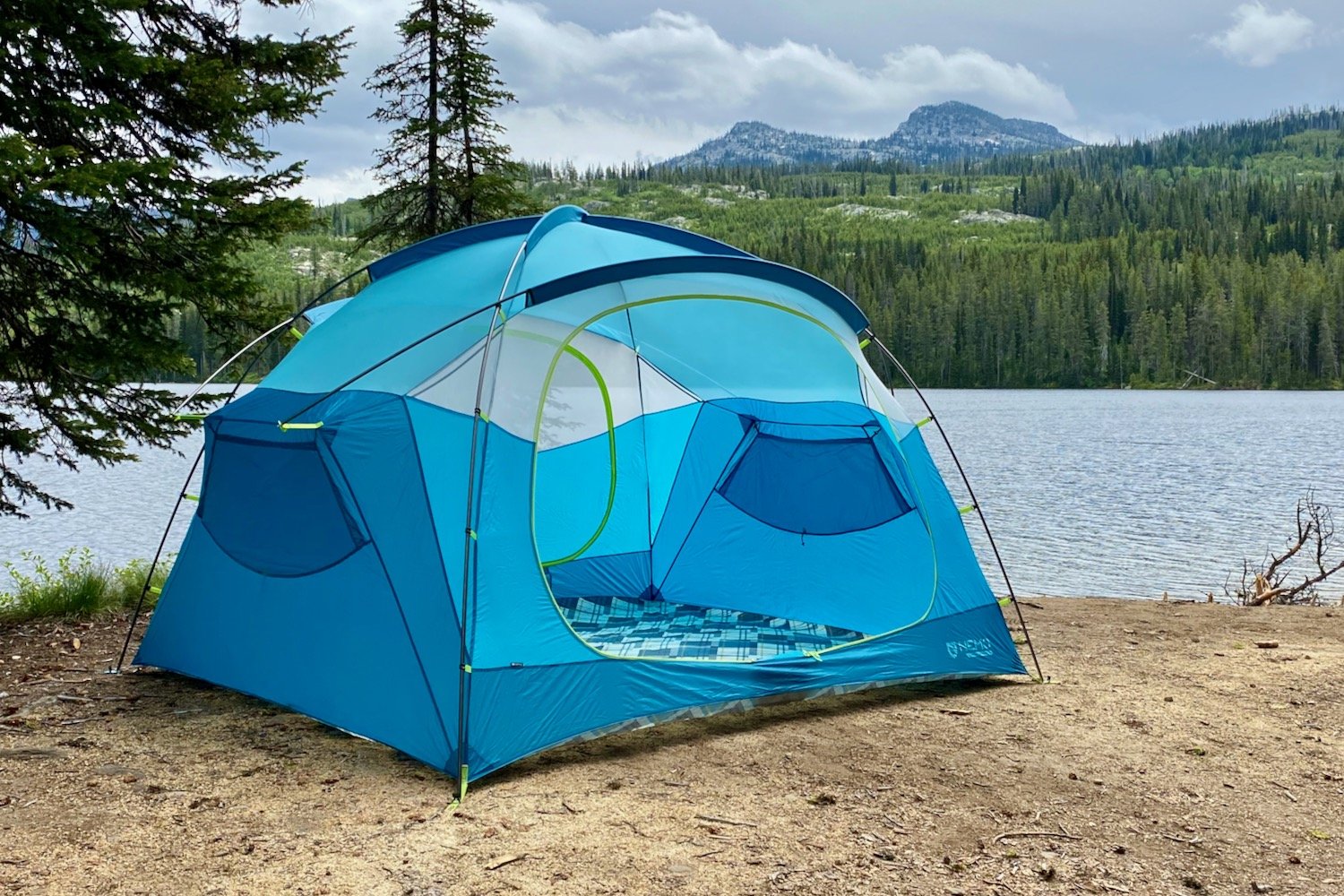
Choosing the right tent is crucial for a comfortable and enjoyable time camping. With so many options on the market, finding the right blend of features, space, weather resistance, size, and ease of setup is no small task, but we hope this guide helps you find the perfect option for your next adventure. Happy trails!