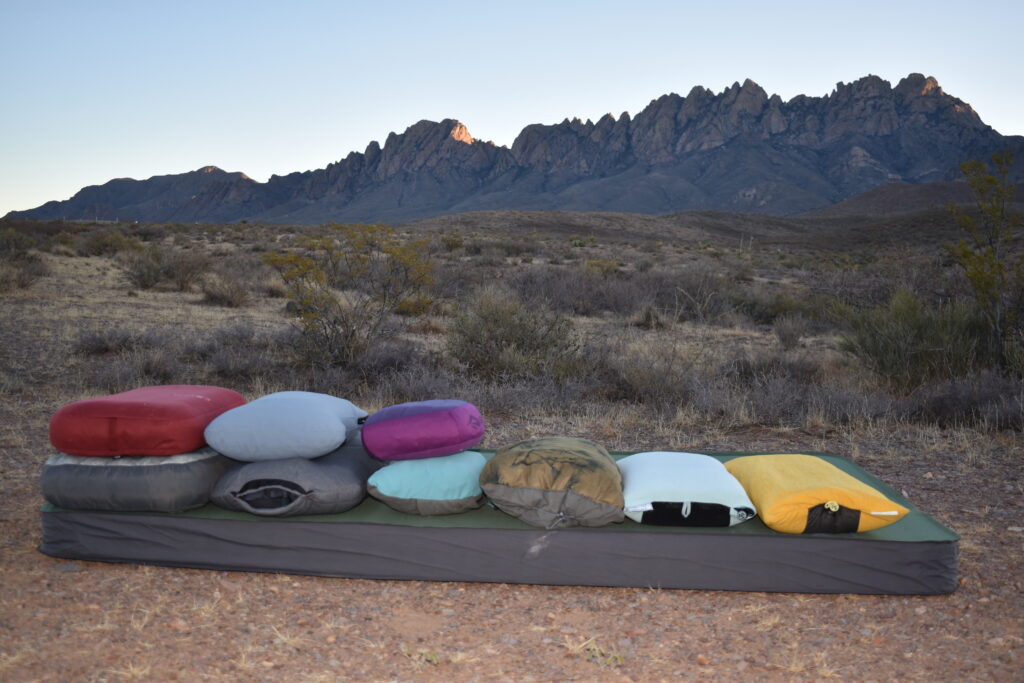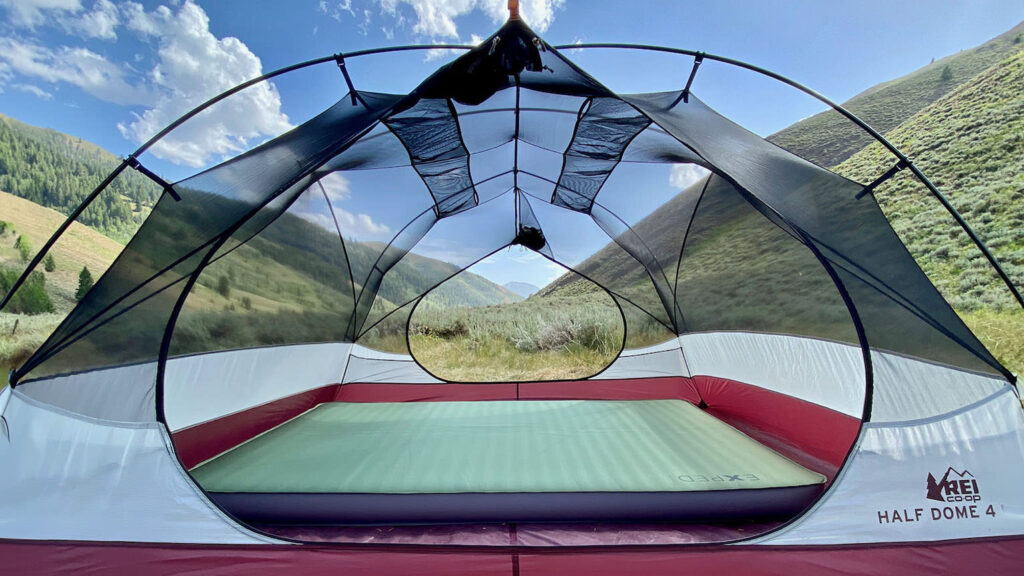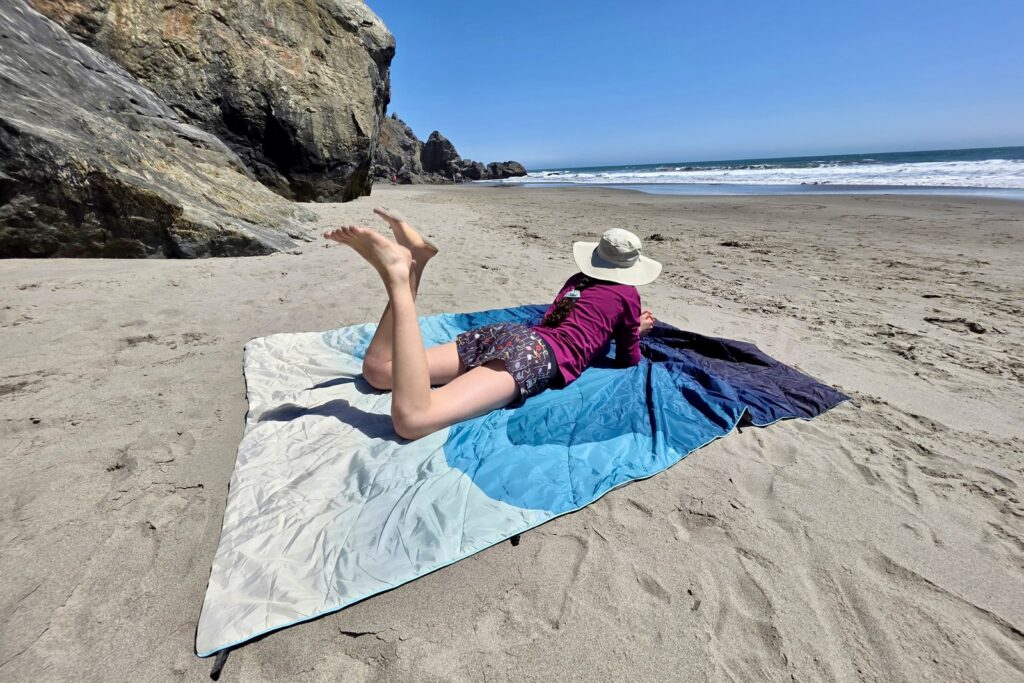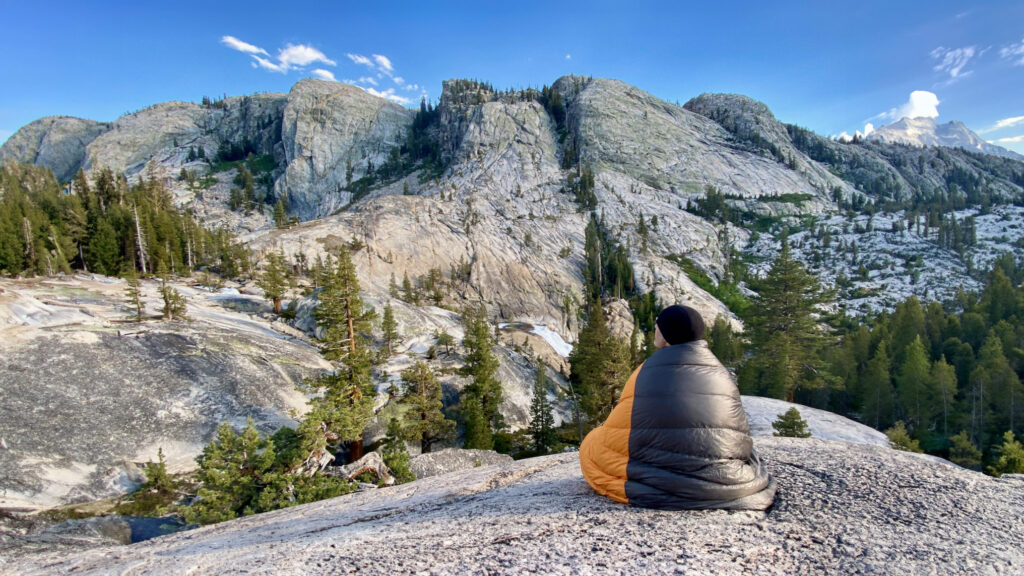


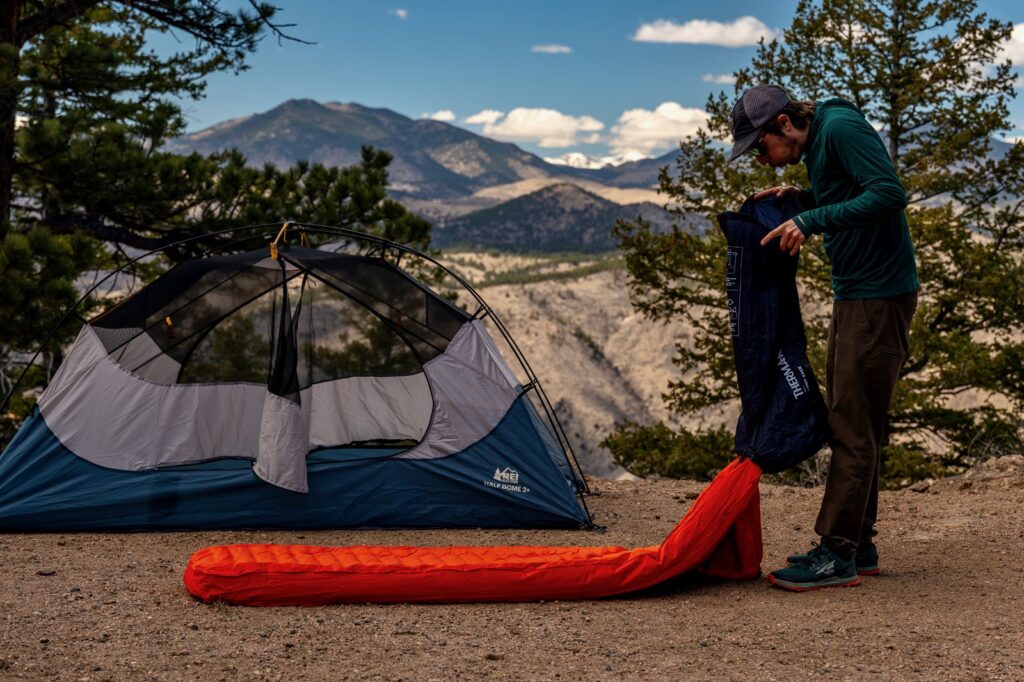
Over our 12 years of rigorous, hands-on testing, we’ve researched 150 different sleeping pads and tested more than 60 across dozens of multi-day treks, months-long thru-hikes, and quick overnights. We’ve spent thousands of nights in the backcountry sleeping in every situation imaginable to bring you real-life feedback on the best sleep systems.
Editor’s Note: We updated this guide on September 17, 2026, to refine our analysis and results, ensure prices and product specs are accurate, and to confirm we still stand behind the picks on our list.
How We Test Backpacking Sleeping Pads
Our team of gear experts has logged more than 3,000 nights in the backcountry testing the top sleeping pad options from reliable brands such as Therm-a-Rest, NEMO, Sea to Summit, Big Agnes, Exped, and more.
We don’t rely on lab specs or quick impressions. We evaluate every sleeping pad using a consistent, side-by-side testing process that measures comfort, warmth, durability, weight, and ease of use across a wide range of conditions.
And for more info, check out some of our other most popular gear guides:

#1. Best Backpacking Sleeping Pad Overall
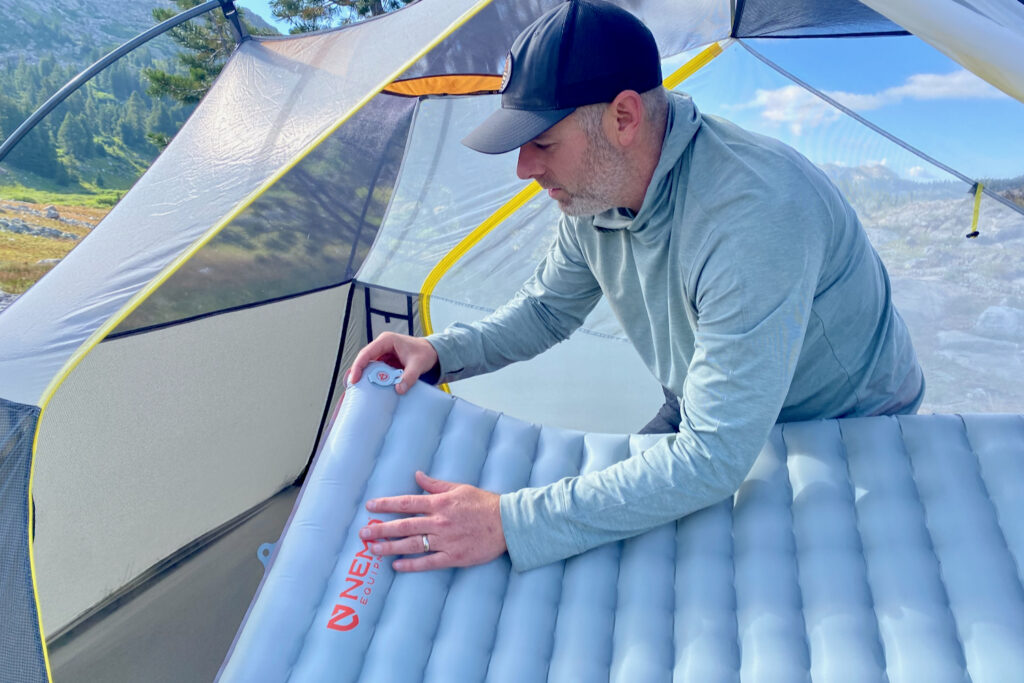
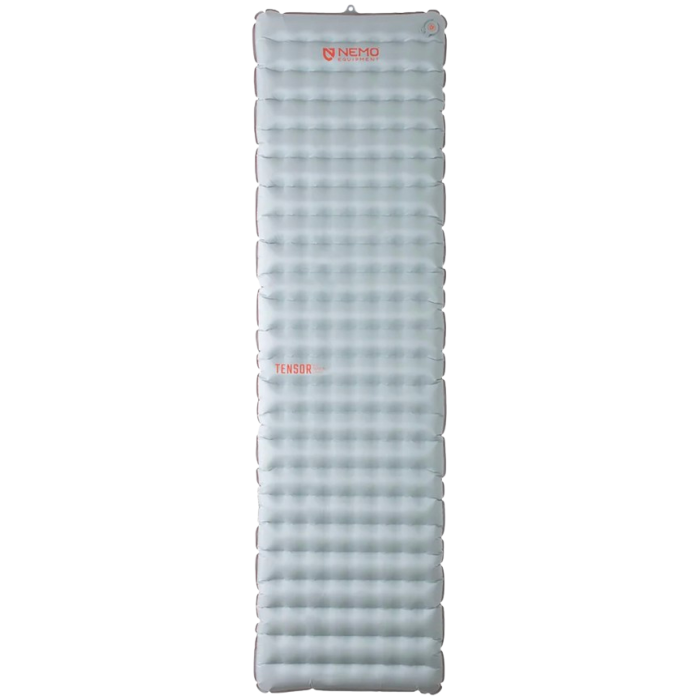
The NEMO Tensor All-Season is both lightweight and comfortable. Our team members have collectively slept on this pad for 150 nights in the backcountry and it’s still our favorite after all that time.

Quick Picks for Backpacking Sleeping Pads
Check out this quick list of our favorite sleeping pads, or continue scrolling to see our full list with in-depth reviews.
1. Best Backpacking Sleeping Pad Overall: NEMO Tensor All-Season ($200)
2. Best Backpacking Sleeping Pad Runner Up: Therm-a-Rest NeoAir XLite NXT ($210)
3. Best Cold-Weather Backpacking Sleeping Pad: Exped Ultra 6.5R ($200)
4. Best Winter Backpacking Sleeping Pad: Therm-a-Rest NeoAir XTherm NXT ($230)
5. Most Comfortable Backpacking Sleeping Pad: Therm-a-Rest NeoLoft ($250)
6. Affordable & Versatile Sleeping Pad: Big Agnes Divide Insulated ($130)
7. Comfortable & Durable Sleeping Pad: Sea to Summit Ether Light XR Insulated ($200)
8. Comfortable & Affordable Pad with Side Rails: Big Agnes Rapide SL Insulated ($170)
9. Best Foam Sleeping Pad: NEMO Switchback ($60)
10. Quiet Pad with Excellent Warmth-to-Weight Ratio: Big Agnes Zoom UL ($200)
11. Budget-Friendly Foam Sleeping Pad: Therm-a-Rest Z Lite Sol ($60)
12. Best Value Sleeping Pad for Back Sleepers: Sea to Summit Ultralight Insulated ($179)
13. Lightest Sleeping Pad: NEMO Tensor Elite ($250)
14. Most Affordable Backpacking Air Pad: Klymit Static V2 ($75)
15. Best Backpacking Sleeping Pad Add-On: Gossamer Gear Thinlight ($32)
NEMO Tensor All-Season
Best Backpacking Sleeping Pad Overall
CleverHiker Rating: 4.7/5.0
Price: $200
Weight: 14.1 oz.
R-Value: 5.4
Thickness: 3.5 in.
Packed Size: 4 x 10 in.
Pros
- Excellent balance of comfort, warmth & weight
- Very comfortable, especially for side sleepers
- Excellent warmth-to-weight ratio
- Quiet
- Fast, easy inflation & deflation
- Excellent Vortex pump sack
- Durable 40D bottom
- Many size & shape options
Cons
- Slightly heavier than the XLite NXT
- Pricey for occasional backpackers
- Not our first choice for severe winter conditions without additional insulation
- 20D top requires normal care around sharp objects and animal claws
The NEMO Tensor All-Season earns our top spot because it makes fewer compromises than almost any other backpacking sleeping pad we’ve tested. The Regular Mummy weighs just 14.1 ounces despite offering 3.5 inches of cushioning and an R-value of 5.4, giving it an outstanding combination of low weight, comfort, and warmth.
Our lead tester has slept on the Tensor All-Season for more than 29 nights in the backcountry, from summer trips to light snow and temperatures around 23°F. He primarily uses the Long Wide rectangular version and finds it exceptionally comfortable as a side sleeper. After all that use, the pad remains in excellent condition with no leaks, valve problems, noticeable abrasion, or other deterioration.
The Therm-a-Rest NeoAir XLite NXT is its closest competition. The XLite saves 1.1 ounces in comparable Regular Mummy sizes, so it’s still our pick for hikers who care about every possible ounce. But we prefer the Tensor overall. It’s warmer, slightly more comfortable in our testing, and much easier to inflate and pack thanks to NEMO’s excellent Vortex pump sack and quick-dumping Laylow valve. It’s also slightly quieter.
That versatility is what ultimately wins us over. The Tensor is warm enough for cold shoulder-season trips and handled our testing into the low 20s, yet it remains light enough for long-distance backpacking. For truly frigid winter trips, we’d move to a dedicated winter pad such as the NEMO Tensor Extreme Conditions or Therm-a-Rest NeoAir XTherm NXT. And hikers who only backpack occasionally may be better served by a less expensive model.
For regular backpackers looking for one premium pad that can handle the vast majority of their trips without sacrificing much in any major category, the Tensor All-Season is the one we’d choose.

Therm-a-Rest NeoAir XLite NXT
Best Backpacking Sleeping Pad Runner Up
CleverHiker Rating: 4.6/5.0
Price: $210
Weight: 13 oz.
R-Value: 4.5
Thickness: 3 in.
Pros
- Excellent warmth-to-weight ratio
- Very lightweight
- Comfortable for the weight
- Proven durability
- Highly packable
- Much quieter than previous XLites
- Multiple size options
Cons
- Pricey for occasional backpackers
- Pump sack is below average
- Slower to fully deflate than dump-valve pads
- Not our first choice for true winter camping
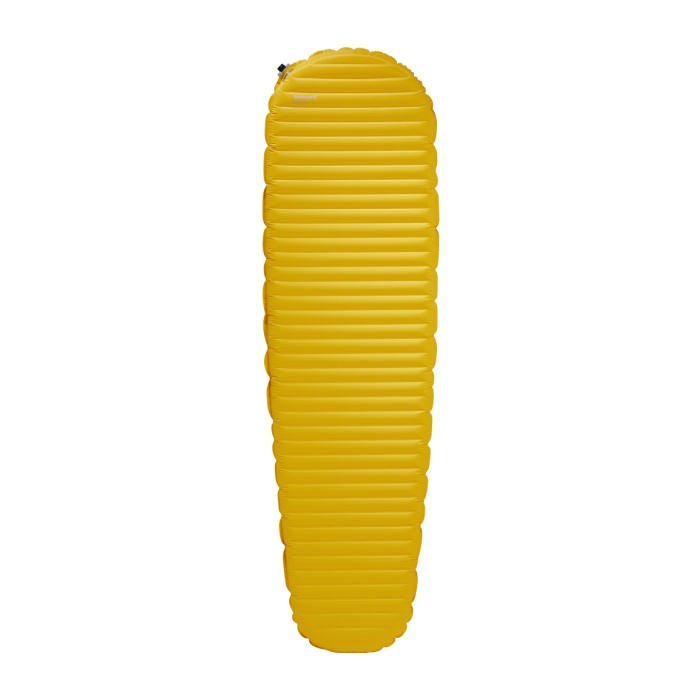
Therm-a-Rest’s NeoAir XLite NXT is easily one of the best 3-season sleeping pads on the market. We have over 100 nights of experience with this pad and you’ll often find it in our packs during spring, summer, and fall trips. The XLite has a rare combination of comfort, warmth, and weight that make it tough to beat for backpacking.
The NXT is 3 inches thick, so it’s warm and cushy. We’ve found the insulation good enough to stay comfortable in temps all the way down into the low 20s when paired with a quality sleeping bag, which is really incredible for a pad this light. We recently took the XLite NXT on a snowy late-season trek through Idaho’s Sawtooth Mountains and stayed perfectly warm and comfortable each night.
Keeping pack weight down on backcountry trips is critical, and the XLite NXT is among the absolute best this arena. At just 13 ounces, the XLite is one of the lightest insulated pads on the market. And you’d be hard-pressed to find another option that offers the same warmth or durability at this weight.
With just a little care during campsite selection, this pad can last for thousands of miles. When we took the XLite NXT on a 300-mile section of the Arizona Trail – a notoriously prickly path – it held up without incident despite some lazier evenings where campsite clearing fell off the priority list. Still, the XLite is an air pad and accidents can happen. The included repair kit makes field fixes easy, and the valve can even be replaced if it fails – a fairly unique feature for an air pad.
We’re also happy to report that the NXT is much quieter than previous versions. We’ve tested it many times with tentmates by our side and camp neighbors nearby with no complaints. Don’t expect complete silence though – we’d say the XLite NXT is now just about as quiet as most air pads – they all make a little noise.
The other minor inconvenience with the XLite comes in the form of ease-of-use. The pump sack that’s included with the XLite is pretty basic, and isn’t as efficient as the top competitors. Additionally, the XLite doesn’t have a dump valve, so you’ll have to squeeze air out of the pad when it’s time to pack up camp in the morning. This will slow down the packing process a bit, but it’s not a dealbreaker.
All things considered, the NeoAir XLite is a truly exceptional sleeping pad that we’ve put through the wringer over thousands of trail miles. It’s an all-time great backpacking sleeping pad and is clearly one of the best on the market.
Exped Ultra 6.5R
Best Cold-Weather Sleeping Pad
CleverHiker Rating: 4.5/5.0
Price: $200
Weight: 1 lb. .2 oz.
R-Value: 6.9
Thickness: 3.5 in.
Pros
- Excellent warmth
- Very comfortable for side sleepers
- Supportive vertical baffles and raised side rails
- Easy inflation with included pump sack
- Many size options
- Reasonable weight for the warmth
- Easy to roll and pack
Cons
- Not the lightest option
- 20D fabric requires more care than our durability leaders
- Underside valve placement can be awkward
- More insulation than many warm-weather backpackers need
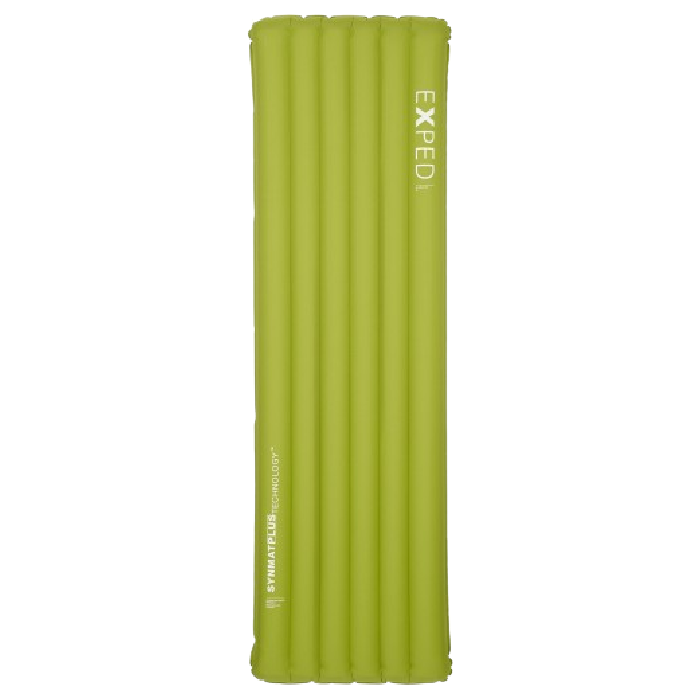
The Exped Ultra 6.5R lands in that sweet spot of comfort, warmth, and weight. It’s not the lightest sleeping pad on the market, but it is one of the most capable in any conditions. With its 3.5-inch thickness and vertical baffles, it provides a supportive but forgiving feel that works especially well for side sleepers.
Warmth, however, might be this pad’s biggest strength. A 6.9 R-value puts it firmly in winter-gear territory, and for many people, it’ll provide more insulation than they actually need for three-season use. That said, having that margin can be a nice luxury, especially on cold, damp ground that zaps heat quickly.
The 20-denier fabric keeps weight reasonable, but it’s a little bit on the delicate side. Pairing it with a foam pad goes a long way in protecting your investment. The included pump sack works well, even if it feels a bit overbuilt, and the underside valve placement can be mildly annoying until you get used to it.
Overall, the Ultra 6.5R is a solid, do-it-all pad. It leans slightly toward comfort and warmth over minimalism, but if you want one pad that can handle just about anything, it’s a good one to trust.
Therm-a-Rest NeoAir XTherm NXT
Best Sleeping Pad for Winter Backpacking
CleverHiker Rating: 4.5/5.0
Price: $230
Weight: 1 lb.
R-Value: 7.3
Thickness: 3 in.
Pros
- Excellent warmth-to-weight ratio
- Our favorite dedicated winter sleeping pad
- Very durable for an inflatable pad
- Comfortable three-inch cushioning
- Supportive horizontal baffles
- Highly packable for the insulation
- Many size options
- Quieter than older XTherm generations
Cons
- More insulation and weight than most summer backpackers need
- Pump sack is less efficient than our favorites
- Slower to fully deflate than pads with dump valves
- Pricey for occasional or warm-weather backpackers
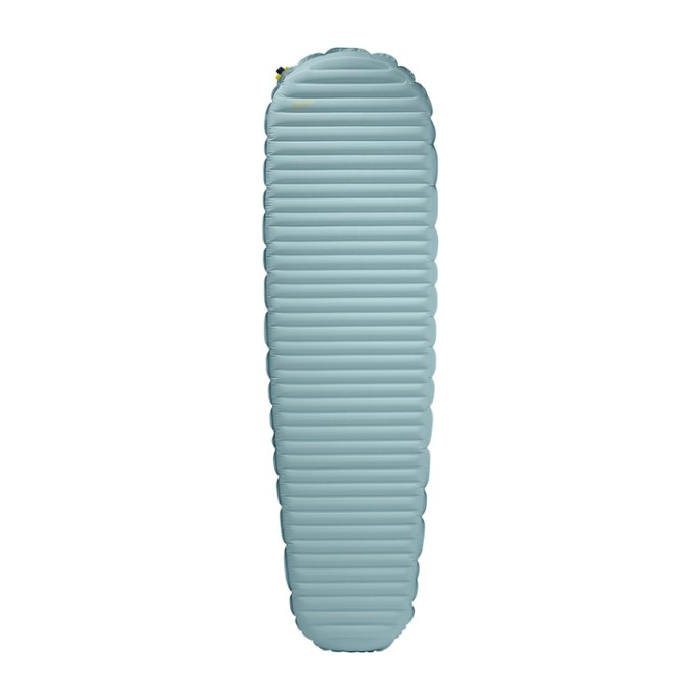
The Therm-a-Rest NeoAir XTherm NXT is our top recommendation for cold sleepers and hikers heading out for adventures in the winter chill.
With an R-value of 7.3, the XTherm NXT is one of the warmest backpacking sleeping pads on the market. It’s also considerably lighter than most other highly insulated sleeping pads, so it’s a great buy for hikers looking for the best balance of warmth and weight.
The XTherm is the pad our team members opt for when we head out on winter backpacking adventures. In our testing, even in absolutely frigid temperatures and several inches of fresh powder, we’ve stayed warm and comfortable thanks to the XTherm.
This pad also has a durable layer of 70-denier fabric on the underside to combat wear and prevent punctures. Its level of durability is among the best we’ve ever tested for backpacking air pads. The XTherm does make a slight crinkle sound when you shift around on it, but its considerable strengths far outweigh this minor downside.
With a weight that’s lower than the typical 3-season pad but an R-value ready for serious winter adventures, it’s no wonder the NeoAir XTherm NXT has been a fan favorite for many years.
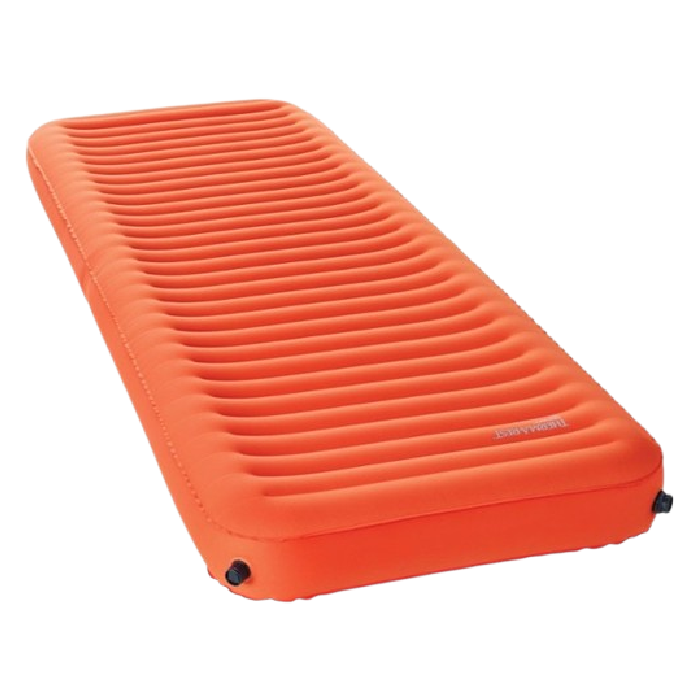
Therm-a-Rest NeoLoft
Most Comfortable Backpacking Sleeping Pad
CleverHiker Rating: 4.4/5.0
Price: $250
Weight: 1 lb. 8.9 oz.
R-Value: 4.7
Thickness: 4.6 in.
Pros
- Most comfortable pad in our current lineup
- Excellent for side sleepers
- Very thick, supportive cushioning
- Soft stretch-knit sleeping surface
- Raised sidewalls help keep sleepers centered
- Strong durability for an inflatable pad
- Easy-to-use twist valve
- Large pump sack and roomy stuff sack
Cons
- Heavy for backpacking
- Too bulky and heavy for most ultralight hikers
- Not insulated enough for true winter use
- Pricey for occasional backpackers
The Therm-a-Rest NeoLoft lives up to the hype and might be the future of backpacking sleep systems. It’s heavy for sure; we wouldn’t take this pad on high-mileage trips. However, it’s amazing how much comfort, warmth, and durability the NeoLoft packs into a sub-2-pound package.
The pad is a whopping 4.6 inches thick, providing enough cushion for side sleepers. However, thanks to its innovative stretch knit polyester fabric that closely conforms to your body shape, the NeoLoft is a good choice regardless of your go-to sleeping position. The large rectangular shape provides an ample sleeping surface while the built-in side rails help cradle you to sleep and keep you from rolling off the pad at night.
The pad’s R-value of 4.7 is plenty warm enough for shoulder seasons and even extends its usage into moderate winter conditions.
While the NeoLoft sacrifices some durability to keep weight down, it achieves a reasonable balance. The 50-denier polyester fabric is about on par with many tent floors – that is, if you aren’t finding pinholes in your tent, not to worry with the NeoLoft either.
This high-volume air pad comes with an equally large pump sack. The wide opening, sealed seams, and secure valve attachment are critical features that make inflating this large pad easy.
Although the NeoLoft is too heavy and pricey for a long-distance trip, the comfort it delivers for those who appreciate a restful sleep is invaluable.
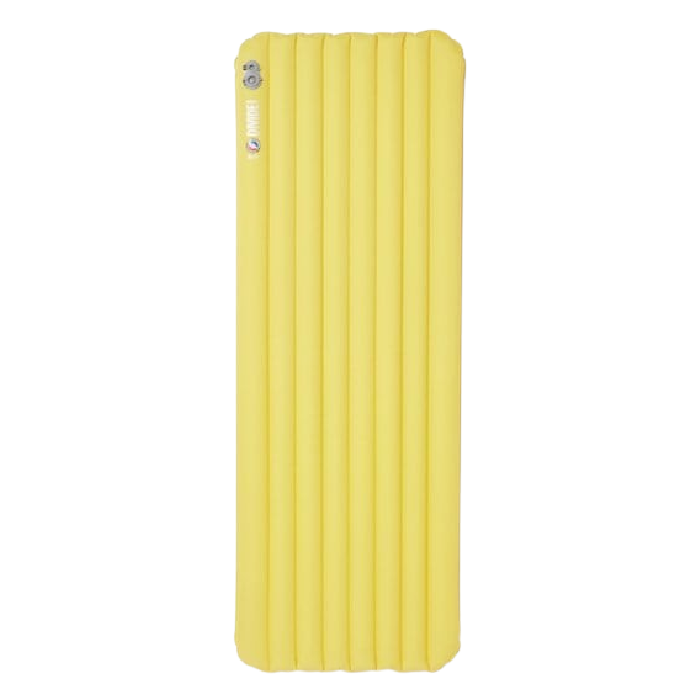
Big Agnes Divide Insulated
Affordable & Versatile Backpacking Sleeping Pad
CleverHiker Rating: 4.4/5.0
Price: $130
Weight: 1 lb. 2 oz.
R-Value: 4.0
Thickness: 3.5 in.
Pros
- Excellent value
- Good three-season warmth
- Durable for an inflatable pad
- Raised side rails help keep sleepers centered
- Easy dual-valve setup
- Many size options
- Rectangular sleeping surface
Cons
- Heavy compared with premium lightweight pads
- Vertical baffles may not suit side sleepers
- Tight stuff sack makes packing fussy
- Not intended for true winter use
The Big Agnes Divide Insulated sleeping pad is the right backcountry pad for anyone looking for a super versatile design.
The Divide Insulated sets itself apart with vertical I-beam baffles instead of the more standard horizontal or cell baffles. While they’re certainly not for everyone (side sleepers especially), they tend to give the body a hammock-like embrace that, in conjunction with the raised side rails, works hard to keep you aligned on the pad all night long.
The Divide comes in an uninsulated version, but the insulated version offers more versatile, three-season warmth with its Thermolite reflective film. While we wouldn’t rely on the Divide Insulated alone on frozen ground in the dead of winter, we wouldn’t hesitate to use it all the way through spring and fall.
Big Agnes ensures the Divide Insulated will last years with its durable ripstop nylon fabric, aviation-grade TPU lamination, and antimicrobial treatment on the inner liner. They also include a full repair kit with 3M repair patches and a replacement valve seal.
Although the dual valve (and included pump sack) speeds up inflation and deflation, the pad’s stuff sack is annoyingly small. Luckily, it’s pretty easy to fold and roll up.
Overall, the Big Agnes Divide Insulated delivers a ton of value in a three-season sleeping pad, whether you’re a seasoned backpacker or a casual weekend warrior on a budget.

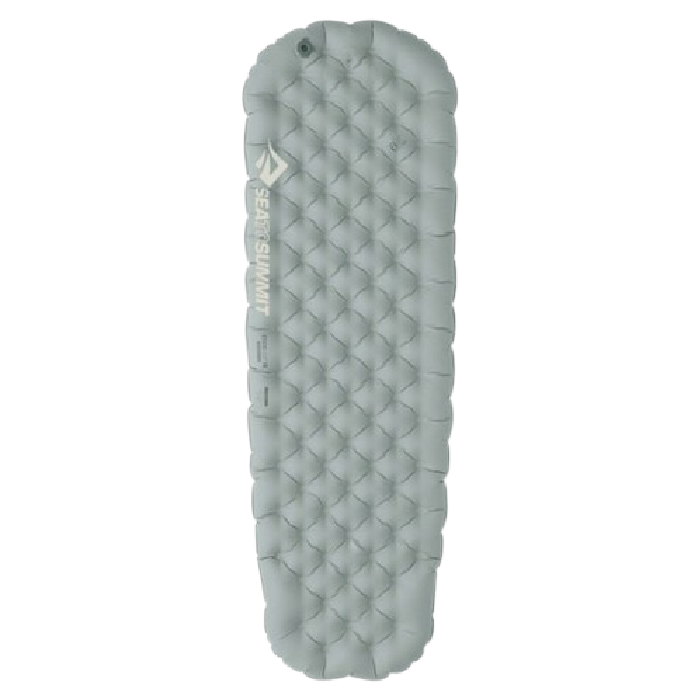
Sea to Summit Ether Light XR Insulated
Comfortable & Durable Sleeping Pad
CleverHiker Rating: 4.4/5.0
Price: $200
Weight: 1 lb. 0.6 oz.
R-Value: 4.1
Thickness: 3.9 in.
Pros
- Semi-lightweight
- Above-average comfort
- Exceptionally durable
- Integrated pump sack
- Cushy
- Good weight distribution
Cons
- Price
- Weight
- Slightly rubbery feel/sound
The Ether Light XR Insulated is one of Sea to Summit’s lightest and cushiest insulated air pads.
The unique “air sprung cells” mimic the support of a home spring mattress, cradling the body and distributing weight in a way most standard air pad baffles don’t. At 3.9 inches, the Ether Light is also one of the thickest sleeping pads on our list, which helps you dial in your preferred firmness and ensures you never bottom out.
Aside from comfort, Sea to Summit’s other big focus with the Ether Light XR is durability. This pad is made with a thicker, stronger material that’s more resistant to tears and punctures than many others. The material does have a more rubbery sound and feel, but it’s not too bad, and we think it’s a fair trade-off for the added strength.
The XR Insulated also prioritizes ease of use with its two-in-one stuff sack, pump sack, and micro-adjustable valve. One of our favorite features is the PillowLock system, a unique set of Velcro-like strips designed to keep your Sea to Summit Aeros pillows in place. Several pillows from their Aeros line made our Best Backpacking Pillows list, and they’re all compatible with the PillowLock on the Ether Light.
With an R-value of 4.1 and a durable build, the Sea to Summit Ether Light is a great fit for 3-season and mild winter backpackers looking for top-tier comfort.
More: Sea to Summit Ether Light XR Insulated Sleeping Pad Full Review
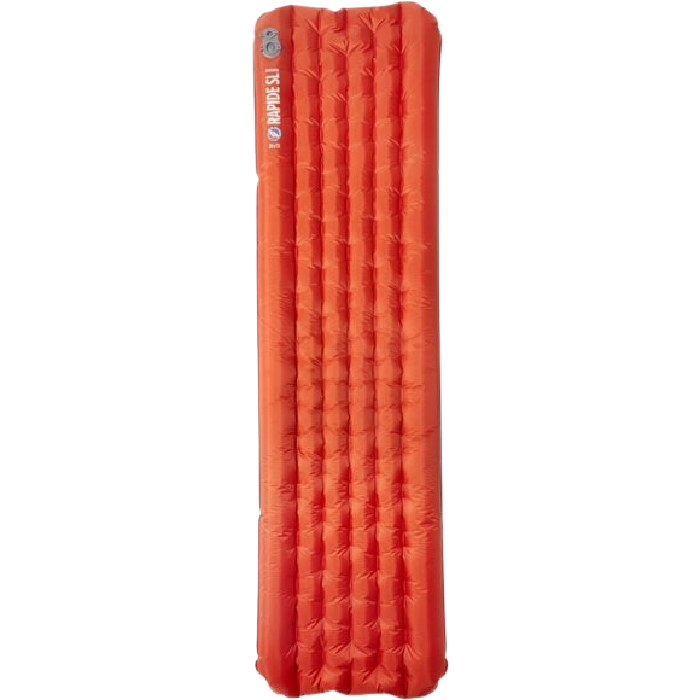
Big Agnes Rapide SL Insulated
Comfortable & Affordable Sleeping Pad with Side Rails
CleverHiker Rating: 4.4/5.0
Price: $170
Weight: 1 lb. 2 oz.
R-Value: 4.8
Thickness: 3.5 in.
Pros
- Excellent comfort
- Thick cushioning for side sleepers
- Raised side rails help keep sleepers centered
- Quiet sleeping surface
- Easy dual-valve setup
- Good three-season insulation
- Many size options
Cons
- Heavier than premium lightweight pads
- Felt colder than expected in near-freezing testing
- Pump sack connection can be finicky
- Tight stuff sack requires careful packing
The Big Agnes Rapide SL Insulated is a cushy, durable, and warm sleeping pad for 3-season adventures. The Rapide is less expensive compared to pads with similar specs, so it’s an excellent choice for backpackers looking to save money without sacrificing comfort.
It differentiates itself from other pads with its large side rails that help to keep you centered. The sleeping surface of the Rapide is 3.5 inches thick – making it one of the thicker backpacking pads on our list – with sides that are a generous 4.25 inches. This makes it ideal for hikers who struggle to keep from sliding off their pads. The thickness also allows you to dial in the perfect firmness level to suit your sleeping style without worrying about bottoming out.
With all the different available sizes, most hikers should be able to find a version of the Rapide that’s comfy. This is one of the only sleeping pads that doesn’t cost extra for a long version, so tall hikers don’t have to shell out extra. Both the regular and long sizes also come in a wide version, there’s also a petite size, and the Rapide is even available as a double sleeping pad.
At 18 ounces, the Rapide is among the heavier sleeping pads on our list. But the weight is very reasonable when you consider how comfortable, warm, and affordable it is. For those who prioritize comfort over all else, the Big Agnes Rapide SL is a top contender.
NEMO Switchback
Best Foam Sleeping Pad
CleverHiker Rating: 4.3/5.0
Price: $60
Weight: 14.5 oz.
R-Value: 2
Thickness: 0.9 in.
Pros
- More durable than air pads
- Affordable
- Quick to pack/unpack
- Doubles as a sit pad
- Quiet
Cons
- Not as comfortable as air pads
- Bulky
- Not warm enough for sub-freezing temps
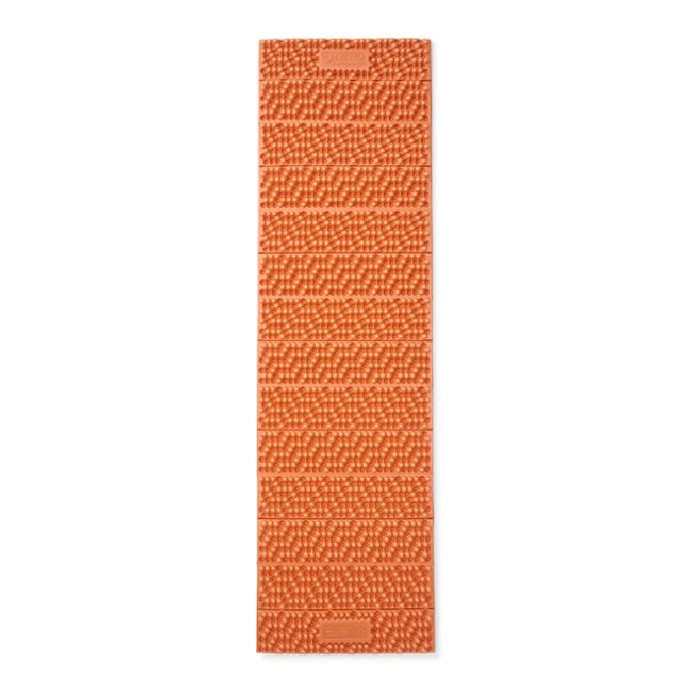
The foam NEMO Switchback is affordable and hassle-free. Foam pads are nice because you’ll never have to spend time inflating/deflating them, and you’ll never have to worry about waking up on the cold ground since they can’t spring a leak. The ease of use and durability are by far the biggest strengths of the Switchback, but this pad is also quite lightweight.
The big downside of the Switchback is that it’s less comfortable than air pads – unless you prefer sleeping on firm surfaces. Still, there are some cases where we’ll opt for the Switchback over (or in addition to) an air pad.
When the CleverHiker team went on a group winter backpacking trip along the White River on Mt. Hood, we each brought one of these closed-cell foam pads to use under our air pads for extra insulation from the snow. We also like using the Switchback when traveling with dogs since we don’t have to worry about puppy paws putting holes in it. We even cut a Switchback in half and bring it as a dedicated sleeping pad for our dog hiking companions.
There’s a lot to love about the convenience, affordability, and durability of the Switchback. So if you prefer a firm sleeping surface, simplicity, and worry-free comfort, the NEMO Switchback might be exactly what you’re looking for.
Big Agnes Zoom UL
Quiet Pad with an Excellent Warmth-to-Weight Ratio
CleverHiker Rating: 4.3/5.0
Price: $200
Weight: 14 oz.
R-Value: 4.3
Thickness: 3.25 in.
Pros
- Ultralight
- Above-average comfort
- Excellent value
- Very small packed size
- Side rails keep you centered
- Quiet
- Valve design allows precise micro-adjustments
- Wider than most pads
Cons
- A bit expensive
- Slow deflation
- Pump sack is a bit cumbersom
- Valve placement isn't ideal for everyone
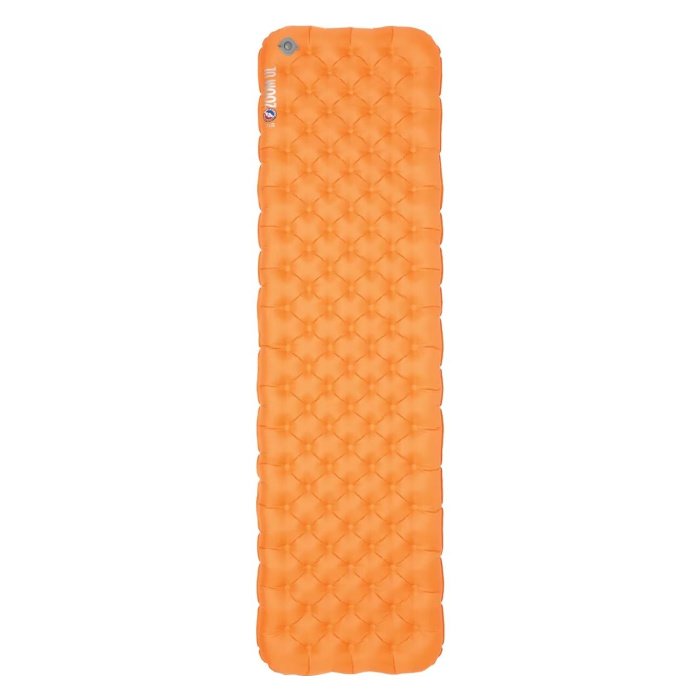
The Zoom UL delivers an exceptionally cushy night’s sleep in a small, lightweight package.
At 3.25 inches thick in the center (and 3.5 inches on the side rails to help keep you in the middle), this is also one of the thicker ultralight pads on our list. This is a real advantage for side-sleepers and those who like a squishy pad since you’ll have more room to adjust the firmness without bottoming out.
So with all that said, why isn’t this pad at the very top of our list? It really boils down to convenience. The valve is a bit slower and more finicky to deflate, and the included pump sack is our least favorite out of all the ones we tested. These aren’t the biggest gripes in the world, but when it comes to the best of the best we had to be picky.
That said, the Zoom UL is an awesome value pad that will have you sleeping like a baby in the backcountry. So if you prioritize saving money over having a few extra conveniences, you won’t be disappointed by the Zoom UL.
Therm-a-Rest Z Lite Sol
Budget-Friendly Closed-Cell Foam Sleeping Pad
CleverHiker Rating: 4.3/5.0
Price: $60
Weight: 14 oz.
R-Value: 2
Thickness: 0.75 in.
Pros
- More durable than air pads
- Adds insulation & durability to air pads
- Affordable
- Quick to pack/unpack
- Doubles as a sit pad
- Quiet
Cons
- Bulky & awkward profile
- Thin
- Less warm than air pads
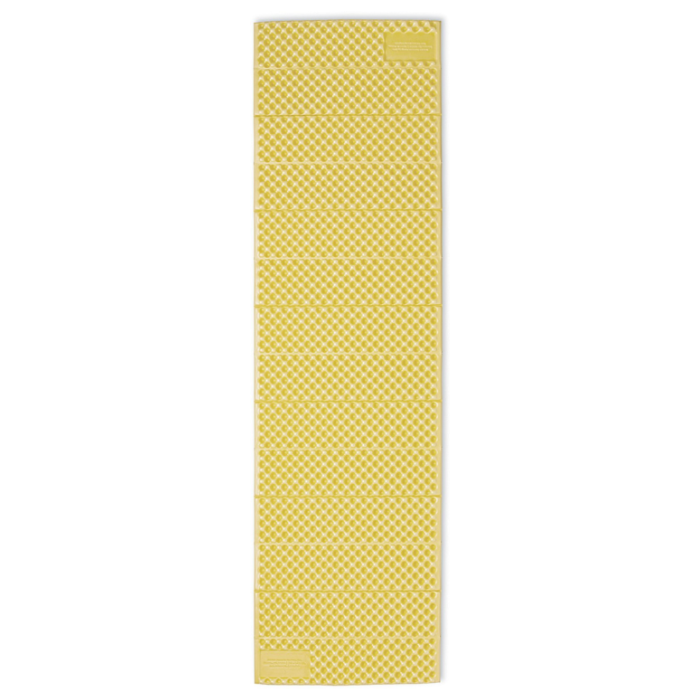
The Therm-a-Rest Z Lite Sol is the original beloved closed-cell foam pad used by thru-hikers, budget-conscious backpackers, and minimalist hikers for years. We love this pad for its ease-of-use, low weight, and affordable price tag.
Just like the NEMO Switchback, the Z Lite Sol is a super durable and versatile. It can be used as a sit pad, a sleeping pad, an insulating layer under an air pad, or as a dog bed.
Though most hikers will likely find an air pad more comfortable, the Z Lite Sol is surprisingly comfy for a piece of foam that’s less than an inch thick. We took the Z Lite Sol on a thru hike of the PCT, and we like it for its quick, easy set-up, low weight, and multi-purpose design. The Z Lite an ideal choice for long-distance trails since it’s unlikely to fail during the long haul.
The Therm-a-Rest Z Lite Sol and NEMO Switchback are basically identical, but we gave the slight edge to the Switchback because it’s a tad less bulky and we found that the nodes kept their loft a little better than the Z Lite’s. At the end of the day, they’ll both perform essentially the same so you can’t go wrong.
Sea to Summit Ultralight Insulated
Best Value Sleeping Pad for Back Sleepers
CleverHiker Rating: 4.2/5.0
Price: $180
Weight: 1 lb. 0.9 oz.
R-Value: 3.1
Thickness: 2 in.
Pros
- Lightweight
- Comfortable for back-sleepers
- Less expensive
- Above-average durability
- Quick inflation/deflation
- Excellent valve design for micro-adjustments
- Wider than most pads
Cons
- Can bottom out when shifting around
- Slightly rubbery feel/sound
- Heavier than some
- Valve location isn't ideal
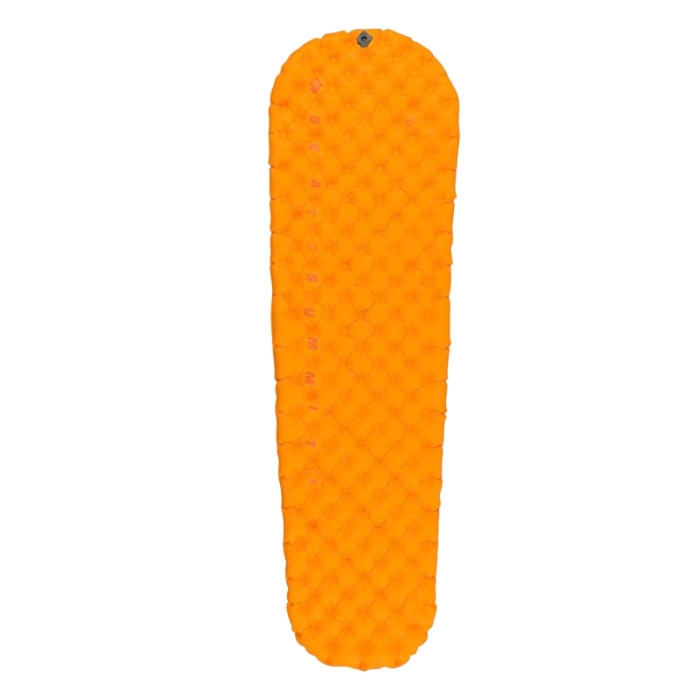
The Sea to Summit Ultralight Insulated pad features “air sprung cells” that provide cushy comfort and feel surprisingly like your mattress at home.
The benefit the Ultralight has over its Ether Light sibling is its lower price tag. The Ultralight is also just about as warm and comfortable as the Ether Light, but it’s a tad lighter and slightly less bulky. So what made this pad rank below the Ether Light? It really comes down to comfort.
With just 2 inches of thickness, some users will likely bottom out when shifting around on the Ultralight, and it probably isn’t the best fit for side sleepers. That said, it still provides a very comfortable night’s rest for back- and stomach-sleepers who tend to stay put when snoozing.
While the Ultralight may not be the right pad for everyone, it has a good valve system that’s quick and easy to use, it’s more durable than the average air pad, and it’s decently light and warm. So if you’re a back-sleeper in the market for a comfortable, lightweight, and sturdy backpacking sleeping pad that costs less than most of its competitors, the Sea to Summit Ultralight is a great choice.
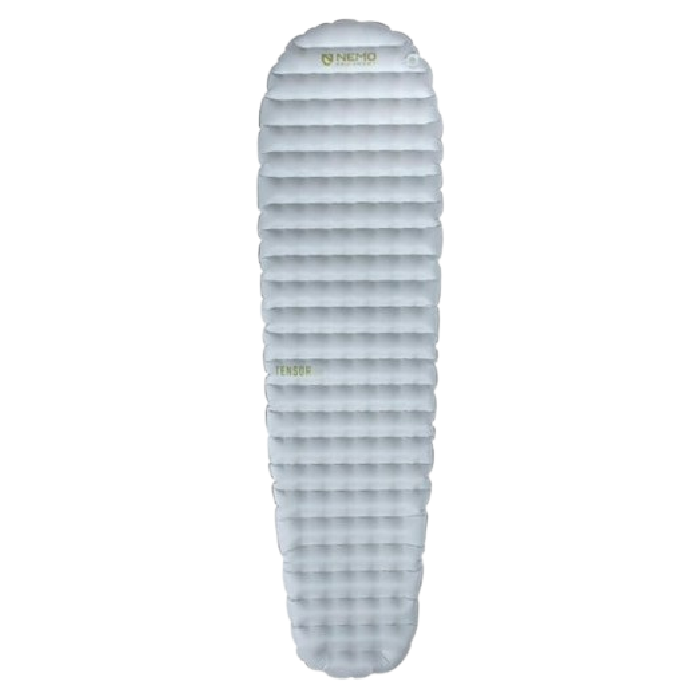
NEMO Tensor Elite
Lightest Sleeping Pad for Summer Backpacking
CleverHiker Rating: 4.2/5.0
Price: $250
Weight: 8.5 oz.
R-Value: 2.4
Thickness: 3 in.
Pros
- Ultralight & packable
- Comfortable for the weight
- Distributes weight evenly
Cons
- Not very durable
- Expensive
- Slippery
The NEMO Tensor Elite is a gram-counter’s dream come true. At just 11.6 ounces, including a stuff sack, pump sack, and velcro strap, the Tensor Elite blows away the ultralight competition. It also packs down very small, taking up minimal pack space.
Although it’s not the most luxurious sleeping pad on our list, the NEMO Tensor provides a decent amount of comfort for its size. It is a respectable three inches thick with NEMO’s Apex baffle system (essentially dimpled horizontal baffles) that distribute weight evenly and naturally contour to your body’s shape. The Tensor Elite is thick enough for most sleepers, but if you are a side sleeper or prefer a slightly deflated pad, it may bottom out on you. It’s also best suited for folks who don’t roll around at night due to its slippery fabric and heavily tapered mummy shape.
The featherweight, 10D nylon construction has advantages and disadvantages. On one hand, it’s very flexible (adding to its comfort) and very easy to roll up. It also expands generously and quickly inflates with the included pump sack. However, the fabric is fragile and requires delicate handling. We’re not saying you have to baby it—just be careful where you set it down.
We don’t recommend the Tensor Elite as a year-round do-it-all pad. Warm sleepers can probably use it during shoulder season, but it’s best suited as a summer sleeping pad.
The Tensor Elite’s ultralight, innovative construction comes with a hefty price tag. This pad is best for the ultralight thru-hiker looking to shave every possible gram from their pack weight.
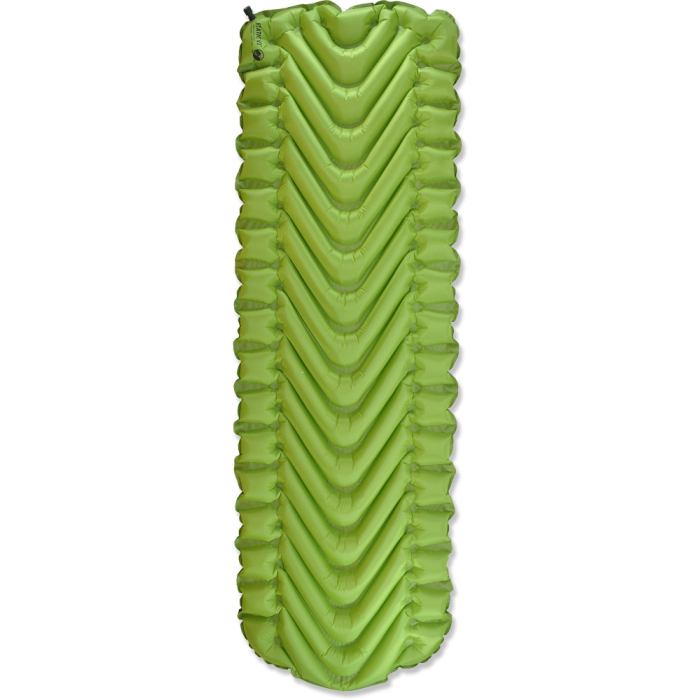
Klymit Static V2
Most Affordable Backpacking Air Pad
CleverHiker Rating: 4.0/5.0
Price: $75
Weight: 1 lb. 0.6 oz.
R-Value: 1.3
Thickness: 2.5 in.
Pros
- Affordable
- A bit wider than others
- Above-average durability
- Lightweight
Cons
- Not very warm
- Can bottom out when shifting around
- Slower inflation/deflation
The Klymit Static V2 is one of the most affordable air pads on the market. It’s built with thicker materials than most lightweight backpacking sleeping pads and is slightly wider than the standard pad size as well.
Though the large spaces between the air chambers may cause you to bottom out while shifting around, the V-shaped tubes on the Static V are quite comfortable. With this in mind, side sleepers could find it difficult to get into a position where their hips are supported, so we think the Static V2 is best suited to back-sleepers or stomach-sleepers who tend to stay in one place while they snooze.
This pad has a low R-value, so it’s best for summer trips. Klymit does offer an Insulated Static V with an R-value of 1.9, but it weighs quite a bit more and that’s not a huge improvement over the 1.3 R-value of the Static V2.
Drawbacks aside, the Klymit Static V2 is still a great choice for backpackers looking to hit the trail without breaking the bank. It’s durable, decently lightweight, and it’ll get the job done at a fraction of the price of other air pads.
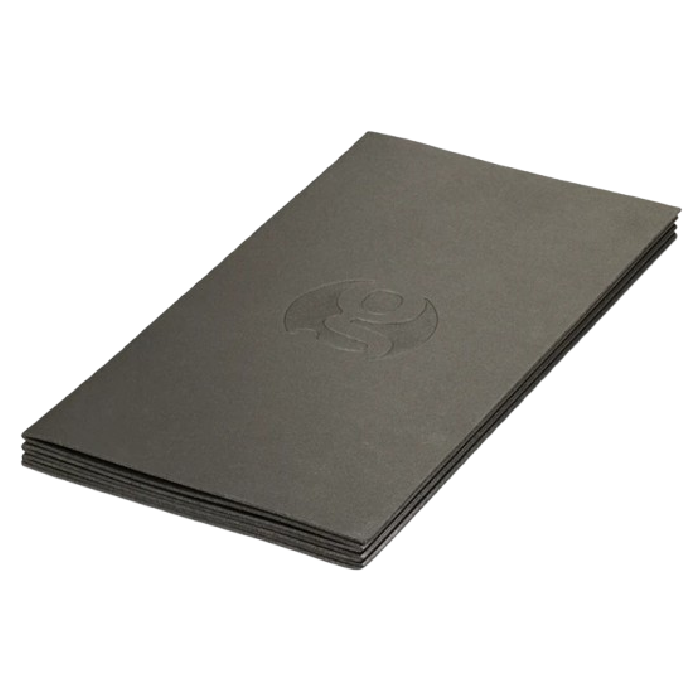
Gossamer Gear Thinlight
Best Sleeping Pad Add-on
CleverHiker Rating: 3.8/5.0
Price: $32
Weight: 4.4 oz.
R-Value: 0.5
Thickness: .125 in.
Pros
- Price
- Adds protection, warmth, and grip to an inflatable pad
- Many uses
- Can be cut to size
Cons
- Not very thick
- Bulky
Unless you’re among the most hardcore ultralight backpackers, the Gossamer Gear Thinlight is best utilized to beef up your current sleep system. The ⅛-inch closed-cell foam provides minimal cushion and weight on its own, but when paired with an inflatable pad, it’s one more layer between you and the harsh ground. More importantly, it protects your expensive inflatable pad from punctures and even helps keep the slippery plastic securely in place.
Our personal favorite feature of the Thinlight is the many uses that it serves before you even get to camp. It’s hard to understate how nice it is to be able to quickly grab the Thinlight and flop it out for a comfy seat at lunch, a quick dirt nap, or even a yoga session. For how little it weighs, it adds a lot of functionality.
It can be a little bulky to pack (unless you are using an UL framless pack, in which case, this is clutch), but you can easily cut it down to your desired size to make it work with your backpacking kit. It also comes in a folded or rolled option, which each pack a little differently.
The closed-cell foam is durable and will last long enough to get your money’s worth, but it will eventually degrade. But whether you’re an ultralight or luxury backpacker, or looking for something for your dog, the Thinlight is a smart addition to protect your gear investment and elevate your overall sleep experience in the backcountry.

Product Comparison Table
| oSort | Product | Price | Weight | R-Value | Thickness | Comfort | Weight Score | Durability | Warmth | Ease of Setup | Packed Size | 0 |
NEMO Tensor All-Season View at REI View at Amazon 
|
$200 | 14.1 oz. | 5.4 | 3.5 in. | 4.7 | 4.6 | 4.6 | 4.7 | 4.7 | 4 x 10 in. | 1 |
Therm-a-Rest NeoAir XLite NXT View at REI View at Amazon
|
$210 | 13 oz. | 4.5 | 3 in. | 4.5 | 4.8 | 4.5 | 4.5 | 4.5 | 4.1 x 9 in. | 2 |
Exped Ultra 6.5R View at REI View at Amazon
|
$200 | 1 lb. .2 oz. | 6.9 | 3.5 in. | 4.7 | 4.0 | 4.3 | 4.8 | 4.8 | 4.3 x 9.1 in. | 3 |
Therm-a-Rest NeoAir XTherm NXT View at REI View at Amazon
|
$230 | 1 lb. | 7.3 | 3 in. | 4.5 | 4.0 | 4.7 | 4.9 | 4.5 | 4.5 x 9 in. | 4 |
Therm-a-Rest NeoLoft View at REI View at Amazon
|
$250 | 1 lb. 8.9 oz. | 4.7 | 4.6 in. | 5.0 | 3.1 | 4.8 | 4.5 | 4.6 | 5.7 x 9.5 in. | 5 |
Big Agnes Divide Insulated View at REI View at Amazon 
|
$130 | 1 lb. 2 oz. | 4.0 | 3.5 in. | 4.4 | 3.5 | 4.6 | 4.3 | 4.6 | 5 x 8 in. | 6 |
Sea to Summit Ether Light XR Insulated View at REI View at Amazon |
$200 | 1 lb. 0.6 oz. | 4.1 | 3.9 in. | 4.7 | 3.8 | 4.6 | 4.3 | 4.4 | 4.3 x 8.1 in. | 7 |
Big Agnes Rapide SL Insulated View at REI View at Amazon |
$170 | 1 lb. 2 oz. | 4.8 | 3.5 in. | 4.7 | 3.8 | 4.5 | 4.5 | 4.6 | 4 x 7 in. | 8 |
NEMO Switchback View at REI View at Amazon
|
$60 | 14.5 oz. | 2 | 0.9 in. | 3.6 | 4.4 | 5.0 | 3.5 | 5.0 | 5 x 5.5 x 20 in. | 9 |
Big Agnes Zoom UL View at REI View at Amazon |
$200 | 14 oz. | 4.3 | 3.25 in. | 4.1 | 4.5 | 4.3 | 4.4 | 4.2 | 3.5 x 8.5 in. | 10 |
Therm-a-Rest Z Lite Sol View at REI View at Amazon |
$60 | 14 oz. | 2 | 0.75 in. | 3.5 | 4.5 | 5.0 | 3.5 | 5.0 | 5 x 5.5 x 20 in. | 11 |
Sea to Summit Ultralight Insulated View at Sea to Summit View at Amazon |
$180 | 1 lb. 0.9 oz. | 3.1 | 2 in. | 4.1 | 4.1 | 4.4 | 3.9 | 4.4 | 4 x 9 in. | 12 |
NEMO Tensor Elite View at REI View at Amazon |
$250 | 8.5 oz. | 2.4 | 3 in. | 4.0 | 5.0 | 4.0 | 3.5 | 4.7 | 3.0 x 5.5 in. | 13 |
Klymit Static V2 View at Amazon View at Klymit
|
$75 | 1 lb. 0.6 oz. | 1.3 | 2.5 in. | 4.5 | 4.2 | 4.1 | 3.4 | 3.9 | 3 x 8 in. | 14 |
Gossamer Gear Thinlight View at Gossamer View at Garage Grown Gear
|
$32 | 4.4 oz. | 0.5 | .125 in. | 3.0 | 5.0 | 4.9 | 3.0 | 5.0 | 10.7″ x 19″ x 1″ |
|---|
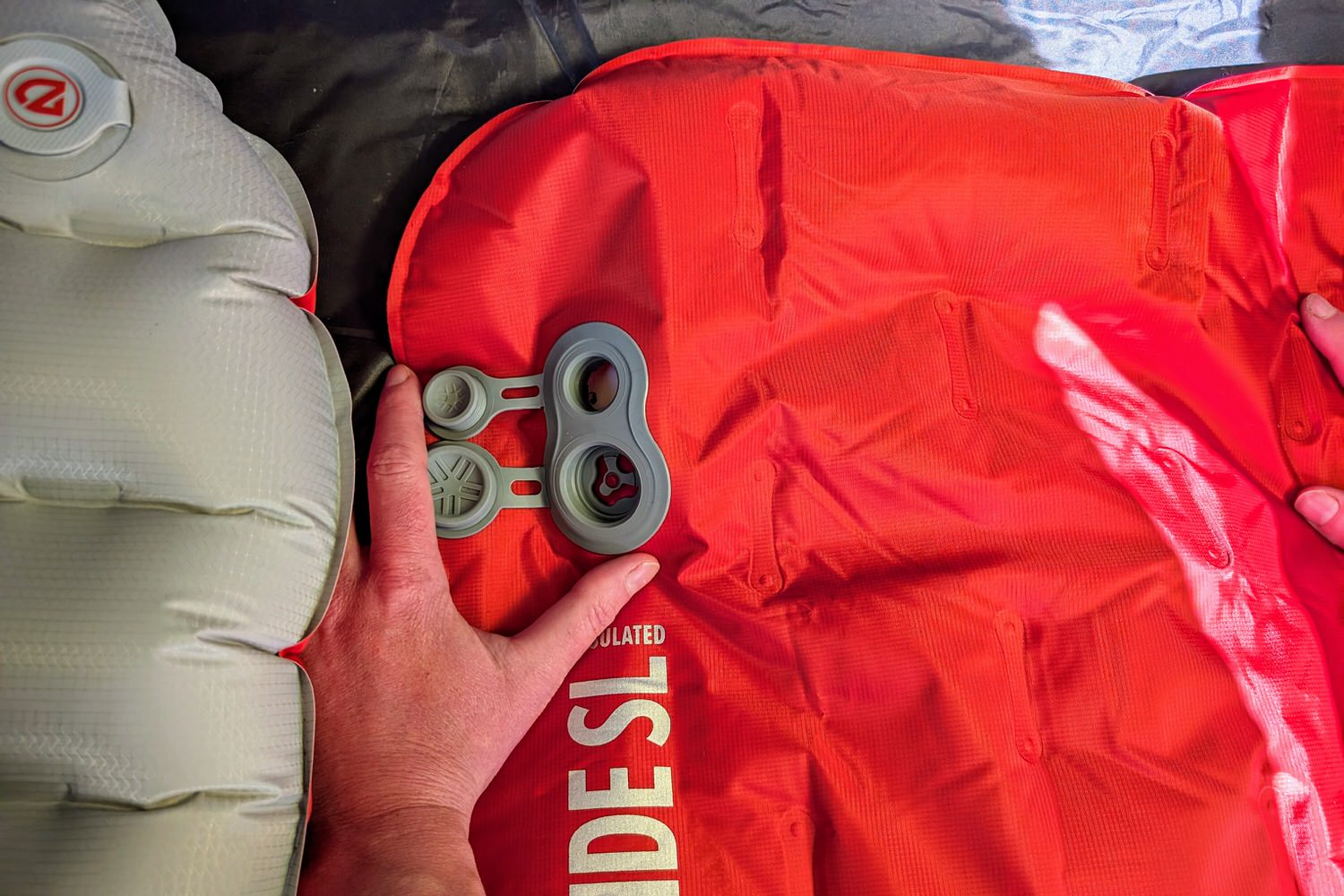
Analysis & Results
We summarize our comparative analysis of these pads along our five testing metrics: comfort, weight, durability, warmth, and ease of setup. We also consider value – i.e. performance compared to price.
What’s the Best VALUE Sleeping Pad?
The best value depends on what you actually need from a sleeping pad. A $60 pad can be a terrific buy if simplicity and durability matter most, while a $200 pad can offer better long-term value for a frequent backpacker if it delivers substantially better comfort, warmth, and weight savings.
If you’re comfortable sleeping on a firm surface, foam pads offer some of the best pure value in the category. The NEMO Switchback and Therm-a-Rest Z Lite Sol are inexpensive, lightweight, nearly impossible to puncture, and useful for much more than sleeping. They can double as sit pads around camp or add insulation and protection beneath an inflatable pad. The tradeoff is comfort and warmth. If you’re a side sleeper, camp on rough ground, or simply sleep better with more cushioning, spending more for an air pad is probably money well spent.
For an affordable inflatable, the Big Agnes Divide Insulated is our favorite balance of price and all-around performance. It costs substantially less than the premium pads on this list while still delivering good warmth, durability, and comfort. The biggest compromise is weight, and its vertical baffles won’t suit everyone. Backpackers willing to spend a little more should consider the Big Agnes Rapide SL Insulated. It improves on the Divide with more warmth and comfort in a lighter package, making the extra cost worthwhile for people who put a higher premium on a good night’s sleep.
At the premium end, the NEMO Tensor All-Season makes a strong case that value isn’t synonymous with cheap. It offers the best overall balance of performance across our testing metrics, and at about $200 for the Regular Mummy, it currently costs slightly less than the comparable Therm-a-Rest NeoAir XLite NXT. The XLite is 1.1 ounces lighter, which matters for hikers who scrutinize every ounce. But in our testing, the Tensor is slightly more comfortable, warmer, and considerably easier to inflate, fully deflate, and pack. For frequent backpackers, we think those advantages easily justify the investment. Between these two excellent pads, we’d choose based on performance priorities, not the small difference in price.
Cold-weather backpackers have a different value equation. The Exped Ultra 6.5R is our favorite value for hikers who need serious insulation. It delivers excellent warmth and comfort without becoming so heavy or specialized that it only makes sense for deep-winter trips, making it a versatile choice for cold shoulder-season and winter backpacking.
If your main goal is simply to spend as little as possible on an inflatable, the Klymit Static V2 is the lowest-cost option in this group. But the savings come with clear tradeoffs: it offers little insulation, below-average comfort compared with our top performers, and it isn’t especially light. It makes the most sense for warm-weather backpackers on a tight budget; if you can spend more, the Divide is a more capable all-around choice.
The Gossamer Gear Thinlight represents value in a completely different way. We don’t recommend it as a primary sleeping pad for most people, but it’s an inexpensive way to protect a much more expensive inflatable pad. Used underneath an air pad, it adds puncture protection, a bit of insulation, and extra versatility around camp. For backpackers who already own a premium inflatable and want to extend its life, the Thinlight can be a very useful addition to the sleep system.
What’s the Most Comfortable Sleeping Pad?
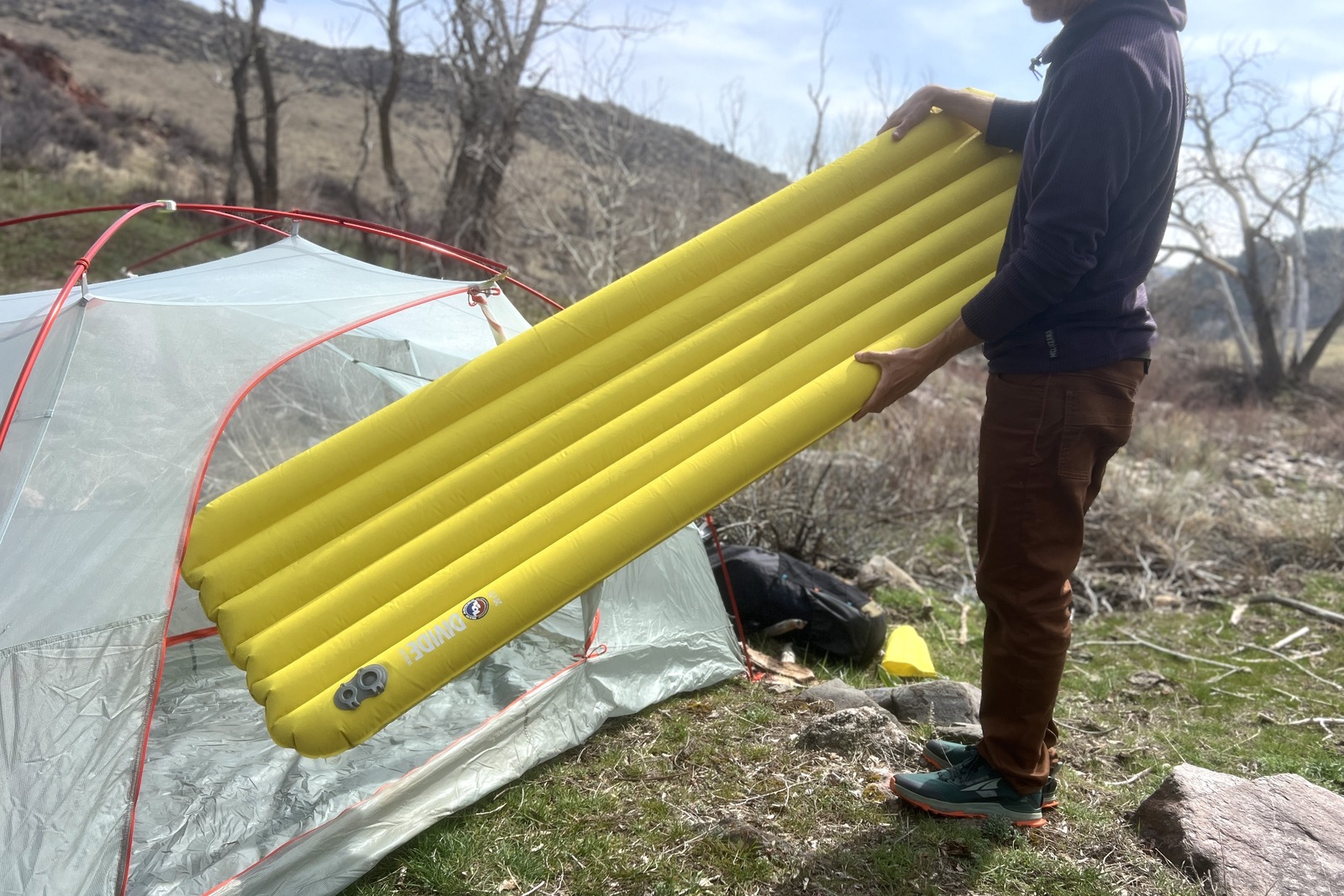
If comfort is your top priority, the Therm-a-Rest NeoLoft is the standout in this lineup. Its 4.6-inch thickness, soft stretch-knit sleeping surface, and body-conforming design create a plush feel that’s closer to a real mattress than most backpacking pads. It’s a particularly strong choice for hikers who are willing to carry extra weight to sleep as comfortably as possible.
The Sea to Summit Ether Light XR Insulated and Big Agnes Rapide SL Insulated take a different approach. Their dimpled air-cell designs conform closely to the body and spread pressure more evenly than stiffer horizontal baffles. Both are thick, cushy pads, and bottoming out wasn’t an issue in our testing. They’re excellent choices for sleepers who like a softer, more cradled feel.
The NEMO Tensor Trail Ultralight Insulated and Tensor All-Season also use a comfortable stippled baffle design, but they pair that cushioning with less bulk and exceptionally quiet materials. At 3.5 inches thick, both provide plenty of room for a side sleeper’s hips and shoulders to sink in without hitting the ground. We especially like the Tensor All-Season’s Laylow valve, which makes it easy to release tiny amounts of air until the firmness feels right. In direct testing, we give the Tensor All-Season a slight comfort edge over the NeoAir XLite NXT.
The Exped Ultra 6.5R is another favorite for side sleepers. Its vertical baffles create a softer, cradling feel than traditional horizontal designs, and its rectangular shape gives sleepers plenty of usable space.
The Therm-a-Rest NeoAir XLite NXT and XTherm NXT don’t conform to the body quite as closely as the pads above, but their three inches of cushioning still provide a comfortable sleep surface without regularly bottoming out. They’re also relatively quiet, making them strong choices for backpackers who want good comfort without moving into the bulkier, more luxurious end of the category.
Which Sleeping Pad is the Lightest?
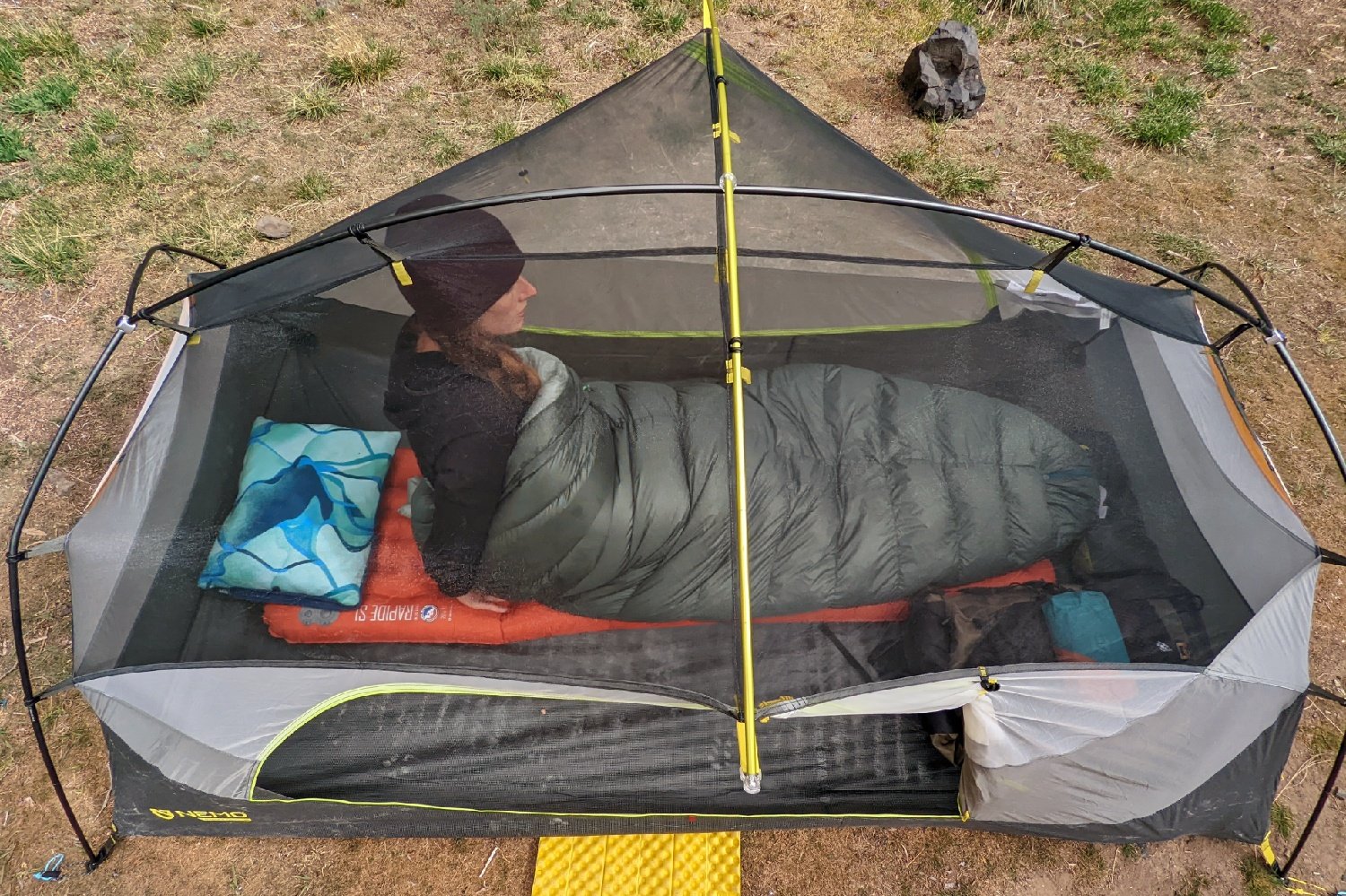
For backpackers focused almost entirely on minimizing pack weight, the NEMO Tensor Elite is the clear winner. It weighs several ounces less than its closest competitors while still functioning as a true inflatable sleeping pad. That makes it especially compelling for ultralight hikers willing to accept more compromises elsewhere to shave every possible ounce.
The Therm-a-Rest NeoAir XLite NXT, NEMO Tensor Trail Ultralight Insulated, NEMO Tensor All-Season, and Big Agnes Zoom UL make up the next lightweight tier. These pads give up a little ground to the Tensor Elite on pure weight but offer more balanced performance for most backpackers.
The XLite NXT is particularly tough to beat if every ounce counts. Its Regular size weighs 13 ounces, compared with 14.1 ounces for the Tensor All-Season Regular Mummy. That 1.1-ounce difference is small, but meaningful for hikers building the lightest possible kit. The Tensor All-Season carries a little more insulation, so the decision comes down to whether you prioritize absolute weight savings or a broader temperature range.
Foam pads like the NEMO Switchback and Therm-a-Rest Z Lite Sol are also light, but their biggest drawback in a backpack is bulk rather than weight. Backpackers who want the simplicity and durability of foam can trim panels to create a torso-length pad and cut both weight and packed volume.
The Gossamer Gear Thinlight is technically the lightest pad here, but we don’t consider it a realistic standalone sleep system for most people. It makes more sense underneath another pad for extra protection and insulation.
Once you move beyond the lightweight leaders, additional ounces generally buy something tangible. The NeoAir XTherm NXT carries more insulation for winter use, while a pad like the NeoLoft trades weight for substantially more cushioning and comfort. Those can be smart tradeoffs, but hikers counting ounces have better choices above.
Which Sleeping Pad is the Most Durable?
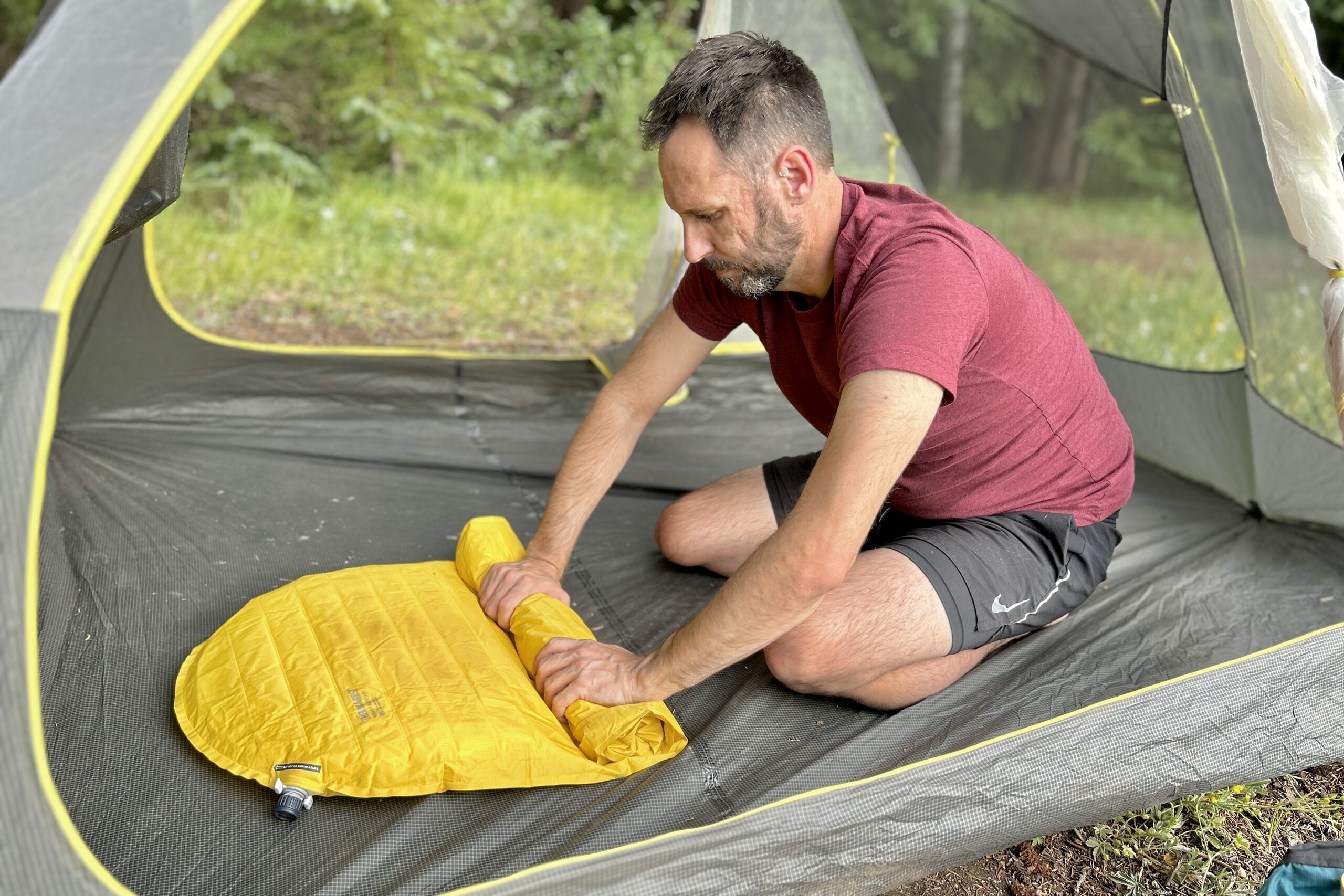
If avoiding punctures and failures is your highest priority, closed-cell foam is still the safest bet. The NEMO Switchback, Therm-a-Rest Z Lite Sol, and Gossamer Gear Thinlight don’t rely on air to support you, so rocks, thorns, and sharp debris are far less likely to end your night’s sleep. A Thinlight can also be placed underneath an inflatable pad to add another layer of protection.
Among inflatable pads, the Therm-a-Rest NeoLoft and NeoAir XTherm NXT stand out in our testing. Both use relatively robust material on the underside, where abrasion and punctures are most likely, with the NeoLoft earning a slight durability edge.
The Big Agnes Divide Insulated, NEMO Tensor All-Season, and Sea to Summit Ether Light XR Insulated follow closely. All use tougher-than-average materials where they matter most, along with well-designed valves that reduce concern around another common failure point.
The Tensor All-Season is a good example of smart material placement. NEMO uses lighter 20D fabric on top and tougher 40D fabric underneath. After more than 29 wilderness nights, our Tensor shows no visible abrasion, coating wear, valve wear, seam damage, leaks, or other deterioration. The thinner top still warrants normal care around sharp objects or animal claws, but that’s a use-case-specific limitation rather than a weakness we’ve actually experienced.
The Big Agnes Rapide SL Insulated, Exped Ultra 6.5R, and NeoAir XLite NXT land closer to the middle of the group for durability. That doesn’t make them fragile. Any inflatable pad can puncture, so choosing campsites carefully and carrying the included repair kit remains part of owning one.
What’s the Warmest Sleeping Pad?
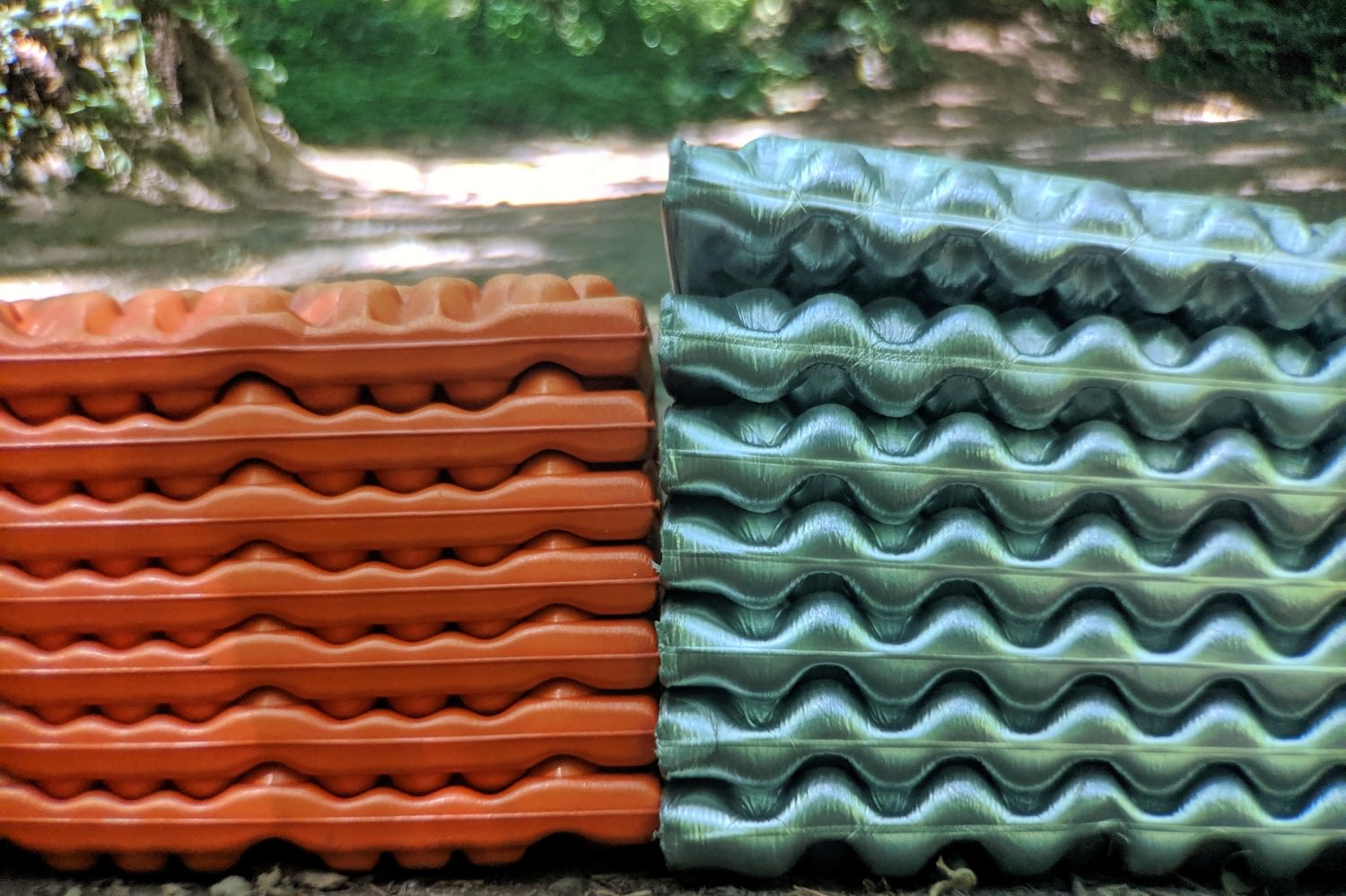
For true winter backpacking, the Therm-a-Rest NeoAir XTherm NXT is the pad we trust most. Its R-value of 7.3 provides serious insulation while maintaining an excellent warmth-to-weight ratio, making it the strongest choice in this lineup when temperatures drop well below freezing.
The Exped Ultra 6.5R is another excellent cold-weather option. It provides substantial insulation while offering a softer, more forgiving sleeping surface than the XTherm thanks to its vertical baffles, 3.5-inch thickness, and rectangular shape. Cold sleepers who put a premium on comfort may prefer its feel.
For a pad that can cover a much broader range of trips, the NEMO Tensor All-Season hits an especially useful middle ground. Its 5.4 R-value provides excellent warmth for its weight, and we’ve slept on it comfortably down to about 23°F, including below-freezing nights with light snow. We consider it an excellent three-season and shoulder-season pad that can also handle mild winter conditions without feeling excessive on summer trips.
There is a limit to that versatility. For sustained trips in the low teens, single digits, or below zero, especially when sleeping directly over snow or frozen ground, we’d step up to a dedicated winter pad like the XTherm NXT or NEMO Tensor Extreme Conditions. Adding a closed-cell foam pad underneath the Tensor All-Season is another effective way to increase insulation for colder trips.
The Therm-a-Rest NeoLoft, Big Agnes Rapide SL Insulated, NeoAir XLite NXT, and Big Agnes Zoom UL all provide enough insulation for typical three-season backpacking and cooler shoulder-season trips. Some emphasize comfort, while others reduce weight, but none is intended to replace a true winter pad.
When snow is on the ground, the Gossamer Gear Thinlight can also add a useful layer of insulation underneath an existing sleep system.
Which Sleeping Pad is the Easiest to Set up?
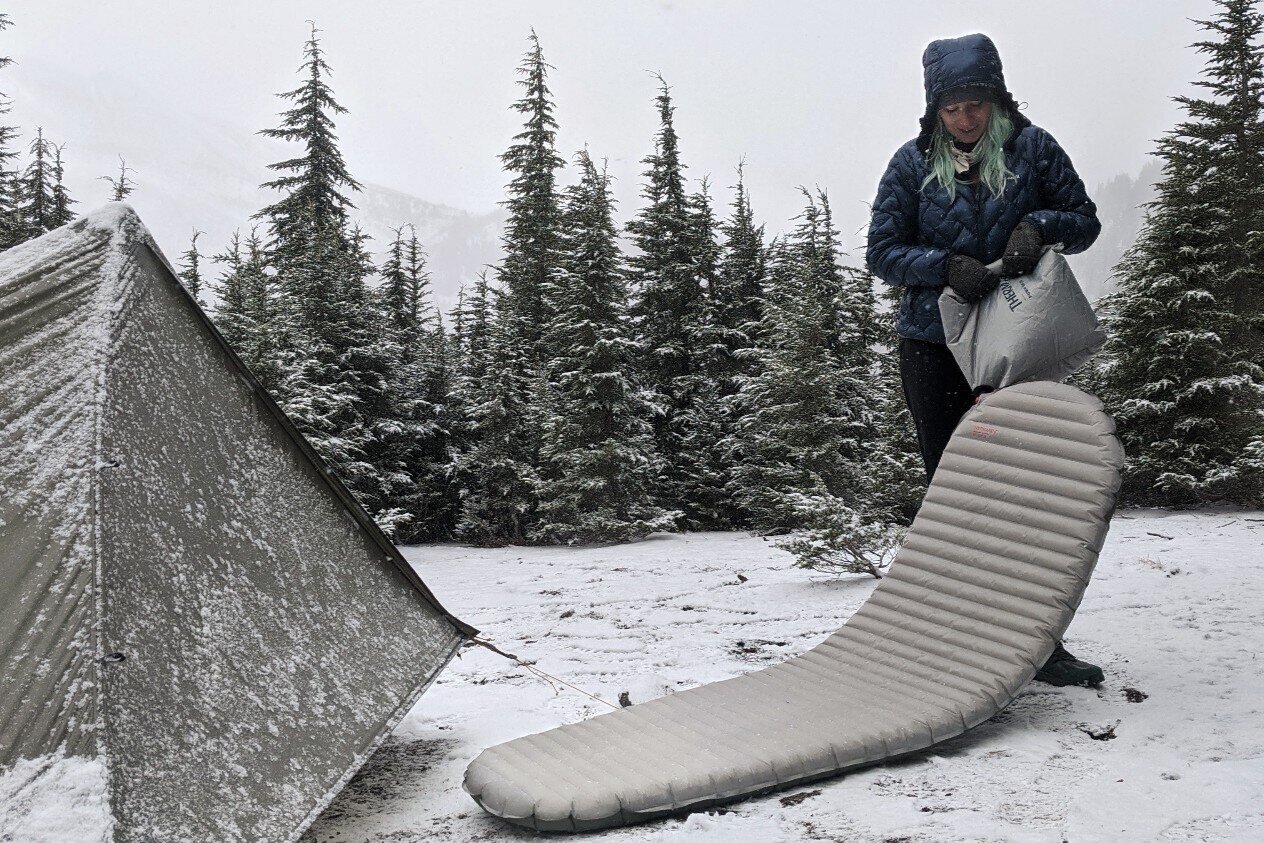
For pure simplicity, foam pads are impossible to beat. The NEMO Switchback, Therm-a-Rest Z Lite Sol, and Gossamer Gear Thinlight unfold in seconds and require no inflation, valves, or pump sacks. That also makes them handy for quick seating or ground protection during breaks.
Among inflatable pads, the Exped Ultra 6.5R is one of the easiest large pads to inflate. It works with Exped’s electric Ultra Pump if you want a nearly hands-off setup, and even with the included pump sack, our test pad needed only about three bags of air.
NEMO’s Tensor lineup is another standout. The Tensor All-Season, Tensor Trail Ultralight Insulated, and Tensor Elite use low-profile valves that pair extremely well with the Vortex pump sack, one of our favorite pump-sack designs. Our Long Wide Tensor All-Season generally takes about four or five Vortex fills, and the Laylow valve makes it easy to fine-tune firmness once you’re lying down.
The bigger Tensor advantage comes when it’s time to leave camp. Opening the dump valve releases air quickly, making it easy to roll the pad tightly without repeatedly trapping air inside. We find the Tensor All-Season noticeably easier to fully deflate and pack than the NeoAir XLite NXT. Therm-a-Rest’s included pump sack is less efficient in our experience, and the XLite takes more squeezing and rolling to get the remaining air out.
The Therm-a-Rest NeoLoft also performs very well here. Its twist-lock valve is easier for us to operate than Therm-a-Rest’s WingLock design, and its large pump sack and roomy stuff sack make managing such a high-volume pad relatively painless.
The Big Agnes Divide Insulated and Rapide SL Insulated use separate inflation and deflation ports, which makes setup intuitive and allows easy firmness adjustments. Both inflate with their included pump sacks in roughly one to two minutes. Their main annoyance comes at the end: the tight stuff sacks leave little room for a sloppy roll, so packing requires more precision than we’d like.
The rest of the pads in our lineup didn’t present any major setup problems, but they don’t offer enough of an advantage to separate themselves from the standouts above.
How to Choose A Backpacking Sleeping Pad
What is A Good Weight for a Backpacking Sleeping Pad?
For most backpacking trips, a sleeping pad weighing 22 ounces or less is very reasonable and balances weight with comfort, durability, and warmth.
Most long-distance hikers, including thru-hikers, will carry a sleeping pad that weighs 14 ounces or less. Some of the lightest pads weigh right around 8 ounces; however, these pads are made from more delicate material, are thinner overall, and have a lower R-value than slightly heavier pads.

What is Sleeping Pad R-Value?
R-value is a measure of a sleeping pad’s warmth. More precisely, it is a reflection of thermal resistance, i.e. how well the pad insulates you from the cold ground. The higher the R-value, the warmer the pad.
Most brands follow a standardized ASTM (formerly American Standards for Testing & Materials) testing method, which makes R-values comparable across brands.
- R-Value 0-3 – Best for nighttime temperatures at or above 45 degrees
- R-Value 3-5 – Best for nighttime temperatures at or above 30 degrees
- R-Value 5-6 – Best for nighttime temperatures at or above 20 degrees
- R-Value 6+ – Best for nighttime temperatures at or above 10 degrees
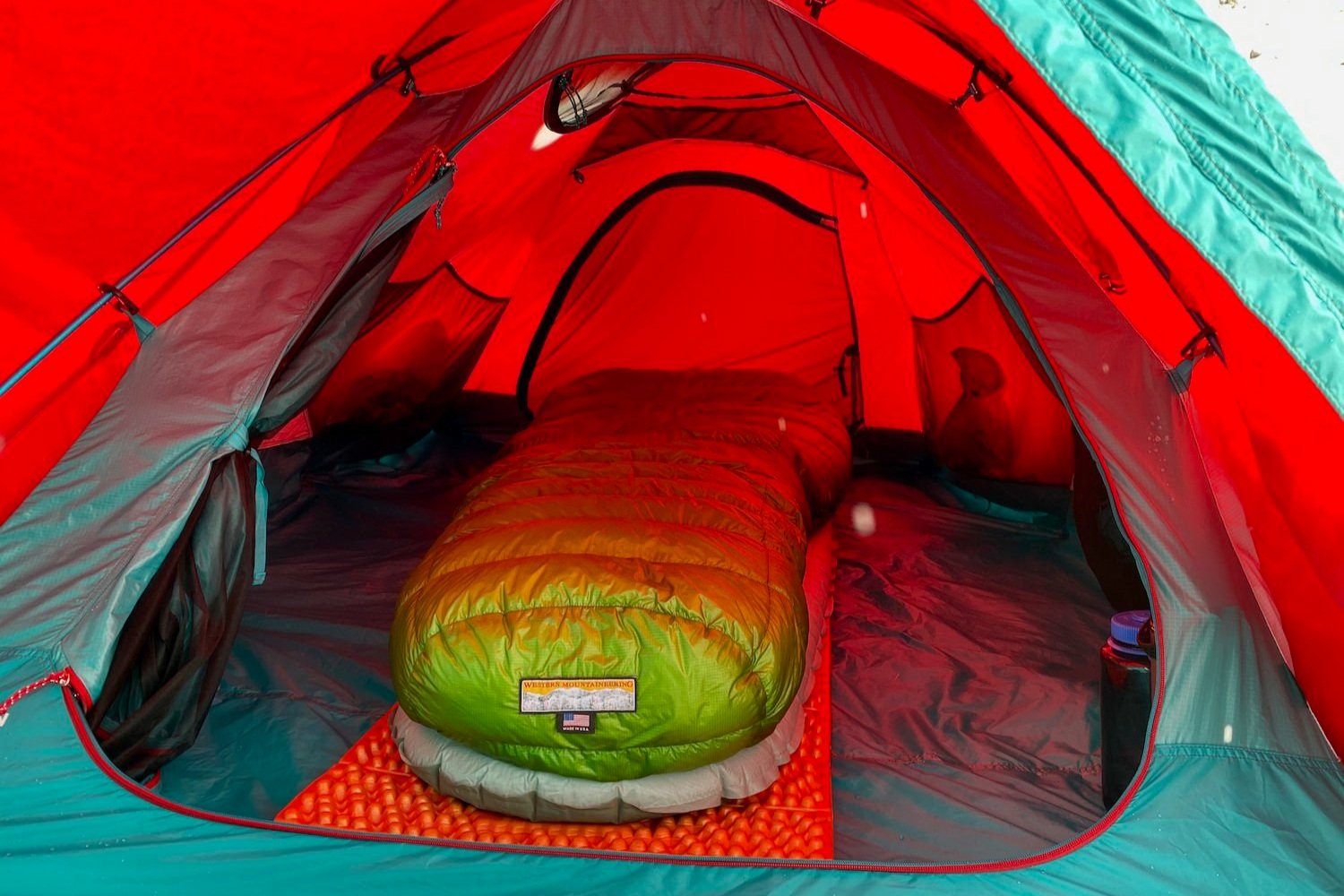
R-value is also additive, meaning, for example, you can put a foam pad underneath an inflatable pad, and the total R-value is the sum of the two pads’ R-values.
How Thick Should My Sleeping Pad Be?
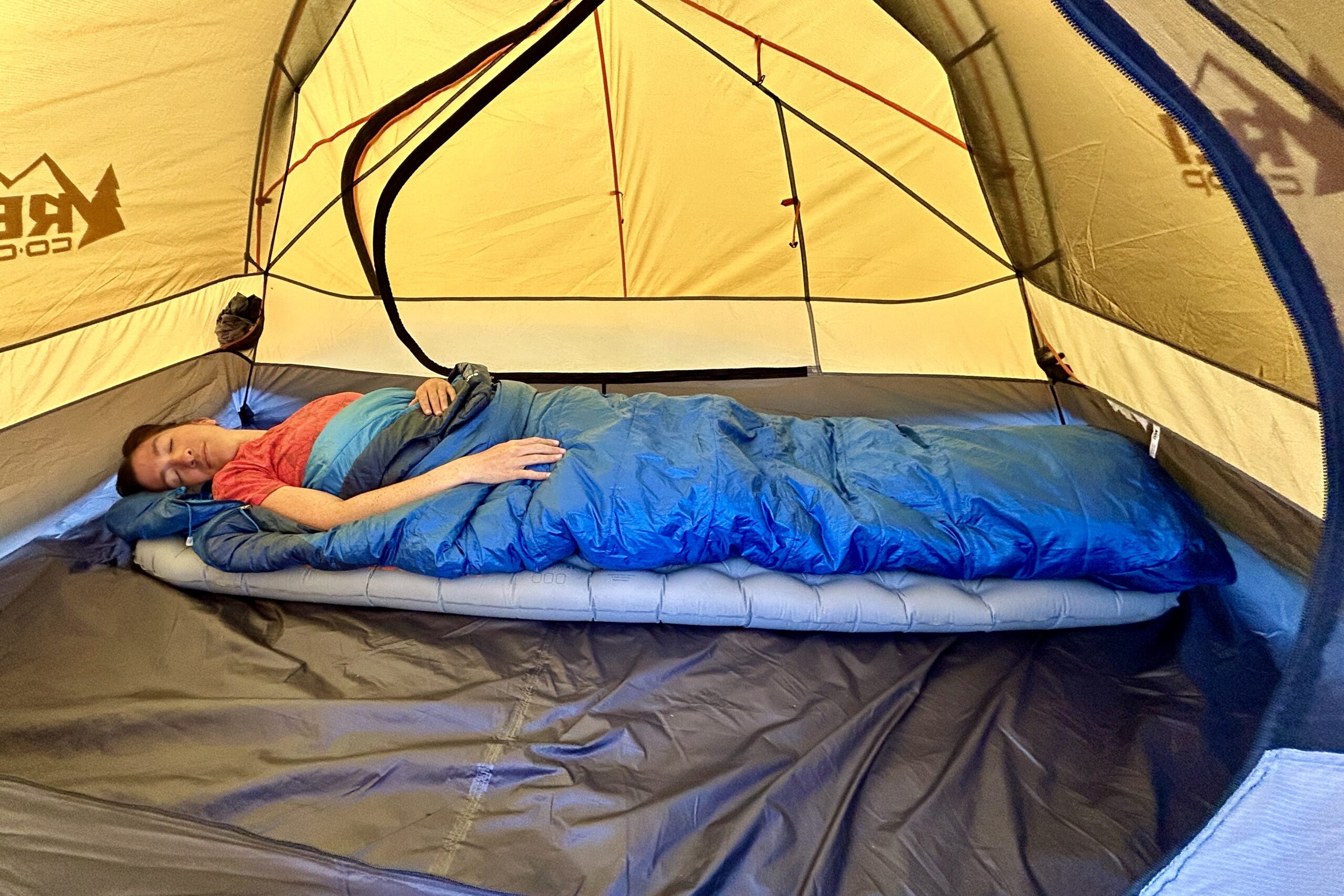
Fully inflated, a sleeping pad should be at least 3 inches thick. Less than that, and most people risk bottoming out (touching the ground). This is especially important for side sleepers.
Why Does My Pad Feel Softer at 3AM?
There are a few reasons why your pad might feel squishier in the middle of the night than when you first inflated it:
- 1. Air contracts as it cools. If you are using a pump sack, the air going in is the same temperature as the outside air. If you are blowing into the valve directly, the air is the temperature of your breath. In both cases, that air cools over the course of the night, taking up less volume, which causes you to sag into the pad a bit more.
- 2. You sleep on your side. Side sleepers depress a sleeping pad more than back or stomach sleepers because they have less body surface area in contact with the pad. Less surface area means more downward pressure and a greater chance that your hip bone will touch the ground.
- 3. Your pad has a slow leak. The valve may not be fully closed, the valve or its seam may have a leak, or the body of the pad might have a small puncture from a pine needle or piece of gravel. In all of these cases, the sleeping pad slowly loses air and eventually brings you in contact with the ground.
Are Inflatable Air Pads Better Than Foam Pads?
In general, inflatable air pads are more comfortable than foam pads because they are thicker. Most backpackers prefer inflatable over foam pads for this reason. Most air pads are around 3 inches thick, whereas foam pads are about .5-.75 inches. Their primary goal is modest insulation as opposed to supreme comfort.
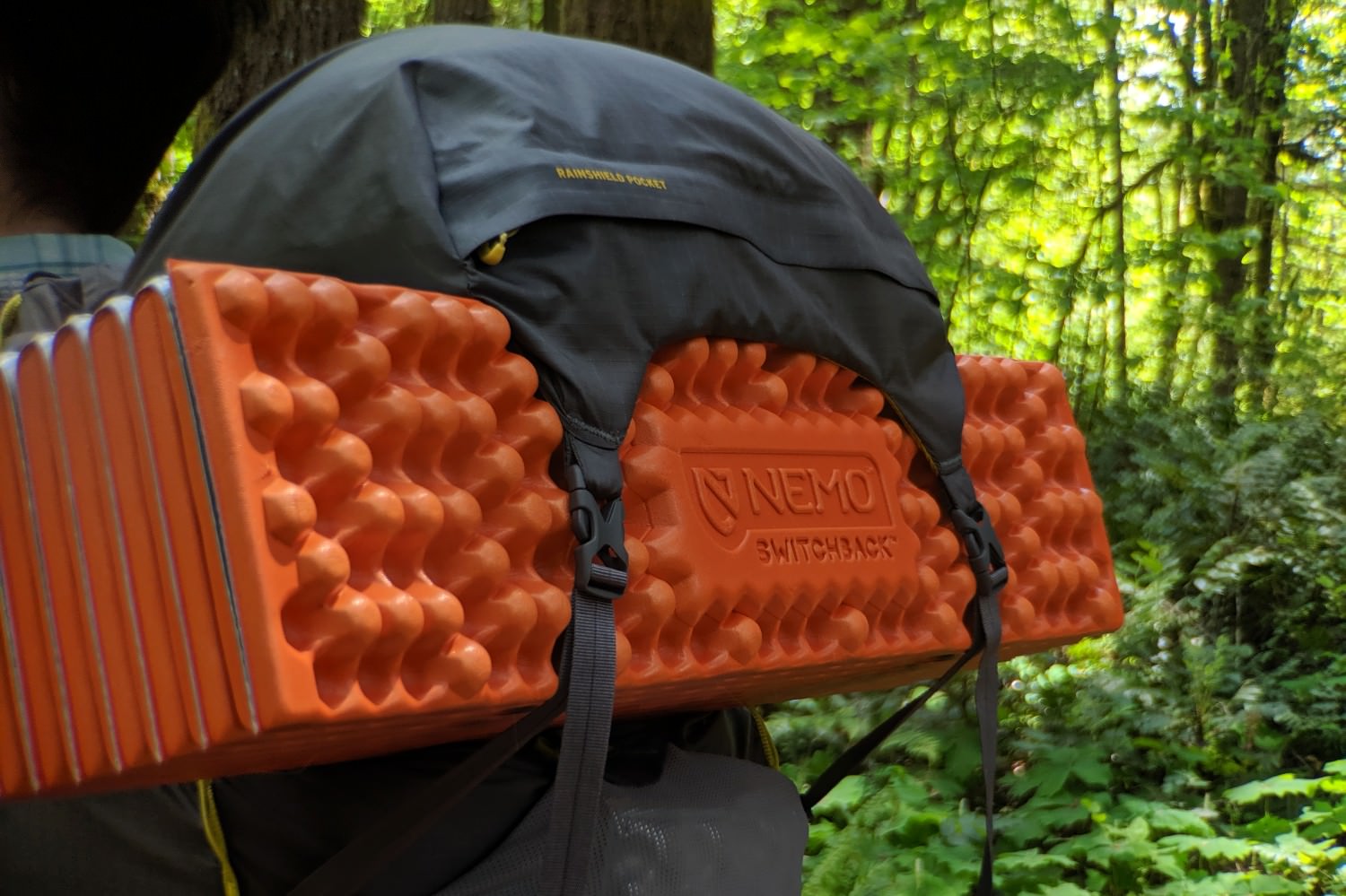
In addition, foam pads are much bulkier and almost always have to be carried on the outside of a backpack.
The drawback to inflatable pads (and upside to foam), is that they are far more expensive – often 3-4x the price, require more effort to set up at the end of a day of backpacking, and are prone to leaks, so you’ll always want to bring a repair kit.
Do I Need A REPAIR KIT for My Sleeping Pad?
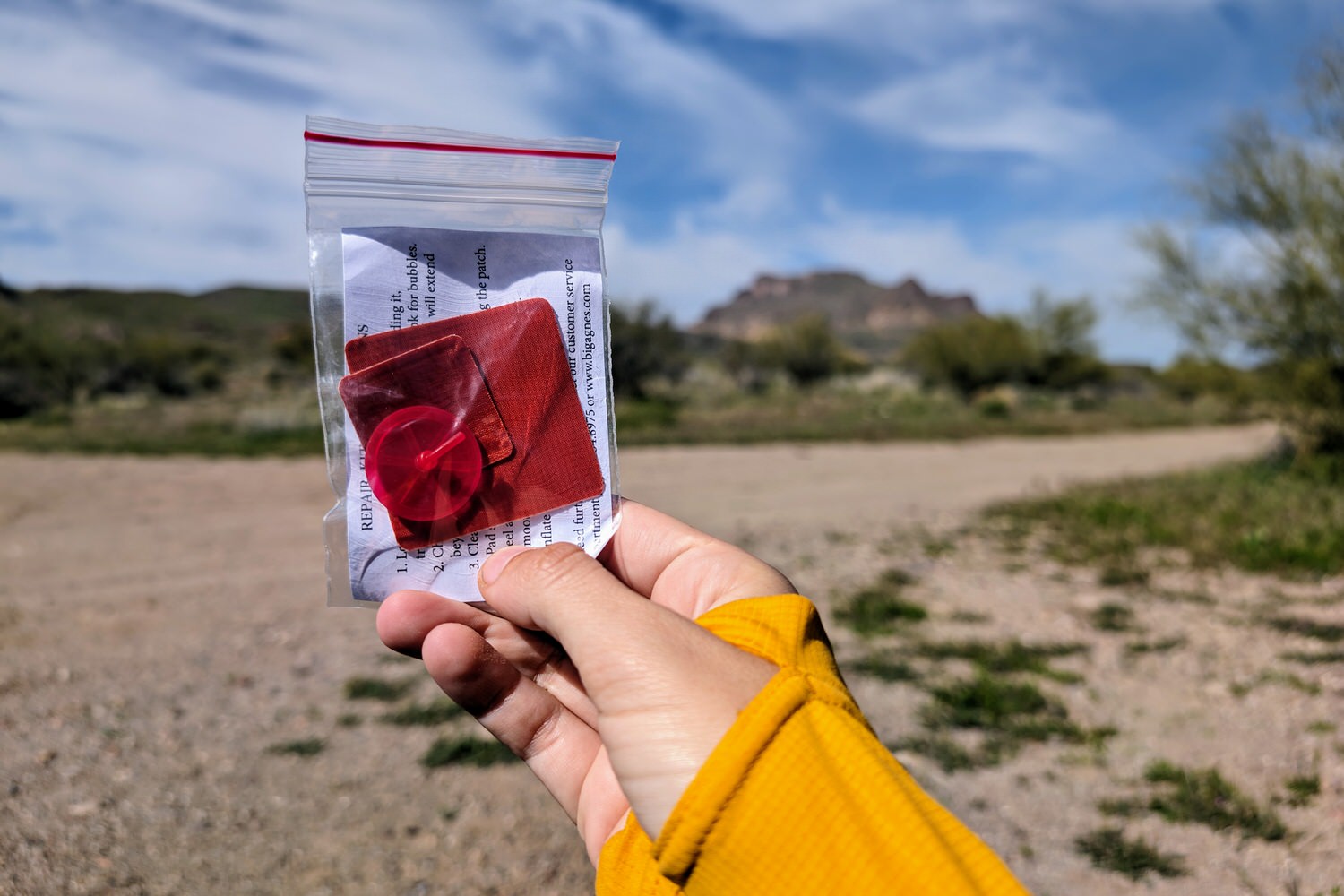
Yes. Pack a small repair kit with your inflatable pad – most pads come with them. Sharp objects (sand, pine and cactus needs, etc.) can puncture air pads, so always clear debris from your sleeping area before setting up camp. We also like Tenacious Tape for all kinds of backcountry repairs.
The added weight of a repair kit, or at least a piece of tape, is trivial compared to the inconvenience and discomfort of a deflating pad.
Do I Need a Pump Sack?
Not usually. Pump sacks can keep you from getting lightheaded while inflating your pad, but they are not strictly necessary. Using a sack may slow the growth of mold inside your inflatable pad (since you’re not blowing moist, germy breath directly into it), but ambient air also contains moisture, so the inside of your pad won’t stay pristine no matter what you do.
What Size Sleeping Pad Do I Need?
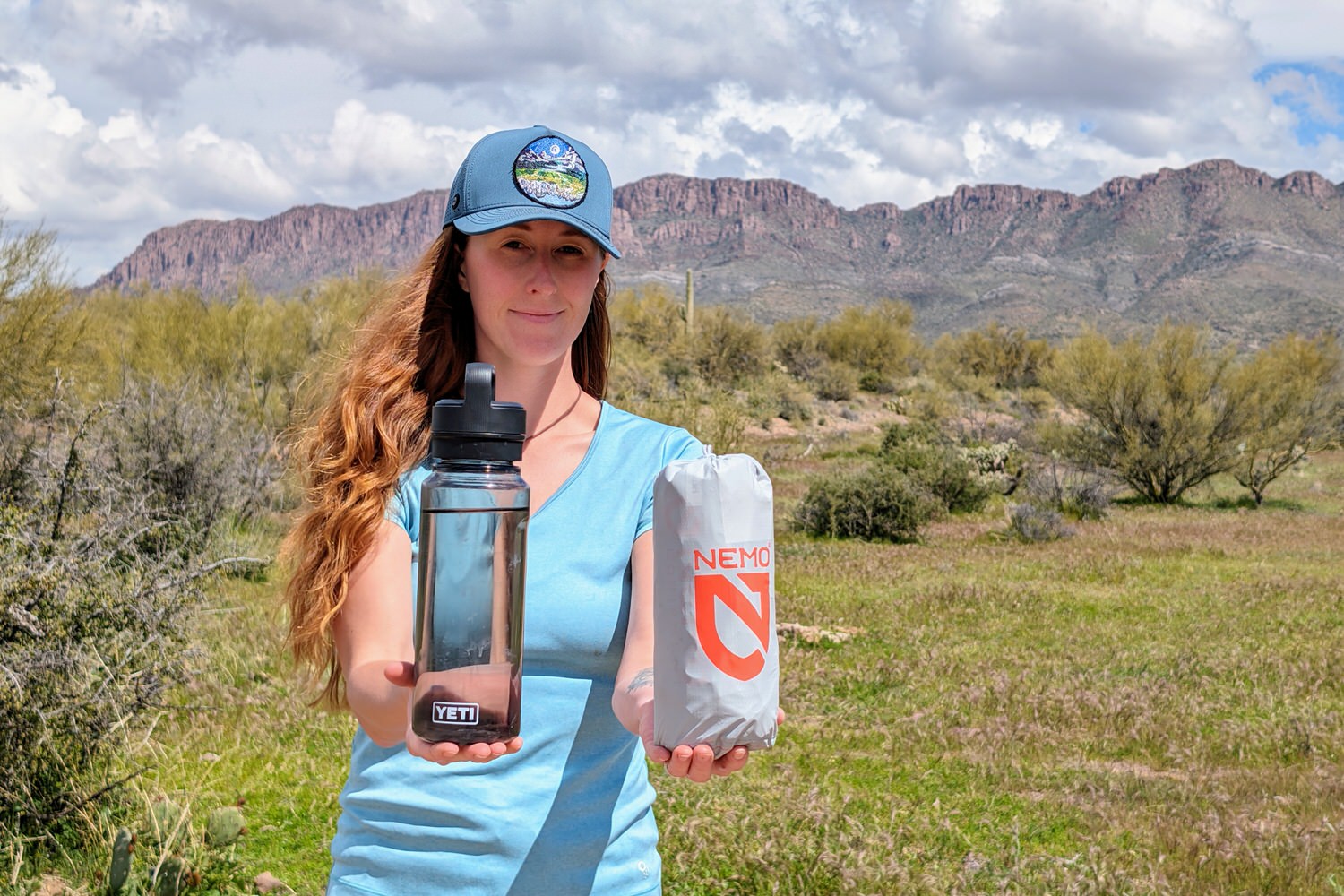
Industry standard dimensions for a regular sleeping pad are 20 inches wide and 72 inches long. This is sufficient for people between 5’4″ and 6′. If you are under 5’4″, you should consider a short version (they are almost always lighter and sometimes less expensive). If you are over 6′, you will likely want a long version of the pad, most of which are 76-78 inches.
Wide versions of sleeping pads are often 25 inches. If you have a wider upper body (i.e. shoulders or abdomen), getting a wider size is a big comfort upgrade, especially if you are a back or stomach sleeper. Side sleepers are often fine on standard-width pads, regardless of body dimensions.
If you are right on the edge of two sizes, consider the style of the sleeping pad. If it has rails, those can help you and your pillow stay on the pad throughout the night, so the smaller size could be fine. If the sides are sloped, consider sizing up.
Remember, you don’t sleep at the tippy top of a pad – there’s at least an inch or two of space between the top of the pad and the top of your head, so if you are, for example, exactly 6′, a 72-inch pad may not cut it if you don’t like the feeling of having your heels hanging off the end.
What is the Difference between a Mummy Sleeping Pad and Rectangular Sleeping Pad?
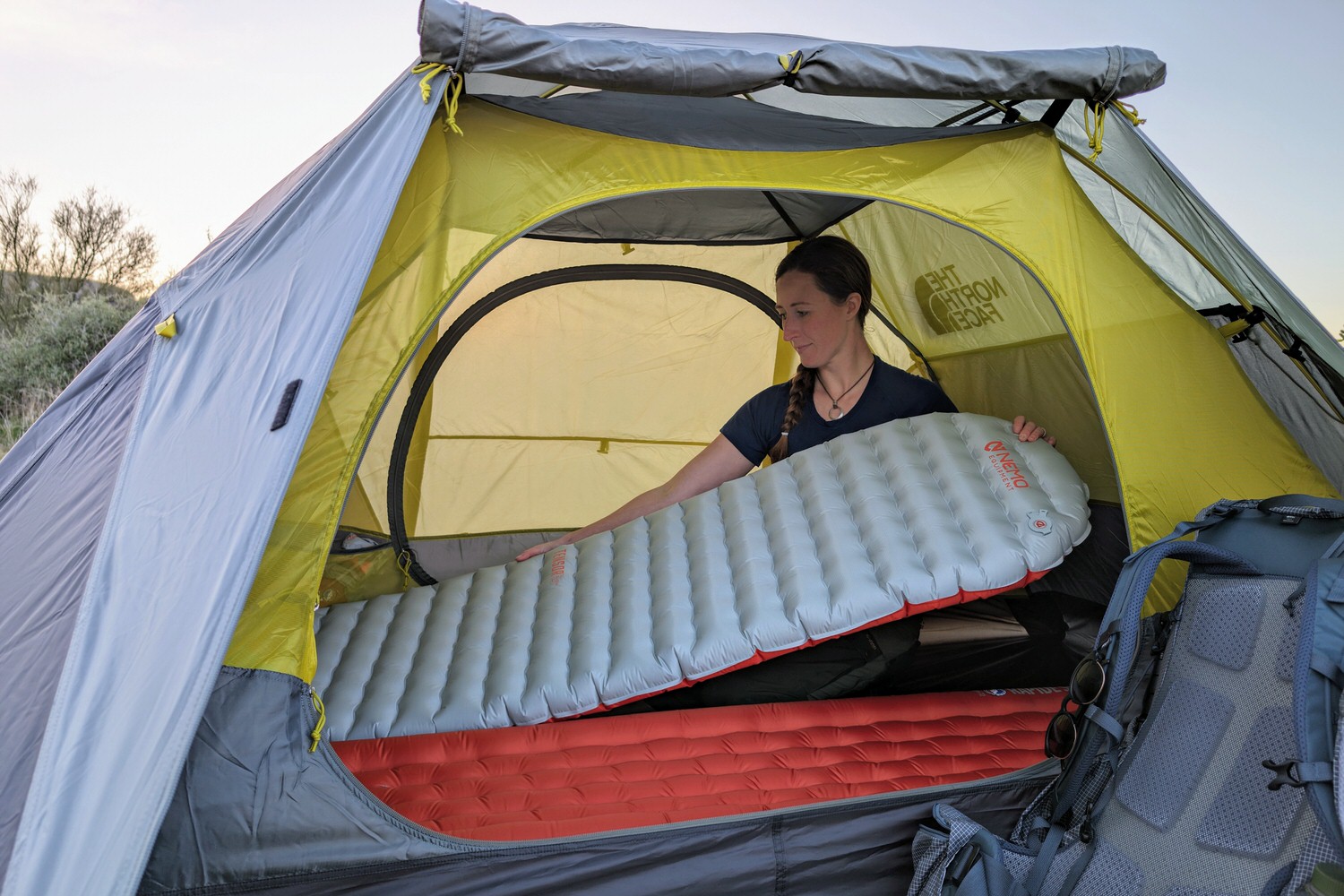
Mummy-shaped sleeping pads (wider at top and narrower at the bottom) save weight, and are sometimes slightly less expensive. Those who like to sprawl out or sleep in the jack-knife position will be more comfortable on a rectangular pad.
Why Trust CleverHiker
Our team of experts has backpacked 100,000 miles and used these sleeping pads for more than 3,000 nights on trail.
Gear Analyst, Brett Kretzer, has hiked several of America’s most iconic long trails, including the Colorado Trail (twice), Long Trail, Wonderland Trail, Spain’s GR11, and multiple treks in Nepal.
His 3,000 miles of deep experience in the wilderness gives him an intimate understanding of sleep systems, and he has tested at least 40 different pads over the years. His prior work as a gear analyst also honed his skills in comparative analytics, which he put to good use testing sleeping pads.
Testing Methodology
We have spent over 3,000 nights on trail with sleeping pads, testing them for comfort, weight, warmth, durability, and ease of use.
How We Test Comfort
Air pads are pretty much always going to be more comfortable than foam models. When we are out in the backcountry, we are assessing thickness, baffle design, and examining how each model distributes weight and provides support.
We also assess the shape (rectangular vs. mummy), and dimensions. We pay close attention to the sound each pad makes when we roll over – some are surprisingly loud, so the quieter, the better.
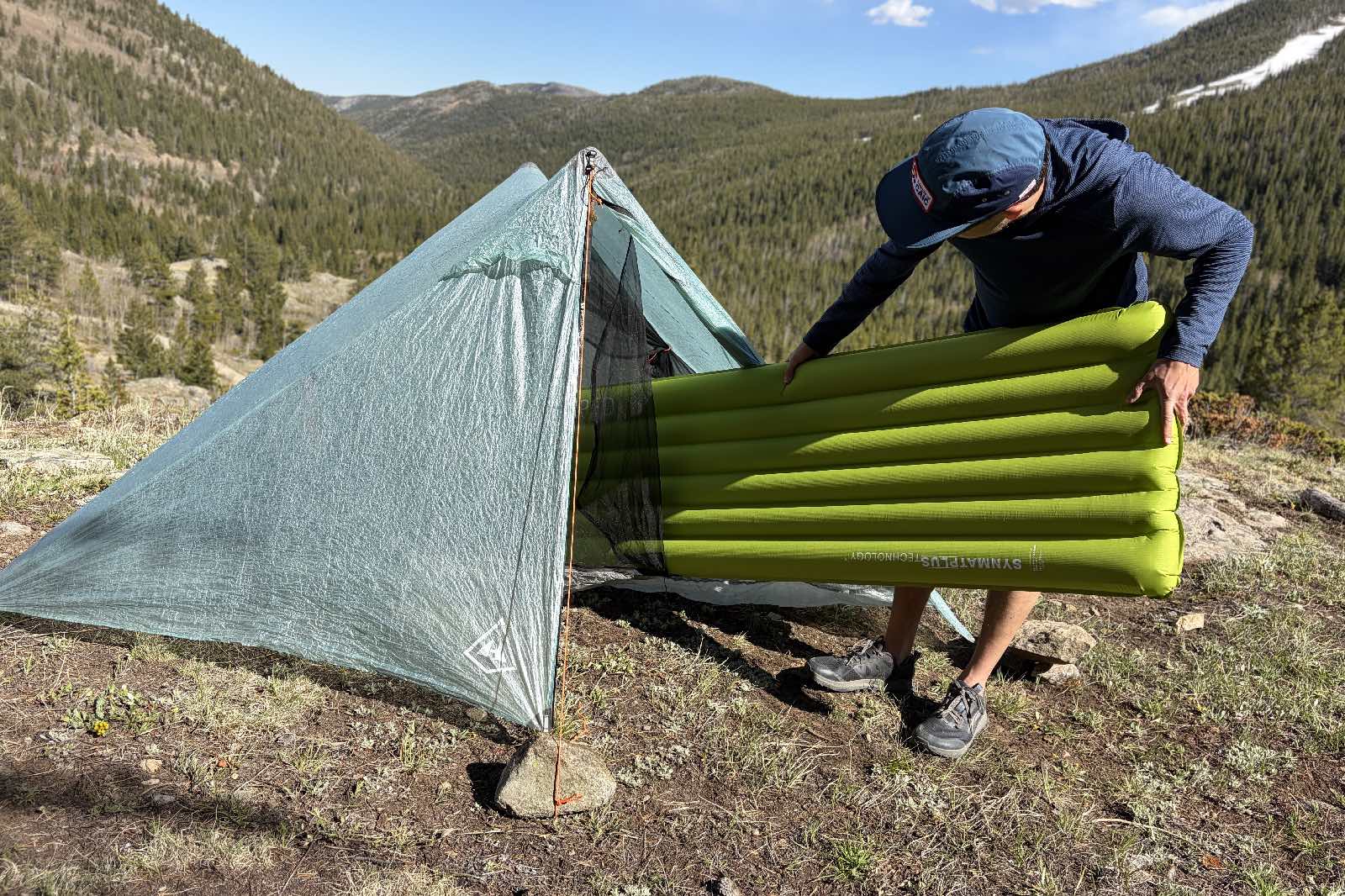
How Do we Measure Weight?
We weigh each pad and compare it to the manufacturer’s specifications to ensure that we are getting what we expect. Lighter pads are better, all else equal, however, there’s almost always a tradeoff with comfort, warmth, and durability.
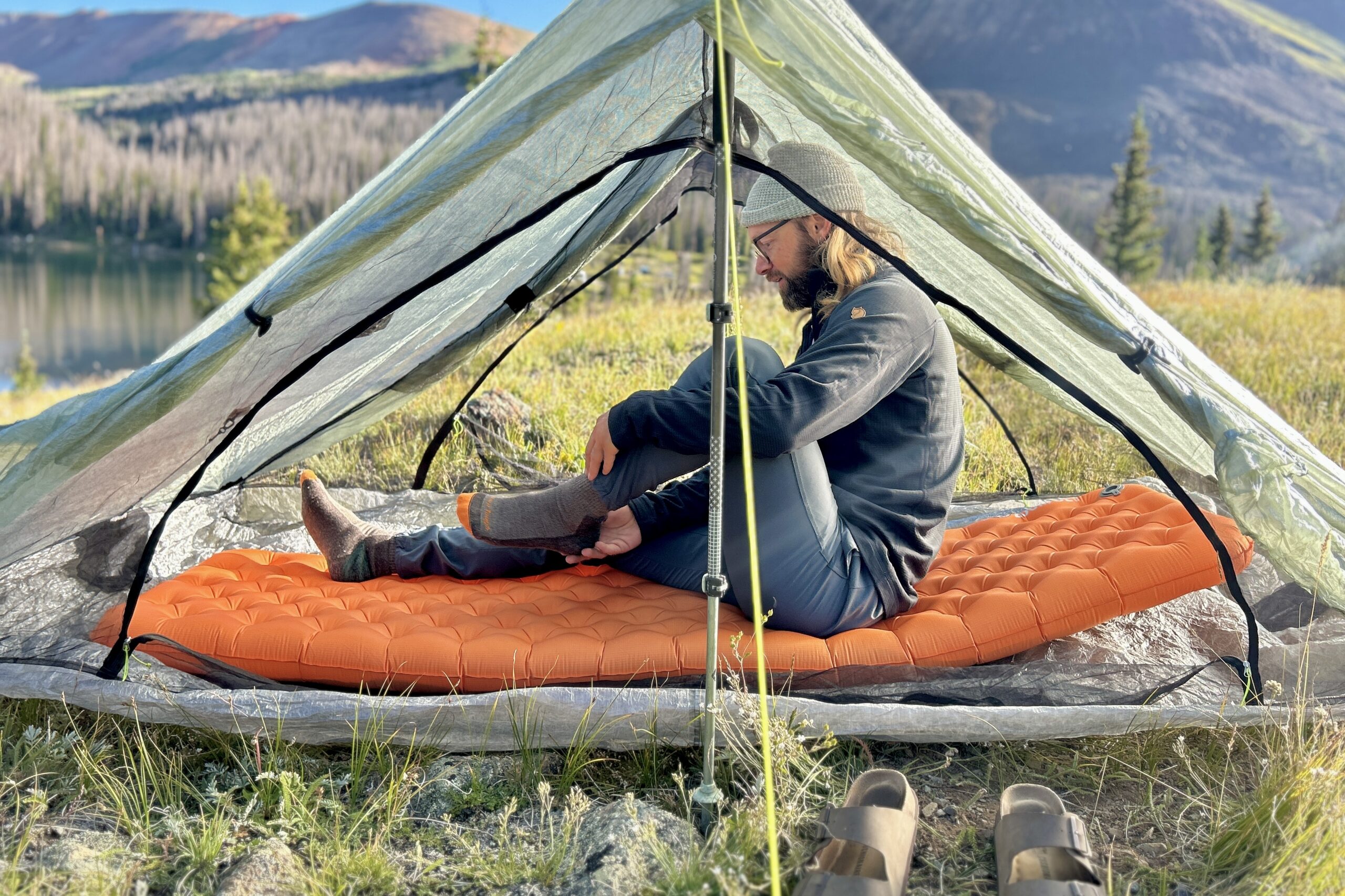
Assessing Sleeping Pad Durability
Material with a higher denier (as well as foam pads) are generally more durable. With that in mind, we scrutinize the construction and thickness of the material and note any wear and tear over time.
We compare the types of materials, and seam quality, and we pay close attention to the design and quality of the valve system, assessing how well the valve itself holds up, as well as the seam between the valve and the main body of the pad. In our experience, the valve seam is one if the spots most prone to damage, because of how often the material is twisted.
For foam sleeping pads, we evaluate the density and quality of the foam, looking for options that maintain their shape and cushioning through repeated use.
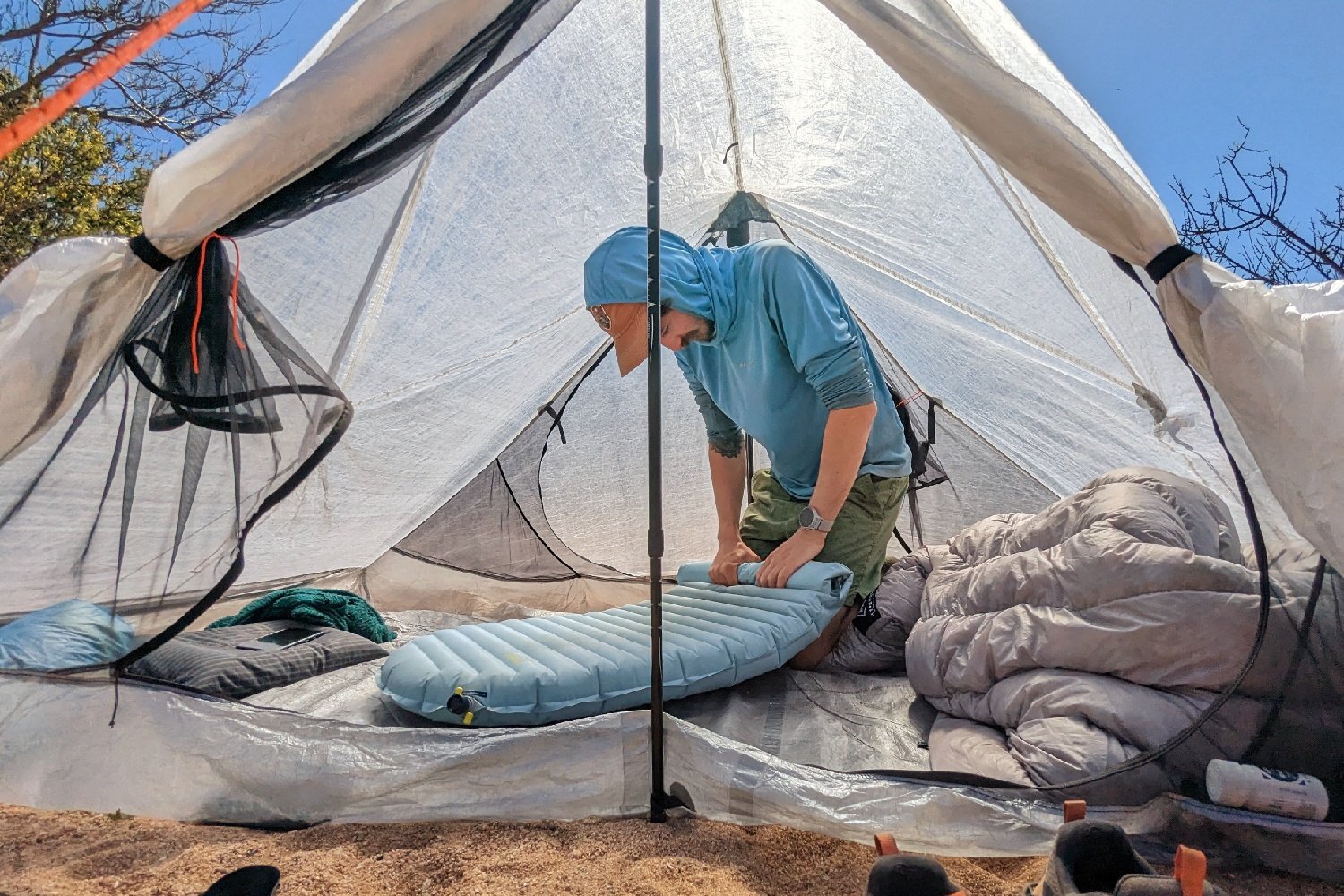
Measuring Warmth
We assess a pad’s R-value (i.e. a measure of thermal resistance) and take careful notes about how often we wake up cold in the night. Thousands of nights in a wide range of temperatures has allowed us to assess the best pads for certain seasons and conditions.

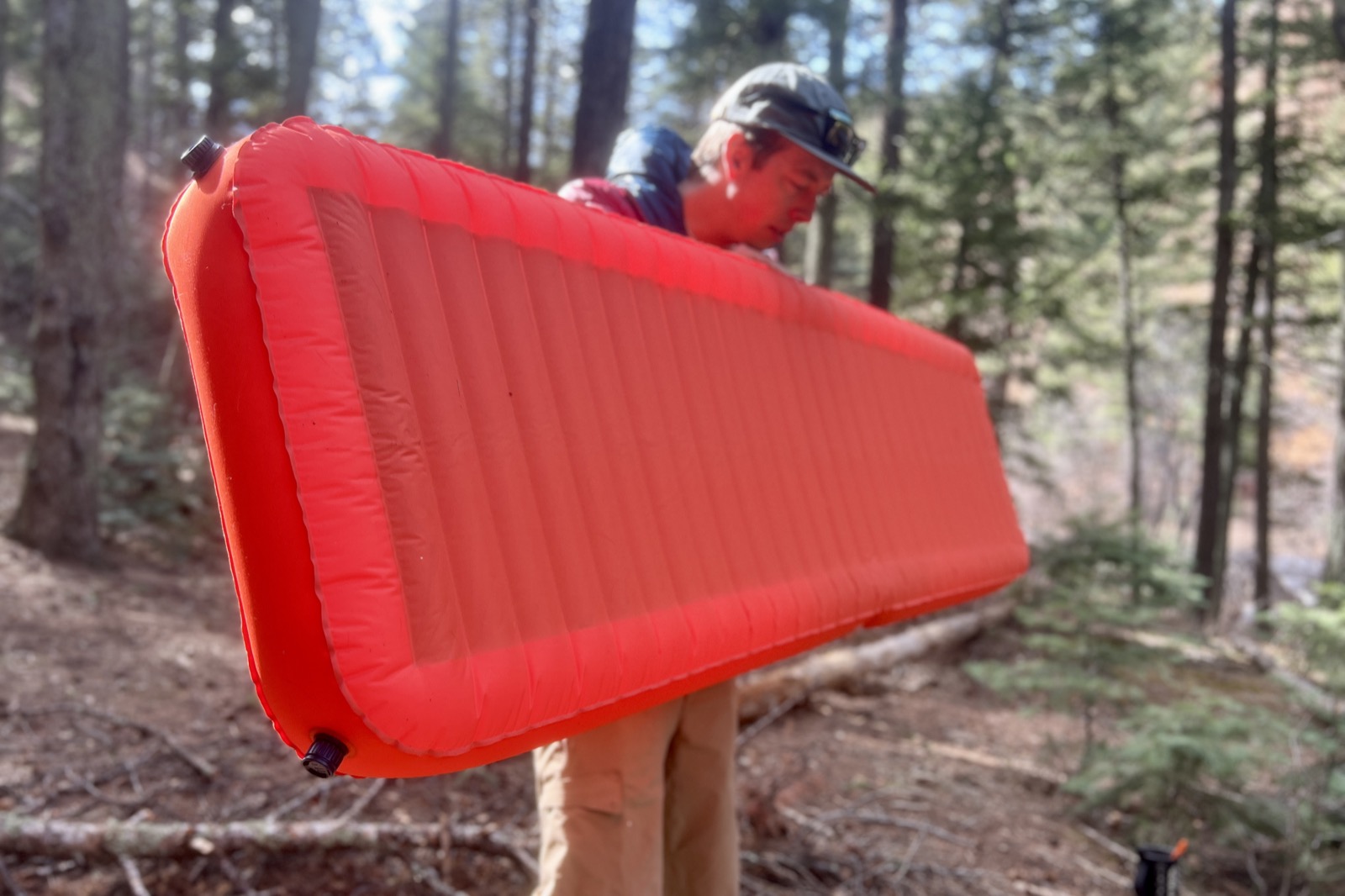
How Easy are These Sleeping Pads to Set Up?
This comes down to how quickly we can get the pad set up the way we want it. For inflatable versions, we time how long it takes to blow them up, both with direct breath and, if applicable, included pump sacks.
Foam pads have a clear edge here: unfolding them is about as quick as setup gets.
Conclusion
Our favorite pad is the right balance of weight, comfort, and durability. We recommend an inflatable pad over a foam pad for most people. If you can keep it at or around a pound with an R-Value of 3-4 (for summer backpacking), you’ll be in good shape. We hope this guide has led you one step closer to dialing in your ideal sleep system!